I’m just letting you know that Godine will run a placeholder of some sort for his catalog, so there’s no need to stress about the cover. You now have plenty of time. I’ll be right here whenever you have something.
I like the sketches, especially because they have so much of you in them — that astringent simplicity that is your trademark.
I like the floating house with its two windows, but I’m not sure we’re there yet. The book being so peopled, and so involved, title poem and all, with the interior lives of people, the sketches seem a little too conceptual to me at this point. What I liked about The Lost Child, I see this now, was the way it combined your atmospheric and metaphorical imagination with the sense of character and the human predicament (and presence) that are so important to me as a poet.
I hope this doesn’t dampen your spirits, and if it turns out you can’t manage the final product before the catalog copy is due, so be it. I love your work, and I’m still convinced you’re the illustrator I want!
I’m attaching what will be the last poem in the book. It picks up the themes of death and loss at the beginning of the book, the pursuit of beauty in section 3, and the consolations and praises of section 4.
Cover001 is essentially trying to simultaneously elicit a sense of solemnity and hope, while ambiguously positioning the house (our material, earthly abode, with all its cares and constraints) as alternately unfastening itself and refastening—detaching and/or regrounding. There’s a light on (optimism) and a light off (despair) in the house. I think this one gives Carl some options for type.
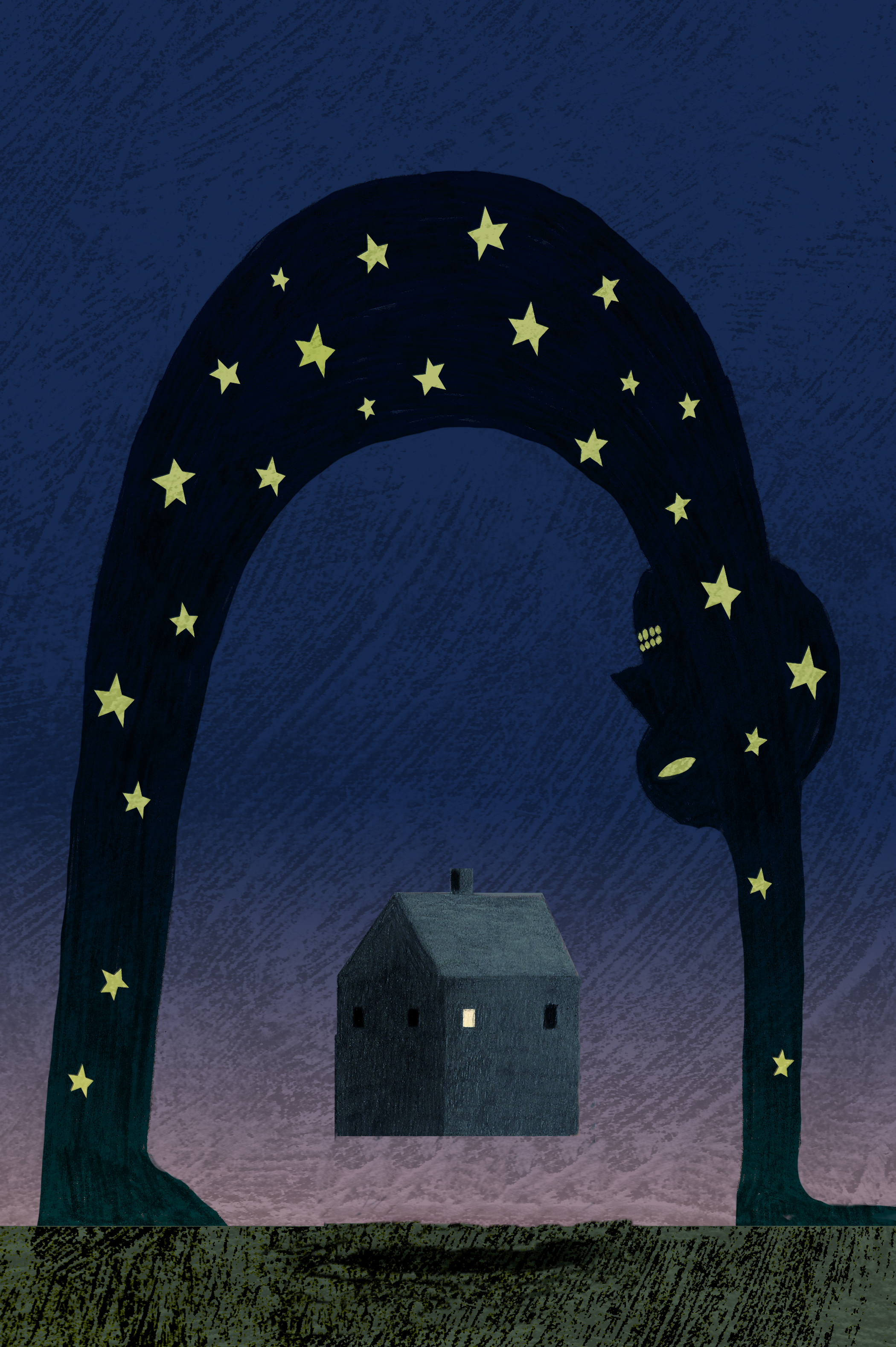
Covers 002 and 003 are a bit more dense, metaphorically, so bear with me. This was actually my first idea and I’m trying hard to make it work. It features a figure, who is both man and night sky, arching over the house. If you can’t see the figure clearly enough let me know. I can make some adjustments to it.
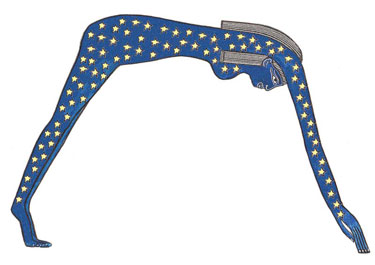
I’m not sure if you’re familiar with Egyptian mythology at all, but I returned repeatedly to the image of Nut, the sky goddess, when cycling through the notions of becoming detached from the material constraints of the world, reconciling through beauty/hope/spiritual affirmation, and then reattaching, refastening, re-grounding. In the way the body arches into the sky and back down again (actually becoming sky) Nut represents many cycles—life and death, day and night, etc.
I was drawn to the way that her body is grounded on earth but also the sky, and the way that the human figure becomes something which transcends its physical, material limitations.
Here’s a little about Nut from Wikipedia:
Nut was the goddess of the sky and all heavenly bodies, a symbol of protecting the dead when they enter the afterlife. According to the Egyptians, during the day, the heavenly bodies—such as the sun and moon—would make their way across her body. Then, at dusk, they would be swallowed, pass through her belly during the night, and be reborn at dawn.[11]
Nut is also the barrier separating the forces of chaos from the ordered cosmos in the world. She was pictured as a woman arched on her toes and fingertips over the earth; her body portrayed as a star-filled sky. Nut’s fingers and toes were believed to touch the four cardinal points or directions of north, south, east, and west.
Because of her role in saving Osiris, Nut was seen as a friend and protector of the dead, who appealed to her as a child appeals to its mother: “O my Mother Nut, stretch Yourself over me, that I may be placed among the imperishable stars which are in You, and that I may not die.” Nut was thought to draw the dead into her star-filled sky, and refresh them with food and wine: “I am Nut, and I have come so that I may enfold and protect you from all things evil.”[12]
She was often painted on the inside lid of the sarcophagus, protecting the deceased. The vaults of tombs were often painted dark blue with many stars as a representation of Nut. The Book of the Dead says, “Hail, thou Sycamore Tree of the Goddess Nut! Give me of the water and of the air which is in thee. I embrace that throne which is in Unu, and I keep guard over the Egg of Nekek-ur. It flourisheth, and I flourish; it liveth, and I live; it snuffeth the air, and I snuff the air, I the Osiris Ani, whose word is truth, in peace.”
Phew—if neither of these ideas appeal to you, please let me know and I’ll continue.
Perfect, Wes. Very lucid explanation. Apologies for my initial confusion—I’ll work on the drawings now and, of course will send you sketches as I complete them.
I will probably need to finish up by the end of the month, after all. I am leaving for another residency outside Chicago 2-22 October, so I won’t be able to focus too much on other projects while there.
Thanks again for this opportunity Wes. I’ll be in touch next week.
No, Rob, that’s not it. I like your original plan and besides want you to follow your gut with this and do what inspires you most. Otherwise, it turns into a job by contract.
Let me be clearer. (I’ve been mulling this.) The metaphor of unfastening — that is, lifting away from earth’s troubles toward the dream of harmony and fulfillment is the central thing in the book. I think the rest of the book flows from that. By the rest, I mean the personal loss and sorrow in section one, the sorrow in the lives of others in section two, the solace of beauty and the search for it in section three, and the pathways to consolation and “fastening back down again” in the world as we have it in section four, significantly titled “Maintaining.”
So if you do what you said in the first place, that is, an illustration (or work of art, as I’d prefer to call it) of that passage you quoted in “The Unfastening,” that would be good. Would you mind sending sketches as you go along?
Thanks for your patience with my muddled commentary in the last email. You see, I’ve never talked with anyone besides my wife about this book, and not even she has given it a full final reading yet. So the talking does me good, allowing me to check on the flow and arc of the book’s contents. I do hope my sense of that arc squares with what you’ve found as a reader.
You’ve lost me a bit in the last two paragraphs, sorry. I will spend the day re-reading the poems to get a better sense of the entirety of the collection.
Would it be fair to say that you are hoping to reflect the cycle as a whole in the cover image?
If pressed to do so, how would you characterize the thematic flow of the four parts?
Funny thing, I thought of this very passage when envisioning the cover — that unfastening from the sorrow and conflict we are born to (and bound to) in our lives on earth. And bingo, this is the passage you pick out.
You’re surely right that the passage is crucial to the book, leading not only to the sorrows and losses that are up ahead, but the “refastenings” that are possible on the very earth we dream of being released from.
The book suggests (or so I tell myself) that a refastening (so to speak) takes a special quality of sight — hence the repetition of sight and seeing in the poems that deal with the pursuit of beauty in the second half of section three, and the God-in-the-eye image at the end of “Losses,” the first poem of section four. Section four is the one that affirms refastening, suggesting poem by poem how it can be done.
But when I give you this quick gloss about unfastening/refastening, I think I may interfere with the complexity of your own thoughts. Did you have another way of looking at three and four? — another way, that is, of speaking about the movement through and out of darkness in three, and the affirmation of four?
I get the feeling from what you’ve said about the passage you chose that the reverberations of the lifting away and levitation are more complicated than I’ve made them…And that rather than pressing this fastening/ refastening thing in the book description, we ought to let the relationship between the title poem and the rest of the collection speak for itself…
I am poring over these poems. There’s so much rich imagery I scarcely knew where to begin but several things truly jump out at me. Much of the imagery that I find so powerful has a narrative specificity that I’m unsure would work well for the cover, but one section in particular is exceptionally imagistic. I wonder if you would consider it a good point of departure in the development of a cover image. It also happens to be part of the title poem, so I think it’s apropos, but let me know if you think it’s not worth pursuing:
…In dreams
the body, which longs for transformation
too, suddenly lifts us above the dark
roofs of our houses, and far above
the streets of the town, until they seem
like any other small things fastened to earth.
So profoundly beautiful! In this passage I sense the convergence of many ideas I saw at play throughout the collection: exhilaration and grief, surrender and resignation, wistfulness and exactitude, bondage and release, material and spiritual.
Does this make sense to you?
I also think that this imagery may relate significantly to the two other covers, in that its emphasis on our relationship to the physical world would once again be called out.
Also, care to say anything about the above lines? If you think I’m onto something and would prefer to not reflect openly, that’s fine. Just let me know and I’ll get to work on some sketches.