Is there a specific event in your life that you will always remember, no matter how much time passes? What about a public event, a tragic one, one that your whole community experienced? Is there a specific eve nt that comes to mind? For many people, the tragic September 11, 2001 attacks in New York City come to mind when asked this question. Ask just about anyone alive during this time, and they can probably tell you where they were when the attacks occurred, or what they were doing, or how they were feeling. Oftentimes, when such an important or prominent event takes place, people can recall it very vividly. A person’s recollection of how they were feeling during such an event is called a flashbulb memory, while their recollection of specific details of the event is called an event memory.
Flashbulb memories are interesting because of how very detailed and vivid they are, even years and years after an event occurs. The question being debated by many psychologists is, how much do flashbulb memories change over time? How can the long-term retention of flashbulb memories be characterized? For example, after 9/11, one might initially recall being at work when he/she hears the news of the plane crashes. However, a month later, when asked again, the same person could report being at home making breakfast. Typically, you wouldn’t expect flashbulb memories to ever change at all because of how detailed, and vividly they are recalled. Nonetheless, changes in flashbulb memories occur quite often. How much and how often do flashbulb memories really change? Why do they change? These are the questions psychologists are seeking to understand. Read more…
An overtime loss. It wouldn’t be so bad if it wasn’t all your fault. Now you sit in the  library trying to finish your research paper due in an hour; you can’t concentrate as visions of the puck slowly sliding through your goalie pads into the awaiting net behind you consume your thoughts. Do you ever find yourself helplessly replaying events that you’re upset about while trying to focus on something else? But why do we have so much trouble thinking when something is bothering us, yet we can work so productively the rest of the time?
If only we could effectively think about multiple things at the same time. You could process the events of the game last night while writing your paper; you could replay that upsetting fight you had with your boyfriend while studying for your Spanish vocab quiz. Essentially, our lives would be that much more efficient, if only we could process multiple thoughts at once.
Read more…
Do you still remember the bedtime stories your parents read for you when you were little? Well, most of us j ust have a vague impression about what was told. Even if we read the story by ourselves, we are unlikely to remember much. However, it is not the same case for our parents: they are likely to remember very much about story, even specific details such as the characters and how you felt about them. Now think back again, comparing the textbook you read aloud for the class in the morning and a message on your cell phone that you read ten minutes ago, which one do you remember better? In my personal experience, I found it easier to recall the sentences from the book rather than the text message. This raises the question: is there a relationship between how people read information and how much is actually remembered? Read more…
 So it’s a Sunday afternoon and you are walking to lunch, the library, or the gym, and all of a sudden you start to sing the words to a song and it seems to come out of nowhere! Has this ever happened to you? I can testify to this and say that numerous times I find myself singing a song and I have no idea why. In fact, why do we still remember childhood songs such as “the wheels on the bus go round and round” or start singing a song we once loved in the 8th grade? The idea that song melodies seem to stick in our memory for long periods of time is an interesting concept.
Weiss et al., 2012, investigated the impact that melodies have on our memory. In their study, a group of participants listened to melodies, either vocal or instrumental, and were later asked to recall what they had heard. The participants listened to melodies from four categories: voice, piano, banjo, or marimba. In addition, the participants had to rate whether they felt happy, sad, or neutral while listening to the melody. They completed a recognition task in which they heard the same 16 melodies and then a set of 16 new melodies. They were asked to rate which ones were old or new. The results of their study concluded that the melodies that had been presented vocally to the participants were better remembered than those that were presented instrumentally, even if the participant liked an instrument more than a vocal melody. There was no difference of recognition or liking among the instrumental timbres.
Read more…
According to the National Sleep Foundation, adults need seven to nine hours of sleep a night. Sure, we all know sleep is important for our health, but life always seems to intervene and these ideal seven to nine hours turn into four to five hours. Lacking sleep like this may make many of us feel tired and irritable, but we often fail to recognize how it may impact our memory for a day’s events. Sleep deprivation makes it tougher to remember things, such as witnessing a car accident or remembering a friend’s story. It is even possible for it to cause us to make up memories for events that never happened!
 Researchers Frenda, Patihis, Loftus, Lewis, and Fenn (2014) strived to investigate this and conducted a combination of experiments about sleep deprivation’s effect on false memories. False memories are memories of an event that either occurred differently from how you remember it or never occurred at all. These can be as extreme as believing you have a memory for visiting a city you never did or as mundane as construing a memory for a video you have never seen before. Making up memories like this can yield dire consequences, especially with eyewitness testimonies where an individual may be wrongfully charged because of a witness’ false memory. However, can a lack of sleep make this more likely to happen? Read more…
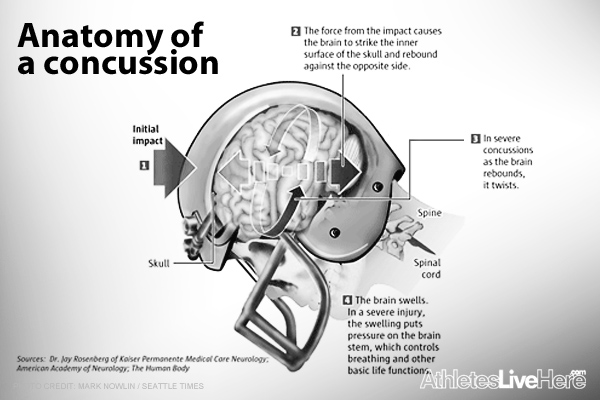
If you had asked the high school version of myself about some of the parents of my peers not allowing their children to play football because of the sports dangers, I would have laughed at the idea. To me this was the greatest game in the world, a game that teaches the values of hard work, perseverance, and a humbleness that is hard to learn other places in life. How can you simply tell someone who has dedicated countless hours and years to their craft that they can no longer do the thing they love the most? But the dreaded “C word” whispered in both high school and college locker rooms across the country is doing just that, as the length of recovery for athletes with a history of concussions is being questioned.
Read more…
In today’s increasingly connected, online world, our personal information — and the identities that come with it — is essentially up for grabs to even the most amateur of criminals. With new data breaches causing panic on a routine basis, identity theft is becoming more and more of a commonplace crime that leaves victims scrambling to pick up the pieces. However, there is one form of identity theft from which recovery is impossible. Over 5.3 million Americans in the United States alone have fallen victim to Alzheimer’s Disease (AD) (Alzheimer’s Association, 2015)– a ruthless and cunning identity thief. Its assault is fairly subtle as it slowly strips its victims of their sense of self, whisking away cognitive abilities such as language, problem-solving skills, attention, and – perhaps most salient of all – the memories that are so crucial to the maintenance of one’s identity and way of life.
Although “memory loss” is listed as a common symptom of AD, this term is particularly uninformative due to the presence of multiple, separate memory systems that serve a variety of different functions – the loss of which are characteristic of AD. For instance, deficits to working memory – or the system responsible for holding onto new, fleeting information long enough for further processing and encoding  into memory storage – have been identified in AD patients. However, most of us would probably associate the vague term “memory loss” with long-term memory (LTM) – the brain’s storage system for permanent, lifetime memories. The memories stored within LTM can be broken down into distinct types, all of which can be affected by AD: procedural, semantic, and episodic memories. Procedural memories essentially involve instructions for common, frequently performed tasks. For instance, after finally mastering the task of riding a bike, we no longer have to actively recall the steps involved. Instead, we automatically run through the motions without much conscious effort. Semantic memory, on the other hand, involves what is essentially our long-term storage of more general knowledge – for example, the “random” facts that you can recall in order to answer Jeopardy questions. Read more…
Do you ever think of a word or phrase and you know you know it, you just can’t seem to find it? You’re frustrated and want so badly to be able to say the word, one might even say it’s at the tip of your tongue. This feeling is called a tip-of-the-tongue state, or the TOT phenomena. It’s likely that on top on this frustrating experience, you are flailing your hands around trying to gesture the word at the tip of your tongue. Although you may look strange doing so, gesturing may actually be the thing that helps you retrieve that word you so desperately want to access.
 Gestures, which are body or limb movements, can be characterized as an element of a word’s meaning in some
one’s mental representation, or bank of knowledge. Humans often pair certain gestures with different words based on a possible function or shape of a word that is an object
For example, for the word ‘brush’, you may run your hands through you hair. This hand gesture is associated with the word ‘brush’ because it is paired with the function of a brush, located in your mental representation. Because of this association, it is possible to find yourself gesturing the functions of a word even though you cannot actually access what that word is. Luckily for those frustrated by TOT states, gesturing can help retrieve the word that is difficult to access.
Read more…
Going in to the 2012 Olympics, gymnast McKayla Maroney was considered to be the best vaulter in the world. There was no doubt in anyone’s mind that McKayla would win the Olympic gold medal. After contributing a nearly perfect vault to help her team win the gold medal, she was ready to do it again for event finals. She did her first vault and took a hop that would likely cost her 3/10 of a
 point. Nothing major, but she knew that she could do better. When she went back to the end of the runway and prepared for her second vault, all McKayla wanted to do was to stick the landing like she had done so many times in practice. She wanted it so badly that she overthought what should have been automatic, she did not rotate enough, and she ended up landing on her butt, causing a full point to be deducted. McKayla choked, costing her the Olympic gold medal.
Mental toughness is a key aspect in all sports. Every athlete knows that no matter how strong you are, how skilled you are, or how much time you have put into practice, when you are in a pressure situation, it all comes down to how mentally tough you are. It is one of the most frustrating things as an athlete to mess up on a skill that you can normally do in your sleep, especially when that one mistake costs you the game or competition. Read more…

Remember back in high school, the last basketball game of the season against your biggest rival? You were guarding the best player on the other team, let’s call her Chelsey. The teams were going back and forth in points. As the seconds ticked off the clock the game picked up in intensity. There was a lot of pushing and shoving that was going unnoticed by the refs. You personally were being elbowed and pushed out of the box by Chelsey. The look on her face was pure determination and aggression; a desire to win the competition. Unfortunately, your team lost, and it was a long bus ride home. During it, all you and your teammates could talk about were the other players and how aggressive they looked.
Later, you see Chelsey again at the All-star game. This time, the two of you are on the same team. You play alongside Chelsey for the entire game, feeding her passes and rebounding her misses, working as a real team. After the game, you hear someone from the other team talking about how aggressive looking Chelsey was. This makes you think back to how you remembered Chelsey’s face as aggressive as well. But thinking back to the playing in the All-star game you don’t remember Chelsey as having an aggressive face.
Why did the way you remember Chelsey’s face change? The answer is context. Read more…

Recent Comments