

This year I decided to sign up for BI265 (Introduction to Anatomy and Physiology) for my Jan Plan course. Going into it, I had no idea what to expect. I knew from my experiences with high school anatomy that it would require a lot of memorization. Given the fact that the class would only last for a month, I also expected the class to move at a very rapid pace. With these thoughts in mind, I walked into the classroom on the first day, ready to begin my second Jan Plan at Colby.
On the first day, Dr. Klepach told us that one of his goals in the course was to teach us to maintain healthy lifestyles, despite the rigorous nature of his class. According to him, this would be an important lesson to learn, especially for those of us who entered the health professions field. Maintaining a healthy lifestyle, especially while taking a course like BI265 at first seemed impossible. We were exposed to a lot of information each class and it was not uncommon for us to have quizzes the day after we were introduced to new material. During the first week, I spent nearly all my time outside of class in the library going over lecture notes and stressing over whether or not I had studied enough. I wondered how it was possible to fit in time for sleep, activities outside class, and three meals a day without stressing out. As it turned out, it was possible to achieve all three of these things and succeed in the class. All it took was some self-reflection and time management.
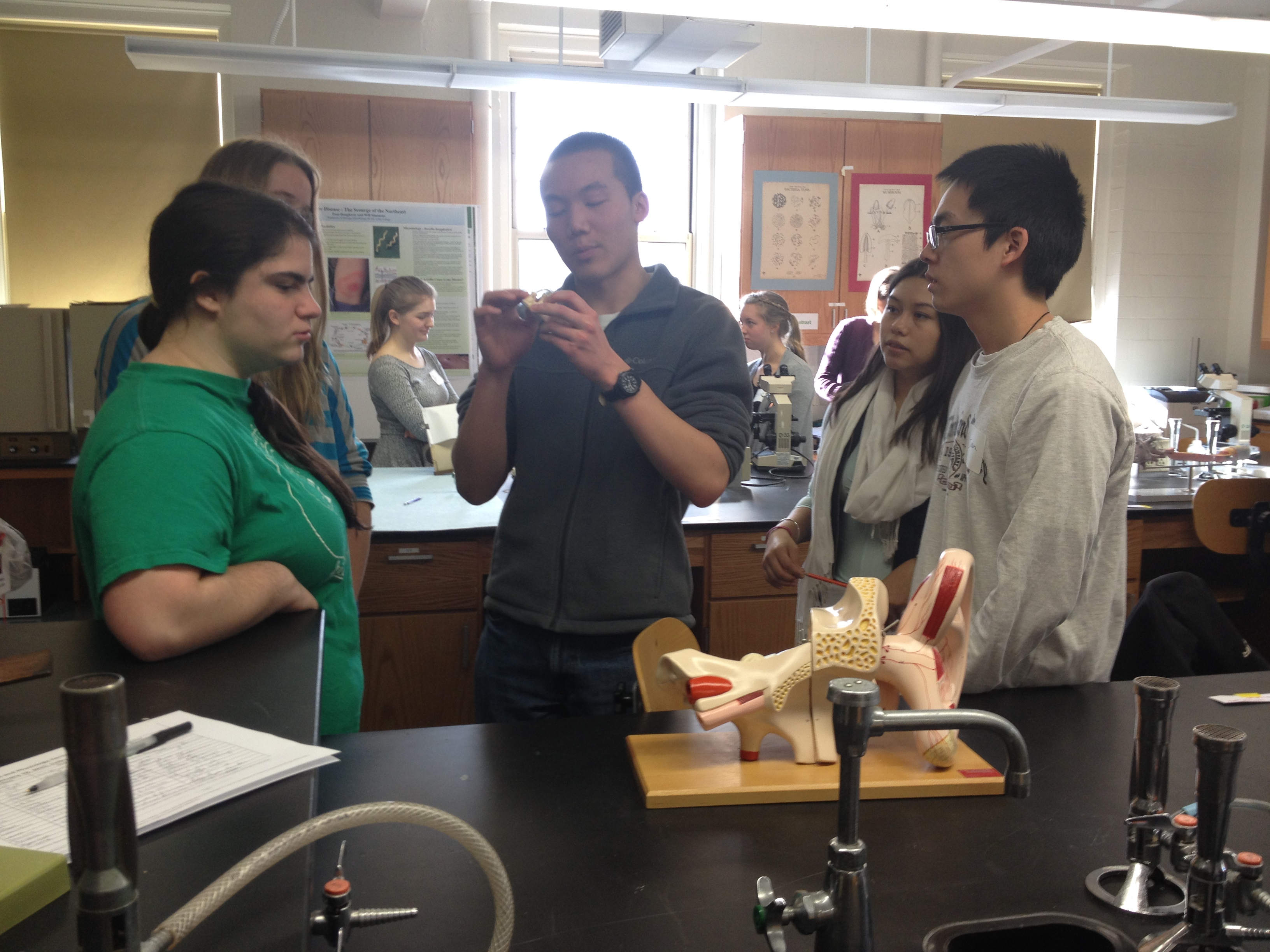
Self-reflection is an all-around good skill to have. It lets you evaluate where you are in the process of trying to accomplish something and lets you see where your strengths and weaknesses lie. In my case, self-reflection let me see a major weakness in my approach toward the class: my study habits. Usually, my approach to studying would be to re-read my notes until the information sank into my head. For a Jan Plan course, this is inefficient because time is very limited. After an unsuccessful performance on the first lab exam, I sat down and thought about how I was studying. I concluded that I needed to implement a more active style of learning. For instance, when studying the different parts of the eye, heart, and ear, I looked at anatomical models of these organs in addition to looking at the diagrams in my notes. Our lab exams asked us to identify structures on anatomical models, which was why it was more beneficial to study the models in conjunction with diagrams. Being able to self-reflect on my performance in the course helped me make the necessary changes to how I approached the material and improve my performance.

In addition to self-reflection, time management was another important skill that helped me get through BI265. In order to fit in time for sleep and other activities outside of class, I had to stay focused and be more efficient when it came time to work. Doing this allowed me to be productive while allowing for more time to enjoy myself outside of class. A technique I used to help with time management was setting up an organized schedule. Through this method, I was able to see when I could devote time to study, keep track of deadlines, and plan ahead. I attribute my decrease in stress levels to an improvement in my time management skills. Being more organized helped me get more done sooner so that I was not left with an overwhelming amount of work in the wake of an imminent deadline (which is very stressful situation). While I learned a lot about the cardiovascular, skeletal, digestive, and other body systems in BI265, I also learned the importance of self-reflection and time management. I have no doubt that these two skills will be beneficial to me for the rest of my college career and ultimately the rest of my life.
