February 24th, 2015 · Comments Off on Lauren Shirley: My Experience in BI265j

Anatomy and physiology form the cornerstone of medicine. Without A&P, medicine as a field would fail to exist. Thus, as a premed student, I saw it as my duty to take A&P to give myself a solid background for my other medical interests and the internships I hope to pursue. After working in a cadaver lab for several summers where I completed dissections of many different joints, I imagined that I had a fairly solid background in anatomy. Additionally, my experience as an EMT and the basic anatomy and bodily processes I had learned as part of my training should make this easy. Right?? Boy was I wrong.

The musculoskeletal anatomy that I had mastered in my lab before was approximately two hours of lecture in a month-long class. My imagination had certainly underestimated the breadth of the class and the many different topics that would be covered. While my previous experiences definitely helped me a little, they gave me nowhere near the advantage I imagined.

I was most challenged by the pace of the class. As we conquered a new body system each day, in both its anatomy and its physiology, there was little time to absorb the details of each system. Rather, the class served as an overview of many main components and processes within the body. We covered everything from the skeletal framework of the body to the minute electrical conduction pathways in the heart, and none of it really got half the time it deserved. However, this class did give me a new appreciation of the miracle of the human body and its myriad evolutionary advantages. I cannot even comprehend the different evolutionary events that would have had to occur for it to reach its current state.

Organs we take for granted, such as the eye or ear, give us a plethora of information about the world around us. While I knew the basic function and makeup of these organs before the class, I had no idea about their underlying intricacies. I was fascinated by the different components that makeup our vision. While the rods in our eyes give us “night vision,” it lacks the color and “high definition” quality that cones provide. While these components appear in different densities in different places on the retina, the brain is able to take in all of the information, which synapses through the optical nerve to create a coherent image of our surroundings. It was information such as this that I learned in the class which gave me a new appreciation for the human body and its physiology.

While this class definitely pushed me to learn a maximum of information in a minimum of time, I really ended up enjoying the Anatomy and Physiology class and would highly recommend it to any other students who are considering taking it for Jan Plan in the future. However, my advice to these students would be this: you get out of the class what you put in to it. Your interest and effort is key to your success in and enjoyment of the class.
Tags: Bi265j
February 24th, 2015 · Comments Off on Allison O’Connor: My Overall Experience in BI265J

This January 2015, I had the opportunity to take Anatomy and Physiology with Dr. Klepach. The human body and the way it functions has always intrigued me, but Anatomy and Physiology was not offered at my high school, so I never had the opportunity to explore this interest in a formal classroom setting. So, the JanPlan A&P class presented me with the perfect opportunity to explore my interests and officially learn about the human body and the reasons behind why it functions the way that it does. This class was even more important, since I am planning to pursue a career in medicine, and I think that basic background knowledge of human anatomy and physiology is imperative for future success in medical school and beyond.

For most of my life I have been pretty confident that I wanted to pursue a career in medicine and when I got to Colby I was very certain of the fact that I was going to take the pre-requisites necessary for medical school so that I could go on to med school right after Colby. Over the past few semesters I took many of the pre-med classes along with and EMT course. Classes at Colby were a little bit of a rude awakening for me, and I did not perform as well as I was used to, despite putting in more effort than I had in high school. Because of this my confidence was shaken. This along with a variety of personal setbacks and health issues prompted me to question my decision to pursue a career in medicine. Coming into this JanPlan I felt like I had a lot to figure out regarding my plans for the future. I was very excited for this class because of my aforementioned interest in anatomy and the functioning of the human body, but I was also anxious since this class had a reputation for being incredibly challenging and a lot of work. I found that the rumors about Anatomy and Physiology were true, however I enjoyed every minute of the course and definitely learned way more than I could have ever anticipated-not just about anatomy, but also about myself and the way I learn as well as stress-management techniques. Dr. Klepach created a classroom environment that took the focus off of grades and switched the focus to actually learning the material while maintaining a healthy lifestyle (eating three balanced meals a day, getting eight hours of sleep each night and trying to manage our stress levels). It is often too easy to get caught up in the grades that you get on an exam or to stress about the final grade that you receive in a class and in all of this worrying about the end result you forget to enjoy the learning along the way. I also have always struggled with managing my stress levels and don’t always get as much sleep as I should on a given night. The classroom environment that Dr. K created for A&P this JanPlan really gave me the space to focus on changing my habits and remind myself of how much I love learning when I am not worried about grades.

Anatomy and Physiology was one of the most engaging, interesting and challenging courses that I have taken at Colby thus far, and the course helped me rediscover my awe and amazement toward the human body and reconfirmed for me that I want to pursue a career in medicine. I consider myself incredibly lucky to have spent the month of January learning about the human body, learning about myself and creating habits that will serve me well in the rest of my Colby career and beyond.

Tags: Bi265j
February 24th, 2015 · Comments Off on Rachel Bird: Flipped Classroom

When I showed up to the first day of my Introduction to Human Anatomy and Physiology JanPlan class, the professor, Dr. Klepach, told us that, for the first week (and maybe longer), we wouldn’t be having a typical lecture-style class. Instead, we were expected to watch podcasts of the following day’s lesson and come up with questions to go over with our classmates. Then, during the lecture block, we would be doing activities and having discussions about the material we had reviewed the night before. After lecture, we would go to the lab for 90 minutes to review anatomical structures and study histological slides in preparation for our lab practicals. As a student athlete with two jobs on campus, having an additional hour and a half of podcasts to watch outside of class, in addition to the homework and studying that was already expected of me, was pretty overwhelming. An average day for me started at 5:45am, when I woke up for morning practice, and then I was either at work, class, practice, or reviewing for the next day’s lecture until I crashed in my bed at night. However, as taxing as the first week of JanPlan was for me, the flipped classroom experiment definitely did pay off in some ways.
For one, it allowed my classmates and me to do fun, interactive activities during lecture block, instead of just sitting listening to a professor talk. One day, during a lecture block devoted to neuron firing and cell physiology, we split into groups and acted out the different types of graded and action potentials. Understanding the electrochemical gradient was a lot easier when I could see my classmates passing through a doorway to achieve an even number of students on each side!
Another benefit to the flipped classroom is that I went into class each day feeling far more prepared and ready to learn. In a fast-paced, content-heavy course like Anatomy and Physiology, it definitely helped me to be able to come to lecture already prepared with questions from the lecture. Given that we were trying to fit a full-length college anatomy class into only three and a half weeks of JanPlan, it was really important to be prepared for class and stay on top of the material. The recorded lectures were helpful in this way because if I missed something while taking notes or needed more review on a topic, I could just pause of rewind the video to the section I wanted to watch again. However, the fact that the lectures were recorded meant that I couldn’t raise my hand to ask the professor a question when it occurred to me, and I would need to wait until the next day for clarification, usually when the topic was no longer fresh in my mind.
As interesting as the flipped classroom experiment was, I was glad when the class voted to return to a normal lecture style for the remaining weeks of JanPlan. Not only did a standard lecture structure allow me more time for athletics and my job, I also felt less stressed about trying to find a 90 minute or longer block of time where I could watch the lectures. Luckily, the PDFs of the lecture slides, and all of the podcasts, were still available through the class website, so if I missed something in class I was able to go back after and review. Although I think that a flipped classroom would probably work better during the regular semester, as opposed to JanPlan, which is already hectic, it was definitely an interesting experiment that forced me to work on budgeting my time and planning out my day so that I could fit in all my commitments.
Tags: Bi265j
February 24th, 2015 · Comments Off on Alexandria Lucas: Meeting with High School Anatomy Students

In high school, I never had an opportunity similar to this one in which I was able to visit a college science class and interact so directly with the college students and the material they are learning. Not only did they get to come and visit, but they were able to dissect a pig’s heart and we were there to help them do it! I do not know what have been a cooler fieldtrip in high school than this one.
It was very interesting and engaging because as we walked around and took them through the lab exam we had just taken, they could identify some of the anatomy and share knowledge about things we may not have learned because they too were currently in an anatomy class. In addition, it was helpful to be in the teaching role as we described and identified the anatomy on the different models. I think this truly works as a way to understand and learn the material better, and is not often a position that us college students are in. This particular lab test was on the heart, eye, ear, and the brain.

After taking them around our lab exam, we went downstairs to dissect the pigs’ hearts. Each group had their own heart to dissect, and it was both an opportunity for the students to learn about some of the anatomy we had just reviewed as well as to explore whatever pieces of the heart they found intriguing further. Some groups dove right into ripping apart the heart, while others took more reserved action and precise cutting to open the heart.

The purpose of this field trip was initially supposed to be meeting with the students to help them come up with ideas for the Maine Math and Science Alliance Science Fair. Because of our current class, we brainstormed ideas that directly related to anatomy and physiology, such as do different styles of music have an effect on the heart rate, or do different color filters of light effect pupil dilation in similar or varying ways.
Perhaps my favorite part of the day, which was the only unplanned part as it happened, was answering questions the group of students I was showing around had on college science classes, premed requirements, college class schedules, and more. Before I came to Colby, I truly had no idea what college was like, and needless to say I also had no idea how classes, lectures, exams, etc. operated. They were very curious about what a typical day looks like and what is different about high school classes versus college classes, and the two biggest things I shared were that exams make up very large portion of your grade particularly in science class, for very infrequently do you have daily homework assignments that significantly contribute to your grade like in high school. I also shared the much greater need for independent learning and studying in college, for it is your responsibility to make sure you understand the material covered in class during lecture and to study outside of class if you don’t. It was fun to be able to reflect on the time I have had here at Colby so far and share my learning and knowledge with students who will soon be headed off to college themselves.
Tags: Bi265j · Special Activities
February 24th, 2015 · Comments Off on Mayra Arroyo: A Healthier and Happier Me

During the 4 weeks of class I learned so much. Not only anatomy, but I also learned a lot about my lifestyle choices and my study habits. Before taking this class, I had never really thought about how the choices I made affected my learning and my health. One clear example is the number of hours I sleep. I was used to sleeping at 12 am or later and snoozing for an hour every morning. After sleeping at 10 or 11 pm every night and waking up 6 or 7 am, I was able to see a difference in my energy levels through out the day. I did not have to take naps during the day and I also did not have to drink coffee to stay awake during the day. This allowed me to be extremely productive and be fully concentrated on what I was doing.
Another example is eating breakfast. I was used to waking up too late and not having enough time to go to breakfast. With my new sleeping habit I was able to go to breakfast every morning. I was the most proud of this new eating habit, not because I started it, but because I was able to continue it the whole month without quitting.
The last lifestyle change I made occurred the last week of class after watching “Sugar: The Bitter Truth”. I started to remove all juice from my meals. I have always known that soda is extremely bad for a person’s health, but I wrongly assumed that juice was not as bad. After watching this video I learned that juice is equally as harmful, and have stopped drinking it. Although I have not been prefect and have had juice, I am much more conscious about drinking water instead of juice at every meal. I also learned from this video that many of the things that we eat today contain fructose, even things that most people would not even think, such as baby formula. This was absolutely shocking and horrifying. I have started to look at the labels of food in hopes to reduce my consumption of fructose. I know these small changes will make a huge difference to health.
This class not only helped me become a healthier individual, but it has helped me become a better student. One way is that I am now a more organized. I have started to make lists in ranking of importance of things I need to accomplish each day. This has not only helped me be more organized, but it has also helped me to prioritize. This was significant for this class, because there was a lot of material. I had to focus on the most important ideas concepts, because it was impossible to study every single topic thoroughly. Although these changes may seem minor, they are not because this is the start I needed in order to become better and healthier student. I plan to continue these new habits during the spring semester and beyond.

Tags: Bi265j · Human Health
February 24th, 2015 · Comments Off on Laurel Edington: MMSA Mentoring Session

One of my favorite parts of this month was mentoring high school students involved in the Maine Math and Science Alliance. Each grand rounds group was paired with two high school students. The two girls my group worked with were named Shea-Lynn and Cierra. Shea is a home-schooled junior and Cierra is a sophomore at Dover-Foxcroft. The plan for the day was to show them around the lab, talk to them about anatomy and physiology, and help them come up with ideas for a science fair project.
Before the students arrived, we took our second lab practical and then walked around talking about the answers to the exam so that we could show the high school students what we have been learning over the past week.

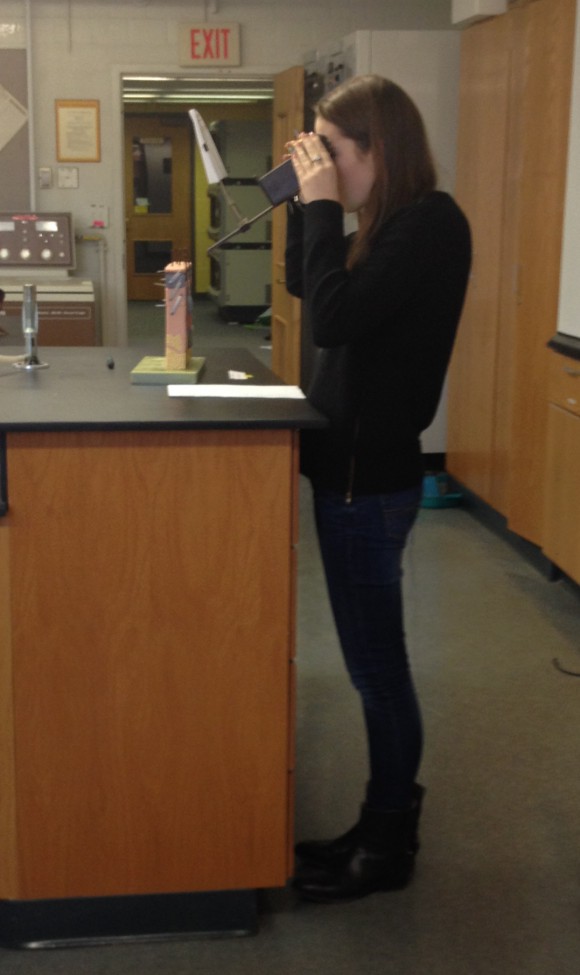 When they arrived and we were in our groups, we went through the entire exam with them. We all looked at the models and slides, explained the answers to each question, and explained the functions of each anatomical structure. This was great because it reinforced the material. Over the past few days I had been trying to memorize all of the structures of the neurons/spinal cord/brain, eyes and ears, and the cardiovascular system. By explaining the structures and functions to Shea and Cierra, it helped me to learn and understand the material even more.

After the lab tour, each group dissected another pig heart since there were some hearts left over from the week before. I was really excited that I was able to be involved in a dissection on this day because I wasn’t able to be in class when we did the dissections the week before. Shea and Cierra, although a little timid at first, dove right in and were able to find the aortic and pulmonary valves very quickly. They did the of the dissection while we instructed and did a little demonstrating.


The last part of the day (after a quick lunch break) was used to help the students come up with topics for science fair projects based on anatomy and physiology. Cierra’s family owns a farm with over 50 beef cows so she wanted to do a project based on livestock. Together, we all came up with the idea of seeing how different types of food affect the growth of the cows. If she did this project, she was thinking of finding the mass and other size measurements for the cows of different ages and comparing the measurements between the cows that were fed hay and the cows that were fed grain. Shea was interested in determining if different emotions caused changes in blood pressure and heart rate. We talked about having people watch different videos that would cause them to experience different emotions and then she would take heart rate and blood pressure measurements before and after the videos to detect any changes. This day was very rewarding because we were able to reinforce what we have been learning, help high school students become excited about science, and we were able to have a great time.
Tags: MMSA Mentoring Session · Special Activities
February 24th, 2015 · Comments Off on Ivan Yang: My experience in A&P

Even though I am a molecular biology major, I had not taken any biology courses in the fall semester, so my advisor highly recommended me to take a biology course for JanPlan. After checking the course listings for January, I decided on a whim to sign up for the Intro to Human Anatomy and Physiology course. Later that week, I met someone who had taken the course last January. She informed me that if I was to take BI265, I would have to be prepared to learn a lot in a small amount of time. There was a wealth of interesting knowledge to be gained from the course, but, she warned, if I was expecting to cruise through JanPlan, I should drop the course. Not sure if I should take her seriously or not, I laughed it off and didn’t think about her words much after that.


After the first week, I definitely knew that this class was not to be taken lightly. The first week was especially rough because of the flipped lecture setting. Not only did we have to study for daily quizzes and lab exams, but also we had to listen to lecture and lab podcasts for the following day’s lecture and lab sessions. I was completely unprepared, and I was forced to adjust my mentality, my study schedule, and my lifestyle habits. However, while there was a seemingly surreal amount of work involved in the course, the amount of material that I absorbed during the four weeks of JanPlan truly astounded me. In addition, after putting in maximal effort just to learn the basics of human anatomy and physiology, I gained deep respect and admiration for the structure and workings of the human body. I truly came to enjoy the class and the subject, and soon enough I found myself embracing Dr. K’s recommended healthy lifestyle habits.
Beyond learning material through lectures and labs and finding a healthy lifestyle balance between working and resting, I also had many opportunities to do things that I had never done before. For example, for the first time in my life, I had the opportunity to perform a wet dissection of a pig heart. Although I was confused at first due to initial difficulties in matching the neatly-drawn heart schematics in my mind with the real deal in my hands, I thoroughly enjoyed the experience of opening the heart with my own hands, placing my fingers through the valves and blood vessels to see where they connected, and seeing how the real tissues and membranes of the heart correlated with the models in our anatomy lab. In fact, I’m sure I would have enjoyed the experience even more if my partner and I had remembered that there were scalpels available for use in the dissection (we had to cut through a very thick ventricular wall with a very small pair of scissors – if you are taking the class and haven’t done the wet dissection yet, REMEMBER that there are scalpels available for use).

In sum, BI265 was a welcome and intellectually stimulating challenge. I absorbed a great deal of anatomy and physiology in the last four weeks, worked with wonderful classmates and a great professor, and learned about myself, my study and lifestyle habits, and stress management. I would recommend this class to anyone interested in thinking and in challenging his/her intellectual limits.

The blood vessel model – my best friend during the weekend before the second lab test.
Tags: Bi265j
February 24th, 2015 · Comments Off on Ariel Oppong: A Memorable Aspect of Anatomy and Physiology- ART!

During the first week of class we made a trip to the Colby Art Musuem. Since the Art museum opened during the summer of 2013 I had only actually participated in one small tour. I feel like a version of myself enjoys art and objectively recognizes its value but a version of myself that is more present on campus does not really have the time or make the efforts to appreciate art. Thus, I was happy we went.
While we were there we completed a scavenger hunt that required our knowledge of different human muscles to find the art pieces that matched with eight different short stories and descriptions. We were allowed to work together or to work in groups of three or less.

After we completed the scavenger hunt we were asked to find a piece of artwork within the museum and to create our own question/description of the artwork with the central usage of a certain muscle being used by the characters or subjects in the artwork. For my question I decided to make focus on a 1997 piece of artwork called Leader by American artist, Betye Irene Saar. Born in Los Angeles, California in 1926, she has been known to incorporate collage and assemblages into statements of political and social protest.

In this picture, a strong woman is standing and maintaining the trunk of her body in a firm position. This position represents the woman’s strong presence in the family dynamic of families of this ancestry. Because of the importance of her stance as a symbol for other aspects of her womanhood, I decided to focus my piece on a large muscle that helps the main subject hold that stance: the gluteus Maximus.

The gluteus maximus is the largest and most superficial of the three-gluteal muscles (including the gluteus medius and the gluteus minimus). The gluteus maximus is proximally attached to the outer surface of the ilium and is distally attached to the superior and lateral surfaces of the greater trochanter of femur. As the largest and strongest muscle in the body, the gluteus maximus is both important in being responsible for the movement of the hip bone and thigh but in also in creating a shape to the human body and creating the appearance of hips. I really enjoyed learning more about Betye Saar, her work, and her work’s impact on general society. At first our student created scavenger hunt questions were supposed to be consolidated into a new list of synopsis for high school students to look at when they came to visit Colby early the following week. However, due to some logistical issue the students were not able to complete the scavenger hunt. Instead of completing a hunt, the high school students completed a heart dissection with us, The day prior to the students’ arrival on campus we had completed an almost trial run like heart dissections on our own in the lab. I enjoyed learning on my own and then showing the high school students different anatomical parts of the heart because it allowed me to see what aspects of the lessons before I was and was not retaining.
Tags: Bi265j · Special Activities
February 24th, 2015 · Comments Off on Calvin Robbins: My Celiac Disease Story

Every year, the BI 265 Jan Plan class holds student run Grand Rounds presentations. A Grand Round presentation is usually done by a doctor and patient (or actor) in front of other doctors to educate them of a surprising finding or elusive diagnosis, thereby helping the doctors in attendance better diagnose the problem in the future. This year a group presented about a man who had Celiac disease but presented as a cardiac patient (check out Ari, Danielle, and Laurel’s Grand Rounds presentation on celiac disease). It inspired me to tell my own story of being diagnosed with Celiac disease.
When I was 10 years old, I started to notice that when I coughed, there were small specks of blood in the mucous. Originally this was dismissed as an issue with dry air, as it was winter at the time, but as time passed, it was recognized as a larger problem.
The obvious assumption was a respiratory issue, so I had X-rays done which showed a very mild case of pneumonia. Soon the Pneumonia was treated but the blood in the mucous remained. Next came a series of blood tests, consultations, more blood tests, MRIs, X-rays, and still more blood tests, of which the only result was slight anemia. Guesses ranged from Acute Interstitial Pneumonia to tuberculosis to cancer, to a stomach ulcer, but every test came back negative. Doctors wanted to do a lung biopsy to check for AIP but my parents elected to wait for the Celiac results as a lung biopsy is invasive, carries a high risk of infection and would have had a long recovery period for an active 10 year old.
Finally, after about 3 months into an attempted diagnosis, a blood test was performed to test for Celiac Disease. The test was positive. An endoscopy was performed to verify Celiac Disease, as blood tests are not 100% accurate. The doctors discovered an abnormality in the small intestine: the villi were heavily flattened. Given this new insight, and after about a month of a gluten free diet, the blood speckling disappeared.
Celiac Disease is a genetic disease in which the body has an immune reaction to the presence of gluten, a protein found in wheat, rye, and barley. After blood testing it was found that my father and sister, who was asymptomatic, both have Celiac Disease, while my mother does not. From my family you might guess that it is recessive, but the actual inheritance mechanism is still unknown. Worldwide, it is estimated that about 1% of people are diagnosed with Celiac disease while most people with Celiac Disease actually remained undiagnosed.
Sticking with the theme of Grand Rounds, my case was actually presented as a Grand Rounds discussion by Dr. Andrew Filderman once the diagnosis was reached. It is thought that these types of atypical situations go undiagnosed or are improperly diagnosed most of the time they are presented, so spreading information about Celiac Disease is an important step in providing better care to patients.
Tags: Human Health
February 24th, 2015 · Comments Off on Lauren Shirley: BI265J and Personal Health
One interesting aspect of BI265j was the emphasis that Dr. Klepach placed on personal health. On the first day of class, we were given sheets to track our sleep, exercise, stress, and eating habits. Initially, I was overwhelmed with the amount of information to absorb and the sheer scope of the class. Suddenly, I was trying to fit 4 hours of class, three hours of lecture online, sufficient exercise, three square meals and at least eight hours of sleep into a day, not to mention the actual studying part of learning for the class!
The first week was a bit rocky for me: trying to learn to use my time efficiently enough to get everything done while not succumbing to mental exhaustion at the amount of information I was trying to absorb was a challenge to say the least. However, switching back to a traditional classroom environment from the flipped environment was a lifesaver! By eliminating two hours of lecture from my homework load, I had sufficient time to study and exercise. I was able to go to the gym almost every day of the week (when I wasn’t fighting a flu).
I really enjoyed having part of the class be about maintaining our own personal health as a means to more effective learning. By placing an emphasis on exercise, I didn’t feel guilty leaving the library to go the gym for a study break. Instead, I embraced this new lifestyle opportunity and learned to play squash, something I had always wanted to do since coming to college, but had never been able to justify the time to do! Interestingly, I noticed that as I exercised more and put more of an emphasis on my own health rather than on numerical success in class, my stress decreased. I can’t say my quiz grades necessarily improved, but I felt like I was better able to absorb the material that was presented to me and was much happier while I was learning.
Also, by tracking my eating, I noticed that when my stress increased, my cravings for unhealthy foods increased as well. While I am not normally a person that eats a lot of baked goods or sugary foods, I definitely wanted them more when I didn’t exercise as much or get as much fresh air. This made me realize the importance of diet as a result of exercise.
Finally, I really enjoyed making sleep a priority during Jan Plan and received around eight hours of sleep every night on average with the exception of nights I was on duty as an EMT.
Thus, this class really taught me that my exercise habits impact both my stress and my diet, and that when I exercised less, other areas of my life would suffer. I was it metaphorically as similar to instructions for putting on an oxygen mask in a plane: Put on your own mask first before you help those around you. By focusing on my own health, effective learning and success will follow. Also, success is not defined just by numbers academically, but by your quality of life in general and how you feel.
Tags: Bi265j · Human Health
February 24th, 2015 · Comments Off on Danielle Levine: Heart Dissection and MMSA Visit
Danielle Levine (’15, Biology)

While taking Introduction to Anatomy and Physiology this JanPlan, I was given the opportunity to perform a wet dissection of a pig heart. Having learned about the surface and blood vessel structural features via the study of powerpoint slides, listening to class lectures, and studying plastic models, the wet dissection gave me the opportunity to view the anatomy learned in an actual heart. Studying a list of anatomical features and seeing pictures of them on paper is a very different experience from actually getting one’s hands “dirty” and exploring a real heart and seeing what those structures actually look like.
Besides being able to dissect the heart in lab, one of my favorite activities of the semester was when during the following week we dissected another pig heart with visiting high school students, and were able to show them everything we had learned about the heart the week before. On Martin Luther King Jr. Day, a number of high school students from different schools in Maine visited Colby for the day as part of a collaboration between the Maine Math and Science Alliance and the Colby Goldfarb Center; we were able to show the students around the lab and talk to them about anatomy and physiology, as well as help them with potential science fair project ideas.
That day, our class began with a lab practical that covered the eye, the ear, and the nervous and cardiovascular systems before the high school students arrived; after we finished the exam, we met the high school students who would be spending the day at Colby with us. Each lab group of Colby students partnered with two high school students, my group with Cierra, a sophomore from Dover-Foxcroft, and Shea-Lynn, a home schooled junior. After introducing ourselves, we took the high school students on a tour of our lab, showing them all the different models we use to help us learn about human anatomy. In addition, we went over with them the lab practical exam that we just took, explaining what the answers were (of course, we had an answer key, and we had gone over the answers in class after we had finished the exam), and the physiological significance of the various anatomical structures identified. This was a very enjoyable experience, as not only did it reinforce my knowledge of the material, but it also gave me the opportunity to share that knowledge with these students by teaching them a little bit of anatomy and physiology.

After the lab tour, we had enough pig hearts left over from the previous week, and so we were able to dissect another pig heart, this time letting the high school students perform the dissection while we helped and taught them about the different structures and features of the heart they were looking at – this teaching was reinforced by the use of pictures and models of the heart.
After successfully dissecting the heart and exploring its anatomic features (and after lunch), we talked about potential Maine Science Fair project ideas for Cierra and Shea-Lynn; they came up with some interesting topics such as the effect of emotions on heart rate and blood pressure. The day was very rewarding, as it gave me a feeling of competence in that I was able to teach others material I had learned in the course – not to mention, it was also a lot of fun!


Pictures of two of the heart models we used to study the cardiovascular system and teach the high school students with.
Tags: Lab · Special Activities