
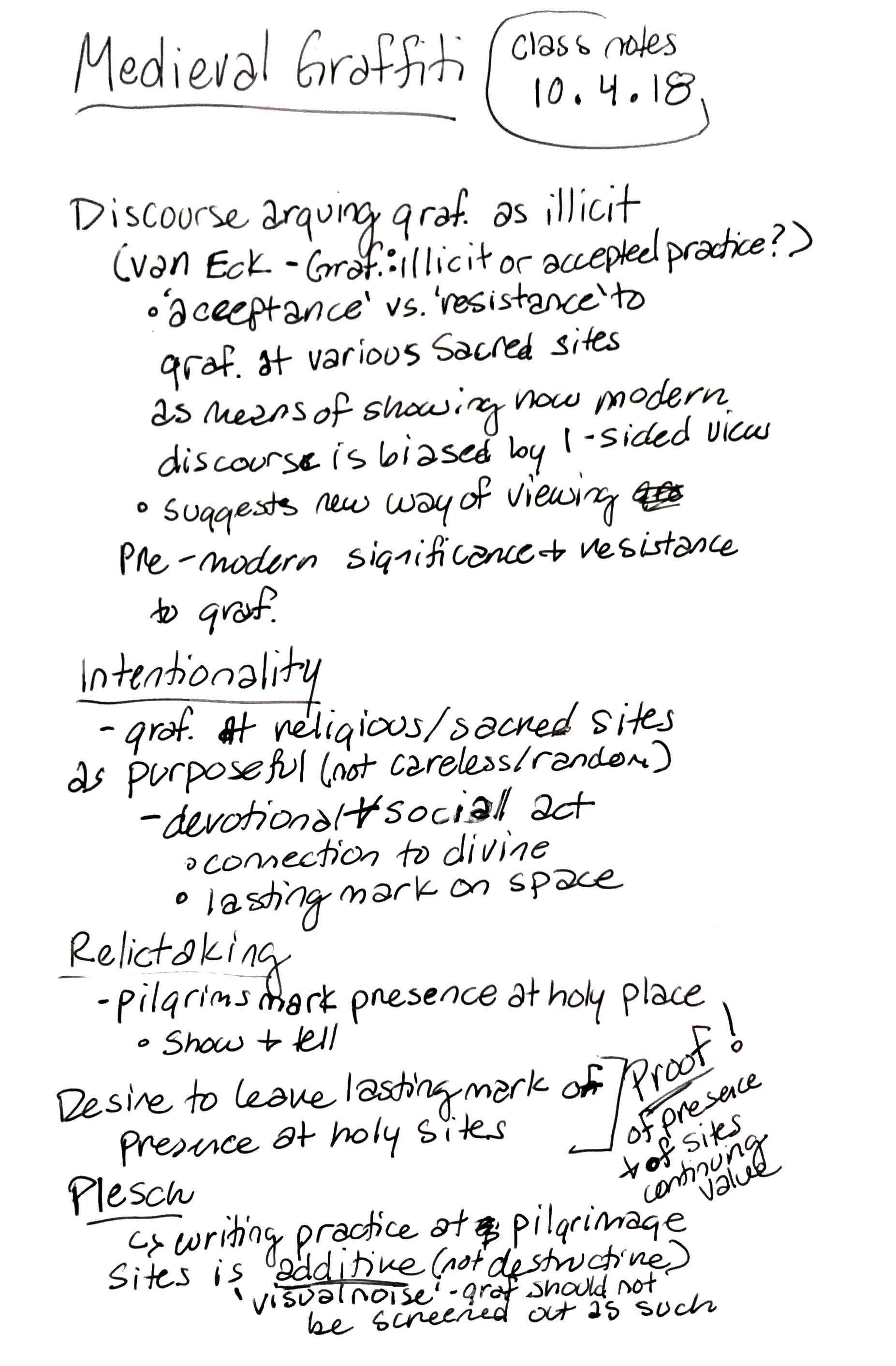
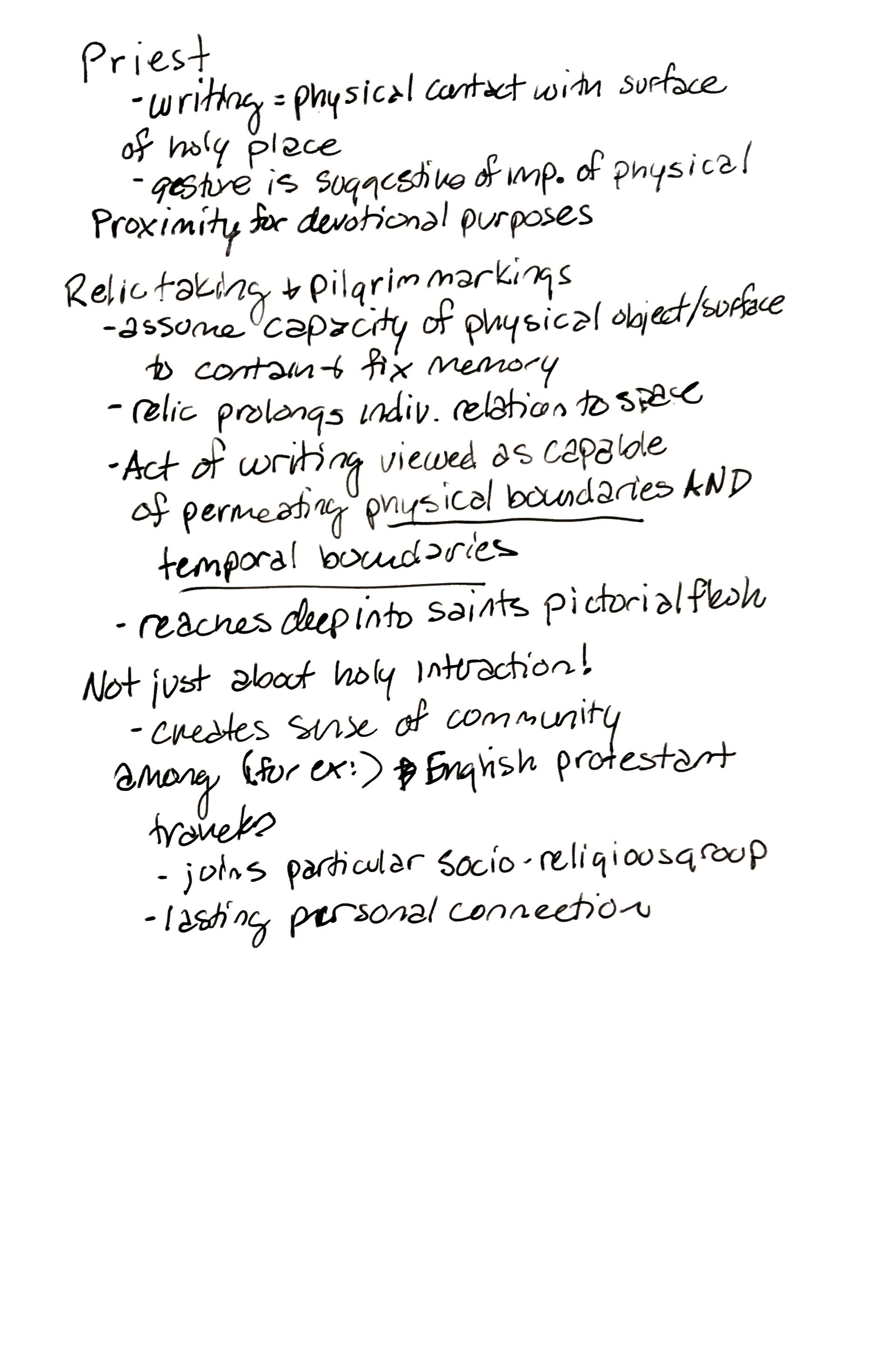
Ancient Graffiti (Notes 9.27.18)
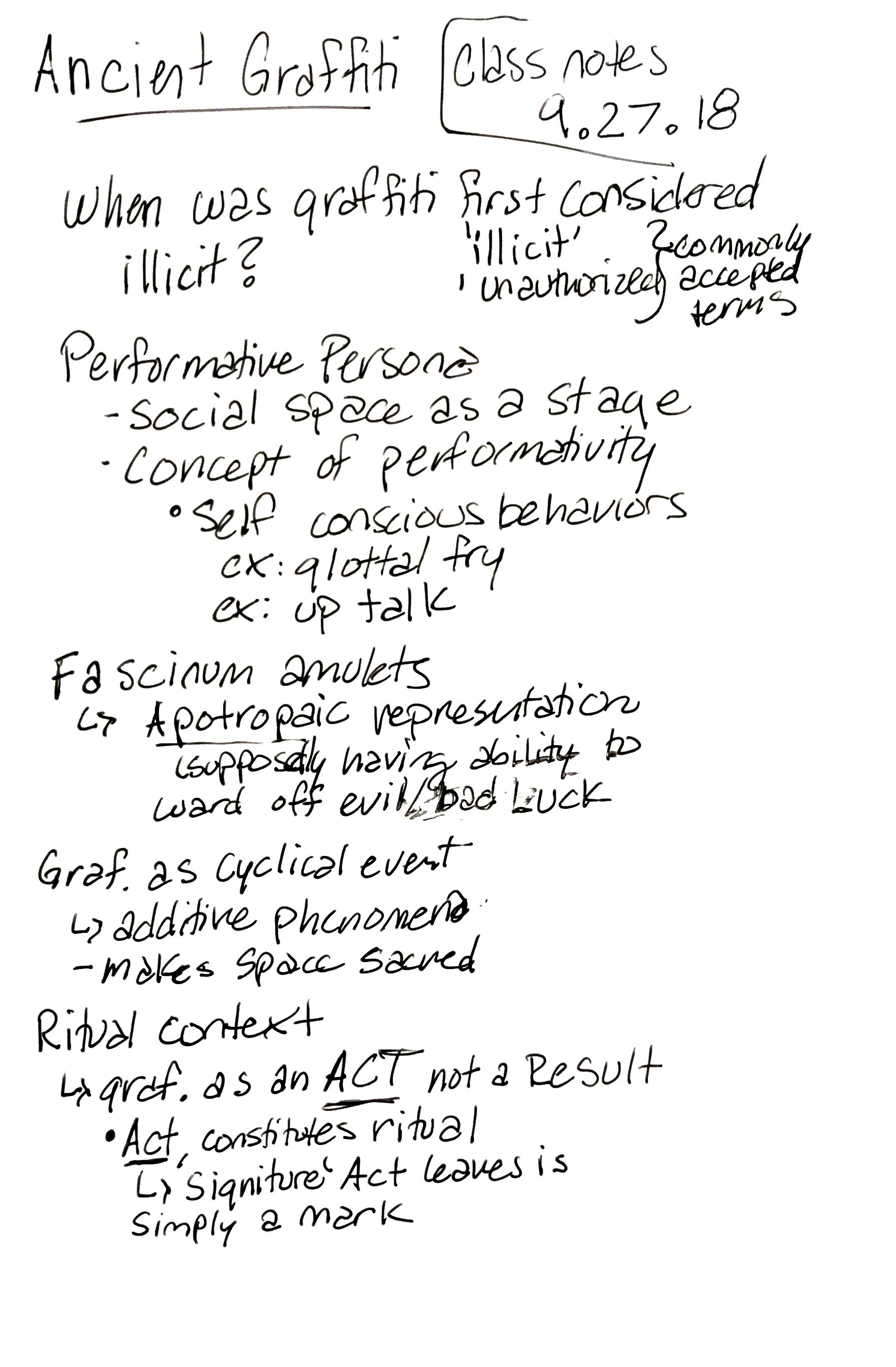
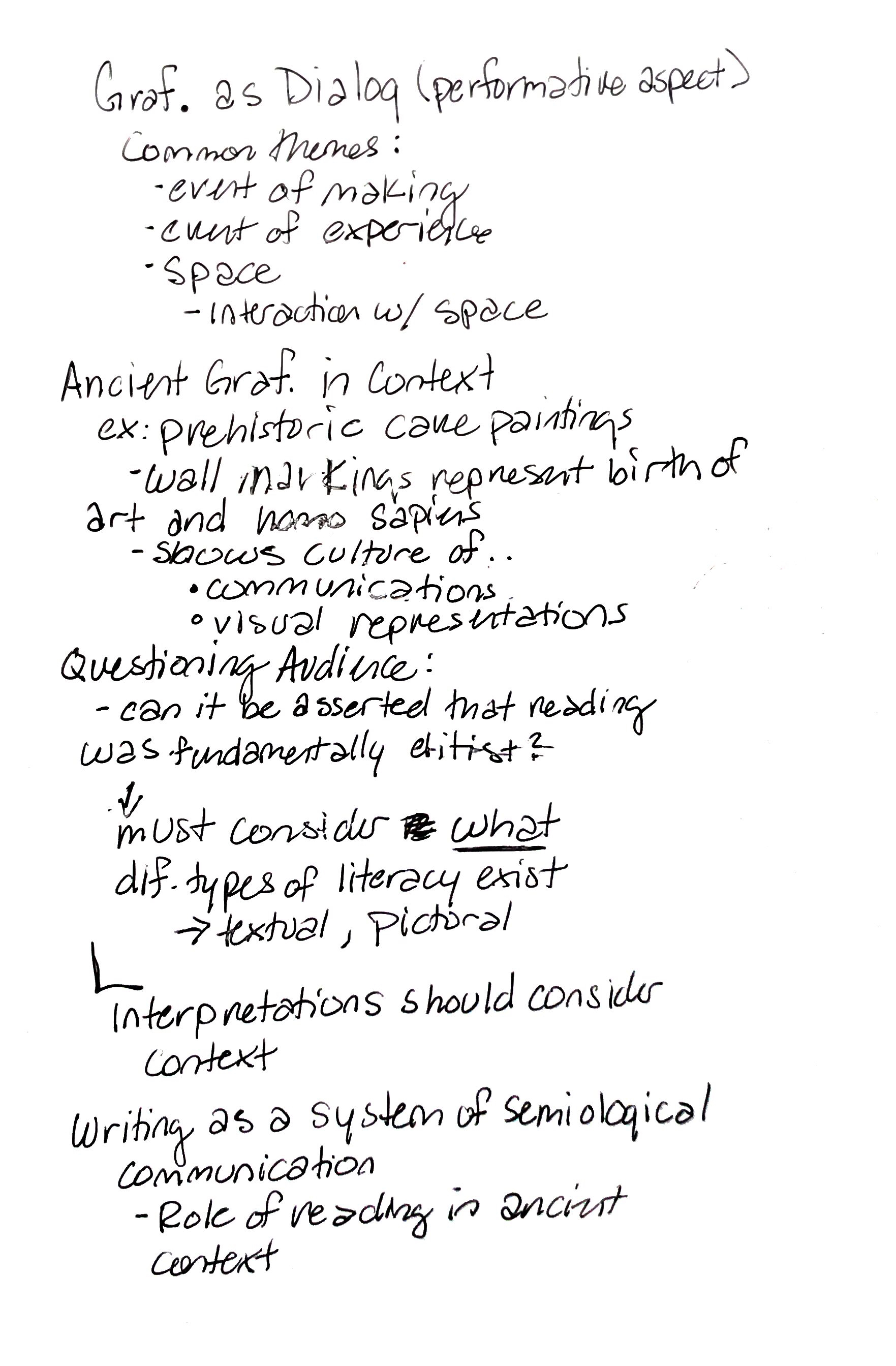
Nancy Spero Reflection
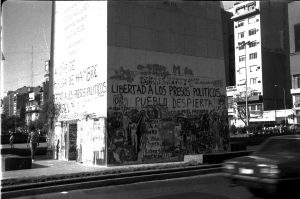
The recent visit to the Museum, reading, and discussion with Beth Finch inspired me to reflect on the ways in which graffiti may be used as a framework to study and interpret images (and words) more broadly. Specifically, I connect our discussion to my analysis of the images produced during the 1983 Siluetazo in Buenos Aires. As many of the images of silhouettes in the original Siluetazo were painted on large sheets of paper, then wheat-pasted onto buildings and trees in Buenos Aires, I have clearly adopted an open definition of graffiti (though it is true that the “ripple” effect of the original Siluetazo produced thousands of images of silhouettes throughout the city––many painted directly on to walls, billboards, buildings, monuments, and the ground), just as coding Spero’s mythological goddesses painted on to the walls (and ceilings) of galleries as graffiti requires an open definition.
From the reading, I also draw similarities between my project and the idea that Spero’s paintings used “architectural space” in inventive and intentional ways. As I have perused hundreds of archival images of the Siluetazo, I have looked at the varying ways in which porteño participants used the architecture of the city as their canvas. The historical roots of the architecture of Buenos Aires––and the displacement and idealism of Parisian Enlightenment and modernity that it connotes––provides a truly remarkable underlying message.
Models and Approaches, Film Screenings, Art-Brut, etc.
Having recently watched both films about the transferral of Basquiat’s work from exterior walls along the streets of New York into gallery spaces, I was confronted by the tangible reality of this transferral when viewing the retrospective of Andy Warhol’s work at the Whitney this weekend. Below is an image of “Paramount,” one of the collaborative works by Warhol and Basquiat. Basquiat’s aesthetic produced a disruptive element to the gallery in which this piece was located, as it was surrounded by Warhol’s silkscreens of mostly brand logos displayed in repetition. In a manner that prompts me to consider the “uncanny” qualities of the “double,” per Jorge Luis Borges, this dynamic of aesthetic juxtaposition echoes the ways in which one might encounter the work of Basquiat outside––disrupting the advertising cacophony of repetitive images, logos, icons that serve as signifiers for corporations.

Incidentally, just as I was taking this photograph, I found myself standing next to Marta Minujin, the Argentine pop artist who’s work––The Parthenon of Books––I have been studying for my research project. This experience prompted me to consider what it means to study the works of living artists: How is it that we prompt questions for, produce discourse surrounding, and attempt to come to conclusions about works of art made by living artists, (considering that they may never read our undergraduate work)?
Models and Approaches
I found “Kitchen’s Closed” to be a really interesting chapter to read given the context of this class. At first, I really struggled to understand why this reading was assigned. I love Kitchen Confidential and I think its an amazing read, but I was confused as to how it has anything to do with art. However, after separating the chapter from its original context, food, I realized that the this piece is really about identity. The long description of the marks on Bourdain’s hand are used to illustrate Bourdain’s identity as a chef. When describing a specific callous on his hand, Bourdain writes, “I’m proud of this one. It distinguishes me immediately as a cook, as someone who’s been on the job for a long time. You can feel it when you shake my hand, just as I feel it on others of my profession, Its a secret sign…” (Bourdain, 296). This idea of “signs” relates directly to graffiti. Graffiti, and all art for that matter, is composed of a group of signs signifying meaning. These signs serve as a form of self expression. This self expression constructs identity. Thus, just like how Bourdain describes the scars on his hand as a sign that he is a chef, graffiti artists use tags as a way to sculpt their identity on the street.
I also really liked the Debuffet essay, “Anticultural Positions.” His argument for outsider art is extremely compelling. The contrasts he poses between Western man and the “primitive” are very interesting. On the surface, all the reasons seem to be rather different. However, they all connect though Debuffet’s claim that culture has ruined art. While he believes reason is also a deterrent for the creation of good art, ultimately culture ruins the authenticity of all art.
***thoughts from after class
I thought “Ugly Delicious” was a very interesting documentary to bring to the class. I think it fit really well with the Bourdain article, but also our discussion of appropriation. It showed the contrast between tradition and innovation and illustrated a positive example of cultural appropriation. In this episode, chef’s appropriated from other cultures in order to create something new, while also paying homage to the culture that they were inspired by. This episode shows the inclusive nature of appropriation and positives outcomes of a contact zone.
Models and Approaches
Post-Seminar Reflection
I am particularly interested in the Word and Image approach, as developed by WJT Mitchell, and in its applicability to my research project. Mitchell writes of the binary problematic in essentializing communication mechanisms to word or image, and, without providing a concrete solution, Mitchell invites a new way of being in the liminal space between word and image. Mitchell applies this to art history, writing of its contradictory nature:
…if, on the one hand, art history turns the image into a verbal message or a “discourse,” the image disappears from sight. If, on the other hand, art history refuses language, or reduces language to a mere servant of the visual image, the image remains mute and inarticulate, and the art historian is reduced to the repetition of clichés about the ineffability and untranslatability of the visual. The choice is between linguistic imperialism and defensive reflexes of the visual. (Mitchell 60)
In this essay, as is especially evident in this passage, Mitchell invites a new way of looking at, interpreting, thinking and communicating about art that valorizes the border space, the between-ness. In doing so, one might reconcile that “we can live neither with nor without, but must continually reinvent and renegotiate” (60). By mobilizing semiotics, one might see that words themselves, as constructed and accepted as “langue,” are icons––they are images that symbolize thought. In coding the written word (signifier) as image, but understanding the ways in which mental imaging simultaneously produces images of the signified. Thus, we rely on both word and image in our quixotic attempts to fully communicate, to comprehend and to fully imagine the holistic and integral constellations of meaning.
In my research on the Porteño Siluetazo of 1983, I will apply a Word and Image approach to the images themselves, in conjunction and conversation with other approaches surrounding the context/performative qualities of the event. The images provoke liminality: the tension between present/not present, visible/not visible. My questions, through interpreting image as word, as a form of communication, perhaps may reach toward transdisciplinary meanings.
Models and Approaches
I found Anthony Bourdain’s Kitchen Confidential to be very interesting. It is not like anything I am used to reading in an art history course. This of course created the question of why we read it. I felt that there can be parallels made between chefs and graffiti artists. Bourdain’s scars were a form of semiotic and the layering of his scars and marks mimics the layering of paint on a wall. The connections between chefs forms a community similar to the communities of graffiti artists. This brings in the topic of identity. The class presentation began with showing Ugly Delicious. This related through the cultural acceptance and blending of cultures. This transitioned nicely to art brut.
All of the pieces we read discuss the idea of beauty and the ideal. There is an importance in giving people something aesthetically pleasing. People react well to appearance and question things when they are not beautiful. This is seen in both ugly delicious and with art brut as a movement. Like food, art does not need to be beautiful to be meaningful. Standards of beauty are determined by the elite. Art brut is an authentic form of art which ignores the authorities which dictate art. Ugly food is a form of art brut. Art brut then relates back to graffiti in culture. Graffiti artists are removed from culture in the same way that outside artists are. Their artwork is a way of sharing culture, but it is not meant to be shown in the way that the elite and beauty standard makers think of art.
Graffiti and The Art World
‘From the Street to the Gallery: A Critical Analysis of the Inseparable Nature of Graffiti and Context’ discusses the rise of graffiti in the art world. Graffiti in urban settings has a different meaning than graffiti in a gallery. Is showing graffiti in a gallery okay? The elimination of the wall and the public spaces gets rid of a crucial part of the definition of graffiti. Illustrations within a city create a story and also a community. Museums create a structured environment, which imposes a certain conversation. This structure highlights the privilege of artists. In the street, graffiti is by fellow citizens and in galleried, we must follow the rules of the gallery and maintain a distance from the graffiti. Streets have no rules. We can touch, interact with, and interpret the graffiti freely. Geographical location is a crucial part of the meaning of graffiti. This article also brings up the idea of a fine artist. Graffiti artists who are shown in a gallery are considered fine artists, yet graffiti artists in the street are not. This highlights the inconsistency in privilege of graffiti artists. When a dealer becomes involved in the showing of graffiti, it loses its meaning. Graffiti can be exhibited, but it must be shown in its original context in order to maintain authenticity.
Graffiti and the Art-World post-seminar
Overall, I found the film Basquiat (1996) by Julian Schnabel to be very interesting and enlightening. I had little knowledge regarding Basquiat before the film, so I learned a lot about his life and relationship with other artists that I previously did not know. One of the scenes that really captured my attention was toward the end of the film where Basquiat tried to add his tag to some graffiti to make it worth more, and the graffiti artists rejected him, showing that he is no longer a part of that subculture. I think one of the most important questions to ask is if Basquiat’s art can still be considered graffiti. There was a clear distinction made between his street graffiti and “fine art” graffiti; they each had different styles and purposes. This leads me to wonder if his graffiti in the galleries can be considered graffiti because they were evidently made differently and with a different intention than his street graffiti. I thought the film was intriguing and well done, but sad at the end.
Graffiti and the Art World
This week’s reading “From the Street to the Gallery: A Critical Analysis of the Inseparable Nature of Graffiti and Context” by Alexandra K. Duncan criticized the display of graffiti in galleries because the white walls of a gallery cannot provide the same context as graffiti in the street. Some of the key points are that on the street, graffiti is illicit, unexpected, approachable, and accessible to all, but in a gallery, graffiti is commissioned, expected, closed off from contact, and only viewed by the upper-class society that visits museum. There is also a key difference between the static graffiti in a gallery and the tags on a train or subway car that rides throughout the city, and graffiti on canvas versus graffiti on rough, imperfect wall. Lastly, graffiti on the street is participating in a discourse with the surrounding graffiti, and this is not possible in a gallery.