From a cafeteria to “The Hill”
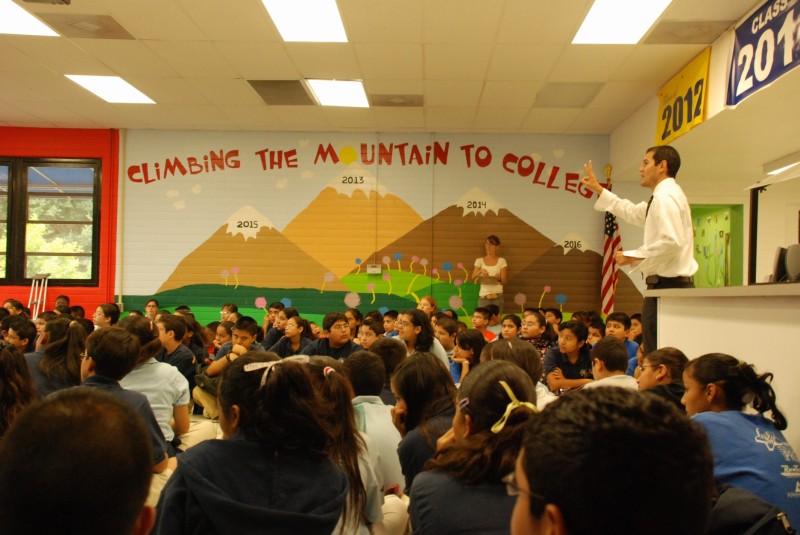
My educational experience started the day that I signed a contract, known as the Commitment to Excelence, at the age of 10, in order to enroll into a school called KIPP: Austin College Prep. This contract was written by the school and it had to be signed by my parents, my advisor, and myself before I could even step foot on the campus. The contract basically says that I will be an examplary student at all times and that my parents agreed to push me and support me no matter what. (If you follow the link on the words “commitment to excelence” and you scroll down you can download the contract so you can see it. It hasn’t changed since I was in 5th grade.) I say that my educational experience started this late in my life because before I was just passed through the system waiting to land on someone’s desk that was willing to help. When my parents made the decision to move me to KIPP I did try to resist the change that they wanted to instill on me. As a kid I was stuck in a system where I wasn’t expected to make anything of myself so I carried myself in that way. It wasn’t until I got to KIPP that I understood that it was me against the world and that there were “no excuses” for not thriving in this world. I couldn’t sit down with my arms crossed and blame the system for where I was in life.
 did try to resist the change that they wanted to instill on me. As a kid I was stuck in a system where I wasn’t expected to make anything of myself so I carried myself in that way. It wasn’t until I got to KIPP that I understood that it was me against the world and that there were “no excuses” for not thriving in this world. I couldn’t sit down with my arms crossed and blame the system for where I was in life.
Every Wednesday morning we would have a meeting in our cafeteria and we would highlight the values of our school, “No Excuses”, “All of us WILL learn”, “Team always beats individual”, etc. These ideas were repeated so often that I bought into them eventually. I went from reading at a 2nd grade level, when I was in 5th grade, to reading at a high school level by the time I was in 8th grade. When I went on to high school I went to another KIPP school called KIPP: Austin Collegiate. This is where I saw the difference between charter schools and private elite schools.
In my time at KIPP: Austin Collegiate I was also playing football for ST. Stephen’s Episcopal school. Her e is where I had my first interactions that would help me succeed in a place like Colby. While I was here I saw how we were “othered” because I came from a different school. On Fridays we would have team dinner before games and I saw how their cafeteria looked more like a restaurant. They had tables made of pure wood and wooden chairs while we had lunch tables that folded up after every lunch. They had ice cream machines, juice and milk dispensers while we had coolers with ice where we got our milk carton from. The guys that came from my school sat with the kids who were on scholarship at St. Stephen’s and the rich would sit apart. On Thursday nights after practice we would go to a teammate house to eat a team dinner before Friday night and this is where I felt the most out of place. We would walk into these houses that were two stories high, had 5 rooms and 3 bathrooms, a pool that overflowed into the lake that had people water skiing and riding around in small boats. We would have to be escorted in and out of the neighborhoods by security just so the rest of the neighbors felt safe but we didn’t dare say anything to the coaches because we felt like that wasn’t our place.
 e is where I had my first interactions that would help me succeed in a place like Colby. While I was here I saw how we were “othered” because I came from a different school. On Fridays we would have team dinner before games and I saw how their cafeteria looked more like a restaurant. They had tables made of pure wood and wooden chairs while we had lunch tables that folded up after every lunch. They had ice cream machines, juice and milk dispensers while we had coolers with ice where we got our milk carton from. The guys that came from my school sat with the kids who were on scholarship at St. Stephen’s and the rich would sit apart. On Thursday nights after practice we would go to a teammate house to eat a team dinner before Friday night and this is where I felt the most out of place. We would walk into these houses that were two stories high, had 5 rooms and 3 bathrooms, a pool that overflowed into the lake that had people water skiing and riding around in small boats. We would have to be escorted in and out of the neighborhoods by security just so the rest of the neighbors felt safe but we didn’t dare say anything to the coaches because we felt like that wasn’t our place.
When we were in the locker room things weren’t that different. At first we had our own little section where all the guys from KIPP would be. I noticed that even though there were more people of color on that team they were different because they had money. It wasn’t until later on in the three years that we played football for them that we started to be more and more accepted into the community. Things started to flow better but I still won’t forget how things started.
This all helped me when I got to Colby because what happened at St. Stephen’s is happening here. I still sit with the people that look like me. I still have one little section for me and that is where I am expected to feel “safe”. I learned how to code switch between the people who looked like me and those that didn’t. At the end of the day I learned to play the game. KIPP showed me the tenacity and tools that I needed to succeed while St. Stephen’s showed me how to try to blend in and when to stand out in a different environment.