I am grateful that I have had the opportunity to be involved in this research project. Although the experience has been challenging and stressful at times, I know my small contribution to this large research project is appreciated and valued (brace yourself, I may get a little cheesy.)
What makes this project special is the number of people from Colby College and across the world who have been involved. My contribution seems small when I think about the entirety of this research project, and I am sure that I am not alone in this. However, without the “small” efforts of every person involved (whether it be conducting interviews, being the interview subject, writing a case study, or contacting students) this project wouldn’t exist. It’s a puzzle that cannot be finished without each piece: each school that participates, every student from around the globe who agrees to be interviewed, every student who signs up for this class. Throughout my time spent on this research project I’ve felt connected to all of these people in a small, but substantial way (I warned you this would be cheesy).
Through the duration of this research project I haven’t been able to shake one question: What does it mean for the elite to be researched by other elite? I have spent some time mulling over this question in my head and have considered many answers (and I am not sure that there is an exact answer for this).
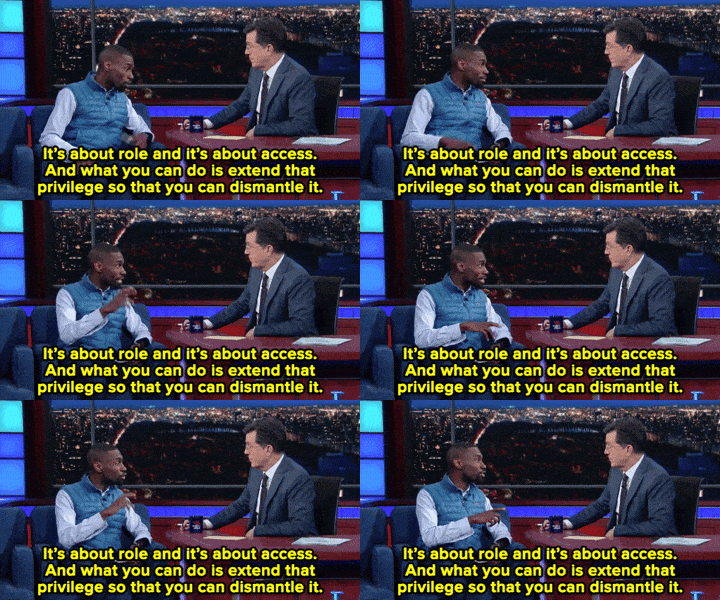
To be frank, at first I thought being elite and researching the elite was bogus. I didn’t understand how we, as elite individuals attending an elite institution, could illuminate the drawbacks of elite institutions without considering our own role in the perpetuation of “eliteness”. We have the resources to investigate what it means to be elite in this society and the disparities of privilege between the elite and the non-elite. We criticize the system, but we are not the ones being harmed by it. Rather, we benefit from the exact system we are criticizing. We, at Colby College and other elite institutions, are privileged enough to be aware of the structures at play that deprive people in the lower class, but the people in the lower class, who are actually effected, are not told about the structures working against them.
Then I read Marco Zamarron’s blog post. His post help me realize that having this knowledge as an elite is important, but what’s most important is what I do with my knowledge. If I have the knowledge of the system of elite and continue to do nothing about it, then I am only perpetuating that exact system. Instead, I need to recognize my privilege and use it to create change. That is what this research project is accomplishing. The privilege of the researchers and students involved in this research project wields power, and, in my opinion, that power is being put to good use.
If you had asked me 3 months ago what it means to be elite, I would have told you a similar, albeit less well-formed, answer that I would give today about wealth and privilege. However, if you had asked me if I was elite, my answer would be a hesitation but ultimately followed by “no”. After studying the true definition of what it means to be this seemingly elusive term of elite, I realized that regardless of my position before I got to college, the sheer factor that I attend this institution and will earn a bachelor’s degree from Colby College makes me irrevocably ELITE.
I spoke in my first blog post about the strange space I filled as a not wealthy student at a expensive, Catholic high school, where I was unsure of my status based on the relative wealth I possessed based on the peers I was surrounded with. And although upon entering Colby I did not, and still do not (college student problems), possess the economic capital that many of my classmates have, with a diploma from Colby, I now possess the social and institutional capital that comes with the cap and gown including networks, knowledge, and prestige.
As a senior, this eliteness of a Colby degree is not something I am complaining about… In the competitive job market of the “real world”, an elite education is what puts you above the rest of the applicants. So why is being elite so bad? Is there a negative stigma that comes with being elite that stems from elites being oblivious to their dominance? So are we to think that because we are aware of our privileges that we are somehow exempt from the elitism? It’s impossible to deny our eliteness as we sit in a classroom situated on a beautiful campus paying $60,000 a year to be here. And even though I am on financial aid and have student loans totaling a scary amount of debt, my eliteness gives me the confidence and assuredness that I will pay back those debts and be okay. And at the end of the day, isn’t that exactly what elite means??
Once I stopped trying to deny my eliteness, I realized that I can embrace it, learn from it, and do the best I can to use it for good. I feel particularly responsible to use my eliteness to further my successes because of my dad and his background. When my dad was 7 years old, his father died. His older brother and sister were already out of the house because they were much older than him. This left my dad, a young child, as “the man of the house”. With only one parent working, my dad and my Memere struggled financially. So, when my dad was 18 he dropped out of high school to join the navy. With just a GED, my dad entered the work force in the federal aviation administration branch of the government. Through hard work and perseverance, my dad now is able to provide for my family and prides himself on this. Because my parents have sent me to Colby, I feel a sense of responsibility in producing economic capital to pay my parents back for all they’ve done and more.
With all the research projects I’ve done before this class, the work stops when I turn in my paper and finish the semester. I get closure by answering my own research questions and relief in knowing I’ve done my job. I think the most challenging, but also the most unique, aspect of this research opportunity is that even though we are individually done with the class and therefore done with our contributions, the work still continues.
Because this project involves so much personal participation for us, especially for those who have to form connections with students through interviews, ending our work without ending the project is a little challenging. In contrast, in my English seminar in queer theory this semester, I designed my own research questions, workshopped the paper with classmates, and eventually came to a satisfactory conclusion through my exploration of the poetry I was studying. Though we may have answers to our immediate questions about Chile and Croft School, we don’t get to stay with Adam to see the end result of this whole, multinational project. How do all these schools perform the same and different functions? What is global citizenship, anyways? Ending the semester without getting closure on these guiding questions is a little tricky.
On the other hand, it’s definitely a special experience to be a part of a project that is so much bigger and ambitious than the research we get to do on our own as undergraduate students. We can see how much hard work past students, even ones we’ve never met, have put into the project. I feel invested in the future of this project, and I’m encouraging my underclassmen friends to take the class next fall so that I can see where the research stands then. Through Adam’s connections, we’ve gotten to interact directly with the subjects of our inquiry rather than spending a whole class reading abstract theory about eliteness. It’s also just very exciting that the work we’ve done in this class is eventually going to help contribute to an actual publication, which is something not a lot of students, especially those who don’t study science, get to experience.
In the end, even though the design of this research project could be challenging, confusing, and overwhelming at times, the experience of getting to contribute to a project that so many other people have worked hard on was incredibly rewarding. Getting the chance to do work that serves a greater purpose than just getting a grade is an opportunity that I wish we had more of through our time at Colby.
While in one of my previous posts I wrote about how I was sitting outside in 70º weather, the flurries of snow currently falling outside my window make Colby feel less like a bubble and more like a snow globe. For the past two years, I have experienced the Colby bubble: not feeling up to date on current events, feeling extremely validated in all my opinions, and the strangeness of being able to drive back to Colby after CCAK in a small, rural, poverty-stricken town. I simply accepted the Colby bubble; I never questioned it- until now. Through researching elite schools, I now feel as though I understand why and how the bubble exists.
After the election, SNL made this clip, entitled “The Bubble.”
This sketch highlights so many of the aspects of what living in a bubble, especially the elite bubble, encompasses. Here are some of the sketch’s most noteworthy and poignant lines:
“The bubble is a planned community of likeminded free-thinkers… and no one else”
Bourdieu notes that elite spaces are often “as internally homogenous and as externally heterogeneous as possible with respect to a number of fundamental criteria.” I remember that when I first read this earlier in the semester, I felt as though Bourdieu said exactly what I had been thinking and struggling to put into words. The promotion of “free-thinking” within elite institutions is ironic since 1) most of their members are like minded (internally homogenous), 2) they often prevent people with different views and backgrounds from entering.
Eliteness is built upon the foundation of exclusion, and the process of researching the Croft School showed this. There were a few scares this semester where we feared our access to the Croft School could potentially dissolve and we would be excluded from their world. Thankfully this didn’t happen and we remained on the inside. While I previously knew that gaining access to elite school was tricky, experiencing it for myself brought a realization of the cyclical nature of needing to use your own elitness in order to gain access to elites.
“Anybody is welcome to join us, 1 bedroom apartments start at 1.9 million dollars”
Exclusion doesn’t only apply to like-mindedness, but economic capital as well. Over the course of this semester I have come to truly understand that while economic capital does not encompass the entirety of social class or eliteness, it is an extremely significant aspect. The idea that anybody can be elite if they work hard and make money is a singularly meritocratic viewpoint that doesn’t acknowledge the systematic forces working in favor of elite reproduction. One of the most mind-blowing findings in researching the Croft School was that it has no financial aid. That automatically eliminates a large group of people from attending, leaving it open to only the most economically elite.
“Join us, starting in 2017”
Clearly, the development and execution of any major project takes a long time. I have never been involved in a research project that 1) has spanned months, 2) is so collaborative, and 3) is a contribution to a much larger work. Taking our time with the research, theory, interviews, case studies, and discussions allowed myself, my group, and I think the whole class, to deeply explore our topic from all angles. After dedicating so much time and energy to the research, I feel not only extremely invested in what I’m doing, but also highly knowledgeable. I thus find myself bringing up Bourdieu and the mindset of elites and reproduction into the most random conversations.
While I’m definitely still in the bubble, I now recognize both its comforts and harmful aspects, and I’ve definitely pushed myself from safely in the middle to a place closer on the edge.
A few weeks ago, a friend sent me a link to one of the best short videos I’ve ever seen. The video is nothing more than a simple song, some graphics, and a speech by Neil Degrasse Tyson, an American astrophysicist and cosmologist, but it changed my outlook on so much. At the beginning of the video he is asked the question: “What is the most astounding fact that you can share with us about the universe?” And he goes on to match this profound question with a thoughtful, moving, and introspective answer equally as profound. The answer is intricate and complicated, but these are my favorite lines from the response:
“I look up at the night sky, and I realize that yes, we are part of this universe, we are in this universe, but perhaps more important than both of those facts, is that the universe is in us. When I reflect on that fact, I look up at the night sky… Many people feel small because they’re small and the universe is big, but I feel big! Because my atoms, came from those stars. There’s a level of connectivity: that’s really what you want in life, you want to feel connected, you want to feel relevant, you want to feel like you’re a participant in the goings on of activities and events around you. That’s precisely what we are, just by being alive.”
Before you think I’ve lost my mind, I promise I haven’t forgotten what class I’m writing this blog for. Admittedly, this quote is a rather grandiose one about our world, the universe, and each and every single one of us living here. It may seem like a stretch to you, but as I listened to it, one of the connections I made was how small this particular class has made the world feel.
This was my first experience ever being such a small part of such a large project; my first time being one single part of a project that spans 5 countries, includes hundreds of students, and has taken thousands of hours. As a psychology major, I’ve had my fair share of studies with participants and other people’s involvement. I’ve worked in labs both at Colby and other Universities, looking at social psychology and neurobiology related concepts, but none of the research projects I’ve done have been collaborations outside of a single institution… So nothing quite like this. I have a new appreciation for how fundamentally critically teamwork and collaboration truly is. Perseverance, understanding, and flexibility are all key components of research at every level, and this project has truly allowed me to comprehend and internalize that.
I was the interviewer in my group, which meant that I had the fortune of having direct contact with Kostas (the student from the Croft School). We were incredibly lucky to have been paired with such a responsible student. He was online on time, never rushed through the questions, asked for clarification when he needed it, and overall was just a really fun, intelligent, engaging guy to talk to. Hearing some of my classmates’ experiences I know that this wasn’t necessarily the case across the board, but my interaction with Kostas could not have gone smoother. I can’t help but be in awe at how small technology has made this world. Kostas was thousands of miles away, and yet we talked about everything from the breed of his dog to Donald Trump’s election like he was right in the next room. As Tyson says, we are all so fundamentally interconnected. Particularly given the climate of this increasingly globalized world, those of us fortunate enough to have the technological means have opportunities to make incredible transnational connections in a way that would not have been possible 20 years ago.
Tyson’s quote made me realize that no matter how small my contribution, this project would not be the same without the work of every individual involved. We are all a thread in the fabric of this curriculum, without which it would unravel. For instance, while I was the actual interviewer, someone else organized the fact that Kostas would be the one I was speaking to. Hundreds of email correspondences likely went into organizing those few hours of actual conversation between us. That’s pretty cool to think about. Thanks, whoever you are!!
The other piece of Tyson’s speech that resonated with me was the part about social connectivity. How, at the most fundamental level, human beings are social creatures. No matter how introverted or shy, at a very biological level, we crave belonging and purpose, and this project has done an incredible job of bringing so many people around the globe together. While we may not all know each other’s names or stories, we have all worked together towards a common goal. Take a second and just think about how incredible that really is… Colby can be such a microcosm, where we all get wrapped up in our everyday lives and challenges, and forget to pause and remember that there is, quite literally, a whole world out there. People we haven’t met, friends we haven’t made, obstacles we haven’t overcome. And despite the unknowns and the distance, these people are likely going to face similar challenges to those of us here at Colby — we are all human, at the most basic level. I understand that feeling like you have a “place” at Colby is so important, but this project has helped me conceptualize the fact that there is so much beyond what we see and what we focus on during our time here on the Hill.
I’ve learned a lot from this class, and what I’ve learned extends far beyond Bourdieu’s theories and the implications and expectations of elite-ness. It’s allowed me to be a part of something bigger than a single assignment in a single class in a single semester at a single school. I’d say that’s pretty special, and the process of working with others to achieve a common goal in an academic setting like this isn’t something I’ll soon forget.


 Because this project involves so much personal participation for us, especially for those who have to form connections with students through interviews, ending our work without ending the project is a little challenging. In contrast, in my English seminar in queer theory this semester, I designed my own research questions, workshopped the paper with classmates, and eventually came to a satisfactory conclusion through my exploration of the poetry I was studying. Though we may have answers to our immediate questions about Chile and Croft School, we don’t get to stay with Adam to see the end result of this whole, multinational project. How do all these schools perform the same and different functions? What is global citizenship, anyways? Ending the semester without getting closure on these guiding questions is a little tricky.




 I was the interviewer in my group, which meant that I had the fortune of having direct contact with Kostas (the student from the Croft School). We were incredibly lucky to have been paired with such a responsible student. He was online on time, never rushed through the questions, asked for clarification when he needed it, and overall was just a really fun, intelligent, engaging guy to talk to. Hearing some of my classmates’ experiences I know that this wasn’t necessarily the case across the board, but my interaction with Kostas could not have gone smoother. I can’t help but be in awe at how small technology has made this world. Kostas was thousands of miles away, and yet we talked about everything from the breed of his dog to Donald Trump’s election like he was right in the next room. As Tyson says, we are all so fundamentally interconnected. Particularly given the climate of this increasingly globalized world, those of us fortunate enough to have the technological means have opportunities to make incredible transnational connections in a way that would not have been possible 20 years ago.