Positionality and Bias in the Research Process
Throughout my research project this semester on Sankofa International College in Ghana, I have listened to, watched, and interpreted many interviews with students and alumni from the school. During this process, I developed a thesis, synthesized data and found evidence to support my claims. Rarely though, did I reflect on how my own positionality affected not only my claims but also what I took from the interviews and data. As a white, female who attends an elite private institution I have a specific lens when reading through interviews and making claims regarding my findings and I think this is important to acknowledge as a part of the research process. As I reflect back on my research process, I believe it is important to ask myself, why did I focus on this particular aspect of the interviews? Why did I choose this theme? Why did some parts of the interviews stick out to me as important over other parts? And how does my own positionality influence my answers to all of these questions?
When reading through the student interviews, I heard many stories of elite students’ experiences at Sankofa and subconsciously immediately compared these experiences to my own eliteness. For example, when one student was talking about their stress level and the workload and busy schedule they had at school, I immediately compared it to my own busy schedule at Colby. This shows how the elite mindset of legitimation is ingrained in me where I look to legitimize my eliteness based on comparing the busyness of my schedule to those of other elite students. Due to this mindset I came into the reading with, the schedule’s and stress levels of the students stood out to me as something important in the interviews. This in turn, made me note these aspects of the interviews as important and go on to include this in my paper. It is important to understand why I chose certain aspects of the interviews to focus on in my paper because it may subconsciously be influenced by my own eliteness.

Also when reading through the interviews with the disadvantaged students that attend Sankofa, it was eye-opening to see how different their experience at the school was than other elite students. Due to my elite background I had never thought about some of the social and academic pressures that these students not from an elite background face in an elite environment. For example, when one student talked about feeling more pressure academically than the wealthy students, saying “I try as much as possible to prove it and in so doing I try, I mean it motivates me, but they’ll suck the blood out of you. It makes you tired like you’re competing, but all they are trying to do is to improve.” (student 2). This quote really caught my attention when analyzing the interviews because it was not something I had experienced before. It had never crossed my mind that students from less privileged backgrounds may feel even more pressure to prove themselves as worthy of an elite education because of their background. Because I have been surrounded by elite students from elite backgrounds for most of my education, this experience particularly caught my attention and therefore I included it and made it a point of focus in my narrative findings of my research paper. It is important to acknowledge why this experience stood out to me when reading the interviews because my own background influenced the way this narrative caught my attention and was deemed important to include in my research paper.
Lastly, for our main theme of the paper we chose to compare and contrast the experiences of disadvantaged students to those of students from elite backgrounds. In reflecting on why I deemed this comparison important to analyze, it is important to note that this concept of having disadvantaged students at an elite school is very novel to my own life experiences. It was especially intriguing to me to look at how these students fit into the social scene of the school because in my school experience I have noticed how I tended to subconsciously surround myself with students with my same social class background.
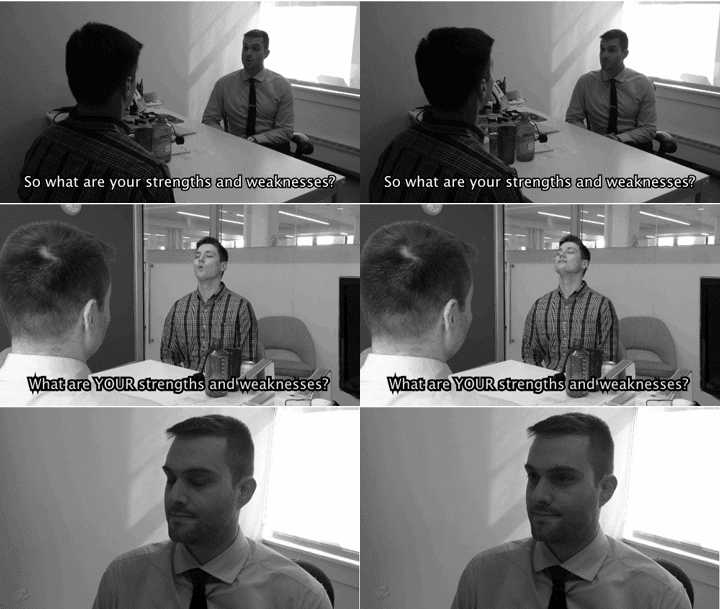
Another important factor of our research paper that may contain bias is the interviews themselves that we were analyzing. Because we did not get to interview the students ourselves, we had to interpret interviews given by other students from past years. Throughout our analysis process, we did not take into account interviewer bias, and just took the interviews for what they were. Oxford reference database defines interviewer bias as “a distortion of response related to the person questioning informants in research. The interviewer’s expectations or opinions may interfere with their objectivity or interviewees may react differently to their personality or social background.” This bias definitely could have affected the data we were analyzing, something we did not really account for. As I reflect back on this experience, I believe it is important to acknowledge that we as outsiders of this process do not know the aspects of the social and personal backgrounds of the interviewers which may have affected how and why they asked the students certain questions during the interview. Overall, as we finish up our research paper based on this data, I want to acknowledge how my takeaways, claims, and evidence is greatly affected by my own bias as a white, female from an elite background, as well as the bias of the student interviewers and the positionality of Colby students conducting this research.