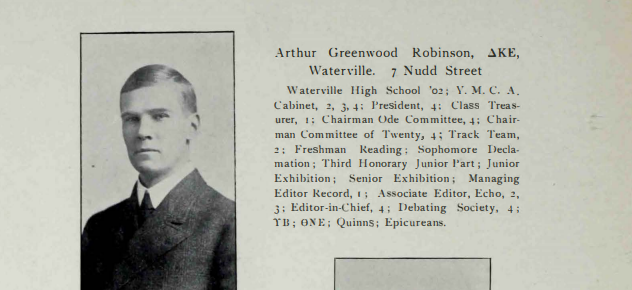
Arthur Greenwood Robinson (A.G. Robinson, 1861-1957) was an American Baptist missionary and educator who graduated from Colby College (Class of 06′) and devoted much of his life to cross-cultural work in China. His career with the YMCA in China and Japan illustrates how early 20th-century missionaries helped shape educational and cultural exchange between the United States and Asia during a period of profound political transformation.
After completing his undergraduate work at Colby, where he served as editor-in-chief of the Echo, President of the campus YMCA chapter, and a distance runner on the Track team, Robinson prepared for the mission field he had already identified as a senior. In 1913, he joined the YMCA in Shanghai, and the following year, he was transferred to the Tokyo YMCA to teach English to Chinese students at Waseda University. Among his students was Li Dazhao, who would go on to co-found the Chinese Communist Party in 1921.
In 1916, Robinson moved to the Tientsin YMCA, where he worked until 1927, building close ties with Chinese educators. After a brief return to the United States during the unrest between Nationalist and Communist forces, Robinson came back to Tientsin in 1929 under the American Board of Missions and continued his educational work until the Japanese military advance into Northern China forced the family out in 1937.
Robinson’s decades of work in education, missionary work, and social relief left a lasting mark on the communities he served. His contributions to China were formally recognized in later years by Chinese institutions honoring foreign friends of the country. His four children, all born in Tientsin, carried their father’s connection to China and Japan into their own lives and careers.