
An Unfortunate Event
Sometimes life feels like a progression of unfortunate events. You go and get ice cream and right before you take a bite the cone slips out of your hand, falls and then oozes on the pavement. You go back to the end of the ice cream line and by the time you get to the front they are out of your favorite flavor. It is easy to feel this way when you are having a bad day or if you are incredibly stressed by an overbearing workload. People also tend to feel this way around deadlines especially if nothing is going their way. For example, as a student you may have had a day like this. You walk into class and realize you left your assignment in another notebook. After class you check your phone and see a rejection email from the summer internship you had your heart set on. Just as you are putting your phone away you drop it and the screen cracks. Meanwhile the kid standing next to you asks how your final paper is going. In that moment you realize you wrote the due date incorrectly on your planner. A minute later you get a text from your lab partner (on your shattered phone) saying that tonight is the only night she can meet to work on the final project. It feels as if every possible thing in your life has gone wrong.
Read more…
If you are not aware of the United Airlines disaster/debacle/controversy/blunder (take

Figure 1: United Airlines aircraft
your pick), I would highly recommend familiarizing yourself. However, to save you some time, I will provide you with a short recap of what happened. On April 11, 2017 United Airlines had over booked a flight from Chicago to Louisville and needed to make room for four members of the flight crew. You can probably guess where this is going – an overbooked flight with four additional seats needed means that four passengers have to change to a later flight (math!). No one wanted to volunteer to give up their seat, so United Airlines bumped four passengers who were already seated from this flight. For whatever reason, one man really did not want to give up his seat that he had already paid for. Thus, United Airlines underwent an “involuntary de-boarding situation” and thought that it would be a good idea to physically remove this man while he was kicking and screaming. Fortunately for us, and unfortunately for United Airlines, this incident was caught by many people on video and then posted to social media. If you’re curious about what United Airlines missed and how they could have potentially avoided the bad PR they incurred after the event, you should continue reading.
Read more…
Have you ever looked at the coverage map for a telecommunications company, like Verizon, and wondered why a company would choose to spend the money on a colored picture instead of just presenting the information in the paragraph? I mean, wouldn’t it be easier and cheaper to just write it all out? Probably, but it wouldn’t be as effective.
Below is a paragraph that describes Verizon’s coverage in the U.S., and a corresponding image that displays the data. When the information is laid out in text, I bet that you, the consumer, would have a much harder time articulating and remembering the information. But by presenting the information in a picture (like that shown below), you can easily discern and remember the differences between the coverage of four telecommunication companies. Why would this be true? It has to do with the way that we encode, or initially learn, information. This is a perfect example of the picture superiority effect, the phenomenon in which people are better at remembering images than they are at remembering words (click here for a quick, fun video that explains this phenomenon).
“Among the four major wireless carriers, only Verizon’s 4G network is 100% 4G LTE the gold standard of wireless technology. Available in over 500 cities, Verizon 4G LTE covers almost 97% of the U.S. population. Experience the speed and power in more places.”

http://www.phonearena.com/news/Which-carrier-offers-the-fastest-mobile-data-and-coverage-4G–3G-speed-comparison_id53828
Read more…
Have you ever seen someone wearing a shirt with a political candidate you don’t like, and automatically assumed the worst about him or her? Or perhaps you have been at a sporting event, and felt a strong connection towards fans cheering for your team. Why do we make judgments about people we know nothing about based on their group identification? Why do we assume good things about strangers who are more similar to us, or bad things about anyone who differs? What justifies this behavior?
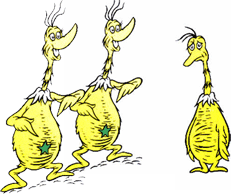
In-group biases
Read more…

www.riskology.co
You wake up one day with the urge to build something—let’s say it’s a chair for your kitchen table. You print the instructions from online, go to the hardware store to get supplies, and then you set up shop in the garage, ready to build your masterpiece. It already seems like quite an undertaking, doesn’t it? And that’s before you realize that you will make a cut too short, need more wood, and all of a sudden the project is going to take twice as long as expected. So, as you stand there in the garage amidst your frustration, you might ask yourself…why the heck am I doing this? Well, I have good news for you. Wood-working enthusiast or not, thanks to the IKEA effect, you’re going to love that chair far more than the one you saw last week at Bob’s Discount Furniture.
Read more…
Happiness, health, love, and money — what else would anyone need? These most universal of human interests are often the center of common phrases, called aphorisms, that express some general principle about how our world works . . . or so they claim. For example, we all know that great spenders are bad lenders, and surely, what sobriety conceals, alcohol reveals. Many people are very familiar with these aphorisms through previous, repeated exposure to them. One critical feature contributing to the popularity of these phrases is their rhyming pattern. But how about the phrase an apple a day keeps you pretty healthy? Well, maybe not. The botched rhyme in this last phrase makes us question the truth behind the statement. This is due to the Rhyme-as-Reason Effect. This effect is a cognitive bias by which people judge the validity and accuracy of a statement as being more true if the statement rhymes. So, although the aphorisms are very vague, the use of rhyme as a rhetorical device asserts their claim in a more persuasive way.  Read more…
There is a cold crispness to the air, but the sun in the cloudless sky gives you the little bit of warmth you need to feel comfortable. It is an early November day, and it is time for the U-12 soccer championship. Maybe you are a player, a parent, a friend, even a referee here today. There are four teams here with the same goal in mind, to win all their games so that they get crowned champion. The Cheshire Rams are the ones you are hoping to win today. You do not know how the day is going to go because all of the teams here have had great records this season and are all very competitive for the title. Hours later, the Cheshire Rams have done it. They are champions! You are in the car riding back, and all you can think to yourself is “wow, I knew it would happen!”

http://articles.chicagotribune.com/2013-06-26/news/ct-x-0626-keilman-column-20130626_1_more-kids-score-childhood-obesity
What is Hindsight Bias?
Did you actually know that the outcome would happen as it did? The truth is, most likely not. Read more…
… But I know you are going to read more. Isn’t it weird that the author tells you not to read his brainchild? Isn’t it bizarre that I have written an anti-advertisement? Isn’t it interesting that you realize you have almost finished reading the first paragraph? Yes you have.
Also you might have seen the emergency exits labeled “EMERGENCY, DON’T EXIT”. Haven’t you asked yourself why that sign is so paradoxical that you would spend minutes deciding whether to exit? Or you have heard a parent telling a running toddler “I bet you won’t catch me”, and almost immediately the adult was caught by that toddler. For so many times you might have asked why to have that deception. You have probably heard of the famous “smoke a pack per day” slogan in quitting smoking, and if so, aren’t you curious why encouraging smoking actually helps people quit?
Read more…
As someone who is a fan of true crime podcasts, I couldn’t help but to binge-listen to the episodes of Wrongful Convictions–a podcast by the Innocence Project detailing stories of people who were convicted for crimes they did not commit. In one of the stories, a person was convicted due to the misidentification by one of the victims of the crime. This eyewitness testimony was enough to carry a 30-year-old sentence in prison.

Pattern recognition of faces of other races can vary according to the cross-race bias.
PC: The Guardian
There are several cognitive errors that could make of this eyewitness testimony (and others) unreliable. Daniel Schacter described in the Seven Sins of Memory (2001) different cognitive errors that the memory is sensitive to, including memory biases. In the case of the person wrongfully convicted, a cross-race or own-race bias could have influenced the misidentification. An own-race bias refers to the tendency of being more accurate at recognizing faces of your own race than faces of another race (Malpass & Kravits, 1969). The bias is not exclusive to the context of eyewitness testimonies and the criminal justice system, however; you can stumble upon the own-race bias during a trivial day. For example, have you ever had a feeling that people who don’t belong to your racial category look “all the same” to you? Or have you wondered why you are very good at recognizing faces of your own racial profile yet can’t make the same accurate distinctions cross-racially? Or maybe, have you ever confused two people from outside your race because you couldn’t distinguish certain individual characteristics to make them apart? Then you’re in the right place to learn about this cross-race phenomenon! In this blog, we discuss possible mechanisms behind the cross-race bias.
Read more…
Have you ever found yourself questioning the decisions of those around you, perhaps as if you had better insight into the thoughts and emotions of a person than they did themselves? Or do you ever catch yourself making internal judgments towards others in a way that pushes aside the legitimacy of one’s own self-understanding? “Why is she doing that? She should know herself better!” These are behaviors that can be understood through a phenomenon commonly referred to as the illusion of asymmetrical insight, a cognitive bias that describes our tendency to think we understand other people better than they understand themselves and us. To put it into other words, Kathy (person #1) would be experiencing the illusion of asymmetric insight if she thinks she knows Kathy (herself) better than Jake (person #2) knows Jake (himself) or Kathy (person #1).

The Illusion of Asymmetric Insight in Action
This bias can be seen in individuals throughout varying contexts, and is also very common among social, political, and religious groups. Multiple studies have explored the manifestations of the illusion of asymmetric insight, many of which attribute the bias to reasons outside our level of consciousness. In other words, we do not have full awareness of when this phenomenon is occurring due to the fact that it is an automatic processes (a process that is quick, easy, requires little cognitive resources, and has the ability to occur without full attention, as opposed to controlled processes, which are slow, difficult, and require cognitive resources and full attention).
So why do we experience this phenomenon so frequently without even realizing it?
Read more…


Recent Comments