
In case there was any confusion…
Hello, and welcome to your reading! While you may have come here looking for some interesting cognitive facts or tidbits, what you’re really in for is a personality profile created specifically for YOU. Through our unique system of assessment, here are your results…
-You have a need for other people to like and admire you, and yet you tend to be critical of yourself. While you have some personality weaknesses you are generally able to compensate for them. You have considerable unused capacity that you have not turned to your advantage.
Was it accurate? Do you feel as though you can suddenly trust the powerful abilities of this post to predict your innermost emotions and traits? If you answered yes or felt that the reading uniquely matched you, then you’ve fallen victim to the Barnum effect. Named after the infamous showman P.T. Barnum, this effect refers to the tendency for people to give high accuracy ratings to personality descriptions that, although said to be unique, can apply to the general population. Barnum famously said that there is a sucker born every minute, and this tendency may explain why those “suckers” seem so gullible. From fortune cookies to the Long Island Medium to Buzzfeed personality tests, this effect explains why people are so eager to accept general profiles that have no veridical backing as the truth.
Read more…
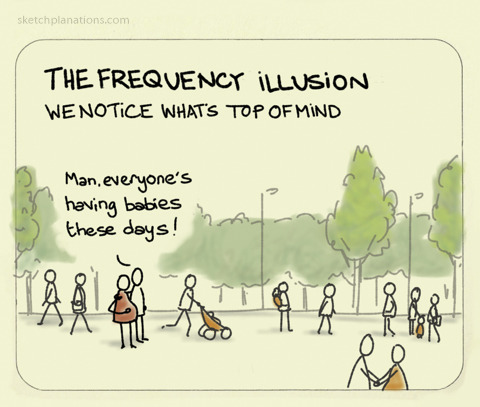
Have you ever scrolled through Spotify and discovered a band you like? Have you ever started listening to all its songs and suddenly you start hearing it all the time on the radio and seeing advertisements for its new album or concert? Or maybe you just found out you’re pregnant and see parents with their kids everywhere you go? While it’s easy to think that maybe you just discover bands that magically and suddenly get really big or that maybe more people suddenly have kids these days, you’re actually probably experiencing what is called the Baader-Meinhof phenomenon or frequency illusion.

Kids are everywhere! Or so you think.
The frequency illusion occurs when a person experiences something, like finding a song he or she likes on Spotify or becoming pregnant, and then afterwards believes that the experience or phenomenon happens all the time. So why does this occur? Well, there are two cognitive processes that are involved in creating the frequency illusion: selective attention and confirmation bias (Zwicky, 2006). Read more…

I think you’d call that an objective overreaction (Marcinski, 2015)
Try to remember to the last time you had a fight with a romantic partner or friend, especially over a small misstep or misunderstanding. Were you angry at the time? Jealous? Hurt? If so, you probably said and did things you didn’t mean; perhaps you were intending to cause your partner the same pain you felt, or were simply lashing out impulsively, not caring to listen to their side of the story. Only your own feelings mattered.
Now think back to the aftermath, when you had resolved the issue and moved forward. Everything that happened in the heat of the argument might seem a bit silly to you now. Maybe your partner pointed out that you had overreacted; your emotions seemed perfectly valid then, but now, in a state of calm as you and your relationship are, you’re inclined to agree with them. There’s no way you acted like that; you had no reason to. You certainly won’t do so the next time you’re in an argument…right?

Unlike faucet taps, these states are rather mutually exclusive: no lukewarm middle ground here (http://image.wikifoundry.com/image/3/5ac715be43f996a35f99bf5976ec1348/GW350H215)
Wrong, says the empathy gap. Read more…
Memory – a simple word consisting of six letters. Memory – a term we frequently use to encompass a broad range of concepts. Memory – the thing that’s left after an event has long passed. But what happens when memory fails us? What happens when we fail to remember the past as accurately as we thought we would?

False memory
In cognitive research, false memories describe memories of events that did not take place or they happened quite differently from how they are remembered. The most common technique to induce false memories in a laboratory setting is a word learning paradigm called Deese-Roediger-McDermott (DRM), in which people study a list of words (such as bounce, throw, basket, bowling, and golf) that are all related to a common item (in this case, ball). When given a memory test people will often indicate that the non-presented common item (ball) was on the list with high confidence (Deese, 1959; Roediger & McDermott, 1995).
This is what researchers described as false memory: remembering something that did not happen.
Read more…
Have you ever been certain a friend said something when they’re certain that they didn’t? How about remembering it completely differently from how they actually said it? If you have, chances are you had a false memory! Don’t worry, you’re not the only one. False memories occur when we remember events that didn’t happen or remember them very differently from how they actually happened (Schacter, 1999). Although it may be unsettling to hear, false memories are very common and hard to detect. As far as you’re concerned, these don’t seem like false memories at all! False memories can be very similar in nature to true memories, which makes them all the more difficult to distinguish. Psychologists interested in memory often study false memories to learn more about the underlying processes that drive memory.

thinking.umwblogs.org
Cognitive psychologists have developed a few different methods of inducing false memories. Perhaps the most reliable and widely used is the Deese-Roediger-McDermott (DRM; Roediger & McDermott, 1995) paradigm. In this paradigm, participants are presented with lists of words that are semantically associated, or related by meaning. For example, the words beach and ocean are semantically associated because people typically have strong connections between the ocean and the beach. After studying these words, participants take a memory test in which they have to decide whether they studied certain words or not. The DRM uses these types of associates to create false memories for words that are never presented, but are highly related to the words that are. One typical DRM list includes words such as banner, American, symbol, stars, and anthem, all of which converge upon the word flag. In this case, the word flag is called the critical lure. After studying this list of words, participants frequently remember seeing flag, even though it was never presented, because it is highly related to the words on the presented list.
Read more…
You’ve just taken an exam. As you push through the doors to the refreshing, cool air of the outside world, you feel a weight lift off your shoulders and a childish giddiness makes its way throughout your body. You feel like you really nailed that exam, which is quite the feat, given you only studied for about 30 minutes the night before. Flash-forward two weeks of vigorously patting yourself on the back, and your exam has been graded. Expecting the absolute best, you accept your graded exam from your professor with a flourish and find yourself just a tad confused to find your grade much lower than you expected.
Read more…
Everyone loves Google, right? All the information you could possibly ever want access to is right at your fingertips – quite literally – with search engines carried around in our pockets. Is Google making us smarter? It should, right? I mean it does provide us with an almost infinite amount of information. Well, here is where things get interesting. Recent studies have introduced a new concept known as The Google Effect, in which we are actually seeing some cognitive deficits caused by our dependency on Google and other search engines.

It is quite counterintuitive that these tools, which provide us with any information we want in just a matter of seconds, would actually hurt and not help our brain’s functioning ability. I know this is confusing, but let me put this into a real-life context that you might relate to a little more.
Read more…
Have you ever found yourself hoping for a positive outcome but instead, you end up experiencing the worst possible outcome? For example, you have endlessly searched and finally found the perfect shampoo to combat your excessive dandruff when all of a sudden, the company decides to discontinue the product. Or when you finally have the confidence to exchange phone numbers with your all-time crush and you call but not only did they give you a wrong number, it is a rejection hotline number. Even those times when you finally make a doctor’s appointment for that 3 week long pain you have endured and when you arrive, you feel as brand new as you have ever felt before. Reflecting on these instances make us wonder why expecting a certain outcome can result in, not only the opposite outcome, but also the worst one. Furthermore, the real question is why? Why does it feel as if the worst always happens? It almost feels as if we wished upon the bad. Read more…
In college it is hard to save money. With the costs of textbooks, late night pizza, and online shopping, I know my bank account is looking a little scary. Often times I find myself avoiding looking at my bank app because I’m afraid to see what my bank statement is, but on payday it is the first thing that I check. Why is that?
This tendency – to avoid checking financial standings when we know that they could be bad – is known as “the ostrich effect,” and is defined as the tendency for people to ignore their problems with the hopes that they will just disappear, similarly to how an ostrich hides their head in the sand when they are hiding from danger, and this tendency is not seen only in broke college students.
Read more…
The Sunk Cost Fallacy
Imagine you have finally graduated from college, gotten a job, and are moving out of your childhood room at home and into a tiny room the size of a closet in the big city. You’re cleaning out and packing up old T-shirts you never wear, sweaters that went out of style years ago, and pants that just never fit you right. Since your apartment is so tiny, you barely have enough room in your closet to fit the clothes you wear on a daily basis, let alone all of these other items. But you love those T-shirts and the sweaters might come back into style and the pants might fit better if you lose some weight. So you pay for a storage unit in the city and waste some of your already very small income. Are you ever really going to wear those T-shirts again? Are those sweaters ever going to come back in style? You know the answer is probably not, and you also wouldn’t miss them if they were gone. But this is hard to remember when you think about all of the money you have already invested in all of these clothes. So instead, you choose to spend even more money on storage to keep items you spent money on in the past but don’t use in the present and probably won’t use in the future. What is this all about?
Read more…



Recent Comments