Imagine that you and your best friend are sitting in the back of the classroom during a lecture on a Friday afternoon. All you can think about is the concert you’re going to tonight that you’ve been excited about for months, so you give up on trying to listen to your professor explain nuclear chemistry. You quietly whisper back and forth with your friend, talking about what you plan on wearing and what time you need to leave. Finally, the lecture ends and before you know it you’re at the concert. The music is blasting and you’re having a great time, but after singing along to several songs you decide you need to go buy something to drink. You start to tell your friend that you’ll be right back, but she doesn’t hear you. You say her name louder a few times, but she still doesn’t notice. Finally, you lean in close and yell in her ear. She nods and says something back but you can’t hear it over the music. You could hear each other just fine a few hours ago in class, but now it’s nearly impossible. What you’re experiencing is a difference in background intensity, and Ernest Weber and Gustav Fechner have a law that will tell you all about it. Read more…
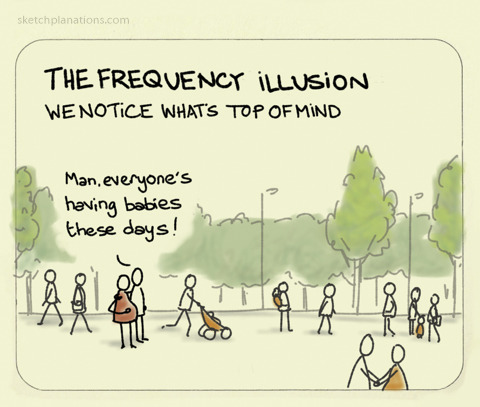
Have you ever scrolled through Spotify and discovered a band you like? Have you ever started listening to all its songs and suddenly you start hearing it all the time on the radio and seeing advertisements for its new album or concert? Or maybe you just found out you’re pregnant and see parents with their kids everywhere you go? While it’s easy to think that maybe you just discover bands that magically and suddenly get really big or that maybe more people suddenly have kids these days, you’re actually probably experiencing what is called the Baader-Meinhof phenomenon or frequency illusion.
Kids are everywhere! Or so you think.
The frequency illusion occurs when a person experiences something, like finding a song he or she likes on Spotify or becoming pregnant, and then afterwards believes that the experience or phenomenon happens all the time. So why does this occur? Well, there are two cognitive processes that are involved in creating the frequency illusion: selective attention and confirmation bias (Zwicky, 2006). Read more…
Have you ever been certain a friend said something when they’re certain that they didn’t? How about remembering it completely differently from how they actually said it? If you have, chances are you had a false memory! Don’t worry, you’re not the only one. False memories occur when we remember events that didn’t happen or remember them very differently from how they actually happened (Schacter, 1999). Although it may be unsettling to hear, false memories are very common and hard to detect. As far as you’re concerned, these don’t seem like false memories at all! False memories can be very similar in nature to true memories, which makes them all the more difficult to distinguish. Psychologists interested in memory often study false memories to learn more about the underlying processes that drive memory.
thinking.umwblogs.org
Cognitive psychologists have developed a few different methods of inducing false memories. Perhaps the most reliable and widely used is the Deese-Roediger-McDermott (DRM; Roediger & McDermott, 1995) paradigm. In this paradigm, participants are presented with lists of words that are semantically associated, or related by meaning. For example, the words beach and ocean are semantically associated because people typically have strong connections between the ocean and the beach. After studying these words, participants take a memory test in which they have to decide whether they studied certain words or not. The DRM uses these types of associates to create false memories for words that are never presented, but are highly related to the words that are. One typical DRM list includes words such as banner, American, symbol, stars, and anthem, all of which converge upon the word flag. In this case, the word flag is called the critical lure. After studying this list of words, participants frequently remember seeing flag, even though it was never presented, because it is highly related to the words on the presented list.
Everyone loves Google, right? All the information you could possibly ever want access to is right at your fingertips – quite literally –with search enginescarried around in our pockets. Is Google making us smarter? It should, right? I mean it does provide us with an almost infinite amount of information. Well, here is where things get interesting. Recent studies have introduced a new concept known as The Google Effect, in which we are actually seeing some cognitive deficits caused by our dependency on Google and other search engines.
It is quite counterintuitive that these tools, which provide us with any information we want in just a matter of seconds, would actually hurtand not help our brain’s functioning ability.I know this is confusing, butlet me put this into a real-life context that you might relate to a little more.
Have you ever found yourself hoping for a positive outcome but instead, you end up experiencing the worst possible outcome? For example, you have endlessly searched and finally found the perfect shampoo to combat your excessive dandruff when all of a sudden, the company decides to discontinue the product. Or when you finally have the confidence to exchange phone numbers with your all-time crush and you call but not only did they give you a wrong number, it is a rejection hotline number. Even those times when you finally make a doctor’s appointment for that 3 week long pain you have endured and when you arrive, you feel as brand new as you have ever felt before. Reflecting on these instances make us wonder why expecting a certain outcome can result in, not only the opposite outcome, but also the worst one. Furthermore, the real question is why? Why does it feel as if the worst always happens? It almost feels as if we wished upon the bad. Read more…
In college it is hard to save money. With the costs of textbooks, late night pizza, and online shopping, I know my bank account is looking a little scary. Often times I find myself avoiding looking at my bank app because I’m afraid to see what my bank statement is, but on payday it is the first thing that I check. Why is that?
This tendency – to avoid checking financial standings when we know that they could be bad – is known as “the ostrich effect,” and is defined as the tendency for people to ignore their problems with the hopes that they will just disappear, similarly to how an ostrich hides their head in the sand when they are hiding from danger, and this tendency is not seen only in broke college students.
Did you notice that you are actually very good at remembering weird things? You may not remember every single person who walks a dog on your way home because it’s just normal. However, if you see a dog walking a dog, you are very unlikely to forget the dogs. Why? Because they are weird! As you may expect, research supports that people do remember “weird” things better than normal things.
Von Restorff (1933) demonstrated that people are more likely to remember a distinctive item in a list of homogeneous items than in a list of heterogeneous items (e.g., an orange in a bunch of bananas vs. an orange in a bunch of different fruit). This is called the Von Restorff effect or the isolation effect.
On Tuesday, November 8th, 2016, Donald Trump was elected President of the United States. Although his supporters were excited and triumphant, many students at Colby College and other campuses across America were left shell-shocked. Students at Ivy League colleges – and those at Ivy League wannabees – seemed especially devastated and stunned. The website The College Fix reported numerous scenarios that suggested that students had expected a completely different outcome. Students at Columbia “came running, screaming, and crying to College Walk at 1 a.m.”, and insisted that exams be postponed so they could recover from the ordeal of Trump’s win. Over at Cornell, a completely bewildered student wandered around campus mid-election screaming, “How the f*** is he winning? What the f***?” At Yale, campus organizers actually organized a post-election group primal scream so students could “express their frustration productively.” Even at Penn, Trump’s alma mater, as it appeared likely that Trump would win the election, a student described a “miserable and most depressing scene.” How could some of the supposedly smartest students in America, schooled on the most elite of college campuses be so befuddled? What happened? Were they really so stupid, or had they perhaps been dumbed-down by their rarefied environment and media predictions based on misleading polls? To read more about misleading polls, click here. The answer can be found in a better understanding of the way the brain selects information from the environment, assesses it for accuracy, and reconciles it with pre-existing beliefs.
In middle school I hated the popular girls because they were so damn pretty. Have you ever hated a group of people because they were good looking? Maybe you thought that a team was automatically attractive without seeing every member? If so then you, like middle-school-me, have fallen victim to the Cheerleader Effect. Read more…
You are a busy college student who has a lot to do after a long day of classes. So you decide to try to organize your life and make a detailed schedule for your evening. You set aside an hour to get that workout in, and then another generous hour for dinner with your friends. Then to the library, you give yourself 45 minutes to read a history article and an hour to finish your lab report, followed
Evening Schedule
by an hour and a half for that chapter of chemistry notes. If all goes as planned, you’ll be back in your room snuggled up with Netflix by 11pm. The problem is, halfway through that chemistry chapter, you glance at your phone and it reads 11:43pm. What happened? You planned out everything you had to do and thought you had given yourself enough time to do it. Unfortunately, you have fallen victim to the planning fallacy. Read more…



Recent Comments