Many know the story of Aeneas, his exile, and his journey to found a great kingdom, but how did Vergil’s personal experiences influence his famous poetry? A careful examination of Vergil’s writings, the Eclogues and the Aeneid, comment upon his own dispossession and reveal his sympathy for exiles and migrants.
War and Strife in Vergil’s Lifetime
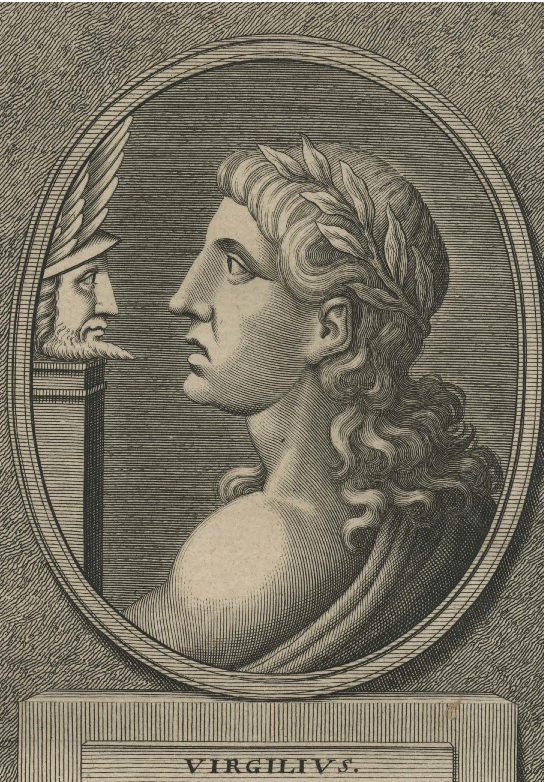 Civil war had engulfed the Roman world into which Vergil was born. How did political trauma affect Vergil’s view of the world and his nation’s history? Vergil was born into a historic era in 70 BCE near Mantua. During Vergil’s youth, as the Roman Republic began to decline, he experienced both political and military upheaval over social class, political power, citizenship, and the future of Rome. The civil war between Sulla and Marius was followed by conflicts between Caesar and Pompey for supreme power. Caesar represented the Populares, a faction that strived to use the power of the people to gain influence. Pompey supported the Optimates, a faction that wanted to uphold tradition and allow the rich and powerful to benefit over the plebeians. Caesar prevailed over Pompey at the Battle of Pharsalia in 48 BCE and gained power as Rome’s “dictator for life.” After Brutus and Cassius assassinated Caesar in 44 BCE, they attempted to reestablish the republic. They were unsuccessful, however, because Augustus, then known as Octavian, fought to become a consul, along with Antony and Lepidus, in 43 BCE. After Brutus and Cassius’s removal from Rome, Mark Antony and Octavian defeated them in the Battle of Philippi in 42 BCE.
Octavian’s Impact on Vergil and His Family
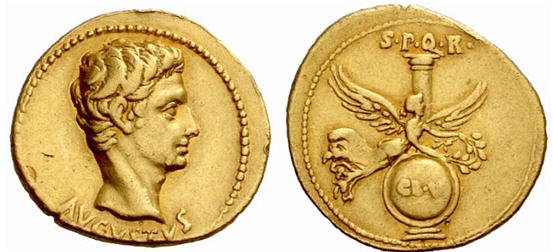 After his victory in the Battle of Philippi, Octavian began to repay his veterans by seizing lands in northern Italy, such as Cremona and Mantua, to give to veterans. Vergil’s family farm near Mantua was among the lands that Octavian and his government confiscated for his ranks in 41 BCE. Perhaps Vergil’s family’s political views were among the causes of their dispossession, since they had supported Brutus, Cassius, and the revival of the Roman Republic. How did Vergil react to his family’s dispossession? Although losing his land must have had some emotional impact on his life, scholars do not know Vergil’s thoughts, because his surviving writings never address his own experience directly. However, academics have tried to deduce Vergil’s reaction to dispossession and migration by examining what he says about these issues in his poems, the Eclogues and the Aeneid.
Tityrus and Meliboeus: Reflections of Dispossession
What was Vergil to do after he found himself on the wrong side of politics and thrown off his land? Many people believe that Vergil wrote the Eclogues in order to earn the favor of Octavian, so he could regain his land. Through Eclogue 1, however, Vergil is able not only to praise Octavian, but also to voice his reaction to rural land dispossession indirectly. Peasants and shepherds must have viewed these sudden transfers of ownership with extreme alarm, making dispossession a common topic of conversation.
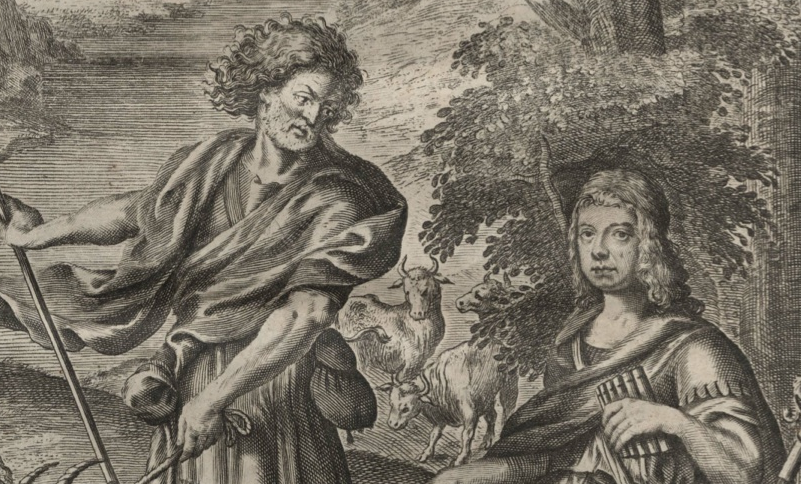
In the first Eclogue, two shepherds who live near Mantua, Tityrus and Meliboeus experience and discuss two different scenarios surrounding dispossession. The government has seized Meliboeus’ land, while Tityrus, an ex-slave, went to Rome and earned the right to keep his land. Meliboeus mourns his loss and reveals his awe for Tityrus during their first encounter:
 Nos patriae finis et dulcia linquimus arva;
nos patriam fugimus; tu, Tityre, lentus in umbra
formosam resonare doces Amaryllida silvas. (Ec.1.3-5)
We leave the boundaries and sweet fields of the fatherland; we flee the fatherland; you, Tityrus, lazy in the shade teach the woods to echo “fair Amaryllis.”
Meliboeus’ opening statement not only encompasses the physical loss of land, but also the loss of love, leisure, and kinship with nature that Tityrus still enjoys. Could Vergil have written these lines without thinking of his family and their dispossession?
Tityrus’ Praise of a Mystery Man
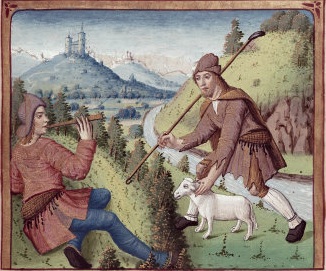
Can scholars ever know the mind and intentions of an author, particularly an author from antiquity? The significance and identity of characters in ancient texts are frequently disputed since scholars cannot know exactly what the author was trying to portray. For example, during Tityrus’ journey to Rome to obtain his freedom, he encounters an unidentified iuvenis, or young man, who tells him that he can continue his usual tasks, and will not be exiled from his property to make room for the ranks of Octavian’s veterans.
 Hic illum vidi iuvenem, Meliboee, quotannis
bis senos cui nostra dies altaria fumant.
Hic mihi reponsum primus dedit ille petenti:
“pascite, ut ante, boves, pueri; submittite tauros.” (Ec.1.42-45)
Here, Meliboeus, I saw that young man,
for whom our altars smoke twice six days a year.
Here, that man first gave an answer to me begging:
“Feed the cattle, boys, as before, rear the bulls.”
Many academics have argued, through much debate and disagreement, that this iuvenis can be no one but Octavian, the leader in charge of seizing land for soldiers. Yet, why would Vergil praise the man who caused his misfortune as a god worthy of sacrifices? Perhaps Vergil wanted to depict Octavian as good-natured and willing to exempt a small, innocent herdsman in order to urge the powerful statesman to return his family’s land.. Some scholars go so far as to suggest that Vergil might have served as a spokesman for the other citizens of Mantua from whom Octavian seized land, which is why the iuvenis may have addressed Tityrus as pueri, the plural form of boy.
Through his characterizations of Tityrus and Meliboeus in the Eclogues, Vergil depicts the sense of loss felt by the dispossessed, and the wave of gratitude and relief felt by those who held onto or regained their land. Nevertheless, it is hard not to attribute praise of Octavian to a calculated plan by Vergil to win back his family’s land in Mantua.
Aeneas: Trojan Exile, Italian Immigrant
Within the first two lines of the Aeneid, Vergil describes Aeneas as fato profugus, an exile because of fate. This early description of Aeneas establishes two overarching themes of Vergil’s Aeneid: exile and migration. So, does Vergil’s sympathetic representation of Aeneas throughout his journey from Troy to allow us to see any parallels with the experiences of the people dispossessed in Italy for the benefit of Octavian’s veterans?
Aeneas’ exile begins with his flight from Troy after the Greeks slyly captured Troy through the deceitful wooden horse. His migrations encompass the wanderings around the Mediterranean Sea and his struggle to find a home in Italy. Aside from instilling sympathy in readers of the Aeneid, Aeneas’ meeting with the ghost of his wife, Creusa, as he flees Troy maps out the migratory path he must follow. Creusa’s prophesy directs Aeneas toward his future and away from his Trojan past. Despite promising an eventual reward, she does not spare Aeneas in her foretelling of future wanderings and lengthy exile.
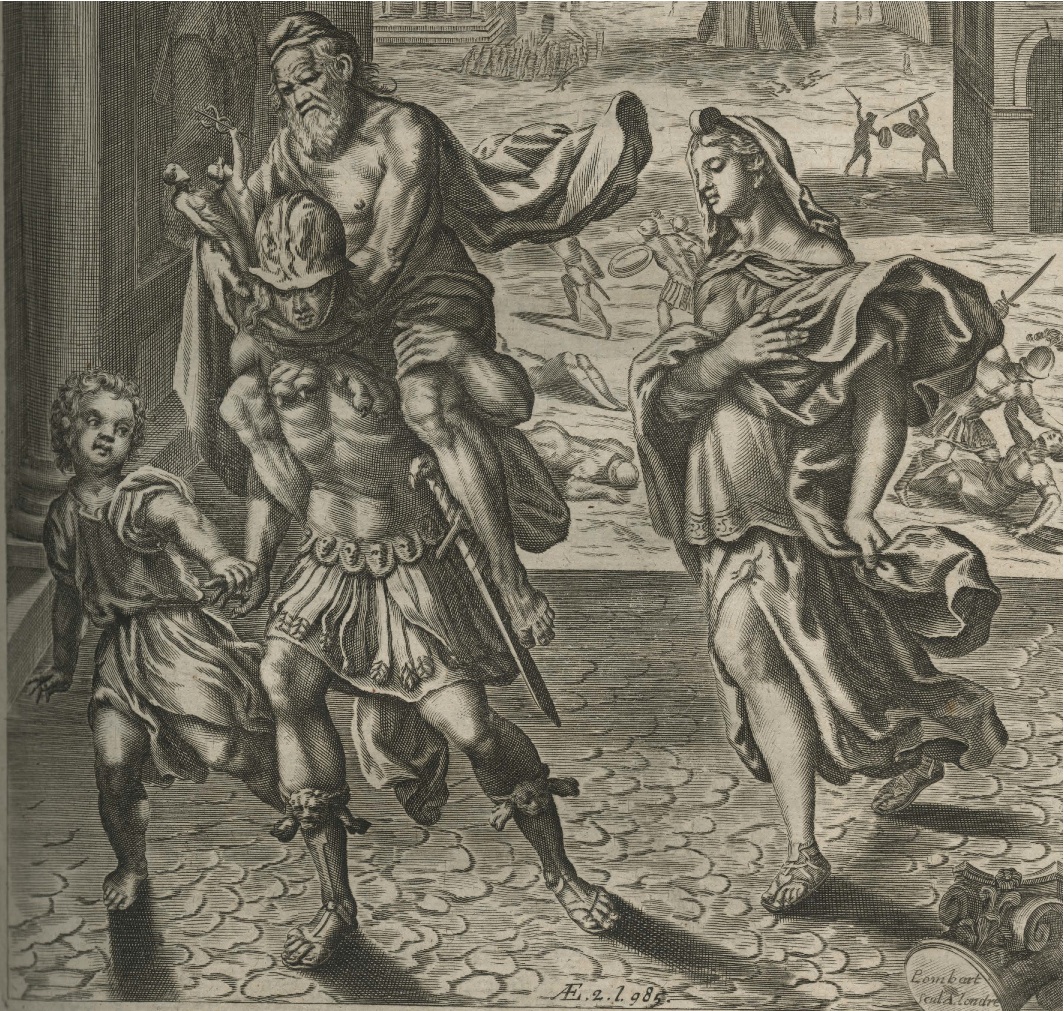 Longa tibi exsilia, et vastum maris aequor arandum
et terram Hesperiam venies, ubi Lydius arva
inter opima virum leni fluit agmine Thybris.
Illic res laetae regnumque et regia coniunx
parta tibi (Aen.2.780-784).
Long is your exile and a vast wave of the sea must be plowed
and you will come to Hesperian land, where the Lydian Tiber
flows with a gentle stream among the rich fields of men.
There will be happy situations, a kingdom, and a royal wife
as your gains.
Creusa’s prediction of Aeneas’ hardships provokes sympathy for him as an exile, but our empathy for him deepens when he does not understand the meaning of Creusa’s prophesy and tries to throw his arms around her neck to prevent her from fading away. Perhaps Vergil wanted his audience to sympathize with Aeneas’ exile and suffering in seeking a new home and losing his beloved wife. In addition, other moments of Aeneas’ difficult migration from Troy to Italy cause the reader to sympathize with loyal Aeneas, including the death of his father, Anchises, at Drepanum in book 3, Mercury’s orders to abandon his happy life with Dido in Carthage in book 5, and his grief at the loss of any comrade throughout his travels. With this litany of loss in mind, perhaps the question becomes whether the depiction of Aeneas’ experience can credibly be distanced from Vergil’s own emotional and physical loss and “exile” from his land.
Dido: A Sympathetic Parallel for Aeneas
Venus’ account of Dido’s exile from Tyre in book 1 of the Aeneid serves to provide Dido with a background similar to Aeneas’ own. Her greedy brother, Pygmalion, killed her beloved husband, Sychaeus in order to gain gold and absolute power in Tyre. Afterwards, Pygmalion hid the deed for a long time. Dido’s loss and innocence as a victim increases the reader’s sympathy for her. As a ghost, Sychaeus appeared to Dido in her dreams, revealed all of Pygmalion’s evil deeds, and advised her to leave Tyre:
 tum celerare fugam patriaque excedere suadet
auxiliumque viae veteres tellure recludit
thesauros, ignotum argenti pondus et auri.
his commota fugam Dido sociosque parabat. (Aen.1.357-360)
Then he urges her to hasten flight and to leave her homeland
and he reveals ancient treasures in the earth as an aid for the way,
an unknown weight of silver and gold.
Dido, moved by these thing, was preparing flight and allies.
Sychaeus’ revelations increases pity for Dido as she becomes an exile from Tyre. In addition, Vergil explicitly describes her as infelix, unfortunate because of her longa iniuria and longae ambages, or long injustices and long journeys while fleeing Tyre and founding . Infelix also applies to Dido with tragic foreshadowing of her suicide after Aeneas must leave her to continue his journey. Vergil portrays Dido as furens, or raging, and prompts the reader to pity Dido through her pleading, crying, violence, and cursing because he had explained her past hardships as a migrant. After Dido commits suicide, Vergil continues to urge the reader to sympathize with her by describing her as dying a death that was neither deserved nor predestined, but premature: a poor woman that was swept up by the fire of madness.
Dispossession’s Impact on Vergil
 Tityrus earned the right to keep his land by appealing to a powerful young man. Dido overcame her exile from Tyre and founded the powerful and beautiful city of Carthage. Aeneas pursued his fate, accepted his exile from Troy, and migrated to Italy to found a kingdom, thus leading to the foundation of Rome and the great Roman Empire. In the face of exile, the characters within Vergil’s poetry have created powerful names for themselves by persevering through their hardships. So how did Vergil’s dispossession and exile from his land impact his legacy? The loss of his land for political reasons, followed by the gift of property in recognition of his poetic talents, must have informed his representation of migration, exile, and the quest for belonging in his poetry. Vergil’s personal experience of exilic feeling contributed to the framework and compassion in his poetry, especially the Eclogues and the Aeneid, which ultimately created his legacy as one of the most famous and influential Roman poets.