
How does Vergil’s Aeneid fit into the overall scheme of foundation myths? And to what extent does migration play a role in foundation myths in general and in The Aeneid in particular? Foundation myths are often fanciful stories about how a race, country, or particularly special and/or holy city was founded, and they are common to cultures across time and space. For example, one foundation myth is the discovery of the Americas by Columbus. The explorer was immortalized by Washington Irving, who rather boldly presented him as an individual that challenged the unknown frontier to create a land free from kings and a place for new beginnings! Greeks and Romans in particular had a large selection of foundation myths as many cities were associated with a certain god or goddess, and the story behind each association was related through a foundation myth. The tradition of foundation myths is also found in cultures besides the Romans and Greeks, such as the story of the foundation of Carthage.
Importance of Foundation Myths
Why are these foundation stories so important? Why do they keep coming up in so many different cultures? Well, these myths offer a way to give importance and a sense of identity to a particular region by associating it with an important god or goddess and with traits lauded by society. Gods and goddesses, even heroes and outstanding citizens, will often be the founders in the stories, allowing a culture to first emphasize traits found desirable and second to elevate a race or city above others by giving it divine origins. Good examples of classical foundation myths are the two different stories of the foundation of Thebes in Greece and the two main stories of the foundation of Rome.
Construction of a Foundation Myth
In Greek, there is a term oikistes, which refers to the founder of that race or city or country, as well as to the pattern of foundation myths in Greek mythology.
…the appointment of a founder (oikistes, anglicized as oikist) with the requisite abilities or connections. He then consulted the Delphic oracle in order to obtain the gods’ approval for the venture – in the Classical period, specifically, the blessing of Apollo in his attribute of Archegetes (“leader of expeditions”) – as the colony would be a new home both for Greeks and for the Greek gods…and to receive general guidance on where to settle.
This quotation lays out the pattern of foundation myth: first a person worthy to be a founder is chosen, they then consult the oracle at Delphi to obtain guidance and heavenly approval for their quest, and then attempt to follow this guidance to their new home. This pattern is clear in the myth of Kadmos (see below) and the foundation of Thebes, and is clear in the Aeneid and the foundation of Rome when Aeneas tells the Carthaginians about consulting the oracle in book 1, and proceeds to follow the oracle’s command over the course of the epic, searching for a new home for the Trojans.
bis denis Phrygium conscendi nauibus aequor,
matre dea monstrante uiam data fata secutus;
I ascended the Trojan sea with twice ten [20] ships,
with the mother goddess showing the way, I followed the oracles having been given;
In these lines, Aeneas describes to the Carthaginians the journey of the Trojans. He begins with their departure from Troy and how his mother, Venus, guided their path. The “oracles having been given” refer to the stop the Trojans made at the island of Delos before arriving at Carthage. Aeneas then spends the rest of the Aeneid heading for the land of his ancestors to start a great city. In this pattern, migration is key as it establishes that the leaders are worthy to be the founders of a great city or nation; it confers heroic status upon them as migrating involves several key elements of the hero story that occurs across the globe.
Greek Hero
 The essential elements of a hero story are the same in Greek literature as in other cultures. They are drawn from the following list:
- miraculous conception/birth,
- threat to the child or hiding of the child,
- society’s desire for change,
- withdrawal and initiation,
- resistance of hero role or temptation,
- magical tools/weapons,
- search for father,
- quest,
- impossible adversaries,
- return from underworld or death,
- and return in disguise to save wife/sweetheart.
Typically, founders in myth are of divine descent, whether they were born from a goddess or the son of a mortal who was impregnated by a god, giving them the quality of miraculous conception. A founder’s need to lead his people somewhere else, for whatever reason, shows society’s desire for change. After consulting the oracle and using the given prophecy to guide them, a founder has a magical tool. Migration in foundation myths is typically the search for a new land or the original fatherland, such as in the Aeneid, which relates at least metaphorically to the search for the father element. Obviously migration and the search for a new land is a quest, adding that element to the foundation myth. The obstacles encountered on this quest, from journeying across the stormy sea to crossing mountains and deserts and fighting powerful enemies, can be seen as impossible adversaries. And finally, founders often married a local woman after the foundation of their cities, which can be seen as a return in disguise to save wife/sweetheart, as being an unknown or stranger is a type of disguise. That is more than half the qualities associated with a hero story, which makes any founder a hero. And being a hero is important, as it means that you are revered as being the best that any man can be and as someone that others should try to emulate, thus emphasizing the traits found desirable by by a people and allowing them to showcase these characteristics. For the Romans, particularly in upper level and literate Roman society, establishing a connection to the great Greek heroic past was desirable because of their admiration for Greek hero literature (e.g. the Iliad, the Odyssey).
Foundation of Thebes: Kadmos
 One foundation myth of Thebes is that of Kadmos. Kadmos was a son of Agenor, a king of Tyre. One day, Kadmos’ sister, Europa, was carried off across the sea to Crete by Zeus, who found her desirable. Agenor then told his sons to go and find their sister and forbade them to return home until they had done so. And so Kadmos begins wandering, looking for his lost sister. In his wanderings, Kadmos goes to Delphi where he confers with the oracle. The oracle then tells him that a cow will meet him as he leaves and instructs him to found a city at the place where this cow lies down. As Kadmos is leaving Delphi, he meets the aforementioned cow and so follows her until she lies down from exhaustion. Now Kadmos remembers what the oracle had said and recognizes that this is the place to found his city and thus sacrifices the cow to the gods. Soon after, Kadmos sends his companions to fetch water from the nearby spring of Ares. This spring was guarded by a terrible beast, which attacked and ate all of Kadmos’ men. When Kadmos came searching for them, he found only fragments and the sated beast. Kadmos slays this terrible monster himself, and Athena then appears to advise him to sow the teeth in the ground, which he does. From these teeth spring a group of warriors fully armed who advance on Kadmos until he throws a rock into their midst, prompting these warriors fight with each other until only five are left. The five survivors then join Kadmos to become the founders of the five great families of Thebes and the progenitors of the “Kadmeians” who inhabit Thebes.
Foundation of Thebes: Amphion and Zethos
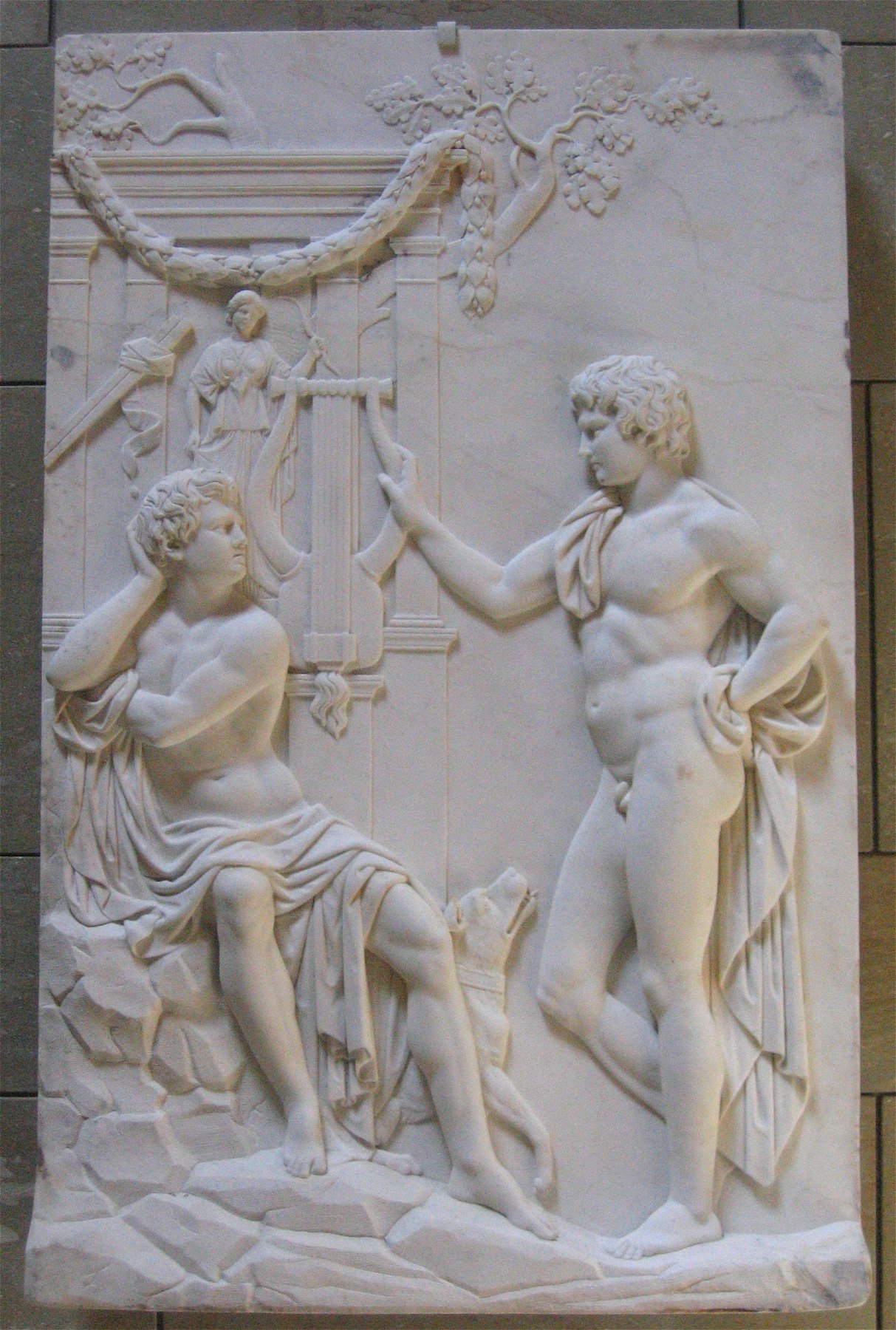 The other myth involves two local twins, Amphion and Zethos, who are sons of Zeus and Antiope, a mortal queen. In this story, Thebes itself has already been founded. But it is the twins who build massive walls around the city to fortify it and protect it from attackers, creating the identifying feature of Thebes and marking out the borders of the city. Thus, their story counts as a second foundation myth. Amphion and Zethos employed different means to build the walls of Thebes. Zethos used his extraordinary strength to carry the stones to Thebes, while Amphion’s musical ability on the lyre was so enchanting that the stones followed him and formed the walls. This second foundation story involves locals rather than immigrants, as they are the sons of a queen of Thebes. They still have divine origin and tools however as they are sons of Zeus and use superhuman strength and musical talent to construct the walls of Thebes.
Foundation of Rome: Romulus and Remus
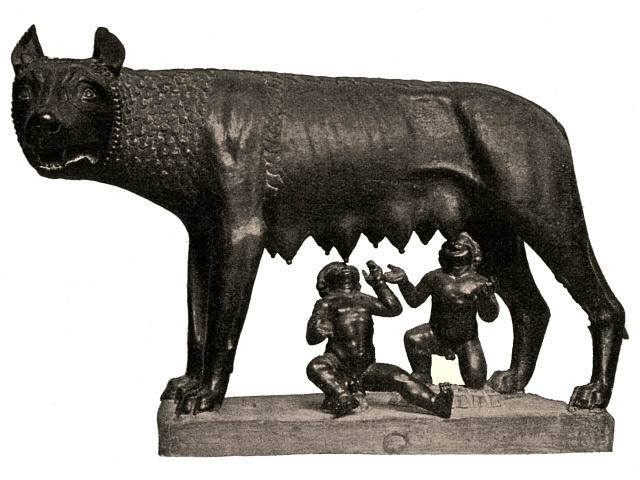 One foundation story of Rome also involves twins – Romulus and Remus. Rhea Silva, the daughter of the Alban King Numitor, was a Vestal Virgin who was raped or seduced by the god Mars (depending on which source you read) and thus bore twin boys. The boys were then taken away to be thrown into the river in a basket, but the basket went aground under a tree. There a she-wolf found and suckled them until the shepherd Faustulus took them home to raise as his sons. Eventually, their parentage and royalty was realized and they moved to the palace of the Alban kings. As they grew older, Romulus and Remus realized how overcrowded Alba Longa was becoming and so they set forth to found a new city at the tree where the she-wolf had found them. As they were laying out the boundaries of the city, they argued over who the city would be named after and a physical fight broke out. During the course of this fight, Remus was killed and thus Romulus was left to found Rome and give his name to the city.
Foundation of Rome: Aeneas and the Alban Kings
 The other main foundation story of Rome revolves around Aeneas, whose story is best known from Vergil’s Aeneid. He is really more of a proto-founder, in that, while he strives to ensure the future of Rome, he dies long before the city comes to be. The Trojan hero already had impressive credentials from Greek literature, having been mentioned by both Hesiod and Homer. Aeneas escapes the fall of Troy, and leads his people to Italy. After defeating resistance from some of the indigenous population, he founds a city in Latium called Lavinium in honor of his wife, Lavinia, daughter of the local king Latinus. He and Lavinia rule over their people called the “Latins”. His son Ascanius goes on to found Alba Longa, and from the line of Alban kings descended from Ascanius and Aeneas comes Romulus who finally founds Rome at the cost of killing his twin brother.
Immigration in Myth
You see that each of these locations (Rome and Thebes) have two foundation myth options: one that involves a foreign immigrant (Aeneas or Kadmos, respectively) and one that involves locals (who both happen to be twins). Why are these distinctions made? Who cares if the founders are immigrants or locals? For the Romans, the immigrant Aeneas came with specific advantages. By identifying as their founder this Trojan foreigner, one mentioned in the greatest and oldest Greek texts, the upstart Romans were able to claim a place in the glorious tradition of the Greek heroic past. Placing Rome into the Greek heroic past is important as any educated Roman saw Greece, particularly ancient Greece, as the noblest form of society, and being related to them made the Romans feel more important. Greek literature was also highly revered as setting a lofty standard which all Roman literature should aim to achieve. The story of Aeneas was a “…link between the Trojans of the heroic age and the beginnings of imperial Rome.”
Influence on Vergil in the Aeneid
Not only would the general societal reverence for everything Greek have affected Vergil, but he would have been heavily influenced by Greek literary models, especially Homer. Choosing a founding hero who already held a place in the Greek heroic tradition immediately associated his epic with greatness. With the Aeneid, Vergil hoped to create a great Roman epic in the Homeric style. He followed the Greek foundation myth pattern of choosing a worthy founder, consulting the Oracle, and attempting to fulfill the prophecy. Aeneas does all of these things over the course of the Aeneid, and his attempts to fulfill the prophecy of the great city of Rome as foretold by Apollo and others are described at length. Aeneas is a worthy founder in Roman eyes as he has pietas and places the state before his own interests (e.g. when he sets aside his love of Dido to continue on his quest to found a great city out of duty to his father and the gods).
Conclusions
Foundation myth plays an important, many-faceted role in how cultures portray themselves. Migration is a key part of foundation myths, constituting a major part of the hero story. In addition, for the Romans, the migrant hero Aeneas offers a link to the literary glory and established heroic traditions of the Greeks.