

Instagram has become the social media platform of choice for many individuals and art institutions. Readily accessible and easy to learn how to navigate, it allows visual imagery to speak for itself, a strategy that is very effective in engaging different kinds of audiences. A user interested in the art world can see posts from institutions, art insiders, and independent critics side by side, offering multiple perspectives on the same broad topic or exhibition. As someone who, admittedly, does not use Instagram, I remain fascinated by how much it comes up in conversations about arts and representation. In our contemporary cultural context, art no longer exists solely within the vacuum of a museum or gallery, and individuals on Instagram are uniquely positioned to facilitate meaningful conversations between the public and the institution. With the ability to post both political and personal statements as well as introduce relevant or up-and-coming works, Instagrammers are able to pose questions and offer commentary and criticism in a way that institutional accounts are unable to. I decided to highlight a few accounts and individuals with different reaches who manage to bridge the divide between the art world and art lovers.
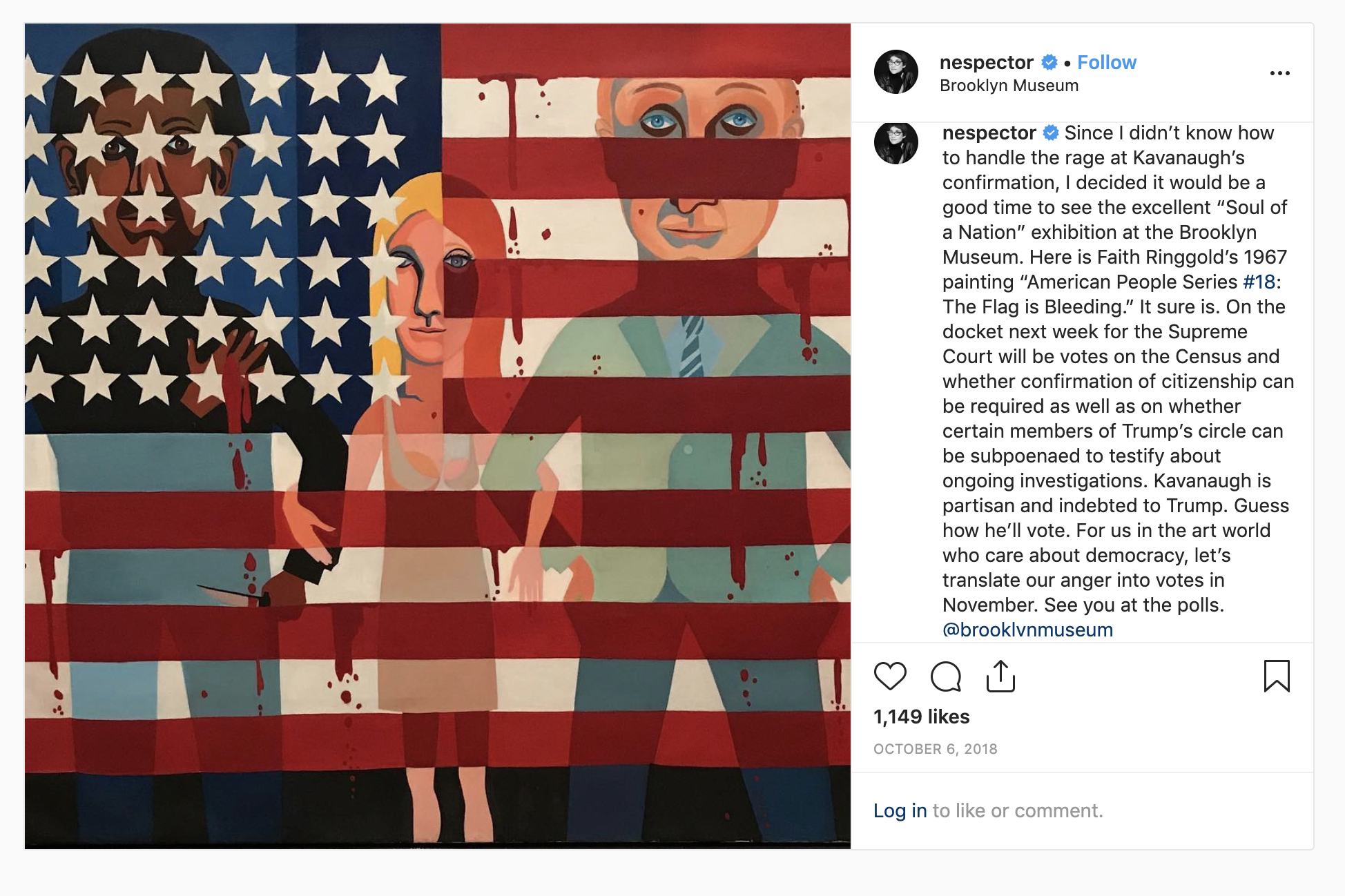
Chief curator and deputy director at the Guggenheim Museum, Nancy Spector (@nespector) is known for being unafraid to voice her opinions. On her account, you can find posts on subjects ranging from art she finds worth sharing with her 129,000 followers to photographs that raise questions about important conversations, such as the #MeToo Movement, the Muslim Ban, and more. Using Instagram as a way to comment on these topics in conjunction with contemporary pieces, Spector intertwines social commentary and art in a way that challenges her audience to reflect on how we exist in certain spaces and think about current events. The fact that she works at an art institution establishes her credibility and allows her to come across as a trustworthy source to art experts and everyday museumgoers alike. Because she primarily posts works of art that are currently on exhibit at the Guggenheim and other museums in the area, Spector’s account seems to primarily appeal to those who are based in New York.
In contrast, Jasmin Hernandez (@gallerygurls) comes from the nontraditional art background of being a former fashion-show producer and a photo editor at several magazines. As an Afro-Latina, she is committed to using her voice and social media presence to create space for artists who are women, people of color, and/or queer and trans. Her blog, Gallery Gurls, was created with the intention of improving the status and visibility of female artists, curators, and art entrepreneurs. Hernandez’s account seeks to spotlight marginalized artists in New York City, giving her followers the opportunity to learn more about how art can be used as a visual representation of their experiences.
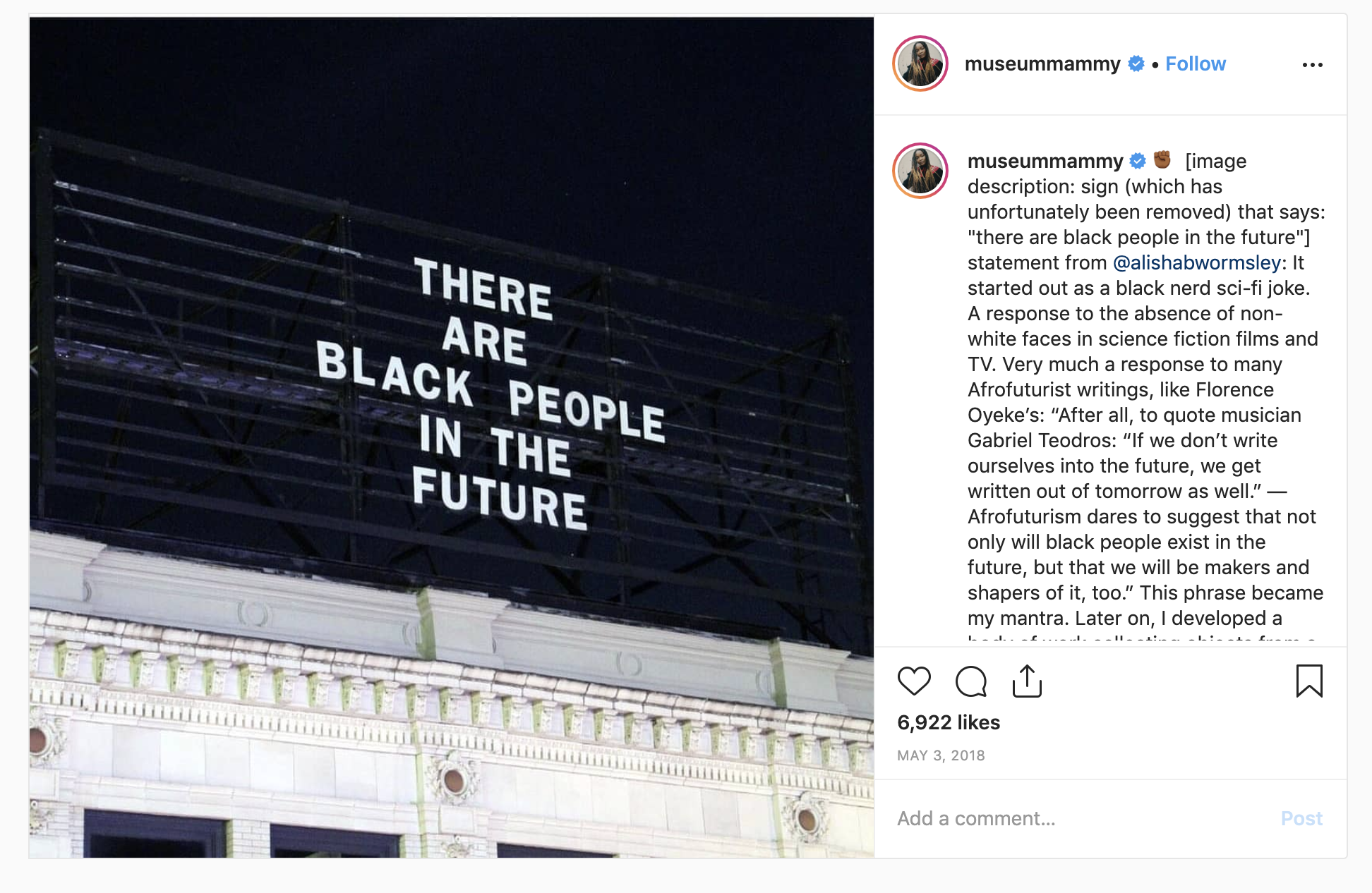
Kimberly Drew (@museummammy), formerly the social media manager at the Metropolitan Museum of Art, is now an independent curator who also runs a blog called Black Contemporary Art. Her background is a hybrid of Spector’s and Hernandez’s. Like Spector, she’s had ties to a notable art institution, and like Hernandez she runs a blog to supplement her Instagram account, with a specific focus on artists of color. Drew’s account incorporates her passion for the fashion industry as well as posts that encourage progressive conversations about body positivity. She is currently working on The Black Futures Project, a visual anthology, in collaboration with writer Jenna Wortham of the New York Times. Set to be released in October 2020, The Black Futures Project explores what it means to be black today. While it is grounded in the narratives of the present, it points to the future in hopes of offering new insights about identity, race, and representation in the digital age. Drew’s 241,000 followers—the largest following of the three accounts reviewed thus far—are exposed to the latest fashion trends, contemporary art and music, as well as body-positive inspiration. Given their different relationships with the art world, Spector, Hernandez, and Drew are all able to reach unique audiences and offer their perspectives on contemporary art.
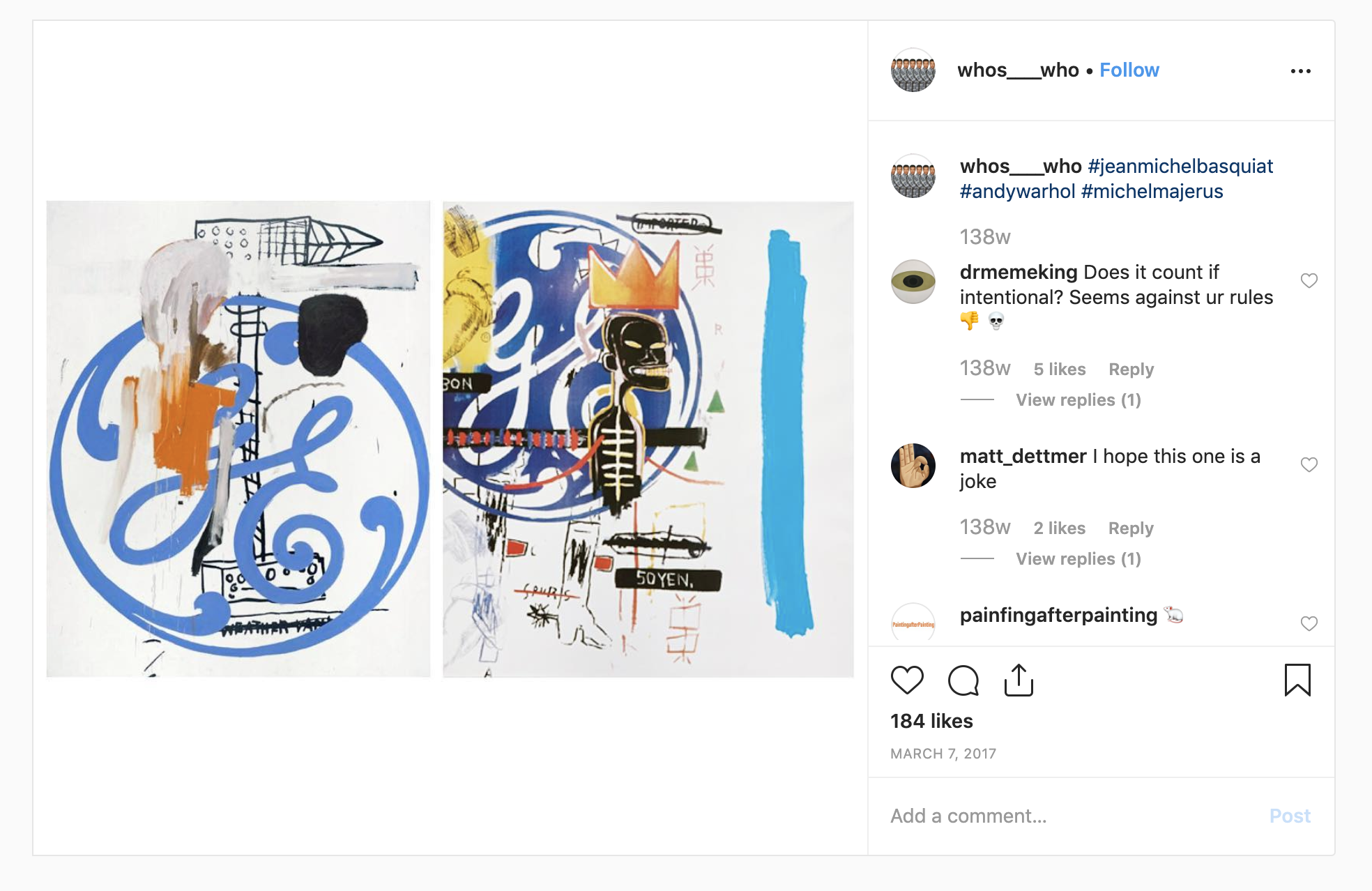
Instagram enables users to reflect on how an artist can manipulate familiar images. An anonymous account (@whos____who) has sparked controversy in the art world since launching in January 2016 by presenting side-by-side comparisons of works that are very similar. The account never posts commentary and only lists artists’ names, allowing viewers to engage in debates in the comments section about which work belongs to which artist and which came first. As a result, it serves as an accessible platform for people to think critically about appropriation in the art world, as well as to consider the universality and appeal of different aesthetic trends.
New Jersey native Hank Willis Thomas (@hankwillisthomas) focuses on themes related to identity, commodity, and popular culture. A conceptual artist whose work has been featured all over the United States, Thomas aims to capture the issues of violence, race, class, and identity through the lens of his camera. Because photography is so often presented as objective truth, he encourages viewers to keep subjectivity in mind rather than subconsciously accepting what is presented to them. His Instagram account is filled with contemporary artworks that relate to how racial identity functions in our society, encouraging productive conversations about what it means to be a minority and exploring the ways photographers can serve as useful intermediates to help facilitate this dialogue.
The art world is notorious for being exclusionary and elitist. Contemporary means of communication can help art institutions overcome not only the issue of inaccessibility but also of unrelatability among potential audiences. The cultural commentators represented here serve as intermediaries between those more educated about art and everyday appreciators of art who may not have background knowledge about the history or techniques that go into an artwork’s composition. Instagram also makes works accessible to those who may be unable to travel to a museum or afford the price of admission, or may have a disability that precludes their attendance. As technology becomes increasingly intertwined with how we connect with one another, influencers on social media platforms such as Instagram can help engage new audiences and promote new and much-needed conversations.
We hear a lot of negative commentary regarding social media influencers and their impact on society but in this case I believe art influencers can help community building and increase understanding. Although Colby and Waterville are geographically isolated from the major art centers, social media accounts like those described here can connect the Colby Museum of Art to important conversations about race, identity, accessibility, and more. The current exhibition I Am Not a Stranger: Portraits by Séan Alonzo Harris, which spotlights Waterville residents from varied backgrounds, includes an Instagram component in which visitors can tag photos of themselves posing against the same backdrop that Harris used for his portraits. This has proved very popular and further emphasizes the communal nature of the project. It also gives the project a presence on Instagram, making it more visible to those outside of Waterville who may want to consider the key themes and questions the portraits raise.
When Instagrammers digitize and post contemporary works, they give others the tools they need in order to form opinions and hold meaningful dialogue with their peers. This empowers us all, as art lovers, to engage in challenging conversations that benefit our communities.