

One of the continuing goals of The Lantern is to highlight Colby students’ research in and engagement with the arts. In this second of two posts for The Lantern, Colby senior Ling Ding ’18 gives us an inside look at her capstone research project focused on the murals of the Tholing Monastery in Tibet.
Tholing Monastery, located at the border of the Tibet Autonomous Region and India, has preserved most of its extraordinarily gorgeous and valuable wall paintings from the eleventh century to the sixteenth century. Together with other historical sites in the region, this religious complex was one of the most important centers to embrace the diverse Buddhist tradition in India, providing extremely significant evidence of the cultural interaction and social exchange at that time.[1]
Despite its tremendous importance, the isolated location of the Ngari Prefecture has kept it hidden from scholars’ attention. Although a general overview of the history of the region has been done, only a small amount of research has been accomplished from an art historical perspective.[2] The main focus of my senior research paper is the two double-portrait paintings from the White Temple of Tholing Monastery. After identifying the figures and the merged international style of the paintings and explaining the possible ritual role of these portraits during the frequent cultural exchange and social interaction in this area, I would argue that this was actually a carefully constructed visual system used as a religious method to spread Buddhism in this culturally and religiously significant region.
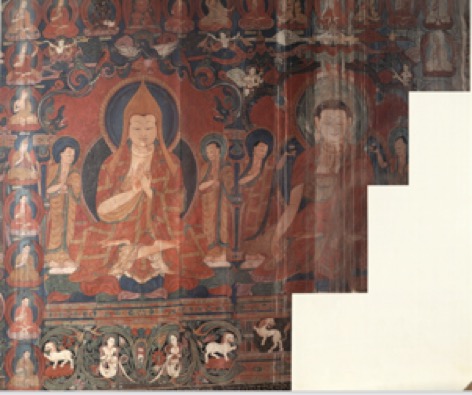
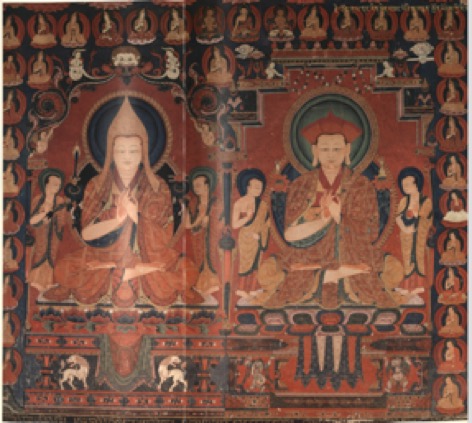
Figure 1: The two double portraits of four historical figures from the murals in the White Temple of Tholing Monastery in Tibet.
The Portraits of Atisha and Ye Shes ’Od;
The Portraits of Tsong Kha Pa and Rin Chen Bzang Po.
Mural Painting,
White Temple of Tholing Monastery, Ngari, Tibet, China.
Late 15th to Early 16th Century
The two double portraits represent a merged international style under the influence of different regions and religions. For each unit, the format of the portrait is consistent with the composition of the most popular lineage paintings in central Tibet. (Figure 2 shows a typical lineage painting that shares the same format as the double portraits.) Sitting on a highly decorated, elaborate throne, the central figure, flanked by a standing disciple on each side, is surrounded by rows of miniature portraits of monks, separating the main figure from the rest of the mural. All the figures, each of whom has an ornamented back aureole, are in decorative multilayered red robes with delicate golden floral patterns. Apart from the central Tibetan influence, the architectural details at the bottom of each painting refer to a northern Indian, and perhaps even Kashmiri, sequence of basement moldings as they are presented in stelae from the Pala Period.[3] Besides the incorporation of the Hindu gods Makara, Garuda, and Naga Kanya, the depiction of the guardian under the throne also shows strong Indian stylistic and iconographic characteristics. In short, the format of each painting follows popular lineage paintings in central Tibet, while the minor elements suggest the incorporation of Indian and Kashmiri tradition.

Figure 2: A typical lineage painting that shares the same format with the double portraits. Sitting on a highly decorated elaborate throne, the central figure with a standing disciple on each side is surrounded by rows of miniature portraits of monks.
Tsongkhapa with Two Kadam Lineages
C.1240-1460s, 25 x 31 inch. (63.5 x 78.7cm)
Rubin Museum of Art
The names of the figures have been variously identified in recently published books.[4] However, my research identifies the four figures as Atisha and Ye shed’ Od, Tsong Kha Pa, and Rin Chen Bzang Po. Ye shed’ Od, the king of Guge, conducted a series of cultural and political activities to promote Buddhism, including building the Tholing Monastery in 996 AD.[5] Later he sent twenty-one intelligent young students to India to study language and dharma, one of whom was Rin Chen Bzang Po, who became an outstanding translator with huge contributions to the translation and the transmission of the dharma.[6] After Ye shed’ Od, the next Guge king invited the renowned Buddhist scholar Atisha to Tibet.[7] During Atisha’s three-year stay in Tholing from 1042 to 1045, he wrote more than twenty books and made distinguished contributions to the spread of Buddhism all over Tibet.[8] As a whole, these cultural activities shaped this great era, which is frequently regarded as the First Golden Age of the revival of Buddhism, with Tholing as the center of this religious movement. As a result, historical events highlight the significant contribution made by the historical figures portrayed in the two double portraits. What’s more, those events during the first revival of Buddhism highlight the significance of Tholing as the center of this great expansion, and at the same time reveal the frequent cultural interaction between India and the Ngari region.
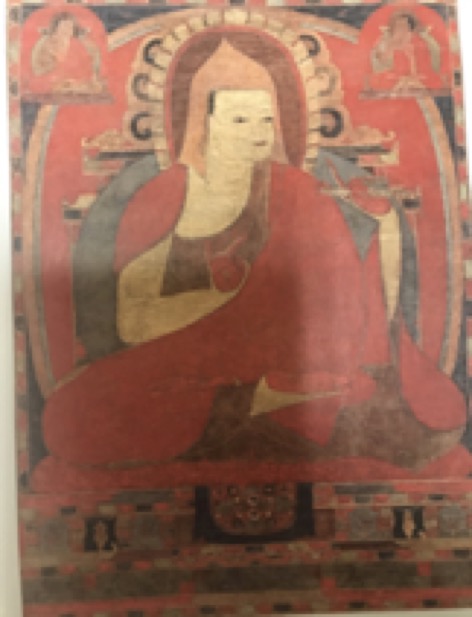
Figure 3: A Tibetan portrait of Atisha under a tall pandit’s hat, as a symbol of the highly-honored scholar. This treatment of hat is parallel with the portrait of Atisha from the White Temple.
Atisha
Early to mid-12th Century
Distemper on cotton 19.5 *13.75 inch
The Metropolitan Museum of Art, New York;
Gift of the Kornos Collections, 1993
An important genre in Tibetan painting of the late eleventh to thirteenth century was portraiture of historical figures.[9] Historical figures were often given distinctive characteristics that make them recognizable as individuals. For example, Atisha always wears a tall pandit’s hat, as a symbol of the highly honored scholar.[10] This is exactly how Atisha appears in our double portraits, which lends support to our identification. A comparison image of Atisha painted in the mid-twelfth century is shown in Figure 3, in which we can identify the same use of the hat.
Under the particular emphasis on the image worship and passage of lineage tradition in Tantric Buddhism, it was believed that personal worship of a spiritual teacher’s image was the most efficient way to achieve spiritual purification. As a result, these portraits were used to signify the association with ancient Buddhism and demonstrate its authoritative lineage going back to Atisha, in order to best promote Buddhism in the Ngari region in the sixteenth century, by drawing local pilgrimages to this mother monastery of historical significance.
The merged international style of the two double portraits shows the frequent cultural exchange between Western Tibet and Kashmir, India. The identities of the figures portrayed can be linked to a series of cultural events that represent the historical significance of Tholing Monastery, which was responsible for the revival of Buddhism in the eleventh century in Western Tibet. With a further discussion on image worship and ritual services in the rest of this paper, I would conclude that the selection of the figures and the style were together a carefully constructed visual system designed by the temple rulers in the later period (five hundred years after Guge).
[1] (This article was inspired by my personal visit to the Tholing Monastery, and was later developed into my senior thesis.)
[2] Benoy Behl, “Monasteries of Rinchen Zangpo,” India International Centre Quarterly, Vol. 35, No. 2 (Autumn 2008), 49–69;
Henss, Michael, “Wall Paintings in Western Tibet: The Art of the Ancient Kingdom of Guge, 1000–1500,” Marg 48, no. I (1996);
Jinpa, Nawang, “Why Did Tibet and Ladakh Clash in the 17th Century? Rethinking the Background to the ‘Mongol War’ in Ngari (1679–1684),” The Tibet Journal, Vol. 40, No. 2 (Autumn/Winter 2015), 113–150.
[3] Melissa Kerin, Art and Devotion at a Buddhist Temple in the Indian Himalaya, Bloomington: Indiana Univ. Press, 2015, 127.
[4] Yachun Yuan, Venerable Treasures, Ancient Fascination: Collections of Ancient Murals in Ngari, Tibet (the White Temple of Tholing Monastery), Zhejiang University Press, 2015;
Peter Van Han, Guge, Ages of Gold: The West Tibetan Masterpieces, München: Hirmer Verlag GmbH, 2016, 12.
[5] Yuan, Venerable Treasures, Ancient Fascination, 23.
[6] Henss, “Wall Paintings in Western Tibet,” 35.
[7] Henss, “Wall Paintings in Western Tibet,” 38.
[8] Yuan, Venerable Treasures, Ancient Fascination, 23.
[9] Steven Kossak, “Early Central Tibetan Hierarch Portraits: New Perspectives on Identification and Dating,” Oriental Art, 1999, Vol. 45, Issue 4, 2.
[10] Kossak, “Early Central Tibetan Hierarch Portraits”, 2.