Author: Walker Foehl

Updated Project Proposal

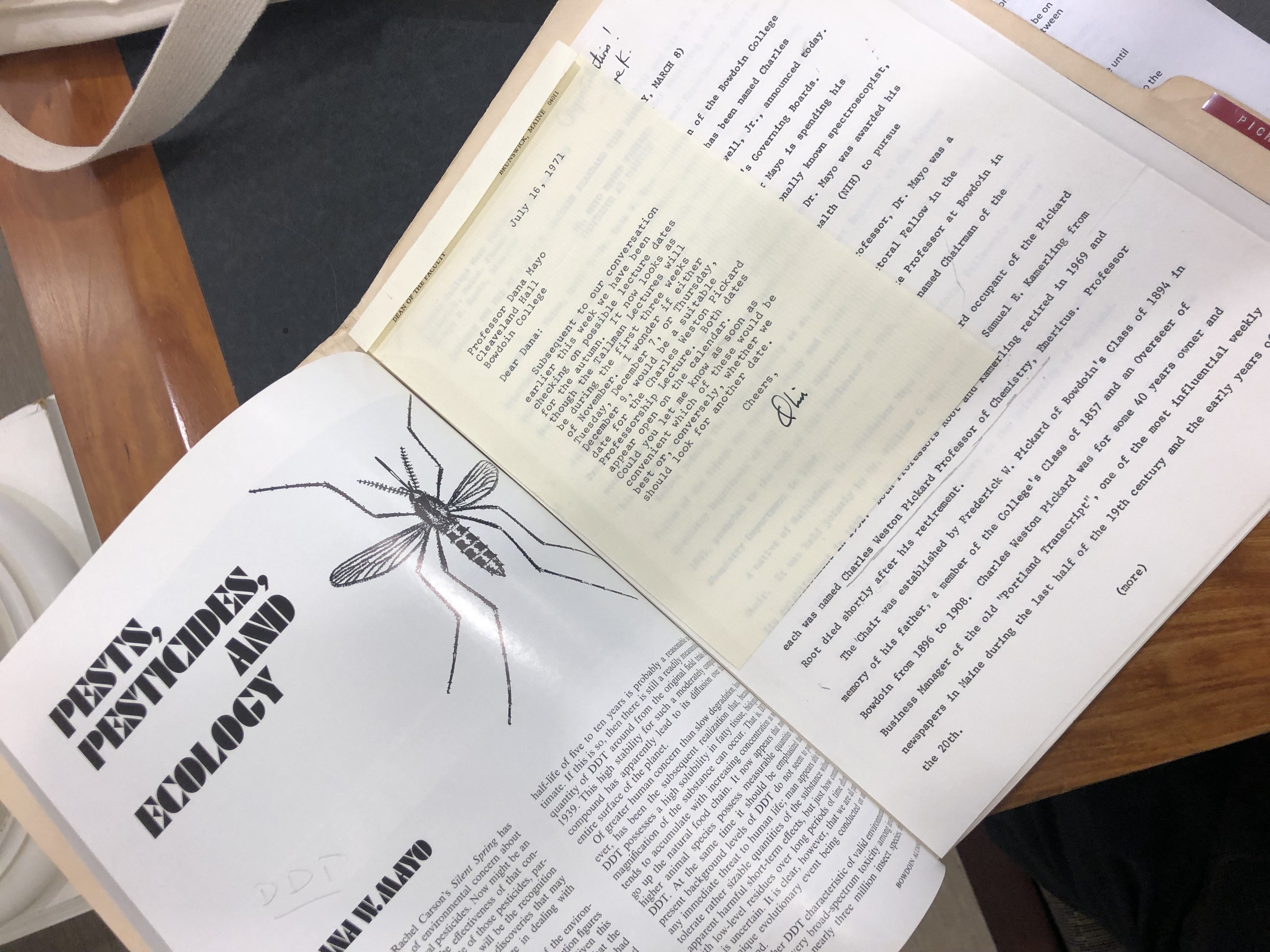
The topic I am proposing is a visual biography of my Grandfather, Dana Walker Mayo. During his lifetime, he made enormous impact to the liberal arts scientific community and the environment. His career path and achievements are something that more of the scientific community should understand and be inspired by. Using documents and video I will concisely and creatively present his revolutionary work to allow his legacy to live on.

Background on Dana Walker Mayo:

He began his career as Assistant professor chemistry Bowdoin College, Brunswick, Maine, 1962-1965.  He was associate professor chemistry, 1965-1968, then professor chemistry, 1969-1970, Charles Weston Pickard professor chemistry, 1970-1991, Charles Weston Pickard research professor chemistry, 1991—2007, and Charles Weston Pickard professor chemistry emeritus, since 2007. In addition, he was President Microscale Organic Laboratory Company, New Castle., New Hampshire, 1985-2007.

The website I will be creating will highlight four main parts of his life that have contributed to increasing study of the sciences and reduction in the environmental effects of laboratory practices. First, I will be digitizing documents my family has from his time as a captain in the United States Airforce (1957-1961). He was a project engineer in the polymer and materials physics branches at Wright-Patterson Air Force Base in Dayton, Ohio.

The second part of his life I will focus this website on is his creation of was his invention of Microscale Organic Laboratory practice. He converted the conventional introductory organic laboratory instruction to microscale revolutionizing organic chemistry laboratory instruction. Not only did this new instructional method change instructional practices, but it also resulted in significant reductions in laboratory hazardous waste by-products and laboratory expense as well as producing significant increases in student lab proficiency. The microscale organic chemistry curriculum was adopted by more than 400 colleges and universities throughout the country. In l986, Dana Mayo was the recipient of the first Charles A. Dana Award for Pioneering Achievement in Higher Education and were cited for “revolutionizing undergraduate instruction in chemistry.” In l987, he also received an award from the American Chemical Society Health and Safety.

I will be digitizing drawings of the first ideas of this invention as well as letters with his collaborators. Furthermore, I will try to scan the Microscale products into a 3D visual on my website and incorporate data that shows the environmental impact of this change in chemistry equipment. I will also be creating an interactive map to show all of the colleges and universities that adopted Microscale. In addition, I hope to interview the remaining survivors who worked on this project with him to add a visual component to the story.

The third part of this website will highlight his contributions to the ways the sciences are taught at liberal arts schools. He pioneered the STS program at Bowdoin College and increased the scope of what it meant to study science. My family has letters of his works to start the first STS program at Bowdoin.

The fourth element of his life I will highlight is his work bringing IR spectroscopy to Bowdoin. I have photos and documents that I will digitize for the website. He played a key role in the development of a number of research and educational programs during his tenure at Bowdoin including bringing the longest continuously running IR course in its field to Bowdoin College in 1972. This course, which continues today, has trained over three thousand scientists working in education, industry and government. Under his leadership the course was taught over two dozen times internationally. Following a 1972 oil spill in Portland Harbor from a leak on the Norwegian tanker Tamano, He and his students took and analyzed samples of oil, sediments, water, and organisms from the affected area. Their analysis confirmed that a unique chemical “fingerprint” could be identified for oil from a single cargo ship, even after weathering and complex chemical interactions with ecosystem components. This research (and Dana’s testimony) led to an award to the State of Maine for damages and to subsequent legislation for an oil conveyance bill, which generated funds for cleaning up future oil spills. I will be recording some quotations from his acceptance speeches and award ceremonies to further reflect his accomplishments and illustrate how his colleagues thought of him.

Materials

I will be traveling to Brunswick, Maine to get the documents and videos for this project. The documents are at my Grandmother’s home in Topsham, ME as well as in the chemistry department at Bowdoin college. In terms of aid from the IT department, I will need help creating the visual timeline I am envisioning for this website. I am familiar using WordPress, but will need some coding assistance to produce the visual path I’m envisioning.

Conclusion:
Dana Walker Mayo; impact and influence on the scientific community

The topic I am proposing is a visual biography of my Grandfather, Dana Walker Mayo. During his lifetime, he made enormous impact to the liberal arts scientific community and the environment. His career path and achievements are something that more of the scientific community should understand and be inspired by. Using documents and video I will concisely and creatively present his revolutionary work to allow his legacy to live on.

Background on Dana Walker Mayo:

He began his career as Assistant professor chemistry Bowdoin College, Brunswick, Maine, 1962-1965.  He was associate professor chemistry, 1965-1968, then professor chemistry, 1969-1970, Charles Weston Pickard professor chemistry, 1970-1991, Charles Weston Pickard research professor chemistry, 1991—2007, and Charles Weston Pickard professor chemistry emeritus, since 2007. In addition, he was President Microscale Organic Laboratory Company, New Castle., New Hampshire, 1985-2007.

The website I will be creating will highlight four main parts of his life that have contributed to increasing study of the sciences and reduction in the environmental effects of laboratory practices. First, I will be digitizing documents my family has from his time as a captain in the United States Airforce (1957-1961). He was a project engineer in the polymer and materials physics branches at Wright-Patterson Air Force Base in Dayton, Ohio.


The second part of his life I will focus this website on is his creation of was his invention of Microscale Organic Laboratory practice. He converted the conventional introductory organic laboratory instruction to microscale revolutionizing organic chemistry laboratory instruction. Not only did this new instructional method change instructional practices, but it also resulted in significant reductions in laboratory hazardous waste by-products and laboratory expense as well as producing significant increases in student lab proficiency. The microscale organic chemistry curriculum was adopted by more than 400 colleges and universities throughout the country. In l986, Dana Mayo was the recipient of the first Charles A. Dana Award for Pioneering Achievement in Higher Education and were cited for “revolutionizing undergraduate instruction in chemistry.” In l987, he also received an award from the American Chemical Society Health and Safety.

I will be digitizing drawings of the first ideas of this invention as well as letters with his collaborators. In addition, I hope to interview the remaining survivors who worked on this project with him to add a visual component to the story.

The third part of this website will highlight his contributions to the ways the sciences are taught at liberal arts schools. He pioneered the STS program at Bowdoin College and increased the scope of what it meant to study science. My family has letters of his works to start the first STS program at Bowdoin.

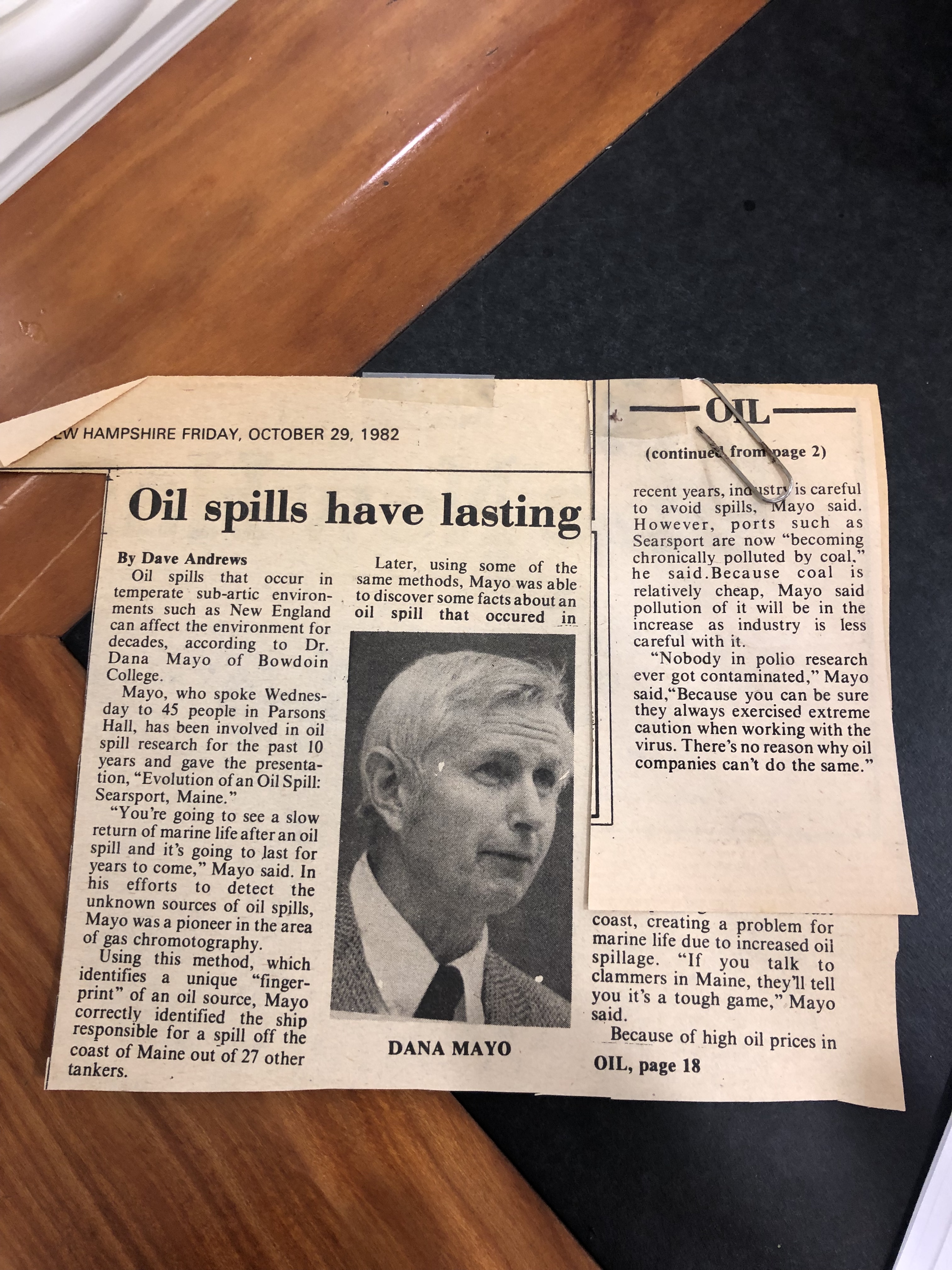
The fourth element of his life I will highlight is his work bringing IR spectroscopy to Bowdoin. I have photos and documents that I will digitize for the website. He played a key role in the development of a number of research and educational programs during his tenure at Bowdoin including bringing the longest continuously running IR course in its field to Bowdoin College in 1972. This course, which continues today, has trained over three thousand scientists working in education, industry and government. Under his leadership the course was taught over two dozen times internationally.Following a 1972 oil spill in Portland Harbor from a leak on the Norwegian tanker Tamano, He and his students took and analyzed samples of oil, sediments, water, and organisms from the affected area. Their analysis confirmed that a unique chemical “fingerprint” could be identified for oil from a single cargo ship, even after weathering and complex chemical interactions with ecosystem components. This research (and Dana’s testimony) led to an award to the State of Maine for damages and to subsequent legislation for an oil conveyance bill, which generated funds for cleaning up future oil spills.


Materials

I will be traveling to Brunswick, Maine to get the documents and videos for this project. The documents are at my Grandmother’s home in Topsham, ME as well as in the chemistry department at Bowdoin college. In terms of aid from the IT department, I will need help creating the visual timeline I am envisioning for this website. I am familiar using WordPress, but will need some coding assistance to produce the visual path I’m envisioning.

Conclusion:
I will be creating an interactive space for people to learn quickly about my grandfather’s incredible work.

Digital Darwin; forever changing the ways we will research?

What intrigued me most was his discussion about the regular and uncontrollable plagiarism that goes on from Darwin Online. This site gives access to the entirety of Darwin’s works. 90,000 pages and 80,000 images are available free of charge to the public. John discussed that the main reason for plagiarism is when people cite the original work of Darwin rather than the site. Therefore, this site is basically giving convince in using Darwin’s work but not getting credited because scholars believe that citing the original text looks more official. John expressed his disappointment in these practices but there is not much to do in the way of changing this cycle.

One question I want to raise from learning about this monumental project in the world of the history of science is what great accessibility does for the world of research? More and more exposure to learning is always the goal but does this ease for analyzing take away from a genuine curiosity of the scholar? Darwin online allows for a student to pick through text in order to discover the quote or information needed. Darwin would have wanted more citing and use of his work but would he also have wanted a student to read his whole thoughts not just bits and pieces?

Another aspect of this work that is interesting to explore is the funding process. This site is completely free of charge and relies on donations and private funding. The United Kingdom Arts and Humanities Research Council was the original sponsor of the site. In addition, historian Janet Browne and the Welcome foundation provided grants. Without scholars like Van Wye and Browne fundraising the works of Darwin and other great thinkers could be cited less and less. Darwin online provides a precedent and inspiration for other online data bases to be created.

The esteem of Darwin is probable for the explosion in press coverage and ample funding Darwin is one of the most famous writers in the world. However, there are many other important writers in history that the world could benefit from if an online data base was created of their work. Because of the reliance on this funding and increase in only using accessible work, will we lose many important documents as a result of millennial laziness?

Colorizing the Past: They Shall Not Grow Old

They Shall Not Grow Olduses technological innovation to allow people in 2019 to feel an authentic connection and greater understanding of an individual in World War I. War is an all-encompassing event. The media’s coverage of war is always highly politicized and presents a bias view, rarely highlighting specific hardships. What is documented is the end result and little of the struggles that produce that result are known. This film presents an intimate observation of authentic footage through a modern lens that gives a voice to the brotherhood and daily lives of war.

One of the most unique parts about this film is its use of perspective. Director Peter Jackson said his goal was to present World War I through the lens of the young men who fought rather than from a historians point of view. This film was a passion project for him. His family fought in the war and he wanted to bring awareness and evoke questions from viewers about their personal family history. The director’s passion about the subject was clearly translated through the shots he chooses for the film. Rather than long shooting scenes, much of the movie is the down time of the soldiers and personal dialogues of their individual backgrounds.

I found the bookends of this film some of the most interesting portions. The initial presentation of black and white imagery coupled with blurry and dark camera footage was a useful contrast to the sudden introduction of color. Although I was listening and interested in the content during the first section I noticed myself become engaged with the introduction of color.

In addition to the introduction of color, another aspect of old footage that detracts from black and white films in the lack of sound. Peter Jackson recreates authentic gunfire, shelling, falling debris giving the footage an even greater modernized quality.

This film presents a prime example of what this course explores. History is filled with information that is lost because of the format of its presentation. We are in the age of obsession with efficiency combined with a quickly deteriorating attention span. The introduction of color and documentation the non-battle times of war brought these men into the twenty-first century. These sixteen and seventeen-year-olds were just like us. This also evoked my thoughts to turn to the incredulity of world wars. I had never been exposed to the naivety of these young men. Many men were quoted in the film questioning why they were even fighting this war. There were even amicable interactions with other German soldiers. One soldier even remarked that war “was like summer camp”. This film highlighted the glory of war and the pride these men felt in fighting for their country. War now is technology and tactic driven rather than unified and bloody.

This film generated an important narrative unique to a story of war. Peter Jackson used his ample resources to bring to life innocent young men’s stories of defending their country.