It means that my purpose in life is partially thwarted – but I have to remain my self-respect and independence.
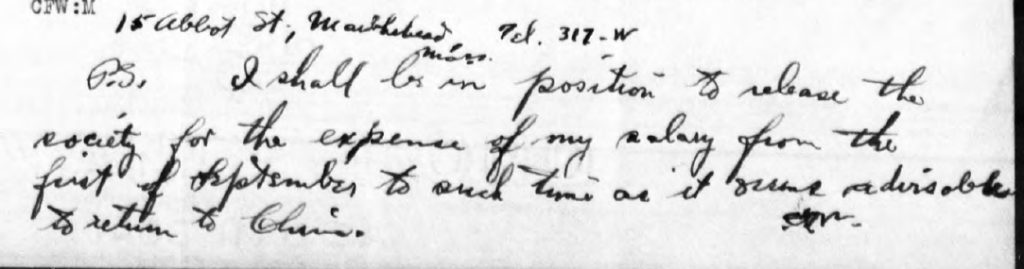
In 1926, After returning to the United States, Wood started a new career at Harvard University related to theology and social devotion. During that period, he received an intention of a Chinese student, Wong Ti-tien, from his previous occupation, to finish his undergraduate program with him. Wood had strong compassion to the place he worked at. Even though the committee urged to persuade him to work in East China due to the lack of people and for better salary, Wood refused such chances. He mentioned that he had his free will, and West China is where missionary work is truly lacked, and all the people in that area, including Yachow, Suifu and even Chengtu, were waiting for his return. The practical demand for such religious service and personal emotional tie with the locals kept him to stay in the same region instead of alternating his destination.
However, throughout his letters and reports, it is clear that Wood also realized the difficulty and some feasibilities of simply spreading the influence of Christianity in China. He punctuated on the importance of social service together with religion, and he also mentioned different kinds of fund shortage to the Baptist board. After a year-long off duty, he returned to China with his wife in 1927 to continue working in the same region. During 1933 to 1935, His personal journey focused on the practicalities of how to serve Christianity locally and advance his mission. In his annual reports and correspondence, similar to the first trip to that region, he detailed the specific processes involved in establishing schools, organizing youth groups, and developing the church, while emphasizing the pivotal role that education played within his missionary work. At the same time, his working environment was fraught with extreme difficulties: the local political situation was volatile, marked by frequent warfare and banditry; transportation conditions were abysmal; and even while traveling, he faced the constant threat of natural disasters and safety risks. In 1934, he almost fell into a river and lose his life. Nevertheless, against all the obstacles, continued to drive forward both school operations and religious activities, demonstrating a remarkable capacity for adaptation and an unwavering determination to remain committed to his long-term mission.
Annual Reports: