Previous blogs about Voyage en Pologne, Russie, Suède, Dannemarc, &c.:
1 Brief Introduction: “Boats against the current”: Discovering Northern Europe and Asia
2.1 Origins: Dive deeper into the origins: a lifelong career of two passionate travelers
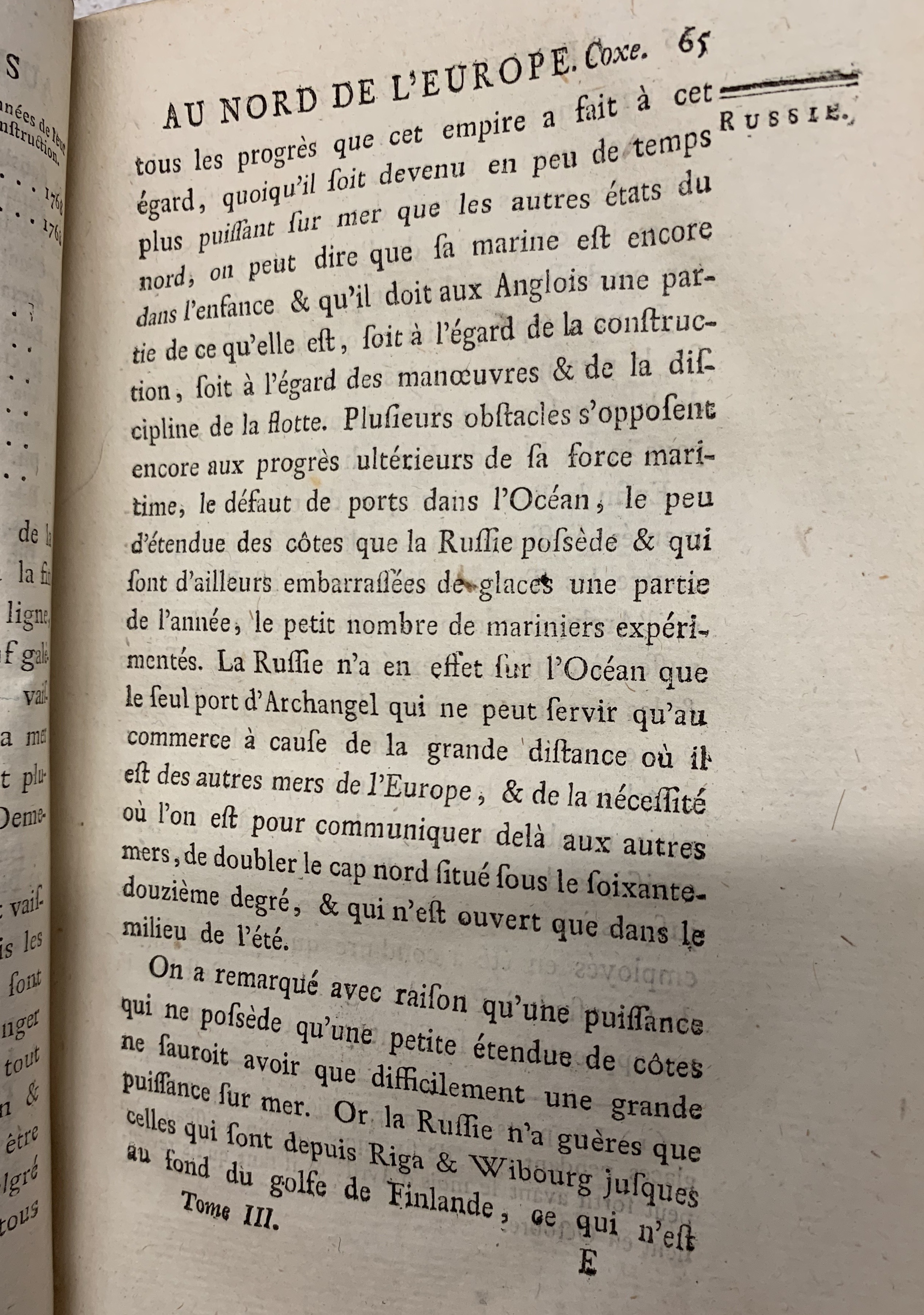
When I first saw the book, I have noticed that it is put in a phase box by Colby’s special collection librarians in order to protect the binding that can no longer hold the book well as it used to be. In contrary to its binding, the content of the book is made by robust papers that maintain their original color after about three hundred years. The paper made by hand at that time is very durable and can last over five hundred years. And at that time, papers were usually the responsibility of the person paying the book to be printed, instead of the person at the printing shop. In this case, the academies that the author and the translator belonged would pay for the printing; this further proves that this book was considered useful and/or profitable. The book’s font size and typography are standard and fit for its medium size; the text is evenly lined to the margin on both sides. The letters are all printed in black ink and in New Roman typefaces.
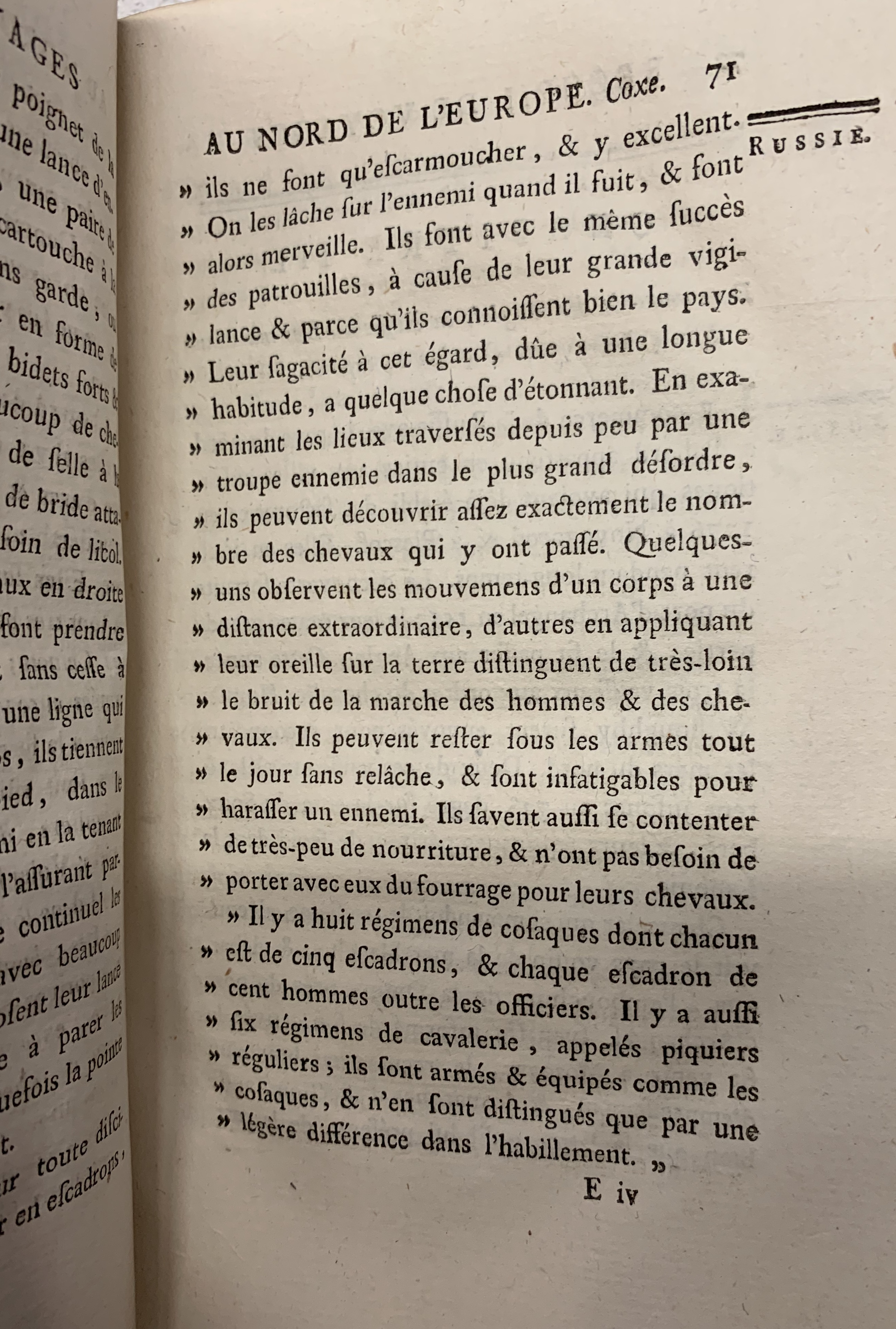
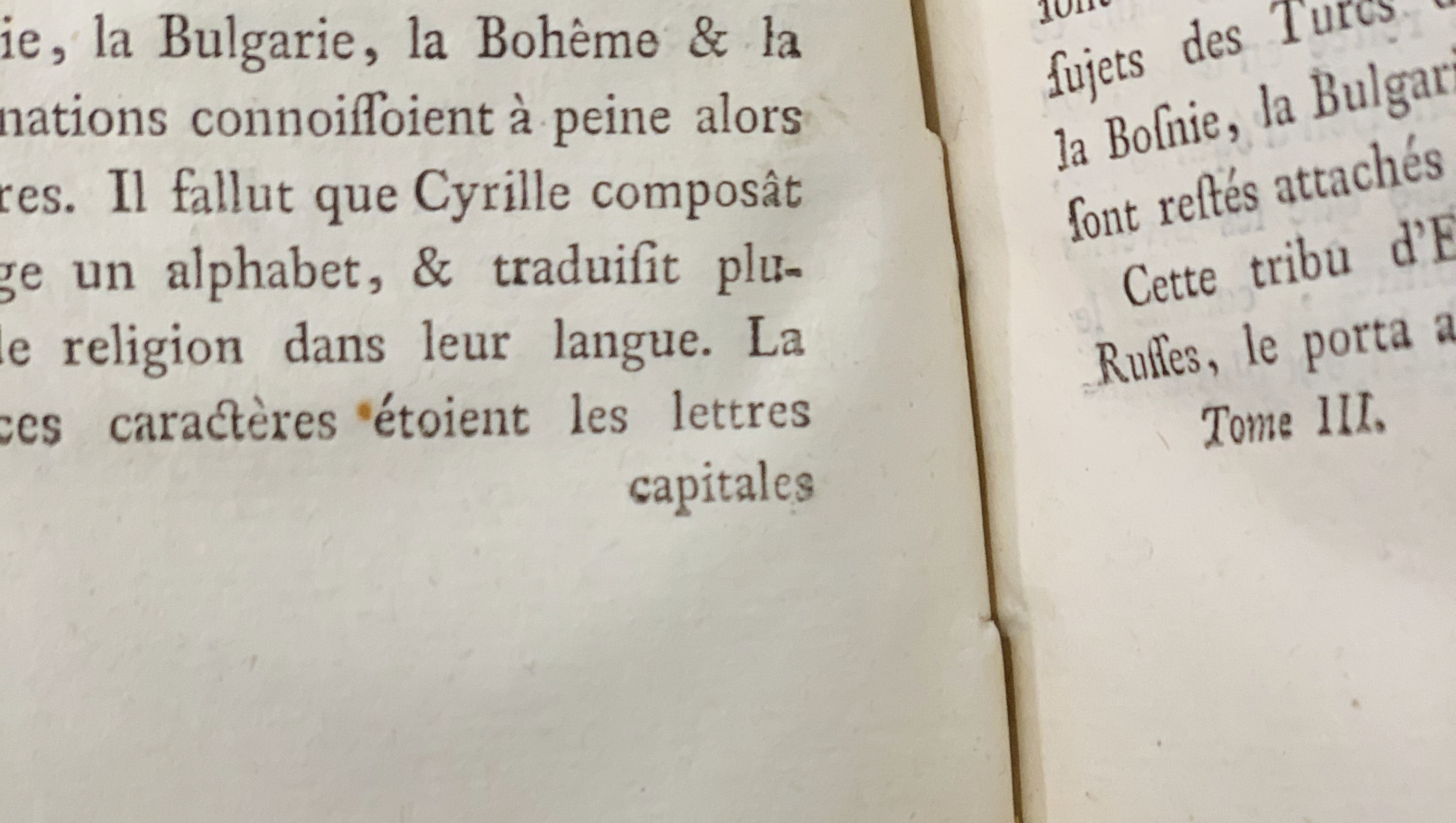
The book that is collected in Colby College’s Special Collection is the third volume of this series, and this volume is printed in a format of an octavo, meaning that a sheet of paper is laid out to print eight leaves (a leaf contains two pages). At the bottom of the front of the first leaf in each gathering, a “recto”, users can find a signature mark with a capital letter and roman numerals (ex. E ij). According to Werner in her book about early printed books, compositors (people who set the types to be printed) usually only include signatures for the first halves of the leaves in a gathering (43). For this book, the mark appears in four continued rectos and then disappears (see the examples in Figure 1 and Figure 4). While every page has its page number on the upper corner, this mark tells the beginning of each gathering to helps the binder arrange them and insert the maps or illustrations in the correct place. The capital letter changes with a different leaf; when the letter changes, the number of the volume (in this case, Volume III) reappears next to the letter on the page (see Figure 1). Further, the page left to the recto, the verso of the previous leaf will have a catchword at the lower corner. These detailed designs show how much work might have been done in the production of this book, and to what degree people who have involved in this production valued the book.
The author and the translator of this book, William Coxe (1747-1828) and Paul-Henri Mallet (1730-1807), have both lived a life when Europe was going through complex social changes. Being members of academies in various countries, both of them probably wrote/translated the volumes with the support of these academies. These collaborative works represent the effort made by some Europeans historians to write European history in that chaotic time period. In the late 18th century, European countries have witnessed or experienced several dramatic social and political events. The peace treaty between Great Britain and the new-born United States was signed in 1783, declaring the independence of the latter. In Russia, Catherine II the Great ruled in 1662-1796, presided over the Age of Russian Enlightenment. As the Russian frontier was pushing westward, Russian society had more and more interactions with other European countries. Therefore, while a huge amount of navigation guides was made in Europe to meet the demand to explore other continents (Asia, American, etc.) by European travelers, this series of books also shows interest in neighboring countries. The multiple published and translated versions show its popularity among (mostly) European readers. Further, the languages these versions have adapted, English and French, indicate the influence of them as international languages and the power of France and Great Britain in eighteenth-century Europe.
Work cited
- Werner, Sarah. Studying of Early Printed Books, 1450-1800: A Practical Guide. Wiley, 2019.
Want to read more? Here are other blogs about Voyage en Pologne, Russie, Suède, Dannemarc, &c: