After some investigation with The Occult Sciences: The Philosophy of Magic, Prodigies, and Apparent Miracles Volume II, I was able to discover some interesting things about the people that played a key factor in creating the book.

This edition of the book was originally written in French by Eusèbe Salverte (1771-1839). It was very difficult to try to find a lot of background on Eusèbe Salverte because almost all the information I could find about him was in French (a language that I do not speak). But after some more research and reading a copy of the first volume of the book online, I was able to retrieve some more information. that Eusèbe Salverte was a French poet, songwriter and politician. He was born in Paris in 1771 and studied at the College of Juilly. Eusèbe Salverte wrote The Occult Sciences: The Philosophy of Magic, Prodigies, and Apparent Miracles with the intention of arguing that people’s beliefs in magic or the occult was often fostered and perhaps even created by “priestly” and or other powerful castes in society in order to govern control over the general public. This view was pretty controversial and even caused Madame Helena Blavatsky, the founder of Theosophy, to even criticize Eusèbe Salverte and his points in her book Isis Unveiled.
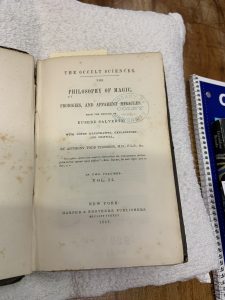
But the English version of this book was translated by Anthony Todd Thomson and published with the Harper and Brothers Publishers (a New York based publishing company) in the year 1847. Anthony Todd Thomson (1778-1849) was born in Edinburgh, Scotland. Anthony Todd Thomson also spent some time in The United States. His family lived in Georgia where his father worked as the Postmaster-General, was a member of the council of the Province of Georgia, and was also a custom-collector for Savannah, Georgia. But he and his family returned to Europe (specifically Britain) due to the start of the Revolutionary War, as they were loyalists.
During his adult life, Anthony Todd Thomson was a general practitioner, and proudly used that designation. He started off his career as a “surgeon” and he wrote a textbook that talked about therapeutics, materia medica, and pharmacy. In the later half of his medical career, he was more of a “physician”. He believed that there was good in combining medicine and surgery. Because he felt like he was a mix of both “surgeon” and “physician”, he settled for general practitioner instead of choosing just one of those two titles to go by. Anthony Todd Thompson was also a foundation professor at London University. There he taught students about pharmacy and the skills needed for such a practice (e.g. dispensing drugs). Interestingly, he told his students that they should not charge money for the drugs or medications that they dispense. He believed that “They were to be professionals, not tradesmen”. Anthony Todd Thomson had a very successful career as a professor as well as a general practitioner. His lectures flooded with people eager to hear him speak. He authored books that had many editions that many young doctors used.

Almost all of the books that Anthony Todd Thomson wrote or translated have to do with the medical field and pharmacy practice. For example some titles of his other works include:
A practical synopsis of cutaneous diseases, according to the arrangement of Dr. Willan, exhibiting a concise view of the diagnostic symptoms and the method of treatment
A conspectus of the pharmacopeias of the London, Edinburgh, and Dublin colleges of physicians, and of the United States Pharmacopeia : being a practical compendium of materia medica and pharmacy
Elements of materia medica and therapeutics, including the recent discoveries and analyses of medicines
All of his works seem to have two major things in common. 1) All of the titles are incredibly long winded, and 2) they all seem very professional and medical. Based on Anthony Todd Thomson’s already established reputation in the medical community, I can assume that The Occult Sciences: The Philosophy of Magic, Prodigies, and Apparent Miracles had to be created for the same type of audience that was already reading his books (medical students, doctors, etc.). What intrigues me the most is that the title of this work seems to contrast from the rest of his work. What made Anthony Todd Thomson choose to translate and write a book such as this?
As I dive deeper and deeper into the history of this book (haha), I become more and more intrigued with what I find. Hopefully by the end of this blog series all (or at least most) of my questions can be answered!
Sources:
“Anthony Todd Thomson.” Geni Family Tree, 7 Mar. 2015, www.geni.com/people/Anthony-Thomson/6000000024437806871
Carson-Priede, Estela. “Blavatsky.net.” Who, www.blavatsky.net/index.php/madame-blavatsky
“Eusèbe Baconnière De Salverte.” Wikipedia, Wikimedia Foundation, 11 Oct. 2018, fr.wikipedia.org/wiki/Eus%C3%A8be_Baconni%C3%A8re_de_Salverte
“Online Books by Anthony Todd Thomson.” The Online Books Page, onlinebooks.library.upenn.edu/webbin/book/lookupname?key=Thomson%2C%2BAnthony%2BTodd%2C%2B1778-1849
SALVERTE, Eusebe, and M. D. Anthony Todd Thomson. “The Occult Sciences. The Philosophy of Magic, Prodigies and Apparent Miracles. Two Volumes by Eusebe SALVERTE, and, Explanatory, With Notes Illustrative, M. on Weiser Antiquarian.” Weiser Antiquarian, Harper & Brothers, www.weiserantiquarian.com/pages/books/56871/eusebe-salverte-and-explanatory-with-notes-illustrative-m-d-anthony-todd-thomson/the-occult-sciences-the-philosophy-of-magic-prodigies-and-apparent-miracles-two-volumes?soldItem=true
Salverte. “The Philosophy of Magic, Prodigies and Apparent Miracles / from the French ; with Notes Illustrative, Explanatory and Critical by Anthony Todd Thomson. … V.1.” HathiTrust, babel.hathitrust.org/cgi/ptid=umn.319510008884615&view=1up&seq=13
Williams, David Innes. “Anthony Todd Thomson and the Rise of the General Practitioner – David Innes Williams, 2002.” SAGE Journals, journals.sagepub.com/doi/abs/10.1177/096777200201000405