By Serena Desai
This is an ongoing blog series. To learn more about the origins and additions of this text, explore the following links:
Origins of the Text: http://web.colby.edu/bookhistory2020/2020/03/04/paul-eber-challenging-roman-catholicism-using-his-calendarium-historicum/
Additions of the Text: http://web.colby.edu/bookhistory2020/2020/03/29/a-diary-or-an-encyclopedia-how-paratext-defines-ebers-calendarium-historicum-conscriptum/
____________________________________________________________
On one unknown day in 1559, the printing press of George Rhau in Wittenberg, Germany mass-produced a travel-sized version of The Calendarium Historicum Conscriptum (The Written Historical Calendar) authored by celebrated theologian Paulo Ebero of Kitthingensius (Kitzingen, Germany). Presumably-owned first by a man named Carmeli Bambery in 1563 (as can be discerned by his looping signature on the inner front-cover), the volume eventually came into the possession of Colby College benefactor, Florence Perry Hahn, nearly four-hundred years later. The College’s bookplate and the text’s original call-number signifies its matriculation into the Special Collections library, where it has sat on the shelves amongst hundreds of other antiquarian treasures for more than half a century. Since its donation, the pocket-sized volume, printed approximately 3,416 miles away in Wittenberg, has been stowed carefully behind temperature-controlled glass casing of the Robinson Memorial Room in Waterville, Maine; this is where, on February 14, 2020, it came within my line of sight. While I could have easily glossed over its plain cover and small size in favor of larger, statelier texts, the enigmatic nature of The Calendarium Historicum’s contents and production style immediately confronted me with too many questions to leave unanswered.
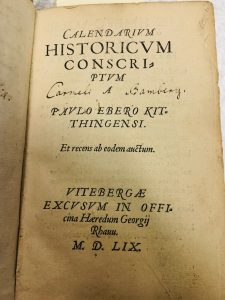
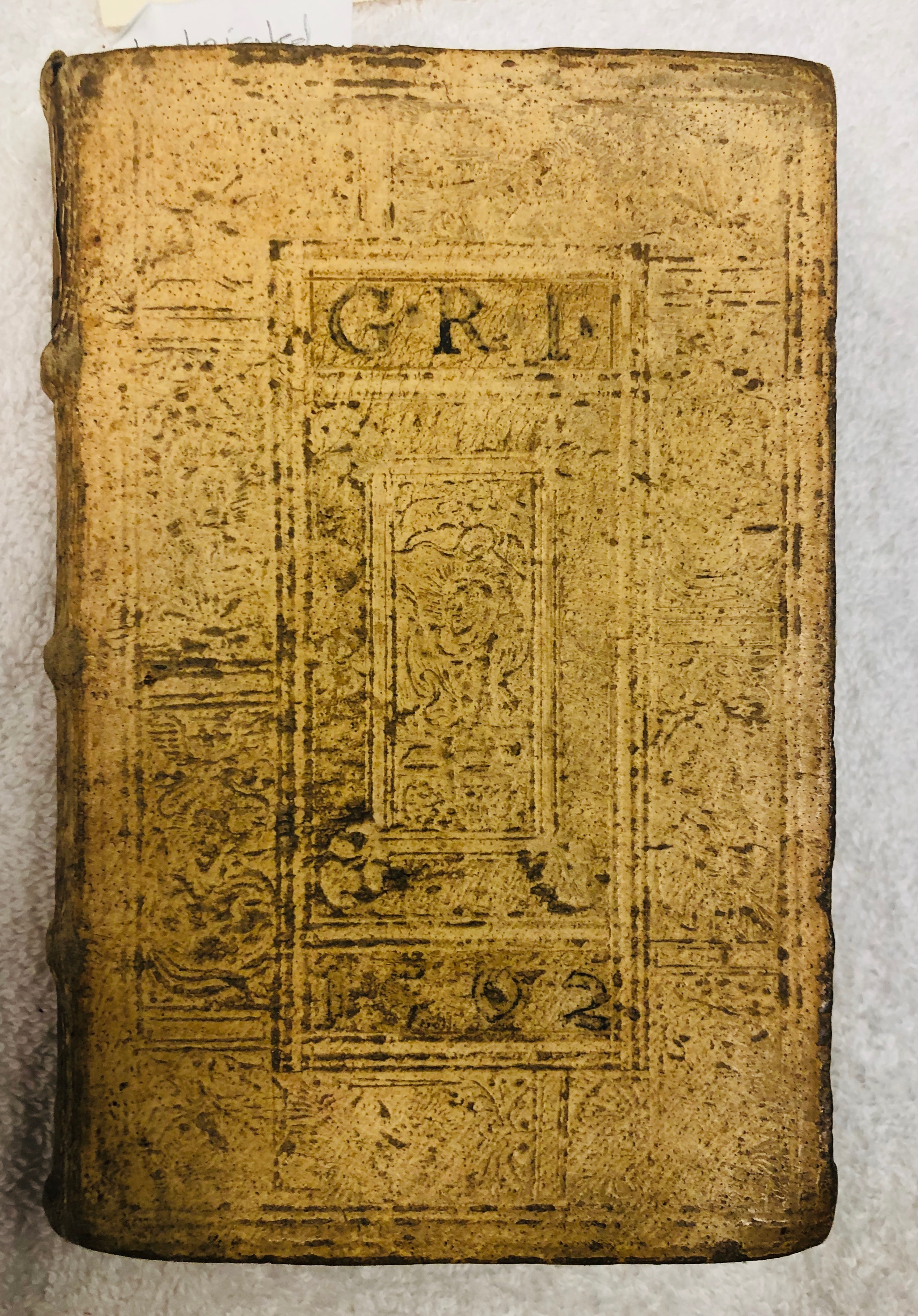
Upon observing this volume, one of the first elements that stood out to me at the outset was the mystery behind the date of its yellowed leather covering. The text itself, written on seemingly-cheap paper pages about as long as my forearm, has the date “M.D.LIX.” written on its cover page— an indication that it was written during the early period of the Protestant Reformation, in 1559. However, the front cover, blind-tooled with ornate Biblical figures, vines, and other unrecognizable images, has been stamped with either “1502” or “1602” (the exact number is unclear due to the deterioration and fading of the ink filling the stamped areas). Under the careful guidance of Special Collections Assistant Director, Pat Burdick, I have hypothesized that it is impossible for the book’s binding to predate the text inside; therefore, the latter date seems more probable than the former. But if this is the case, who rebound the book— and more intriguingly, why? The mystery of the dates is further compounded by the fact that the inner-back cover of the book has been annotated by a previous owner, who noted that he owned it in 1563. If this page is stuck to the new binding, how would it have been possible for the inner-back cover to predate the leather right on the other side? Such mysteries revealed themselves to me within the first few hours of my ambitious mission to “decode” this codex.
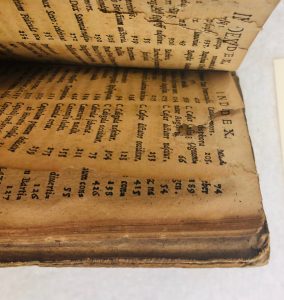
The condition of the book is just as mystifying; while the black ink is still very clear and dark on the book’s first two hundred pages, the elegant Times New Roman-esque typeface in the Index has been severely marred by some living creature— be it insects, rats, or other vermin. There are most-certainly teeth-marks in the holes at the top right corners of each page, but the damage is erratic and significant, dissimilar to typical worm damage (which normally looks like a singular hole drilled through the same position on multiple pages). The bottom left corners of multiple pages are stained a light brown color, perhaps indicating water-damage or the spill of some sort of liquid.
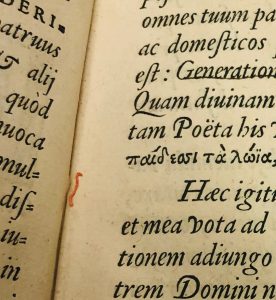
Other indications of human use are littered throughout the text, including (but not limited to): smudges of brown ink and fingerprints from previous owners, a piece of dark brown tape stuck at the top right-hand corner of page 119 (perhaps a bookmark, as there is a full paragraph of Bombery’s annotations on that page), a fold-line at the top left-hand corner of some pages (indications of someone having dog-earred the page for later reference), and most fascinatingly, a single, centimeter-long piece of red thread caught in the gutter of the Dedicatory Epistle. Where did the thread come from? Is it a remanent of the previous binding, the remains of an old bookmark, or simply the loose end of a Colby College student’s sweater? Such questions will undoubtedly dominate my further research of this sixteenth-century work.
While the pages of the book have been severely destroyed in some areas, the binding of the book remains in tact, holding the book together with strong white thread. The leather cover and its stamping, though faded and difficult to decipher, remains in decent condition; images of a saint blowing a bugle, columns with Doric entablature, and the large capitalized letters “G.R.I.” are still distinctly visible on its surface.
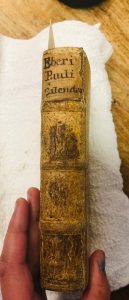
Furthermore, the raised bands on the spine of the book are topped with a relatively-undamaged square piece of leather bearing the shorthand title of the text itself: Bheri Pauli Calendar (exhibiting a different spelling of Paulo Ebero’s name). The clear disjunction between this leather square and the rest of the text’s covering makes me question whether or not it was a section of the original binding cut and pasted to the new one for the sake of tradition or authenticity.
While the binding of the book was undoubtedly intriguing, a myriad of compelling questions flitted across my mind while I attempted to analyze the context of the blind tooling on the front cover. Firstly, what do the “G.R.I” initials stand for? Are they the initials of George Rhau, the German printer whose name appears in the colophon? If this is the case, and the book was truly rebound in 1602, would it have been possible for the repair to have been made by the same business in Wittenberg that printed the text in the first place? And how were texts still being mass-produced under Rhau’s name, seeing as he died in 1548— eleven years before the text was supposedly printed? I predict that researching the printing press of Georg Rhau in Wittenberg will shed some light on the answers I seek— but for now, I shall take note of my findings and come back to them at a later time.
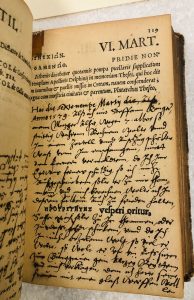
In order to understand the contents and context of the book itself, I browsed through the pages— each sub-headed with a capitalized day and month of the year, followed by a block of text in smaller font (sometimes written in multiple languages). Flipping through the text has revealed that the work is made up of the following sections: a Dedicatory Epistle, a short Elegy, a Preface, a Calendar separated by month and day, some Month Charts, a few Zodiac Rubrics, and finally, an Index. While certain pages of the volume are filled with Biblical information (indicated by the repetition of names such as “Mary” and “Jesu” throughout the text), other pages are left almost completely blank.
The previous owner of the book— likely Carmeli Bambery— annotated the pages with his own dense notes and marginalia. While most of these annotations are indecipherable to those who cannot translate Latin, one can make out various dates (he mentions 1569 on page 87, and 1579 on page 119). There are also numerous Bible references (for example, he underlines the phrase “Generation Rectorum benedicatur” and writes “Psalm: 111” in the Dedicatory Epistle). While the detailed histories of events that occurred on each day and month of the year dominate the work, certain pages are filled with what look to be Zodiac charts, while others are covered in lists of the months in various languages.
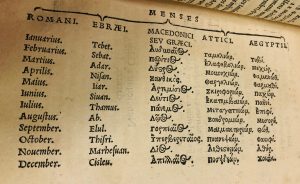
It appears as if the book is a version of the Roman Calendar, based on the twelve-month system that it relies upon and the familiar names of each month (“Ianuarius,” “Februarius,” and “Martius,” for example). This information, along with the deliberately-blank pages throughout the book, suggests that Ebero created this historical calendar to remind readers of important Biblical events that occured on each day of the year, and to encourage readers to continue this history with their own notes. Since this book was printed in Germany, as is stated in its colophon, I find it quite interesting that none of it is written in German. While the book looks like it was mass-produced due to its paper pages and lack of colored ink or images, it also seems like it was meant for the eyes of an intellectual— someone who had the money and education to learn the languages of religion and ancient politics (Latin, Hebrew, and Greek).
All of the aforementioned information, along with the questions I posed along the way, represent enigmatic, disjointed pieces of this text’s long journey across the globe. Mysteries such as the date-change on the binding, the red thread caught in the book’s Dedicatory Epistle, and the history of author Paulo Ebero (along with the origin of the George Rhau’s press in Wittenberg) are all intriguing reasons why this book stood out to me from behind its protective glass casing. While the codex cannot be physically longer than five inches, it is packed with the history of the previous five hundred years— and through careful research and analysis, I plan to reveal its secrets.
Works Cited (Physical Texts):
Carter, John, and Nicolas Barker. ABC for Book Collectors. 8th ed., Oak Knoll Press and the British Library, 2004.
Ebero, Paulo. Calendarium Historicum Conscriptum à Paulo Ebero. Georgij Rhaw, 1559.
General Background Information (Online):
Information on Paulo Ebero: https://en.wikipedia.org/wiki/Paul_Eber
Information on Georgij Rhaw: https://en.wikipedia.org/wiki/Georg_Rhau