The Holy Spirit does not offer an overwhelming amount of information with regards to its origin, but the Internet does. The extent of information provided by the book itself includes author, title, publisher, year, and its background within the library at Colby. Credits are not given to any participant in the communications cycle; there is no mention of illustrators, scribes, binders, or anyone impacting the book’s existence except the reader through provenance. The data provided in the text is very straightforward and fundamental, which left room for some research and discovery.
The book was published in 1680 in London as a second edition. I did not find any records of the first edition, so I’m unsure of what changes were made between the two releases. I struggled to find information on the author as well. He wrote controversialist literature, most of which focused on Christianity. Provided that some of his publications were sermons, he could have been a priest, but I don’t know much more about him. The imprimatur is dated May 4th, 1677 in London, permitting the book, which addresses Christian topics in a controversial context, to be printed.
The Holy Spirit was printed on behalf of an individual named Henry Brome, though no official publisher is revealed; perhaps, there was not one. His name was signed in the front and recorded on the title page where it states that the book was printed on his behalf. Interestingly enough, when I researched the location of where it was printed, the “Gun” in St. Paul’s Churchyard, I encountered a handful of other texts published for the same man. In 1674, six years prior to the printing of The Holy Spirit, Brome received what is called a “Catholick Ballad” or an “invitation to popery. http://ballads.bodleian.ox.ac.uk/search/printer/Brome%2C%20H.
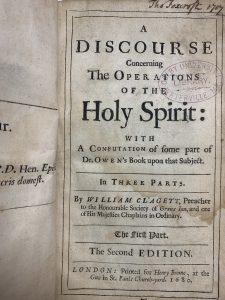
There were seven other records of texts with similar contents on the same website. In 1676, Brome also ordered geographical cards to be made on his behalf at the Gun in St. Paul’s Churchyard, which are said to be used for both card games and conveying geographical information. https://www.worldcat.org/title/geographical-cards-made-and-sold-for-henry-brome-at-ye-gun-in-st-pauls-church-yard-london-1676/oclc/434475172. I encountered numerous other texts with varied subject matters printed for Henry Brome in the same location between 1678 and 1681, and even one for a man named Charles Brome: probably a relative. http://(https://www.worldcat.org/search?q=%22the+gun+in+St.+Paul%27s+churchyard%22&qt=notfound_page&search=Search.. Another interesting discovery I made was that Charles Brome purchased the same book, but there is a record of him reselling it in 1690; I wonder if Henry did as well. https://www.worldcat.org/title/discoruse-sic-concerning-the-operations-of-the-holy-spirit-with-a-confutation-of-some-part-of-dr-owens-book-upon-that-subject-by-william-clagett-late-preacher-to-the-honourable-society-of-grays-inn-and-one-of-his-majesties-chaplains-in-ordinary/oclc/839419826&referer=brief_results). I found this to be extraordinarily exciting because it illustrated a timeline of these people’s lives. It also indicated that he was probably wealthy if he could afford customized cards, and books, and was a regular recipient of invitations to “popery” affairs, although I’m not sure if those were as prestigious then as they sound in 2020. It also suggests that the printing company was trustworthy and skillful if Brome kept returning to it to order his products. The book was probably turned over to another owner named Thomas Foxcroft in the 1770’s, as indicated on the title page. Unfortunately, the provenance throughout the text does not shed light on which owner wrote which annotations, though.
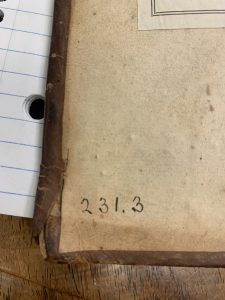
The inside left bottom corner of the front cover reads “231.3,” a shelf mark inscribed in dark ink, probably with an early pen, for organizational purposes. In order to figure out when the number was written, I searched throughout the book seeking other markings in dark ink, but I only encountered an “x” on page 61, which was probably just an annotation. The names were all likely signed with a quill and ink, so the number was most likely printed by Colby University or Waterville College. There are also two stamps on the front few leaves: a Waterville College Library stamp from between 1820 and the 1860’s, and a Colby University stamp from between the 1860’s and the 1890’s. The front inside cover now houses the most recent addition: a Colby College library sticker, closing up The Holy Spirit’s history of movement before now.