Mungo Murray, the author of my book, is at once someone who seldom appears on the public record and someone whose life is quite worthy of note. The details of his life remain elusive, although a general timeline is able to be established. The year and date of his birth is unknown; however, we do know that he was baptized in Fowlis Wester, near Perth, Scotland, on the 18thof March 1705. In August of 1733 he married Margaret Gory. Over the course of the next seven years, he completed his apprenticeship as a shipwright, entering the Royal Naval Dockyard at Deptford in 1738. In 1754, while working as a shipwright there, he published his first work, A Treatise on Ship Building and Navigation.
In 1758, Murray was appointed as a midshipman to Lord Howe’s flagship HMS Magnanime, receiving a warrant in 1760 to teach mathematics and navigation. His service on board Magnanime saw her service at numerous engagements, most notably Quiberon Bay. During his time of service he published his second work, The Rudiments of Navigation, which he “compiled for the Use of the Young Gentlemen on board His Majesty’s Ship Magnanime.” It was on board this ship that he would have instructed Henry, Earl of Gainsborough in navigation, the man to whom the book is dedicated.


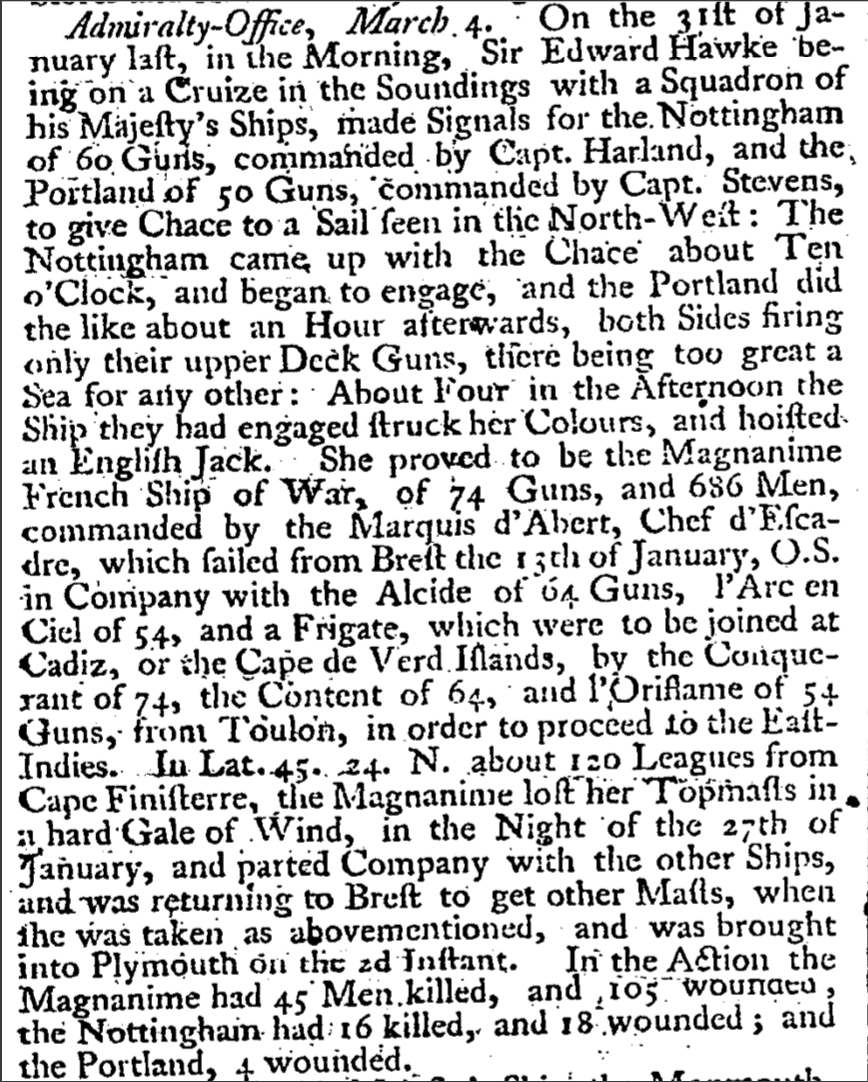
With regards to His Majesty’s Ship Magnanime, I had a hunch based on the name that the ship was not of British origin, but rather captured from France and sold as a prize. In turn, this was proved correct, as I was able to find a newspaper article including the notice of her capture by two warships of the Royal Navy, HMS Portland and HMS Nottingham, on the 31stof January, 1748.
In 1760, during his years of service on board HMS Magnanime, Murray published The Rudiments of Navigation. It was printed in London by D. Henry and R. Cave. These printers printed both of Murray’s works, having printed his Treatise on Shipbuilding and Navigation six years prior. A second edition of his Treatise was printed for A. Millar, a bookseller in the strand. Most interestingly, in his Treatise, Murray leans heavily on the navigational techniques of M. Duhamel du Monceau, whose work, The Elements of Naval Architecture, was also printed by D. Henry and R. Cave.
His printers, D. Henry and R. Cave, have had an interesting career as well, based on what I could find. I was able to find mention of these gentlemen in an 1868 edition of The Bookseller, a catalogue of published works in Britain. On the 10thof January 1754, an elder Edward Cave (the uncle of R. Cave) died after completing the twenty-third annual issue of his magazine, The Gentlemen’s Magazine. His work was soon taken up by a D. Henry and an R. Cave, whose names appear on the twenty-fourth issue of the magazine. Henry was a Scotsman, born in Aberdeen in 1710. He married a sister of the elder Cave in 1736 and began to print in Reading. The earliest printed work of his which I was able to track came a year after this wedding, when he printed The English Schollar’s Assistant by the appropriately named Samuel Saxon. He moved his operations to St. Johns Gate in London in 1754. It is at this point that I was able to track down the earliest instances of their names being listed together upon a printed book, appearing in The Elements of Naval Architecture by M. Duhamel du Monceau and A Treatise on Ship Building and Navigation, Murray’s other work. In this way, many of their (especially later) works had a maritime theme. With regards to Richard Cave, beyond their joint business dealings, I was able only to find that he died in 1766, six years after the printing of Murray’s Rudiments.
Although I was able to find a much on the author and printers, I was able to find little information on the suppliers. The paper is neither particularly expensive nor inexpensive, however it is made with a high rag content and is thus rather durable, which befits the intended function of the book as a navigational aid subject to a great deal of use. I was unable to discern a watermark. The work was printed on a printing press, although I was unable to find more detail than that. Due to the small size of the book, it was quite likely printed through the press house’s preferred imposition scheme whereby pages are each printed on a much larger sheet, folded, and cut accordingly. The engravings within the book were done through intaglio plates.
Work Cited:
“News.” General Evening Post, March 5, 1748 – March 8, 1748. Seventeenth and Eighteenth Century Burney Newspapers Collection, https://link.gale.com/apps/doc/Z2000435317/BBCN?u=colby_main&sid=BBCN&xid=f165de97. Accessed 2 Mar. 2020.