Reading Rilke: Ben Shahn’s For the Sake of a Single Verse
Shayna Purow
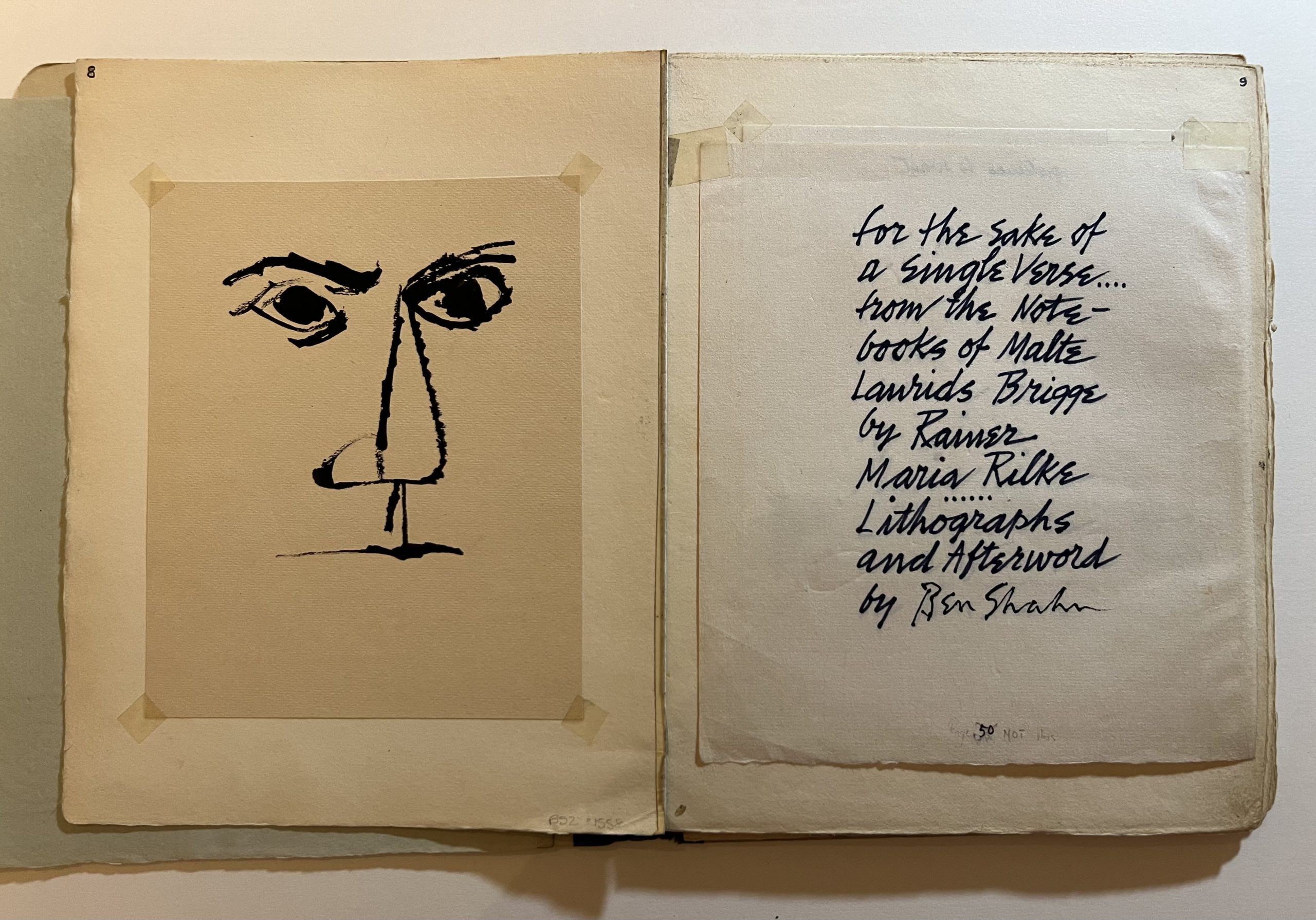
Ben Shahn’s For the Sake of a Single Verse illustrates a passage from The Notebooks of Malte Laurids Brigge written by German poet Rainer Maria Rilke in 1910. This semi-autobiographical novel, Rilke’s main prose work, explores existential dread and the search for meaning through life’s journey from birth to death. Shahn stated earlier in his life that he was aiming to find “some deeper source of meaning in art, a Constant Spring that would not run dry in the next change in political weather (Shahn 43). The selected passage of The Notebooks of Malte Laurids Brigge gave the reader insight on how to find this meaning in both art and their general life.
The unbound maquette contains fifty-six pages, twenty-three images on the recto accompanied by eleven pages of text and nine blank pages on the verso. Shahn’s selected passage is a portion of one paragraph from page six of the original book, but the illustrations do not begin until halfway through the paragraph (Rilke 6). The colophon mentions an afterword with Shahn’s commentary, which is included in the published editions but absent from the maquette, where blank pages appear in its place. For the Sake of a Single Verse was published twice—first as a portfolio of twenty-four signed lithographs in 1968, and later as a trade paperback edition in 1974 with Shahn’s signature at the bottom of each reproduced image.
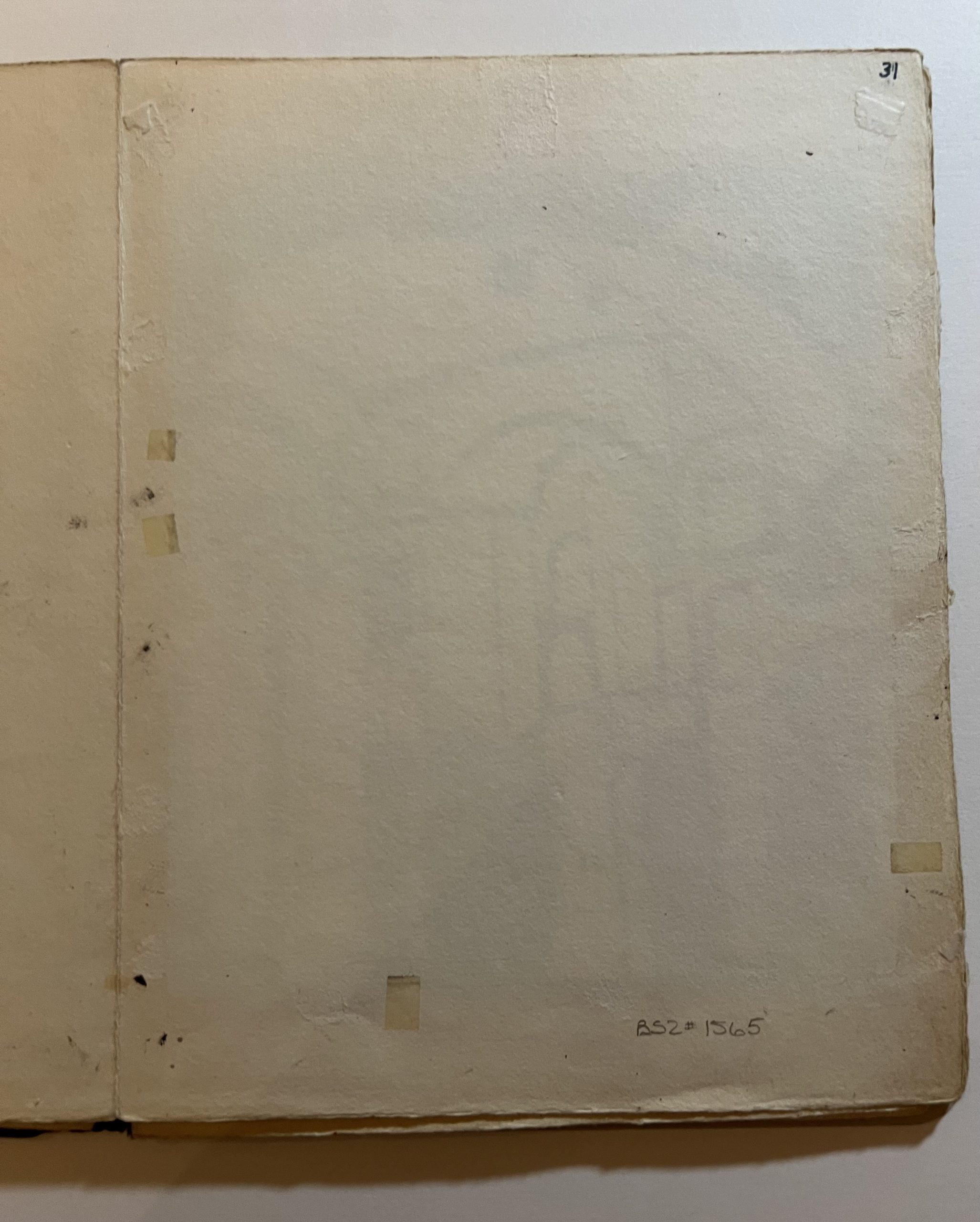
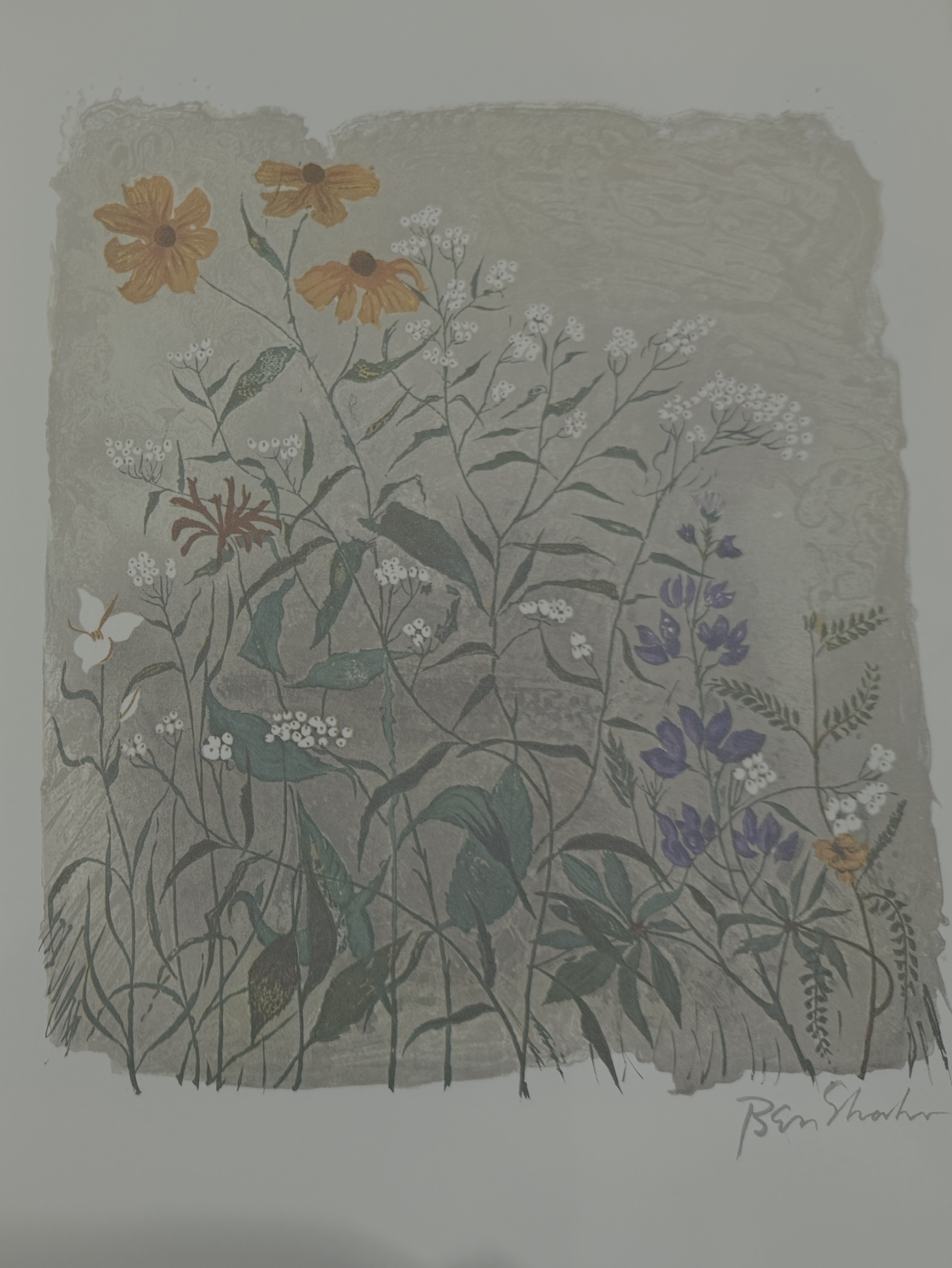
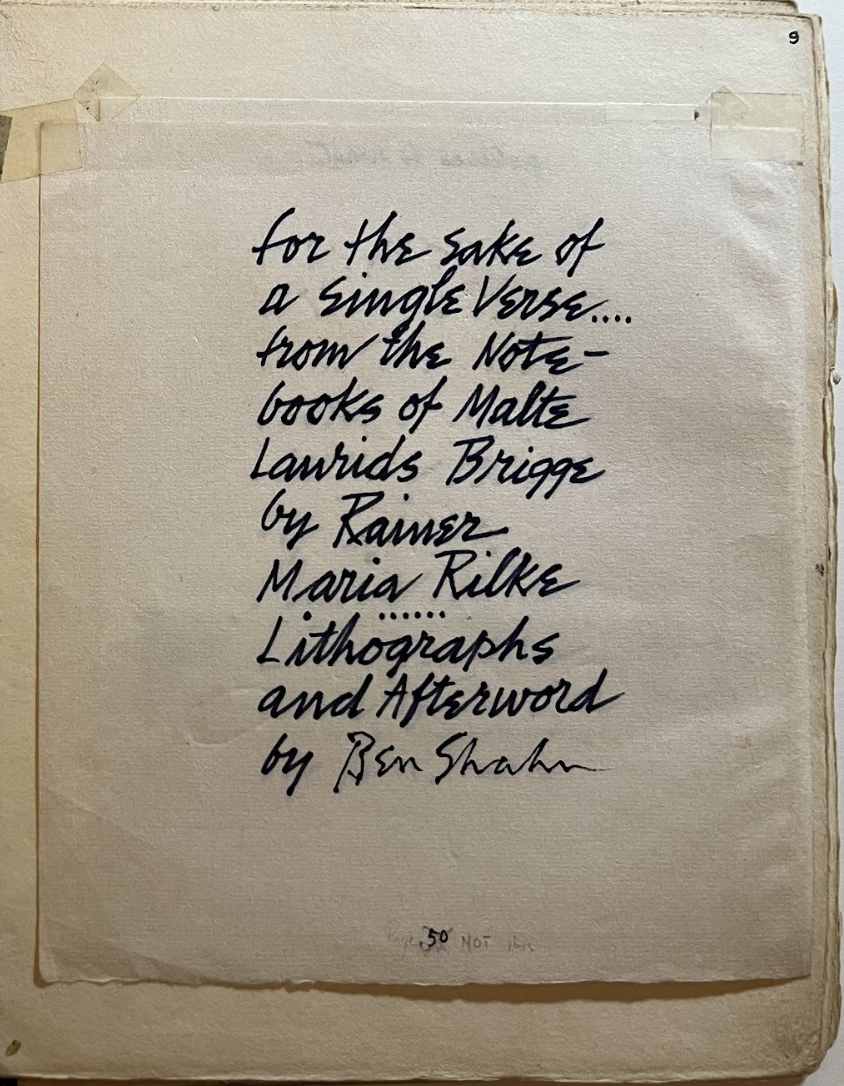
The maquette bears witness to Shahn’s working process, revealing his detailed planning and communication with the publisher. Some of the images have not yet been paired with text, and one of the published lithographs is missing, marked on page thirty-one by tape surrounding the edges. The tape suggests the missing image was removed at some point for reworking. The page numbers also suggest reworking; the colophon is labeled “50” but is actually page nine of the maquette. Sequential numbers appear in pencil at the bottom of each page, instructions for the publisher, starting with BS2 1558. There are also other notes in pencil, such as the desired image size of 11 ½ inches marked on page eleven (increased from the original size where the entire sheet was 11 1/4 by 8 3/4 in.) These instructions come to life in both the published portfolio and trade edition, where the artwork was enlarged to occupy a larger proportion of the page. The maquette’s layered construction—each image taped over a larger sheet of paper (or two, as seen on the colophon)—demonstrates Shahn’s mind changing from the original image pasted.
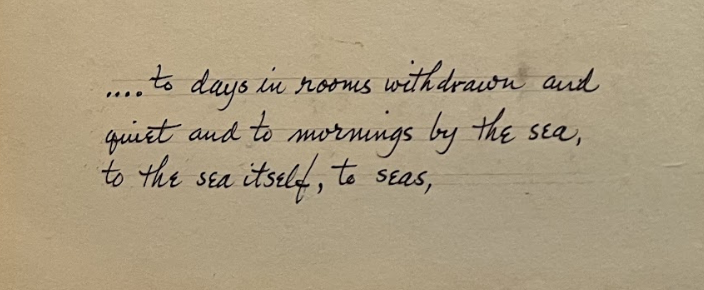
Furthermore, there are instances where an image on the recto is paired with a full sentence on the verso, followed by two pages with images but no text on the verso. In the printed editions, the sentence was split and later assigned to the subsequent images originally without text, indicating Shahn’s foresight in the piece being published as a portfolio. The cursive handwriting in the maquette reflects Shahn’s casual, natural style. This choice allows the accompanying images to take center stage. Despite the writing’s simplicity, the lettering displays meticulous attention to detail; Shahn prepares the page for writing with pencil lines to ensure the height and spacing of each letter and word is consistent and the block of text fits the page to his satisfaction. The images encompass a range of styles and techniques, from Shahn’s characteristic simple linework to watercolor and gouache. The use of color is inconsistent; some images are just black pen, some have just one color added, and some have several. The maquette’s images are notably more abstract than many of Shahn’s other works.
Analysis
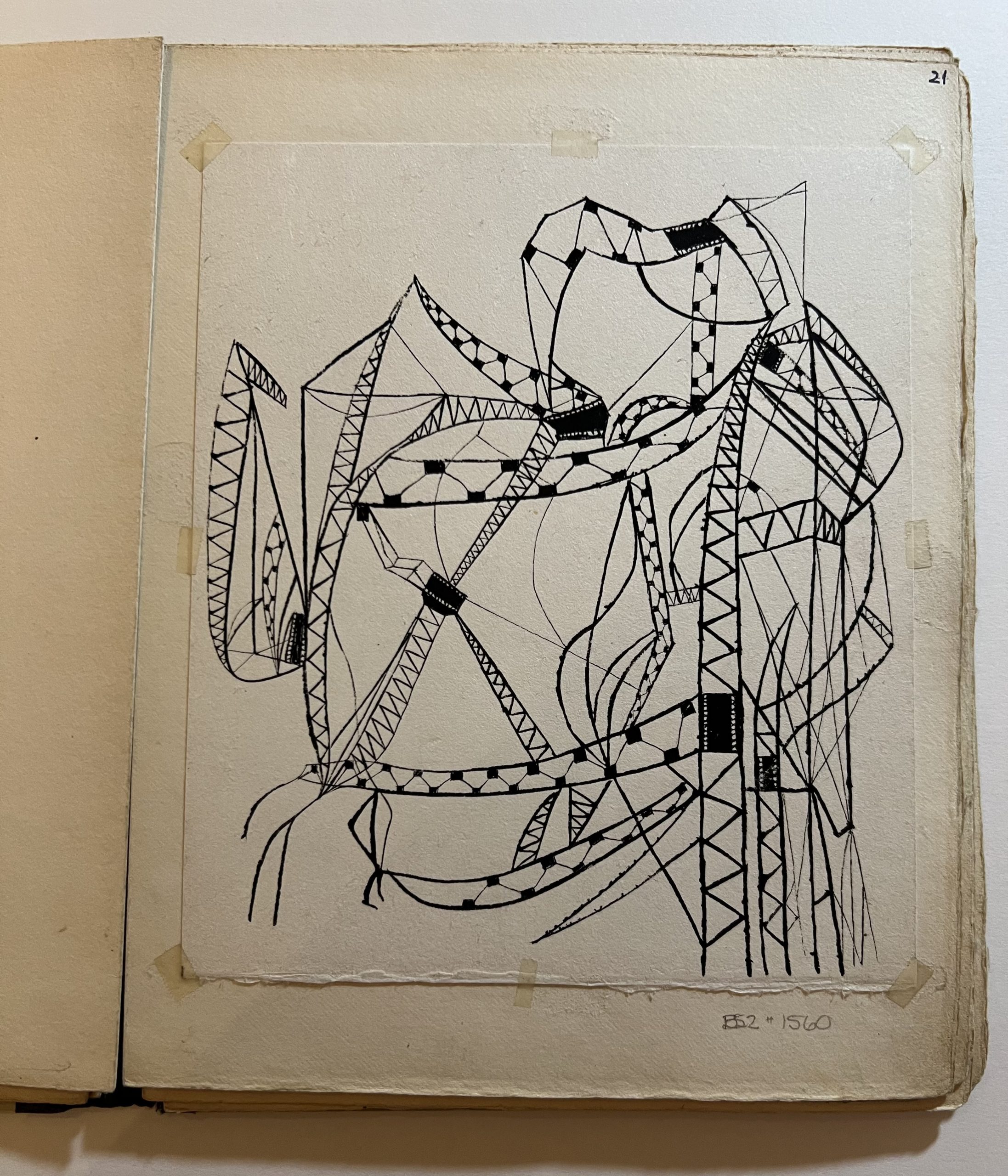
While the images reflect the themes or ideas presented in the corresponding lines from the book, they are not depicted in a naturalistic style. Shahn’s response to Rilke’s text “For the sake of single verse, one must see many cities, men, and things . . .” (20–21) is characterized by different line weights to capture the essence of a building. The geometric shapes created in the negative space mirror the angularity of building infrastructure but do not overtly depict a city.
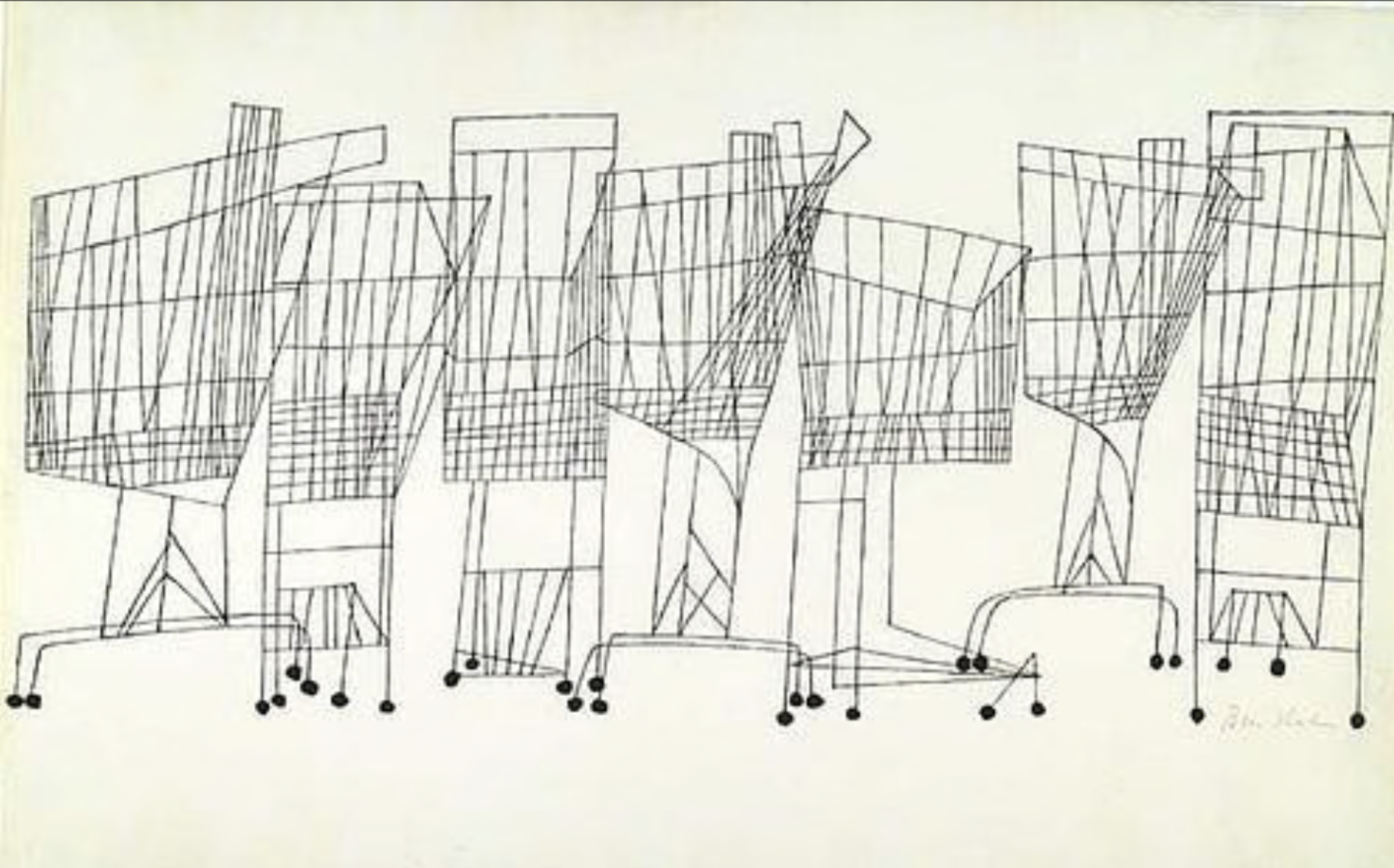
The linework is typical of Shahn, and like his earlier Grocery Carts. In both, the figures overlap, but in the maquette, the varying line weight emphasizes the outer edge of the page. Drawing the viewer’s eye to the edge of the page brings attention to the page’s size. Shahn’s meticulous attention to the paper size reveals his clear intent for the maquette to be published as a portfolio, where the images would occupy a larger proportion of the page.
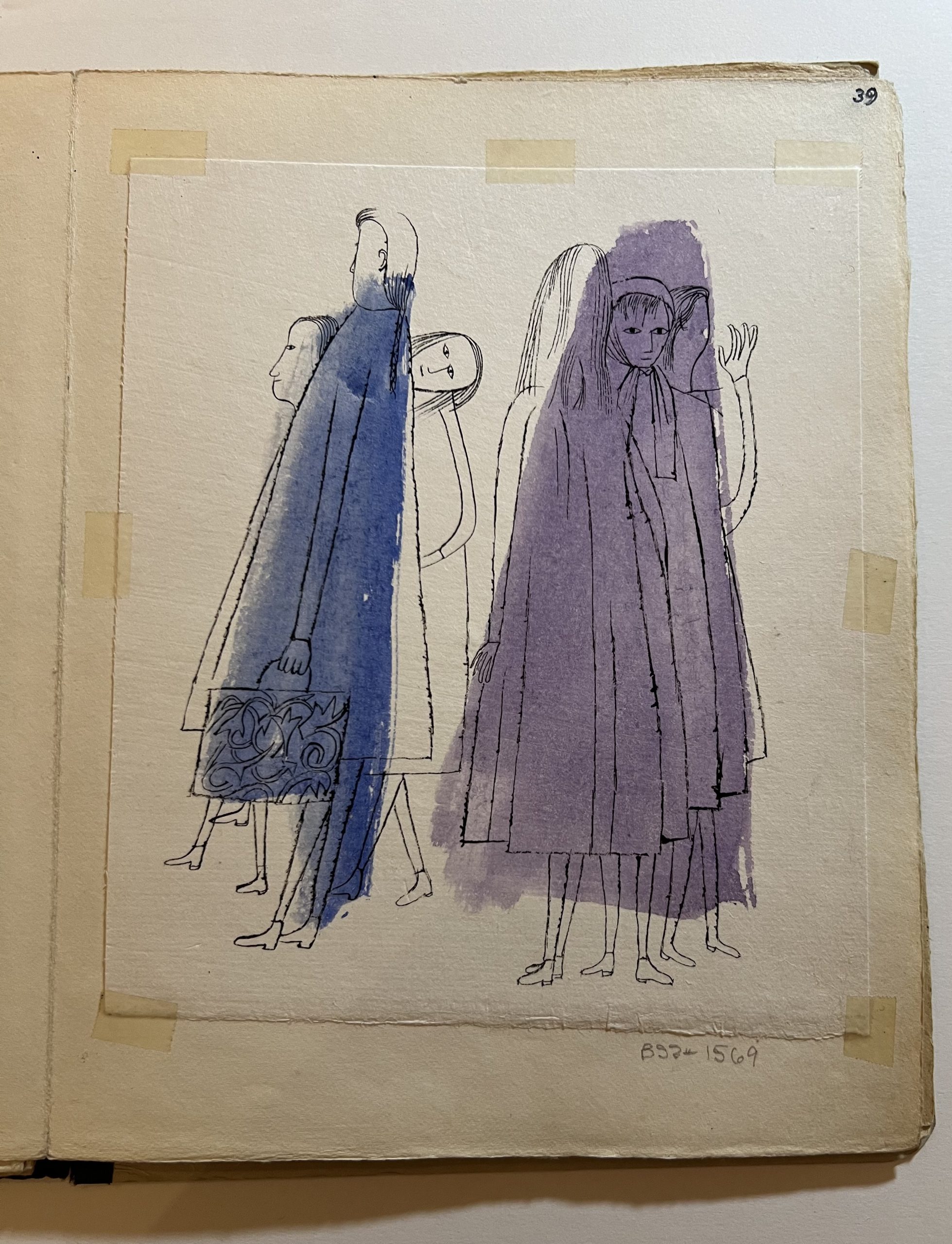
The more colorful images are similarly abstracted, like page 39 in the maquette. While Rilke’s full line reads “to days of childhood that are still unexplained, to parents whom one had to hurt when they brought one some joy and one did not grasp it (it was a joy for someone else),” only the first clause appears with this image in the published editions. We see two groupings of three figures, the left splotched by blue watercolor and the right by purple. The figures are drawn overlapping, so each is barely distinguishable. In the left grouping there is an extra foot visible, and one of the hands on the right has disproportionate and stuck-together fingers. These oddities in the figures visually embody the struggles of life, a major theme in both Shahn’s work and the Rilke portfolio.
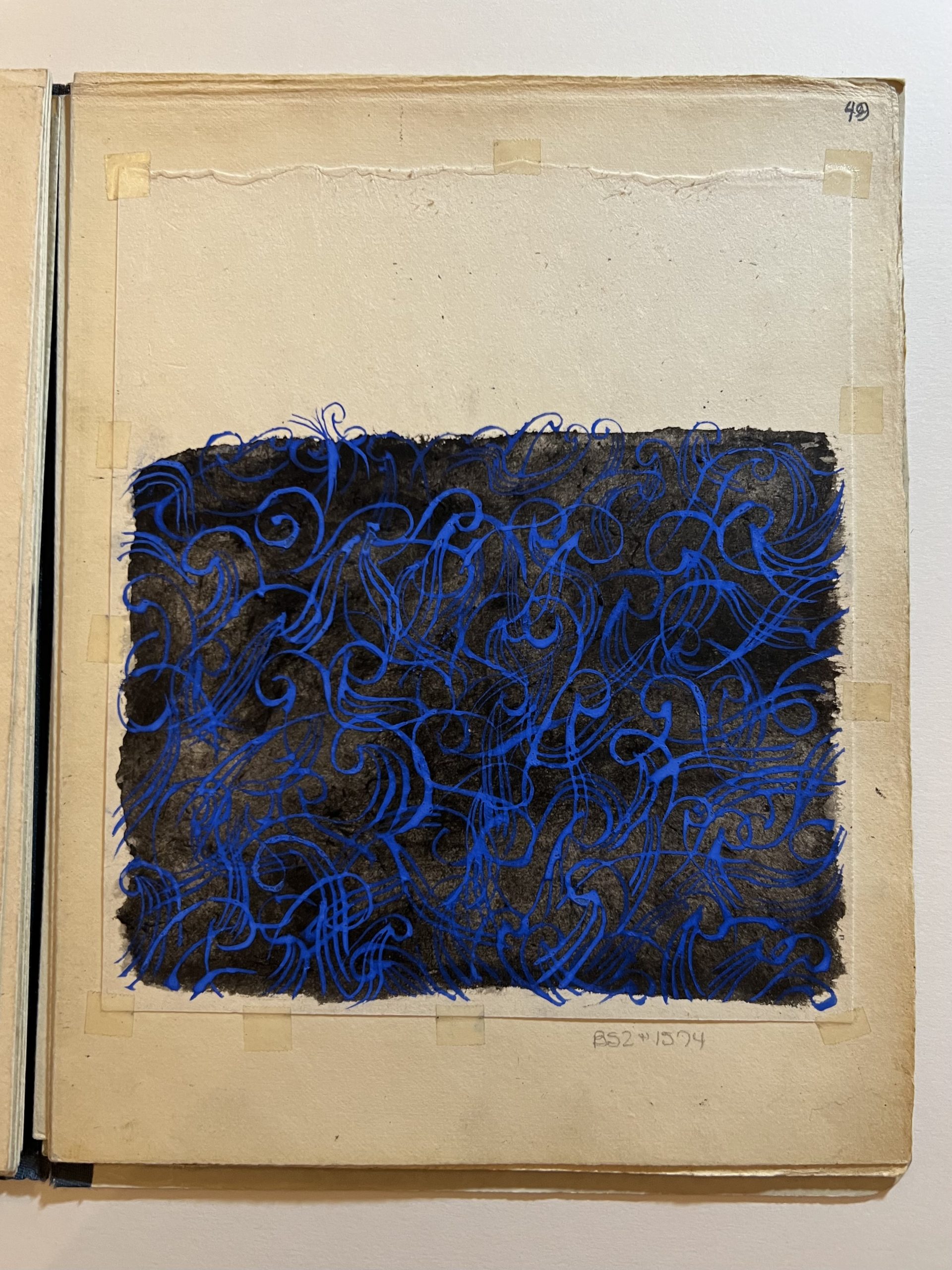
The abstraction increases as the maquette continues, like page 49 (fig. 7). This image faces a blank page in the maquette but appears with the text “to seas” in the trade edition. The half-page illustration features bright blue gouache lines layered over a black background. It’s likely that the background was painted in watercolor rather than gouache. This combination of gouache and watercolor appears in other images of the portfolio, the opaquer gouache used for linework over a more translucent background. Each line is curled at the end and overlaps, creating a pattern that reflects the rhythmic nature of waves. Yet, the illustration would not be identifiable as the ocean without the blue color and corresponding text. This abstraction allows the viewer to determine what they see in the image. For example, the viewer can determine if the sea is turbulent or tranquil, loud, or soft, and morning or night.
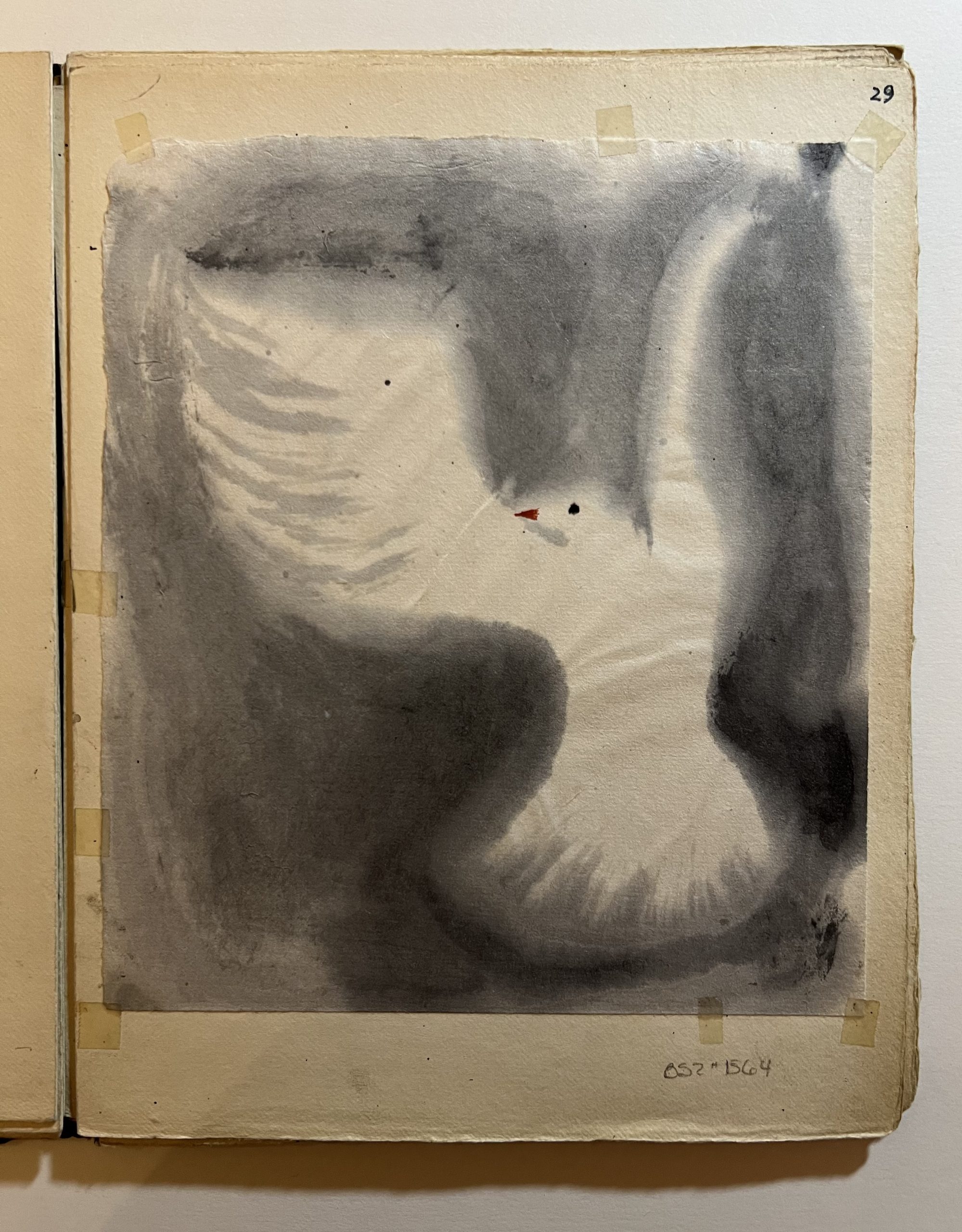
In contrast, some of the illustrations relate more directly to the text. This reflects a duality central to Rilke’s work—the tangible versus the intangible, or the known versus the unknown in human experience. For example, page 29 of the maquette did not yet have text but eventually was paired with “one must feel how the birds fly.” The image loosely renders a bird with an outstretched wing, suggesting flight and thus conveying a specific, recognizable moment. The images with identifiable figures evoke a more tangible sense of reality. The figures that are distinguishable remind the reader of the text-image relationship. If all the images were highly stylized, they might potentially obscure the text-image connection for the reader. Shahn relies on the text to convey his and Rilke’s message of birth to death physical and intellectual challenges. By juxtaposing figurative and abstract elements, Shahn visually translates the existential complexity of Rilke’s themes, allowing viewers to experience the tension between the clarity of outward existence and the ambiguity of inward reflection.
Why The Notebooks of Malte Laurids Bridge
One might wonder why Shahn chose to illustrate this specific passage. While Shahn took a particular interest in abstraction later in his life (Bryson Shahn, “Introduction” 1), the abstraction and content of Rilke’s text and Shahn’s images are especially intriguing in comparison to Shahn’s political and religious work. Shahn’s illustrations create a space where the viewer can interpret the shapes in multiple ways without being confined to a literal representation. To Shahn, the original text had the same effect. The afterword reveals some of Shahn’s motivations: “Here was a writer about the processes of art who was not telling me what to do, what to think, how to paint… He was sharing with me the doubts and the hesitations of art” (Rilke, Maria, and Shahn 63). Through abstraction, Shahn, much like Rilke, refrains from imposing on the viewer a fixed interpretation. Instead, he invites them to engage with idiosyncratic emotional and conceptual nuances.
Shahn’s use of abstraction is similar to Rilke’s writing style, both inviting the reader to draw individual conclusions about the meaning of their work. The dialogue between these two artists stemmed from a deep connection formed when twenty-eight-year-old Shahn first encountered Rilke’s work in Paris in 1926. The passage Shahn selected from The Notebooks of Malte Laurids Brigge displays this connection, describing intellectual struggles to which Shahn related. Although Shahn did not create For the Sake of a Single Verse until a year before his death in 1969 (Greenfield 318), he immediately felt a kinship to Rilke’s main character, writing, “Malte Brigge had only just arrived in Paris when the notebooks began. He too was 28. This young man seemed almost to be me” (Rilke, Maria, and Shahn 61). Shahn, as a young artist, was intent upon finding what differentiated art from just paint on canvas. This kinship with Malte Brigge deepens as Shahn reads the rest of the book, in it finding what he could not find in the rest of “art literature of the late Twenties in Paris” (Rilke, Maria, and Shahn 62).
Rilke’s work acted as a catalyst for Shahn, sparking profound reflections on the purpose of art, both in his personal life and within a larger context. This led Shahn to the realization that art is a direct emanation from the individual, from the innermost recesses of their consciousness, and from the shape and form of their person. Rilke wrote: “I am learning to see; yes, I am beginning to see.” Shahn followed: “How wonderful! No one could take that away from him. That is the great experience of life. No one would take it away from me either” (Rilke, Maria, and Shahn 62). Shahn understands art not just as a technical pursuit, but as a journey of exploration and self-expression, one that aligns with the doubts and uncertainties Rilke embraces in his writing. For the Sake of a Single Verse reflects Shahn’s desire to perceive life’s strangeness and unbearable glory, and, in doing so, to someday open someone else’s eyes to it as well.
Conclusion
Rilke’s belief, expressed in his text, is that a true artist must gather wisdom over a lifetime before producing something of lasting significance. In much the same way, Shahn’s own artistic journey mirrored this slow accumulation of insight, waiting until the later years of his life to channel these realizations into For the Sake of a Single Verse. For Shahn, this book was less about activism and more about an inward journey understanding the artist’s role as an interpreter of human experience.
Appendix
Rilke Passage
For the sake of a single verse, one must see many cities, men and things, one must know the animals, one must feel how the birds fly and know the gestures with which the little flowers open in the morning. One must be able to think back to roads in unknown regions to unexpected meetings and partings one had long seen coming, today of childhood that are still unexplained, to parents whom one had to hurt when they brought one some joy and one did not grasp it (it was a joy for someone else); two childhood illnesses, that so strangely begin with such a number of profound and grave transformations, today’s in room with John and quiet and into mornings by the Sea, to the sea itself, to seas, tonight’s have travel that rushed along on high and flew with all the stars— and it is not yet enough if one may think of all of this. One must have memories of many nights of love, more of which was like the others, of the screams of women and labor, end of light, white, sleeping woman in childbed, closing again. But one must also have been beside the dying, must have sat beside the bed in the room with the open window and the fitful noises. One must be able to forget them when they are many and one must have the great patience to wait until they come again. It does not get the batteries themselves. Not till they have turned to blood within us, to glance and gesture, nameless, and no longer to be distinguished from ourselves – not till then can it happen that in the most rare hour the first word of a verse arises in their mitts and goes forth from them.
Afterword (By Ben Shahn, From Trade Edition)
I was twenty-eight years old; I had just recently arrived in Paris. I had certainly never heard of Rainer Maria Rilke when I found on one of the bookstalls along the Seine a small volume called “Les Cahiers de Malte Laurids Brigge.” I was entranced by the writer’s observations, not just on Paris, but life itself. Malte Brigge had only just arrived in Paris when the notebooks began. He too was twenty-eight. This young man seemed almost to be me.
I had arrived in Paris via the Gare de l’Est. I had walked and walked, never getting enough of seeing and being where I was. I came to know Boulevard de Sebastopol, then the networks of little streets, Rue du Roi de Sicile, Rue des Roisers, Rue de Francs Bougeois. I made the Carnavalet my personal museum; Place des Vosges was my own private retreat. I was the discoverer; surely no one had seen this place as I now saw it.
I imagined that Rilke had arrived in Paris by way of the Gare d’Austerlitz. He had walked along the Seine, crossed the Ile de la Cite’ where he came upon the Hotel Dieu and made in that vicinity so many touching observations. Such was the beginning of my kinship with Rilke.
But there were other and more profound reasons for this kinship. Like every young artist under the sun, I was intent upon finding the deep and abiding way of things, I read the constantly proliferating art literature of the late Twenties in Paris—the manifestos, the tracts, the declarations, the testaments, the confessions, the diaries, the autobiographies, the monographs, always seeking the clue, the magic key to what was what, the elusive ingredient that made art, art, and not just more paint upon canvas, more filled up space. There must be something, I thought—as young artists still think, and that they still seek—some knowledge that must be possessed by the elect, that must endow them with those especial powers not possessed by ordinary persons.
But however avid my reading, my looking, seeking, pondering, I did not find any such clue at all. The tracts and the manifestos said too much the same thing. Oh, certainly, line, form, color, texture were the stuff of the images of art—no denying that. But one had to be honest with himself; this was all rudimentary. Essential, indeed, but there was more. There was something further that infused an image that gave it life. I agreed with the manifesto-writers that art should not be burdened by mission to uplift, nor should it be loaded with academic rules and principles. I was as ready as anyone to throw off the traces and be free.
But I wanted to be free also of the new academy that was already moving in, already setting up its cast-iron rules for the new generation of painters. Indeed it did create them, and indeed the artists if today are still tyrannized over by its grim ethic of disengagement. (When will they free themselves? Who knows?)
Alone now in my thinking, I began to believe that art did, afterall, have a mission—certainly not the Beaux-Arts kund of mission, but another one. Its mission was to tell what I felt, so say what I thought, to be my own declaration, I could not accept the current ones; they expressed some other fellow’s beliefs and intentions, not mine. Pictures would be my manifesto.
Rilke wrote: “I am learning to see; yes, I am beginning to see.” How wonderful! No one could take that away from him. That is the great experience of life. No one would take it away from me either. It is tempting to be part of the avant-garde, it is so exciting to be part of a movement, daring yet secure. But it is an illusion and it creates within the painter a complaisent sense of having done things which in truth he has not done.
The way to painting is a lonely road, a one-man path. It holds no security; it is not cozy. Every moment of painting is a moment of doubting. The only criterion is the criterion of self, of what one wants, what one thinks he believes, his own shaky philosophy. There are no guideposts, no maps, no geography to tell him that he is on the right path. No friend, however sympathetic he may be, can predict the quality or the validity of the image that the painter hopes to bring forth. The only vindication of his course of action is a realized image, a work of art.
I read and was so lured by the manifestos. I avoided them but still with a great nostalgia to participate in the socializing and the ferment that were a part of them—of what today would be called “the scene.” But I knew they were foreign to me and that in truth there was for me no choice.
I had now long ago found in the Rilke the passage that came to mean so much to me. Here was a writer about the processes of art who was not telling me what to do, what to think, how to paint. No; he was too engrossed in his own discoveries. He was sharing with me the doubts and the hesitations of art, the probings, the slow emergence of forms. His every line of writing was art, and yet such art was inseparable from its life content. No manifesto could ever tell me more clearly than this one paragraph of Rilke’s that art is an emanation from a person; that it is shaped and formed out of the shape and form of that person. In being so acutely personal to him it achieves also a rare universality. Rilke is speaking, (is he not?) to the innermost recesses of the consciousness, an area in which we spend so much of our time and expend so much of our feeling, and yet an area that is so remote from communication from our fellow-beings, an area that is, unhappily, increasingly remote from the reaches of art.