Reimagining Sacred Language: Ben Shahn’s The Alphabet of Creation as Art, Text, and Spiritual Exploration
Howie Gao
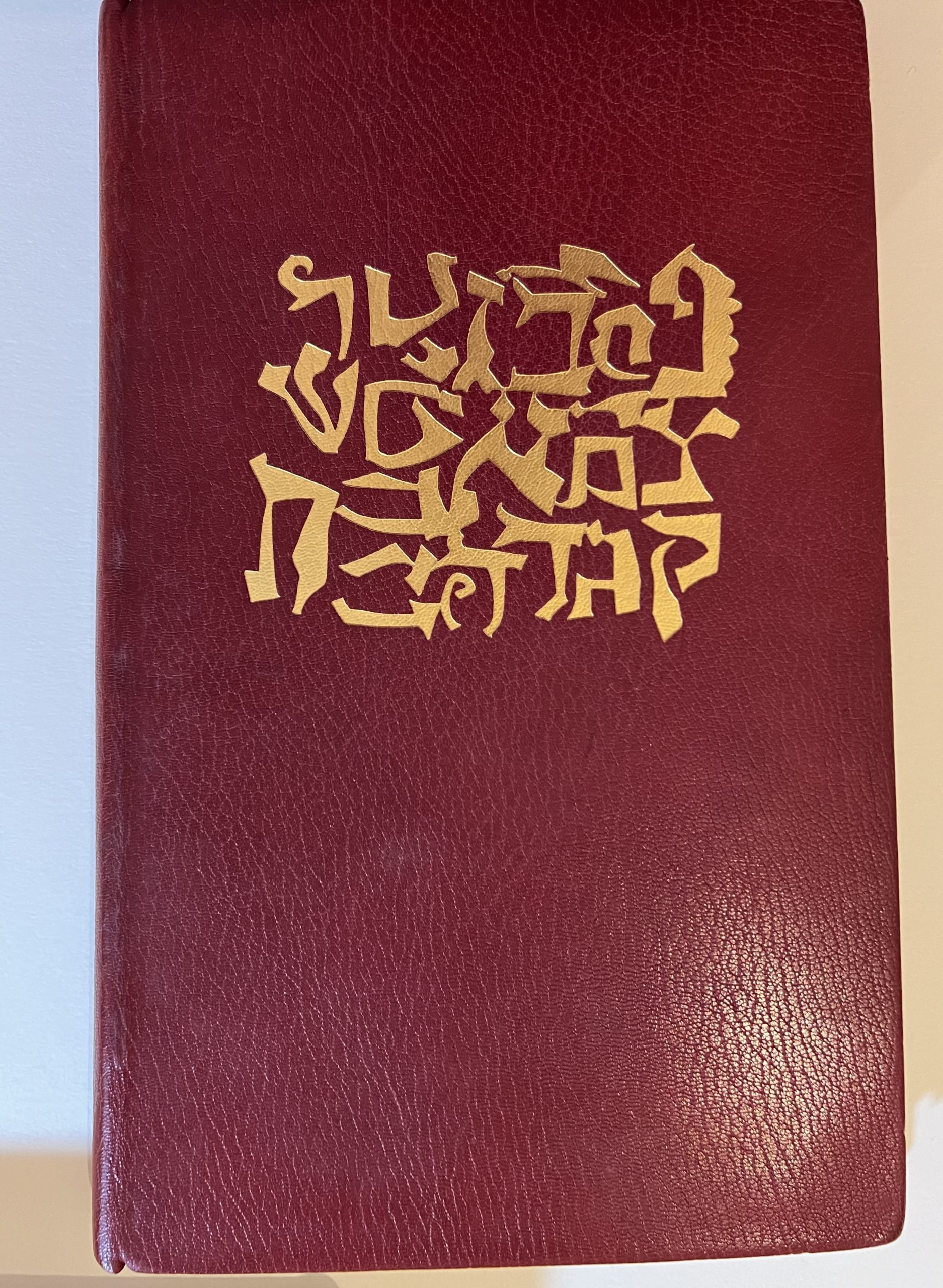
“In 1954 I made a book of this legend, rewriting it from several fairly conflicting accounts and creating at the same time my own version of the Hebrew alphabet. This reverts, I suppose, to an early time in the evolution of the Hebrew letters, a time when the letters were free, and when . . . each letterer created his own variation of the basic forms.” —Ben Shahn (Love and Joy About Letters 157)
Introduction
Ben Shahn’s The Alphabet of Creation is more than an illustrated book; it is a rich fusion of art, spirituality, and cultural heritage, rooted in Jewish mysticism and the artist’s personal journey. The version held by the Colby College Museum of Art, a unique maquette that Shahn personally designed and had professionally bound for his collection, offers invaluable insight into his process and devotion to the work’s themes. This essay explores how Shahn’s fascination with the Hebrew alphabet and the mystical text of the Zohar inspired The Alphabet of Creation, transforming it from a traditional narrative into a visual and spiritual exploration. Drawing on insights from Shahn’s own writings, Bernarda Bryson Shahn’s books, and Howard Greenfeld’s biography of Shahn, this paper examines the elements that make this work a powerful expression of Shahn’s artistry, including his love for letterforms, his fascination with mysticism, and the unique attributes that the Colby maquette.
Description
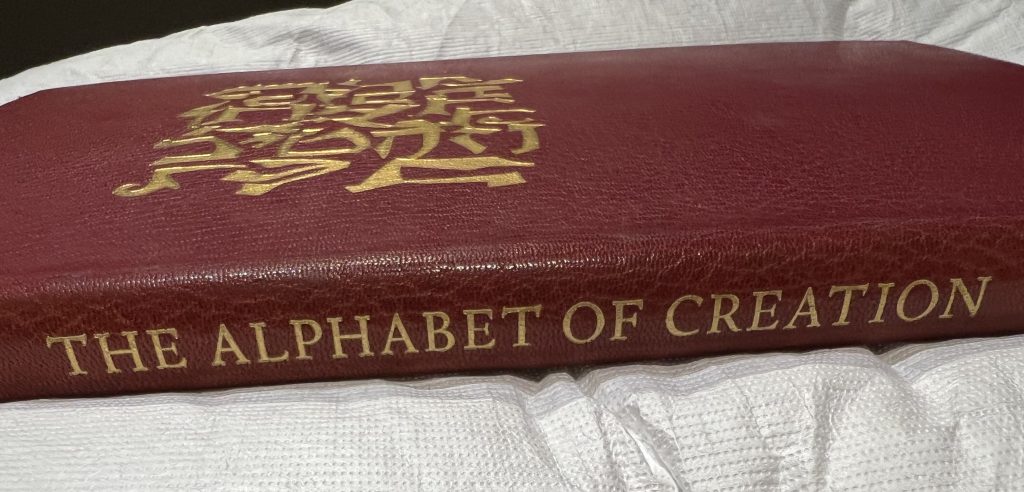
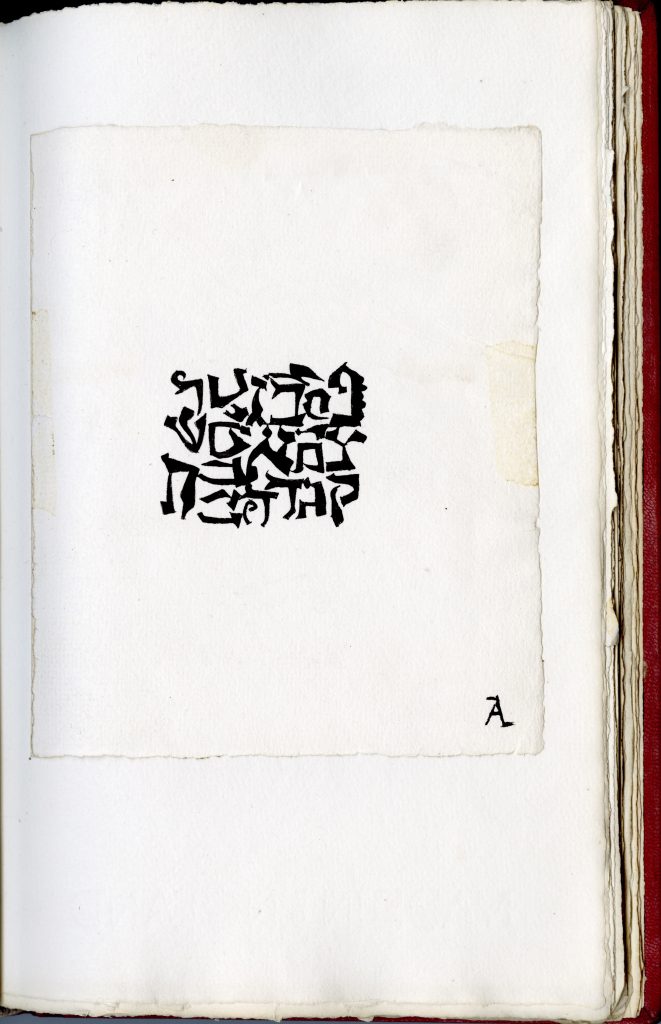
The maquette of The Alphabet of Creation in the Colby College Museum of Art is a singular artifact that provides a deeply personal glimpse into Ben Shahn’s creative vision and process. This unique work was created before 1954 when the first edition was published by Pantheon Books. Distinct from the later trade editions, this version is notable for its physical presentation and the intimacy of its design. Its binding measures 10 1/8 by 6 1/2 by 5/8 inches while the untrimmed paper sheets 9 7/8 by 6 inches. It is safe to say that the maquette was professionally bound in a luxurious fashion: red calfskin, with the title tooled in gold on the spine and Shahn’s signature chop on the front cover. The chop contains the entirety of the 22 Hebrew letters, “In Japan he had a chop created of the Hebrew alphabet, which he stamped on new and even older works” (Ben Shahn: On Nonconformity 2024 31). He reflects that the Hebrew letters in this work harken back to an earlier era when their forms were fluid and dynamic, akin to the creative freedom seen in traditional Chinese and Japanese calligraphy, where each artist developed their unique interpretation of the basic characters (Love and Joy 157).
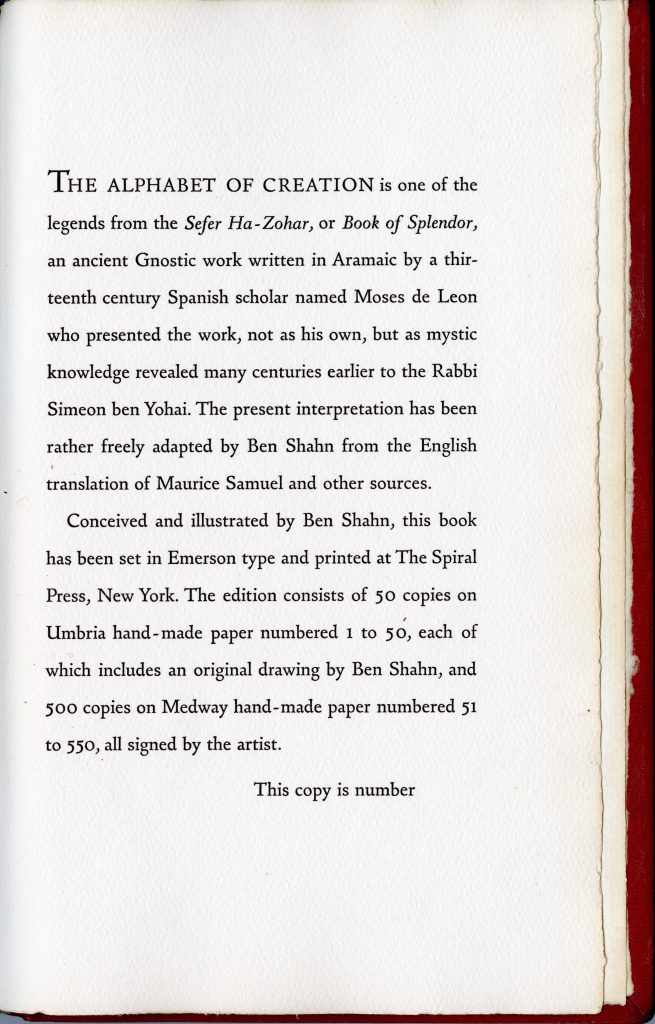
Another luxury feature is the beige slipcase protecting the book, measuring 10 3/8 by 6 3/8 by 1 in., with tiny red leather parts to cover the arch of the spine, making the case a perfect seal. Also to be noted is the inclusion in the binding of Colby’s maquette of the printed first page and the colophon from the 1954 trade edition. This could only be achieved after the maquette would have been returned by The Spiral Press, further suggesting that Shahn did not see this piece as a draft that can be discarded.
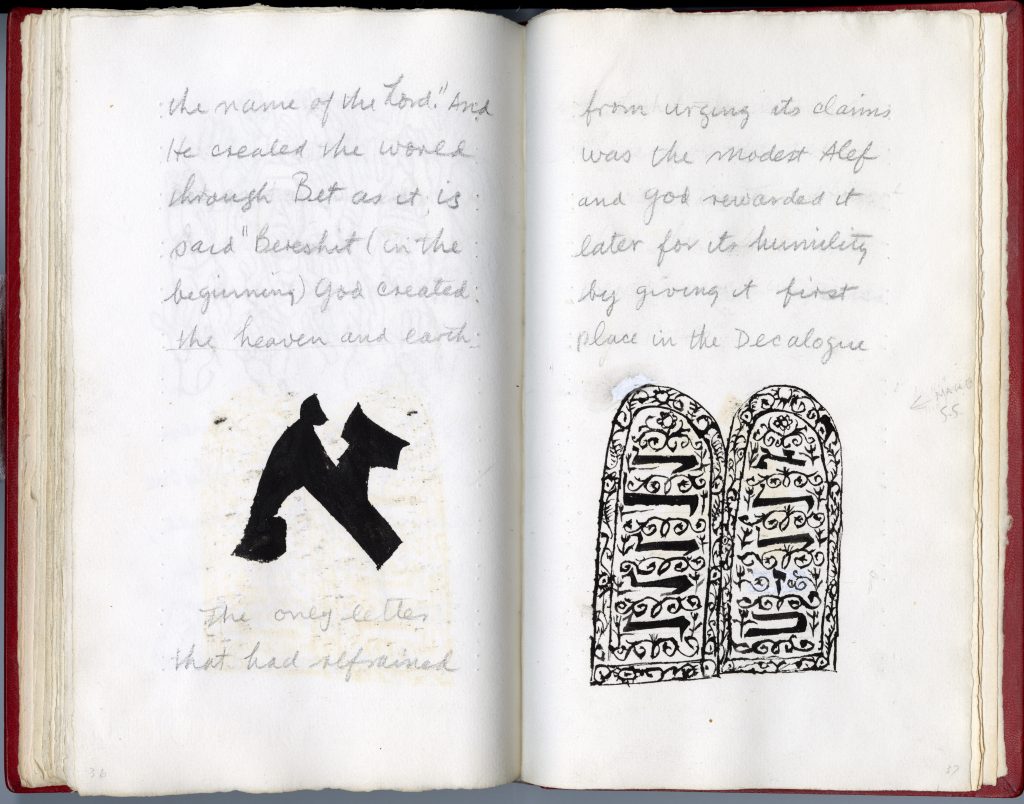
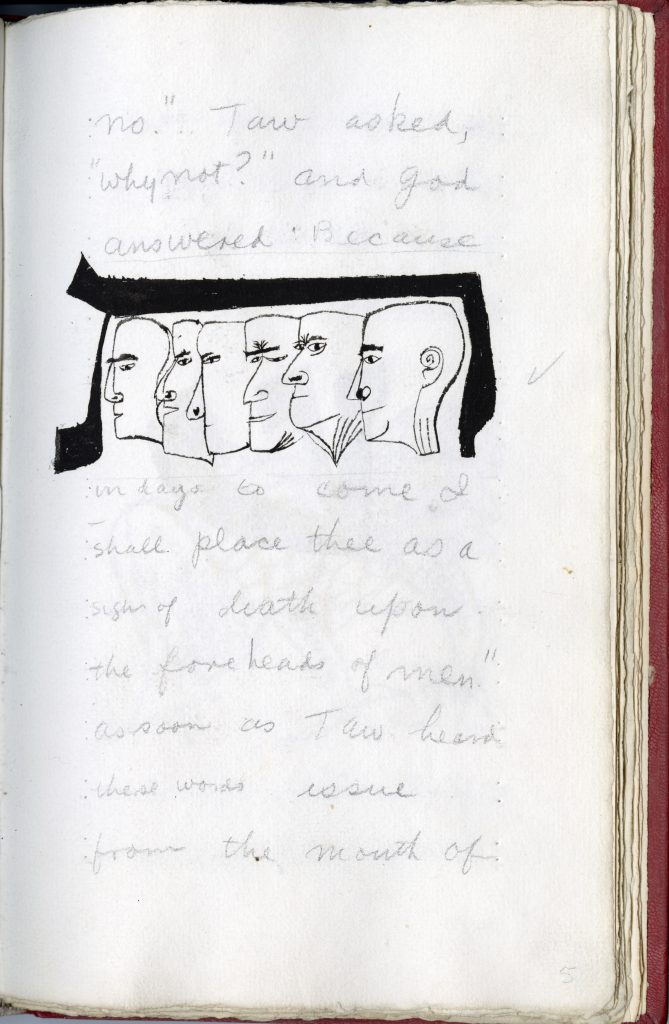
The maquette begins with three blank folios, which are followed by six ink drawings, each displayed on a recto. It contains thirty-five pages of handwritten cursive text in pencil, accompanied by forty-one ink drawings merged with the paragraphs, and three separate ink drawings each a smaller piece of paper tipped into the binding, and four blank pages, before concluding with the colophon. The pages combine handwritten texts with original drawings executed in both pencil and ink, showcasing Shahn’s profound engagement with the Hebrew alphabet and his efforts to bring its mystical themes to life.
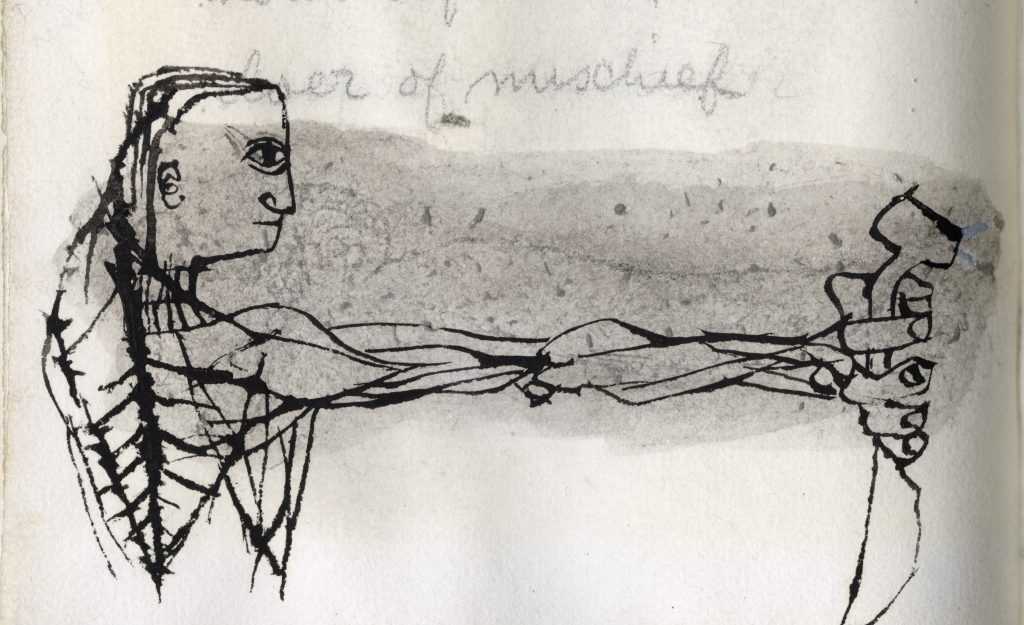
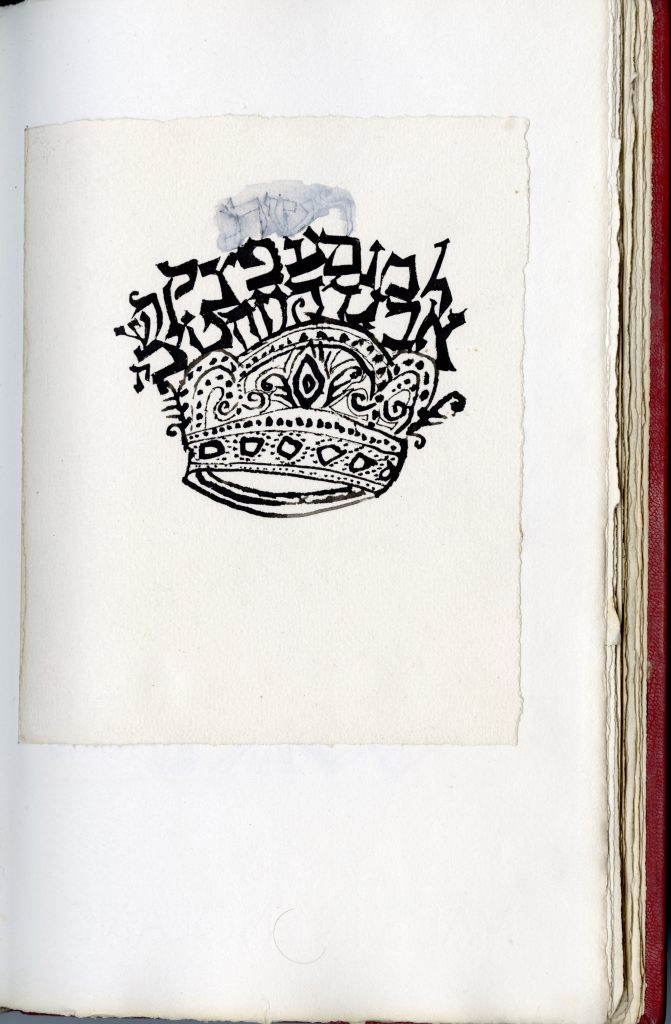
On page 28, we witness Shahn revising his original depiction; the muscular male profile with extended arms has been dimmed and revised with water and was not included in the trade version. On one of the sheets tipped at the beginning that bears a crown with Hebrew letters, we see the contours of more letters that were not filled in, revealing his process of creation.
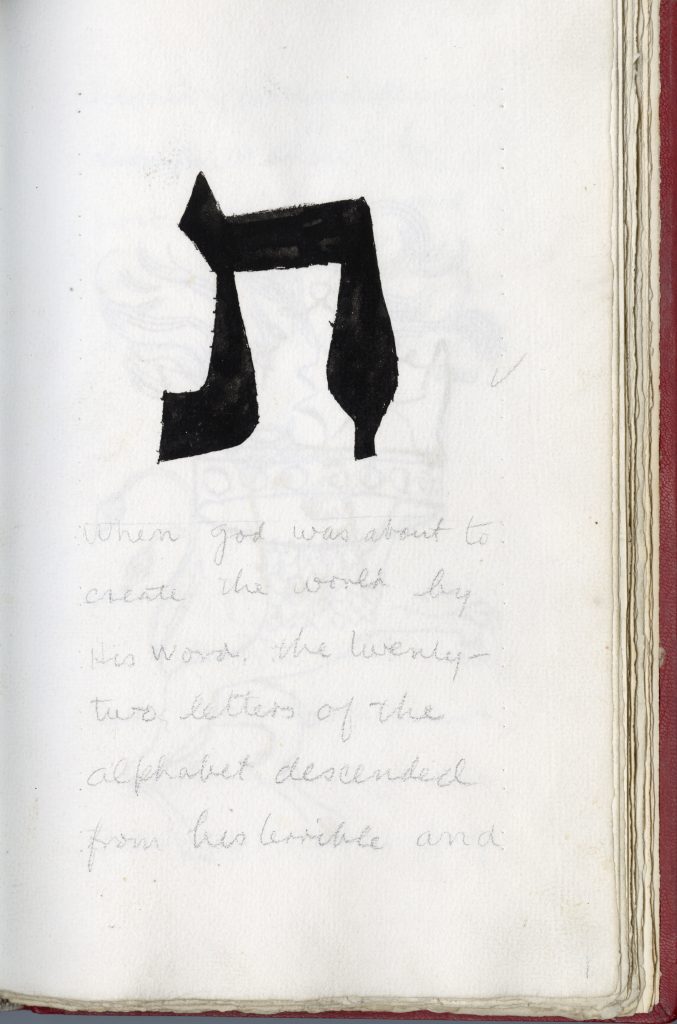
Shahn’s calligraphy plays a central role in the book’s design, reflecting his deep fascination with letterforms and the visual harmony he derived from the Hebrew script. In Love and Joy About Letters, Shahn expressed his lifelong reverence for letters, viewing them as vessels of mystical and creative potential. He wrote, “I loved to draw and to contemplate the big flowing letters; I was most at home with them,” a sentiment carried in the organic, flowing style of his calligraphy within this book (143). This exploration of letters as “quantities, and spaces are quantities” (146) is evident in the maquette, where the interplay of text and negative space is meticulously balanced, allowing each letter to breathe and resonate on the page. Like Tav, the black, thick, and square silhouette pertains a strength and audacity to the letter in his texts (Shahn, Alphabet of Creation 1).
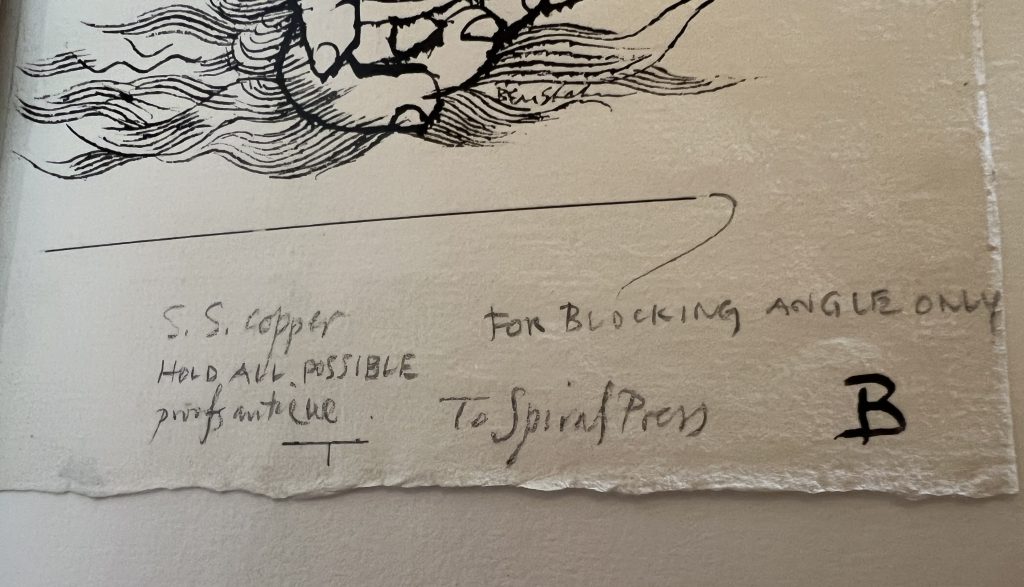
The colophon indicates that 550 copies were set in Emerson type. As a result, the pages’ layout was altered with Shahn working with Joseph Blumenthal, the owner of The Spiral Press (Bryson Shahn 237). In the maquette, there are numerous instructions on how to place the drawings, along with lined frames in pencil, consolidating the status of this edition as a live record of the production process. The presence of page layouts, scattered notes, and carefully placed illustrations gives the maquette an experimental quality that allows us to witness Shahn’s creative process.
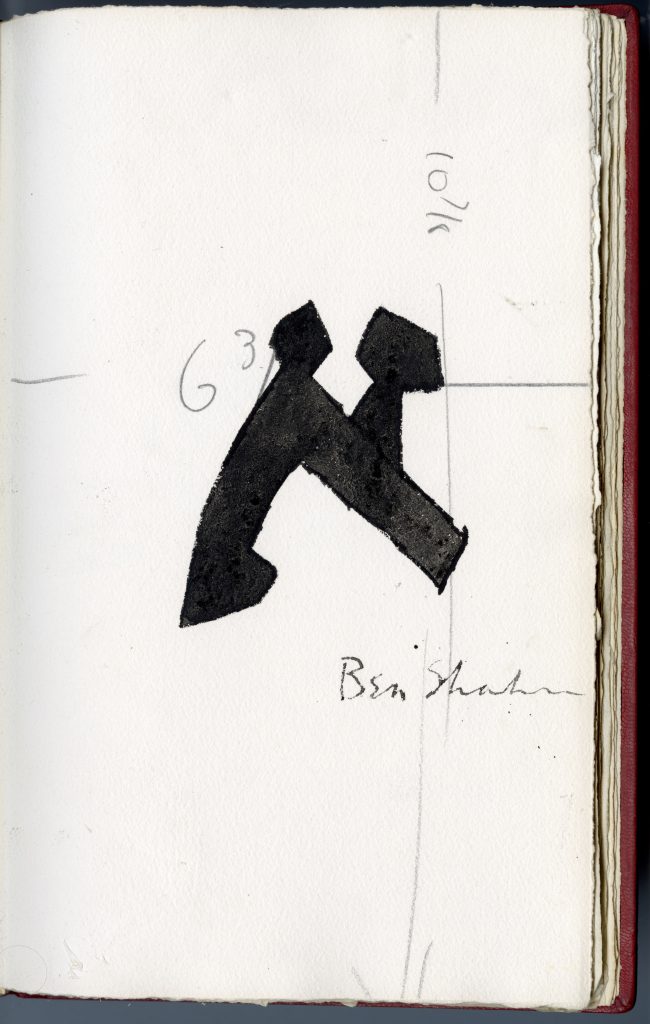
Along with the Hebrew letters, Shahn incorporates images that highlight their mystical and symbolic significance. Rather than functioning solely as linguistic elements, each letter is presented as both a visual and spiritual symbol, an interpretation inspired by the Kabbalistic teachings of the Zohar. Drawing from various versions of the Zohar, Shahn crafted his own narrative in The Alphabet of Creation, embracing the idea that each Hebrew letter embodies divine energy and serves as a vessel of creative power (Love and Joy 148).
Shahn’s retelling of the legend of the Hebrew alphabet brings to life the mystical tale of creation, where each letter appeals to the Lord to be the instrument of the world’s genesis. Beth’s plea, rooted in its association with “Baruch” (blessed), earns it the honor of creating the world, as reflected in the opening of the Torah: “Bereshith—in the beginning, God created the Heaven and the Earth.” Yet, the tale’s heart lies in Aleph’s humility. Declining to vie for recognition, Aleph is ultimately exalted, becoming the first letter of the Decalogue (Love and Joy 157).
The Zohar’s Significance and Jewish Scholarship
The Zohar, a foundational text of Jewish mysticism, plays a crucial role in Ben Shahn’s The Alphabet of Creation. Known as the Book of Splendor, the Zohar is traditionally attributed to the Spanish-Jewish mystic Moses de León, who claimed it was based on the teachings of an earlier sage, Rabbi Simeon ben Yohai (Love and Joy 148). Written in Aramaic, this mystical text delves into the esoteric interpretations of the Torah, exploring themes such as the nature of God, the structure of the universe, and the symbolic power of the Hebrew alphabet. According to the Zohar, each letter of the Hebrew alphabet holds divine energy, playing an active role in the creation of the world. This concept of letters as carriers of mystical meaning resonated deeply with Shahn, who saw in them a profound connection between language and spirituality, “[t]he glory of Hebrew that I had sensed so deeply as I had first learned to make the letters. Now I did not hesitate to register my own feelings” (Love and Joy 148).
Shahn’s adaptation of The Alphabet of Creation was his own reimagining of these mystical ideas. The book allowed him to pursue his lifelong fascination with “letters and lettering,” as he sought to bring to life the Zohar’s teachings on the power and mystery of letters. The text provided a structure and narrative for Shahn’s exploration of the Hebrew alphabet, pushing him to reinterpret ancient symbols through his unique visual style.
Shahn’s knowledge of Hebrew, however, was limited, which led him to consult with Jewish scholars to ensure accuracy and authenticity in his interpretation. Among these scholars was Moshe Bressler, Shahn’s neighbor in Roosevelt, New Jersey. Bressler, a Jewish scholar and folklorist, became an essential resource for Shahn (Greenfeld 275). The close relationship between Shahn and Bressler reflects the traditional Jewish reverence for scholarship, where intellectuals engage deeply with religious texts, constantly placing themselves “in conversation” with the written word. In Jewish tradition, these figures are more than academics; they approach sacred writings with a sense of devotion, uncovering layers of meaning that connect readers to divine wisdom (Holtz 15). Through his guidance, Bressler helped Shahn navigate the complexities of the Zohar’s mystical language, enriching the authenticity of The Alphabet of Creation.
In addition to textual guidance, Shahn’s interpretations of the Hebrew letters—bold, creative, and deeply symbolic—reflected his own artistic sensibilities while honoring the Zohar’s mystical perspective. Shahn sought to bring each letter to life in ways “playful and witty, playful and threatening,” turning the letters into entities with their own expressive power (Love and Joy 158). Through his visual reinterpretations, Shahn transformed the letters into works of art that speak to the ancient belief in their creative and spiritual potency, bridging the gap between traditional mysticism and modern art.
Artistic Process and Creative Joy
When Shahn declares: “Who can fail to find there an immediate sense of the hand that made the letters? There is a joy of workmanship that no time and weathering can erase,” he confirms his ardor in the shapes and form of letters, and even across cultures (Love and Joy 161). He also writes about his preference for writing in long-hand, as the text appears “more intimate and more real.” He added: “If I come across a passage in a book, or a piece of verse that I want to make my own—as some people make such things their own by memorizing them—I sometimes write it in longhand. And I’d like to incorporate such script in paintings” (Love and Joy 161). Such sentiment is reflected in our maquette. The perceived freedom is also confounded under the lines he draws to situate the ink paintings. According to Bernarda, Shahn perceived his ethnic ties and religion only to be hindrances to autonomy, but he did remain religious and had begun this process of rediscovery “when he had become assured in the authority of his own conscience” (Bryson Shahn 257).
Conclusion
The Alphabet of Creation’s maquette captures the depth of Ben Shahn’s creative process, offering a glimpse into the development of his ideas from rough sketches to refined, final pages. This artifact is more than a prototype; it reflects Shahn’s meditative engagement with the Hebrew alphabet and his effort to blend contemporary artistry with the mystical teachings of the Zohar. Through its thoughtful design and annotations, the artifact transcends its physical form, serving as a bridge between tradition and modernity. Shahn’s work preserves the spiritual power of the Hebrew letters while reimagining them for a new audience, leaving behind a legacy of profound artistic and cultural significance.
Sources Cited
Ben Shahn: On Nonconformity. Edited by Laura Katzman. Exhibition catalogue. Museo Nacional Centro de Arte Reina Sofía, Madrid, 2024. 31.
Bryson Shahn, Bernarda. Ben Shahn. New York: H. N. Abrams, 1972.
Greenfeld, Howard. Ben Shahn: An Artist’s Life. New York: Random House, 1998.
Holtz, Barry W, Back to the Sources: Reading the Classic Jewish Texts. New York: Simon & Schuster, 1986. 15-16.
Morse, John D. Ben Shahn. New York and Washington: Praeger, 1972.
Shahn, Ben. The Alphabet of Creation: An Ancient Legend from the Zohar. New York: Pantheon Books, 1954. Trade edition: New York: Schocken Books, 1965 and 1988.
—–. Love and Joy About Letters (1957). Reprinted in Ben Shahn. Ed. John D. Morse. New York and Washington: Praeger, 1972. 143–63.