Ben Shahn’s Children and God: Reflections on Spirituality and Shared Humanity
Noam Reinhorn
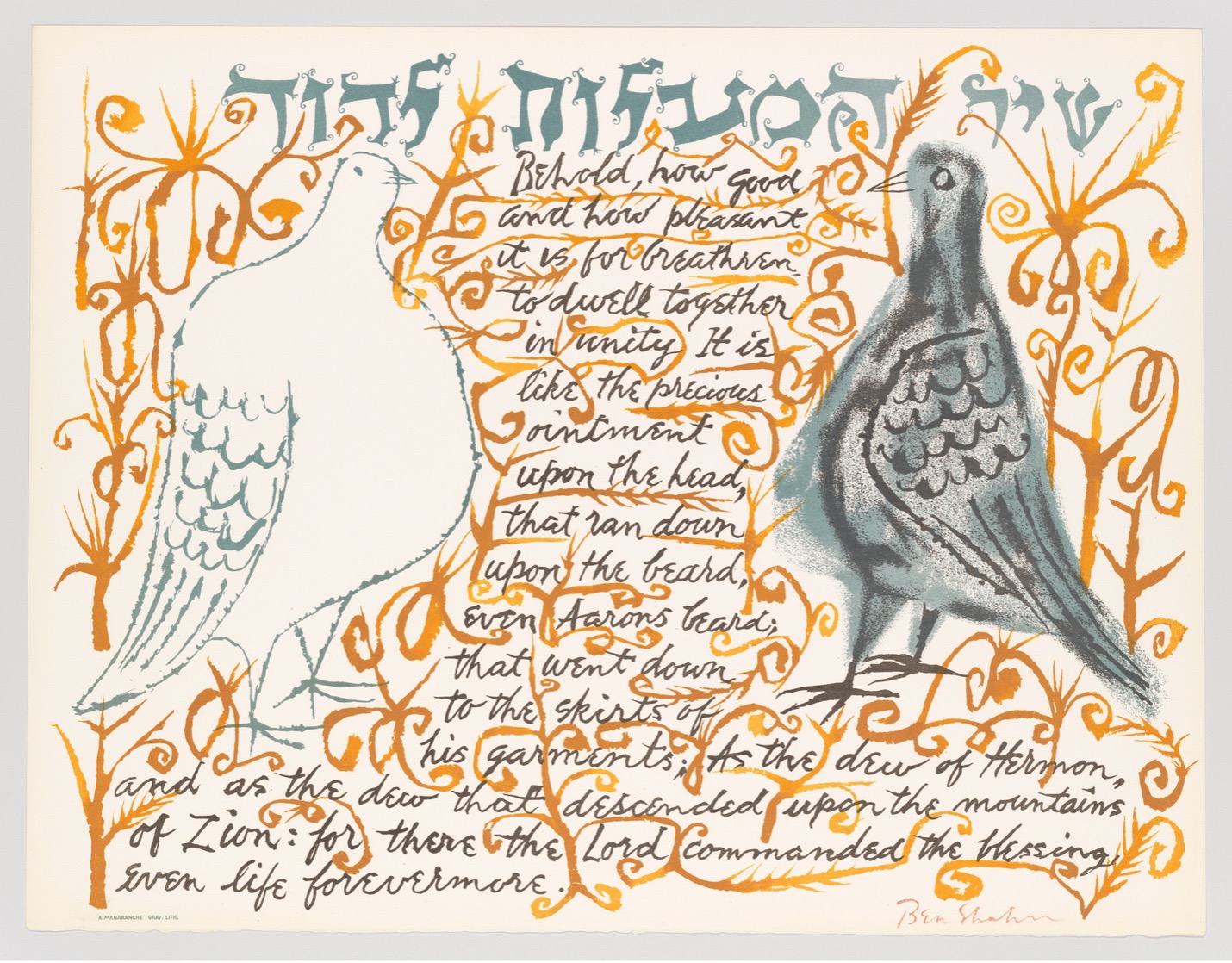
During the 1960s, Ben Shahn experienced a significant evolution in his artistic endeavors and personal introspection. Bernarda Bryson Shahn writes in the introduction to Hallelujah that Shahn was able to return “freely” to the “religious ties and traditions” of his youth “without the sense of moral burden and entrapment” (Bryson Shahn, “Introduction” 1). The introspective focus of his later career is reflected in his 1963 lithograph of Psalm 133, where Shahn explores spiritual and existential themes by giving visual form to the Psalms’ poetic and deeply human qualities. His vibrant colors, bold lines, and expressive typography convey emotional significance, emphasizing the joy of living together in unity. Psalm 133 blends modernist aesthetics with traditional subject matter, bridging contemporary art with timeless spirituality. Shahn employs a symbolic language that draws from both his Jewish heritage and broader humanist themes.
Despite this introspective turn, Shahn remained deeply committed to social commentary and activism. His 1965 portrait of Martin Luther King Jr. for the cover of Time magazine demonstrates his belief in art as a force for social change, addressing issues of human suffering and oppression. Similarly, Children and God reflects Shahn’s evolving desire to capture unfiltered perspectives, this time through the voices of children. This project aligns with his rejection of labels, as he stated in 1966: “I am a human artist. I don’t like categorization in groups” (Kirshenblatt-Gimblett 202). Shahn’s mindset, rooted in breaking free from societal constraints, influenced his approach to Children and God, in which he explores spirituality as a shared human experience rather than one tied to specific cultural or religious traditions. By focusing on children’s candid reflections, Shahn blends his activism with the introspection that he experienced later in life, creating a work that bridges social engagement with personal exploration of universal themes.
Ben Shahn and Tony Schwartz
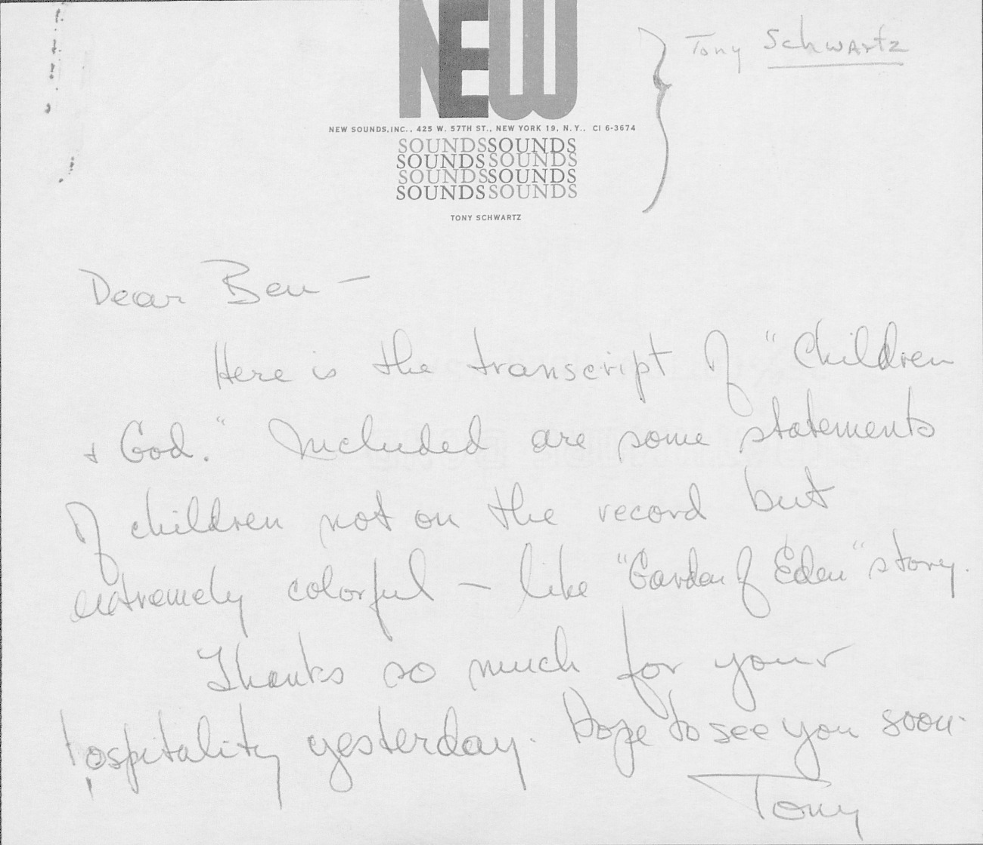
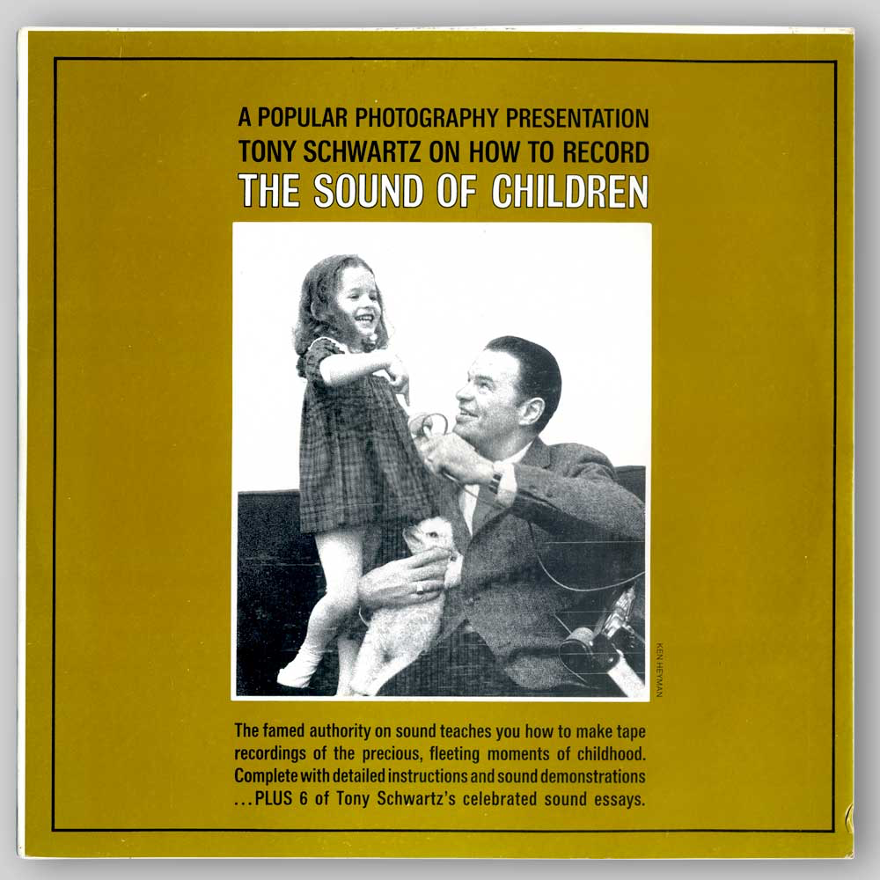

Collaboration between Ben Shahn and Tony Schwartz was pivotal in shaping Children and God. Abby Shahn remembers the two men’s relationship, which extended beyond a professional engagement to a personal friendship. Ben Shahn’s papers in the Archives of American Art hold a letter that Tony Schwartz sent Shahn along with transcripts of some of the interviews he had conducted with children on the topic of “Children and God.” Referring to a record which came out in 1967, Schwartz explains that these “are some statements of children not on the record but extremely colorful” (Archives of American Art and Schwartz).
Shahn and Shwartz’s collaboration was defined by mutual respect: Schwartz’s recordings offered an unfiltered glimpse into children’s spirituality, and Shahn sought to free the children’s voices from any imposed narrative, allowing their reflections to speak for themselves and given their voices a visual dimension that honored their simplicity. In the maquette, Shahn strives to preserve children’s authenticity by using the exact words of eight children while arranging the quotes to create a compelling narrative.
Analysis of the Maquette
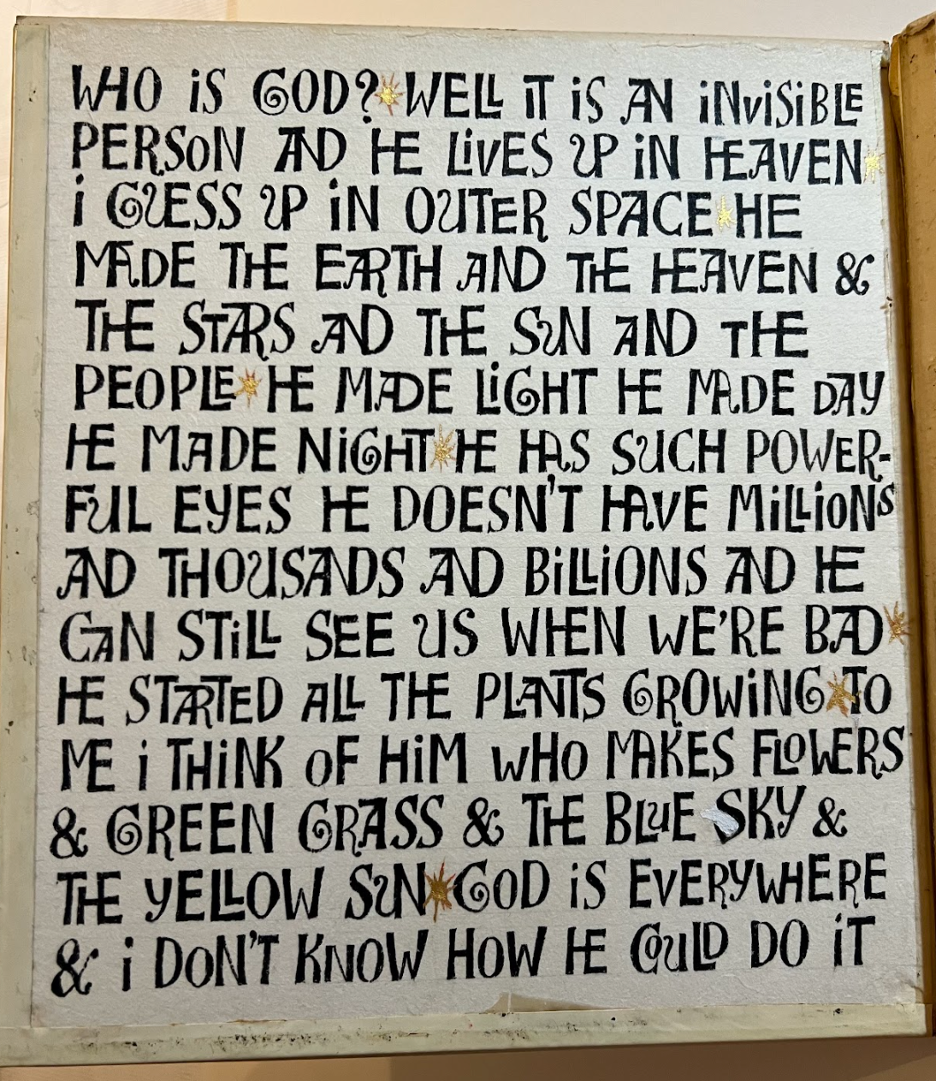
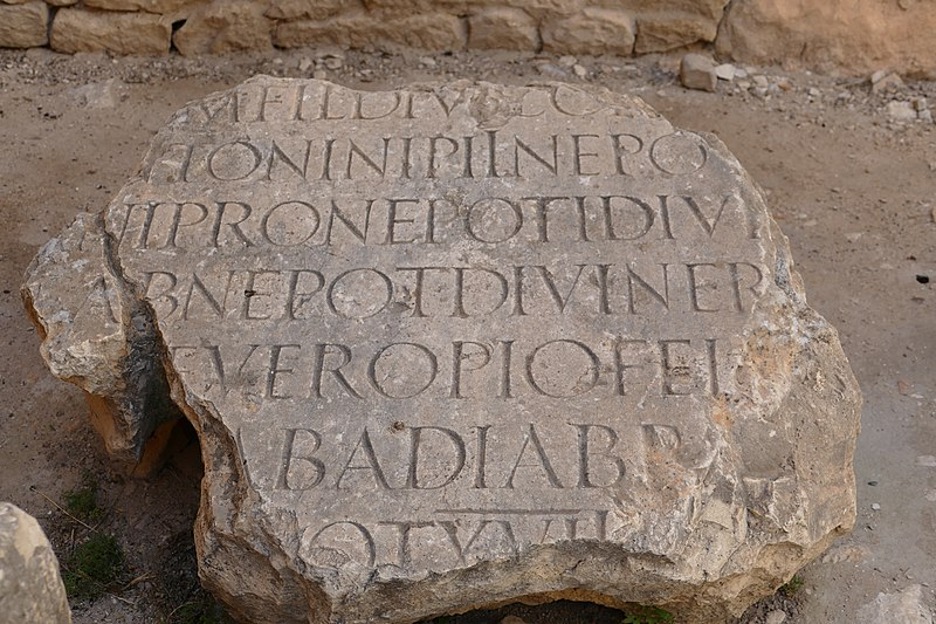
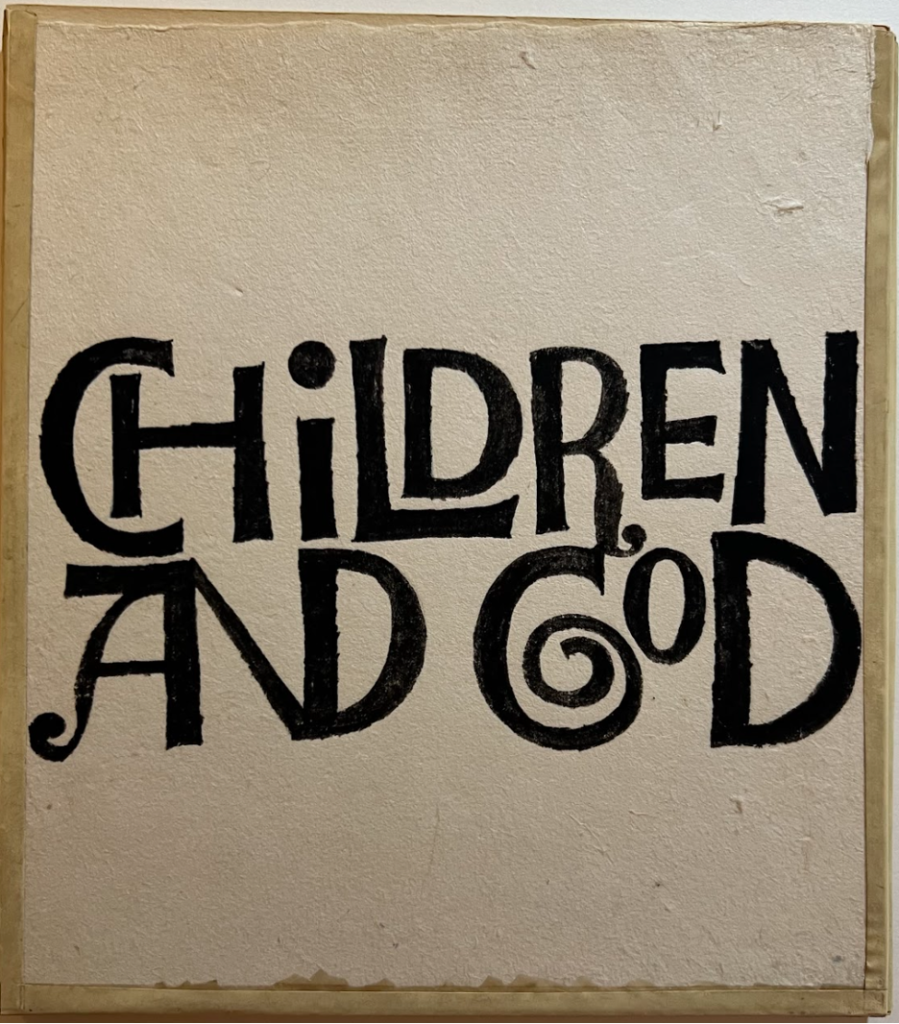
The bold text painted in black that appears on the cover has an unrefined quality, reminiscent of a child’s writing. It conveys the sincerity and spontaneity of children’s voices. The informal lettering establishes an immediate visual connection with the book’s central theme, signaling to the viewer that what lies within are the unfiltered views of children. Moving beyond the cover page, the reader is greeted with the only page of text in the book. The text’s placement on the page as a single paragraph resembles Ancient Roman transcriptions carved in stone. The page is densely filled with eight quotes from children, separated not by traditional punctuation, but by a golden star. This deliberate approach reflects Shahn’s mastery in his handling of letterforms. Bernarda Shahn notes that he “had to learn to space—the ultimate test of a letterer” (Bryson Shahn, Ben Shahn and Lettering” 90), underscoring the careful intention behind the design.
The text’s layout has a playful quality, reflecting the spontaneous nature of children’s imagination. The stars convey a sense of wonder and align with the theme of exploring divine concepts through children’s eyes. Shahn’s meticulous efforts to replicate the original words and phrasing of the children reinforce their authenticity. With this page layout, Shahn places the children’s reflections at the forefront, allowing their pure and unmediated views on spirituality to guide the reader through the book’s visual narrative.
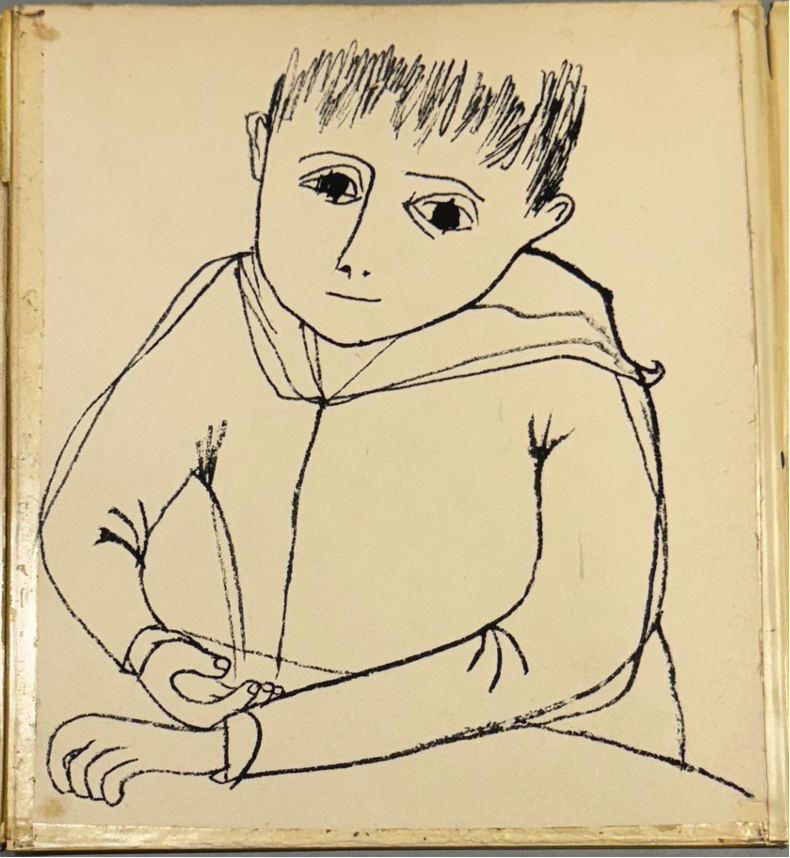
We next encounter an illustration of a child in a contemplative pose drawn in black brushstrokes. The simple lines and minimal details invite viewers to connect with the figure whose gender remains unclear. The top of the child’s head is left unfinished, suggesting openness, vulnerability and susceptibility to external influences.
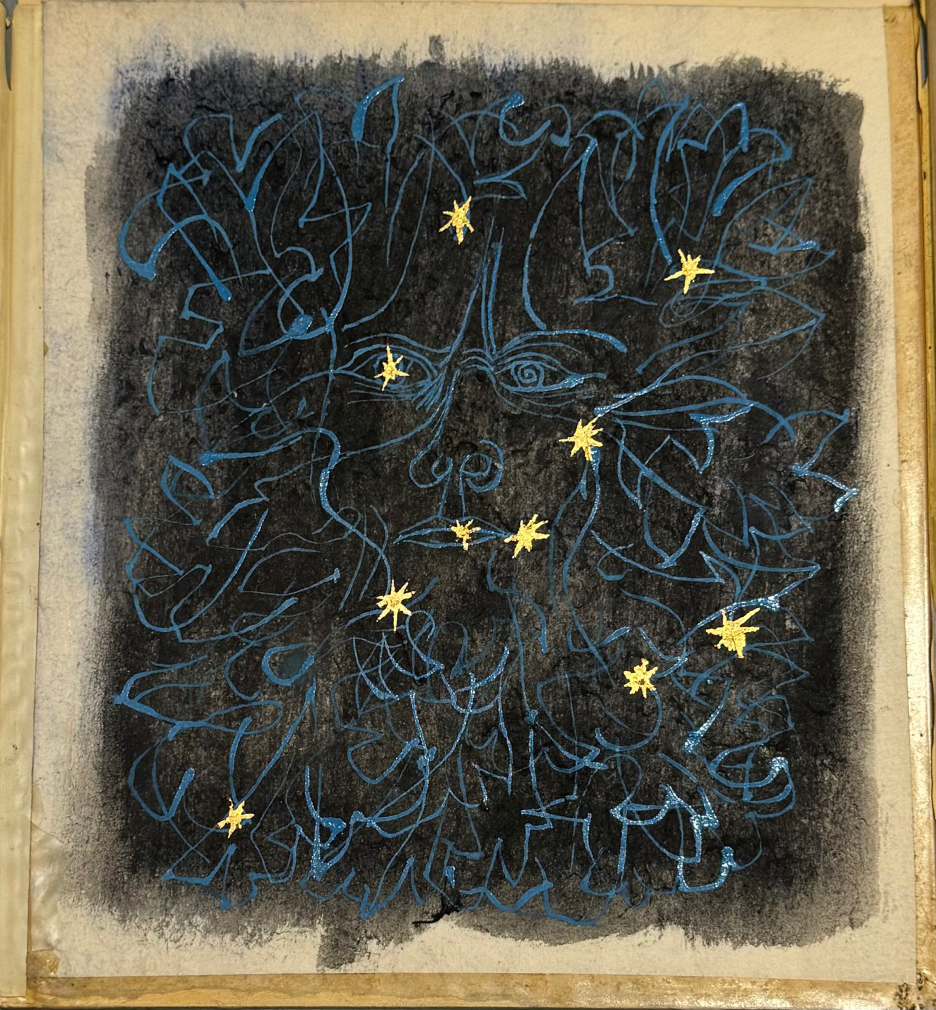
After this black-and-white figurative depiction, page three introduces a more abstract design, in which a face appears amid swirling lines and star that evoke a cosmic presence. The fluidity within the composition conveys expansiveness and boundlessness, reinforcing ideas of God as a limitless force, an idea that the children echo one after another. The golden stars recall those in the text and establish a consistent visual language that suggests the divine throughout. This idea of God as a boundless force aligns with the concept of a higher power that transcends cultural boundaries, much like the portrayal found in Deutero-Isaiah, a text that Shahn may have been familiar with. In these writings, God is depicted as the creator of the entire universe, a common figure for all of humanity. Julian Morgenstern, a prominent American rabbi and biblical scholar, highlights that Deutero-Isaiah emphasized God as “the Universal God, and only secondarily, as an act of choice by Him, did He enter into a particularistic relation with Israel” (Morgenstern 271). This vision of a universal God, who is a god to all people, echoes throughout Shahn’s book, which does not focus on a specific religion but instead presents God as an idea that unites. By focusing on God rather than one religious doctrine, Shahn invites readers to see divinity as a shared human experience, accessible and relatable to all, regardless of individual beliefs or cultural backgrounds—or even of age.
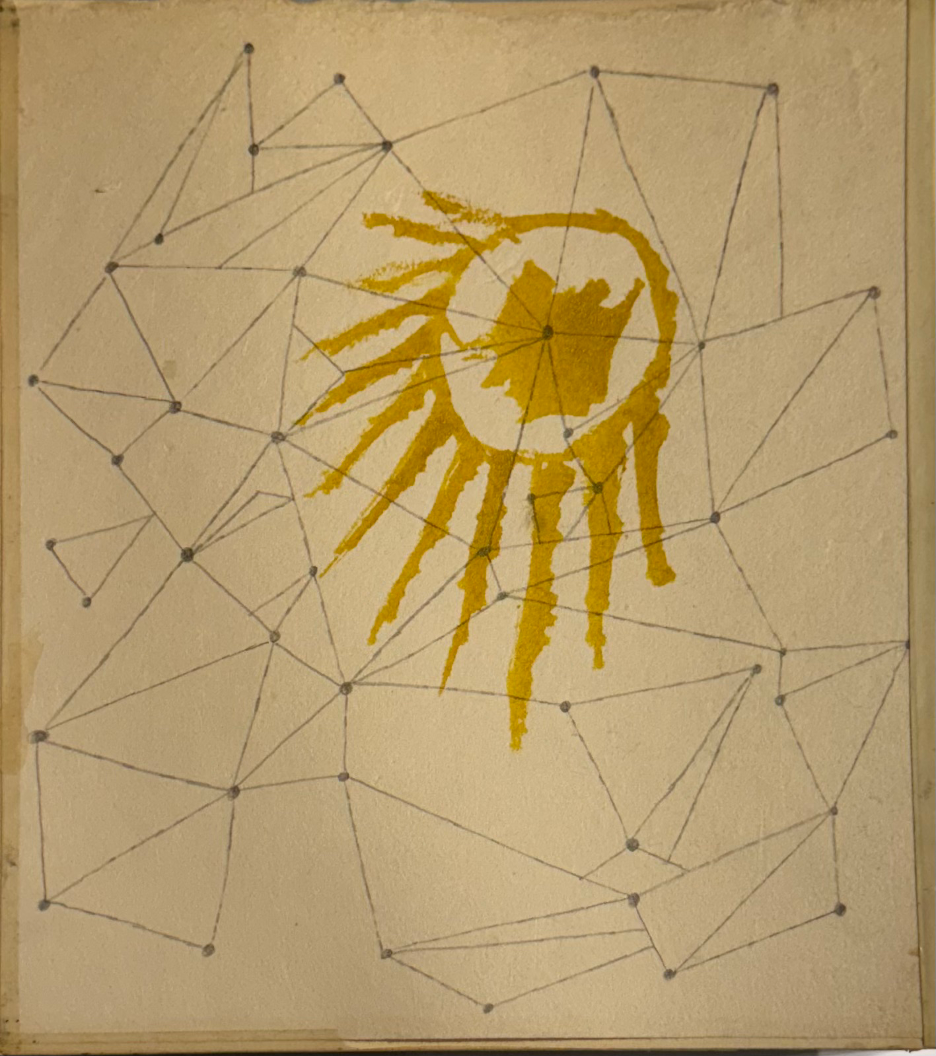
Shahn’s next illustration introduces an atomic dimension to his depictions of God. As an artist in the Atomic Age, Shahn was an active voice in peace movements following World War II, particularly advocating against nuclear weapons. His work often depicted scientists, victims, and atoms, reflecting his engagement with themes of human vulnerability and scientific discovery (Katzman 221). The depiction of atoms and molecules in Children and God is not a novelty but a recurring theme throughout Shahn’s career. In Lute and Molecules, Shahn juxtaposes a musical instrument with elements that closely resemble those found on page four image of Children and God, this time combined with a stylized sun with radiating lines, which suggest a relationship between the spiritual and physical realms, hinting at divinity as a life-giving and unifying force. By incorporating atomic and molecular imagery, Shahn suggests that God’s presence permeates human existence, emphasizing a collective connection that transcends individual lives and binds humanity together.
Final Thoughts
The last page of Children and God repeats that sun, this time illuminating a landscape of verdant trees, symbolizing growth and vitality. The contrast between the warm sun and rich greens and blues conveys the developing aspect of creation. Shahn’s use of the sun as a recurring motif reinforces the idea of God as a life-giving force. Through this imagery, Shahn presents God not as tied to a specific religion but as a universal creator, sustaining life and uniting all humanity—a reflection of the children’s descriptions of God as a nurturing and boundless presence. In the interviews, the children frequently mentioned God’s role in encouraging them and the natural world, highlighting their innocent perception of God as a caring force that is both protective and creative. This concluding image encapsulates Shahn’s vision of a world where divinity is a shared experience, transcending individual belief systems and offering a common ground for all. Children and God ultimately testifies to the idea that spirituality, creativity, and innocence can connect people across boundaries, encouraging readers to come together.
Sources CitedAlley, Ronald, Catalogue of the Tate Gallery’s Collection of Modern Art other than Works by British Artists, Tate Gallery and Sotheby Parke-Bernet, London 1981, p.686
Archives of American Art, Ben Shahn Papers, 1879–1990, bulk 1933 – 1970, Box 34, Folder 29: “Children of God” (interviews of children) by Tony Schwartz, circa 1955. https://www.aaa.si.edu/collections/ben-shahn-papers-6935/series-10/box-34-folder-29 [accessed 27 November 2024].
Bryson Shahn, Bernarda. “Ben Shahn and Lettering.” The Penrose Graphic Arts International Annual 66 (1973): 89–100.
Bryson Shahn Bernarda. “Introduction.” In Ben Shahn, Hallelujah: Twenty-Four Lithographs. New York: Kennedy Graphics, Division of Kennedy Galleries, 1970. 1-2
Continuo. “Tony Schwartz ‘The Sound of Children.’” 6 April 2009.https://continuo.wordpress.com/2009/04/06/tony-schwartz-the-sound-of-children/ [accessed 27 November 2024].
Greenfield, Howard. Ben Shahn: An Artist’s Life. New York: Random House, 1999.
Katzman, Laura, Beatriz Cordero Martín, Christof Decker, and John Fagg. Ben Shahn: On Nonconformity. Madrid: Museo Nacional Centro de Arte Reina Sofía, 2023.
Kirshenblatt-Gimblett, Barbara and Jonathan Karp, eds. The Art of Being Jewish in Modern Times. Philadelphia: University of Pennsylvania Press, 2008.
Morgenstern, Julian. “Deutero-Isaiah’s Terminology for ‘Universal God.’” Journal of Biblical Literature 62.4 (1943): 269–80.
Schwartz, Tony. “Children and God.” A Popular Photography Presentation: Tony Schwartz on How to Record the Sound of Children. Capital Custom, 1967. https://www.youtube.com/watch?v=pJS9HdbJYX0 [accessed 27 November 2024]. Reissued in
Tony Schwartz Records the Sounds of Children. Washington, D.C.: Folkways Records 1970.