Celebrating The Lord: Ben Shahn’s Artistic Rendition of Ecclesiastes or, The Preacher
Jenifer Zanabriga
Ecclesiastes or, The Preacher by Ben Shahn is an illuminated, handwritten version of the Old Testament book. The bound maquette measures 14 by 11 inches and is housed in a slipcase (14 x 11 x 7/16 inches). It contains thirty-four pages with Shahn’s cursive handwritten text of the book of Ecclesiastes, eight original watercolors, twelve illuminated Hebrew chapter headings that contain the opening line or an famous line from the chapter, and a cover decorated with gold leaf. Shahn’s paintings range from simple line art to overlapping forms and rich hues of watercolor.
A limited edition of 240 copies was printed in 1967 in Paris, France, by the Trianon Press. Twenty-six copies “were printed on Arches Grand Vélin pure rag paper,” 200 printed on “Arches Vergé pure rag paper” (Shahn, Ecclesiastes colophon), and fourteen were hors commerce. Each copy includes an original lithograph drawing signed by Shahn and faithfully reproduced facsimiles of the paintings (Shahn, Ecclesiastes, Colophon). Several Parisian workshops were involved in the production of the deluxe edition, contributing typography, lithography, serigraphy, collotype, stenciling, gold lettering, and binding. A trade edition came out in 1971 from Trianon Press and Grossman Publishers.
Background
In a foreword to the trade version of his book, Shahn writes about his personal connection with the scripture. He mentions the witty use his father made of the biblical book in order to cheat “the telegraph companies out of their toll for countless numbers of words.” By writing the reference to a verse that fit the context, be it a message of condolences or cheer, Shahn’s father demonstrated the text’s universality but also the widespread familiarity with it: “any person to whom my father might conceivably have been sending a telegram would without question have at his finger tips the Biblical passage referred to” (Shahn, Ecclesiastes “Foreword”). Another source of inspiration for Shahn stemmed from his interest to deeply engage with the content of the text and to “celebrate its of particular way of celebrating the Lord” (Shahn, Ecclesiastes “Foreword”). The verse “there is nothing better, than that a man should rejoice in his own works; for that is his portion: for who shall bring him to see what shall be after him?” (Eccles. 3:22) took on a particular resonance for Shahn and his decision to become an artist. For Matthew Baigell, Ecclesiastes 11:9 resonates for Shahn as a commentary on his own relationship with time and growing older (Baigell 113). Shahn created two artworks that allude to the significance of this verse for him, one in the maquette and before that in a book published in 1965 by Joseph Blumenthal’s Spiral Press (1).
Description of the Maquette
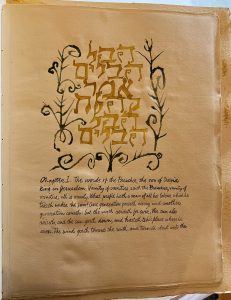
The preliminary stages of the maquette can be observed on pages one and three, which are mounted on a piece of larger paper. Right from the beginning of the book, with the first chapter heading and text, we see the importance that the dialogue between text and image holds for Shahn. On the whole, the appearance of the openings in the maquette are maintained in the Ecclesiastes trade book. However, since in the maquette Shahn wrote text on the reverse of his artworks while in the trade book it was left blank, the appearance of the openings varies slightly with text and image occasionally switching sides.
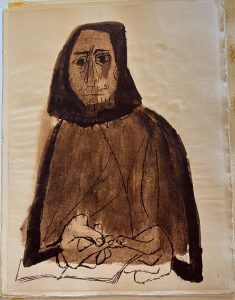
Every image responds to the text, some more directly. Bernarda Bryson Shahn refers to the first picture as The Preacher, corresponding to the opening verse: “The words of the Preacher, the son of David, King in Jerusalem” (Bryson Shahn 265; Eccles. 1:1). Painted in brown hues, we see a pensive man with folded hands holding a book. The figure wears a dark, hooded cloak and appears somber, echoing the verse: “For in much wisdom is much grief: and he that increaseth knowledge increaseth sorrow” (Eccles. 1:18; Shahn, Ecclesiastes 2).
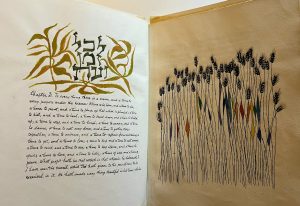
The illuminated heading of chapter three, with wheat leaves decorating Hebrew writing, echoes the facing image of a colorful wheat field. The image refers to the chapter’s famous opening that there is a time for everything, “a time to plant, and a time to pluck up that which is planted” (Eccles. 3:2; Shahn, Ecclesiastes 8).
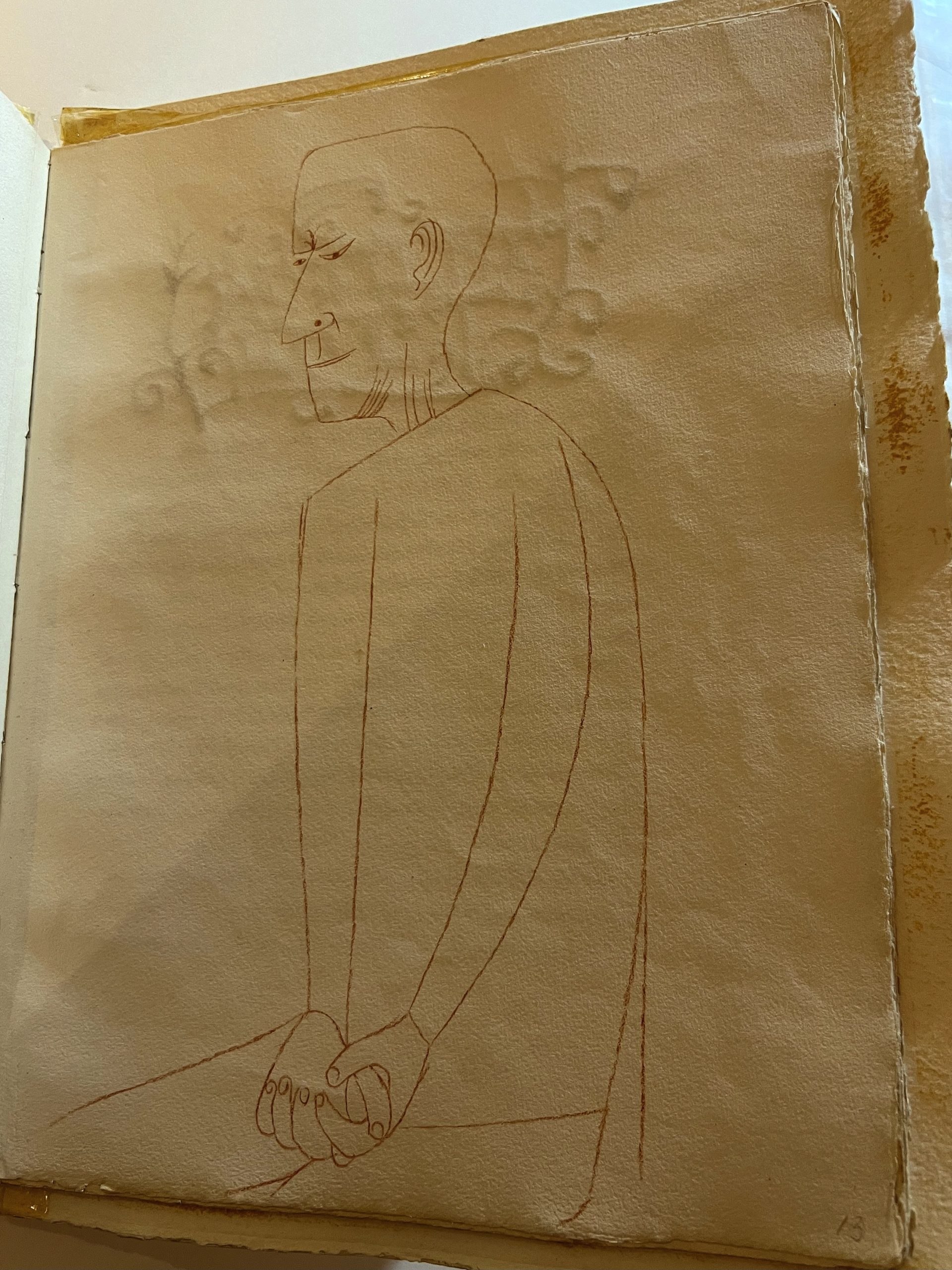
The outline of a lone man sitting with his hands on his lap, which corresponds to the verse “The fool foldeth his hands together, and eateth his own flesh” (Eccles. 4:5), which doesn’t appear on the same opening but on the previous page (Shahn, Ecclesiastes 11). This brief lapse of image and text correspondence can be taken as a pause for the reader to reflect on the text before turning the page and seeing the form materialize.
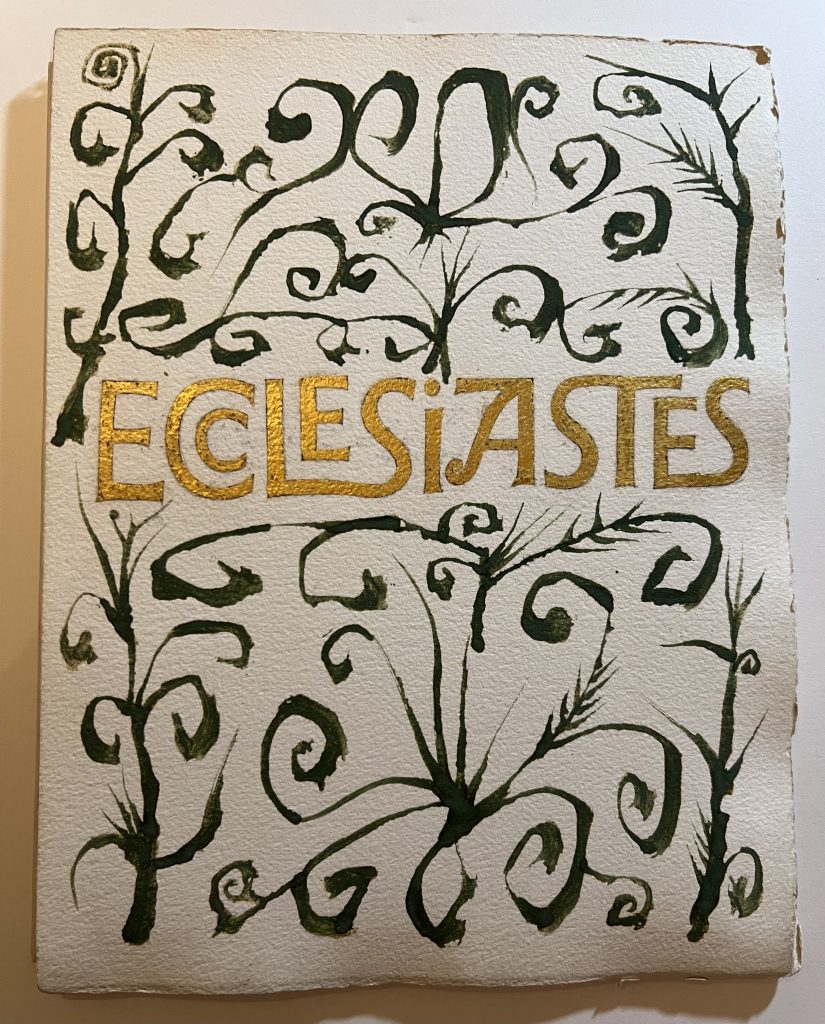
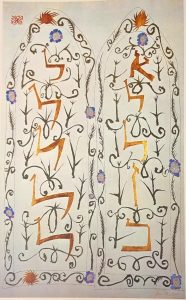
All twelve of the illuminated chapter headings include plant-like watercolor decorations made with a fine-tip brush in different watercolor hues. The decorative details resemble thin vines with spirals that curl around the Hebrew letters. The same vines grace the book’s cover. Two of the headings feature small, multicolored flowers in their design (Shahn, Ecclesiastes 4, 26). These flowers appear in earlier works.
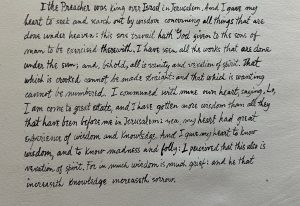
In addition to carefully decorating the chapter headings, Shahn’s decision to add calligraphed Hebrew writing to those headings and meticulously copy longhand the entire book confers a very personal dimension to scripture. Patricia Lovett notes the impact calligraphy has on a text’s content; the imperfections and irregularities of the letters allow the calligrapher’s personality to shine through and create a “specific expression, the expression of the scribe’s heart which is the secret of calligraphy, which is also the strength of calligraphy” (Lovett 147). Shahn recognized the value of imbuing the text with such a personal touch. Furthermore, the varying boldness of the cursive text reminds the reader of the act of handwriting as we are made privy to the dipping of the pen into the inkwell.
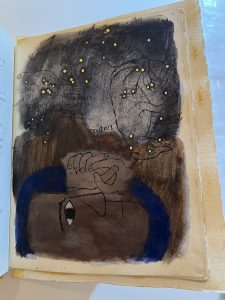

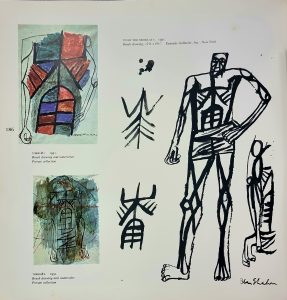
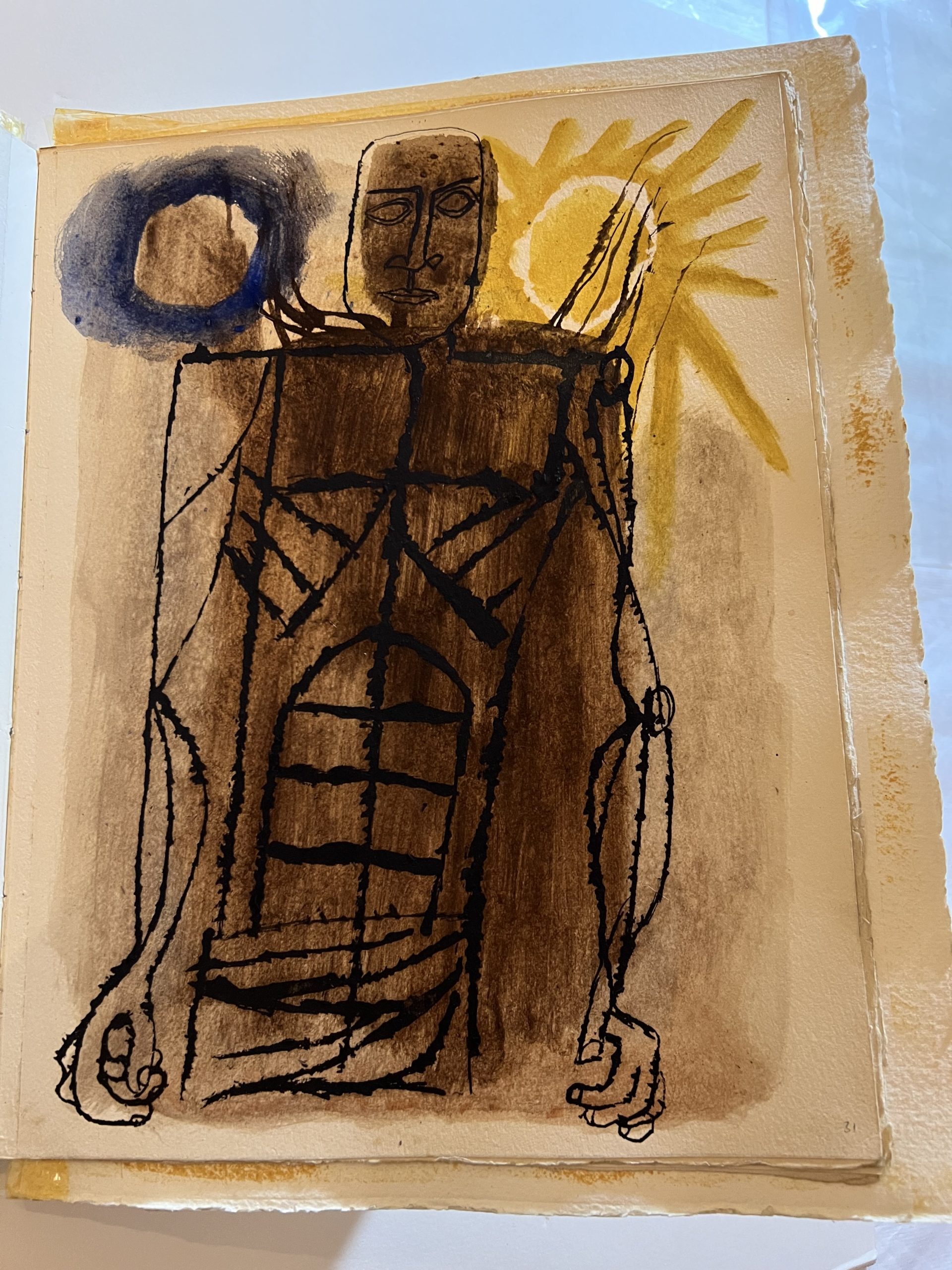
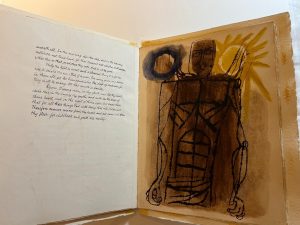
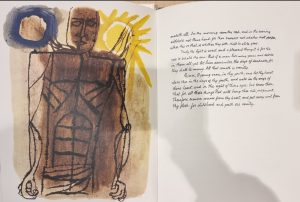
In Ecclesiastes, we recognize themes that recur throughout Shahn’s career, for instance, wheat fields. In Chapter eight, a dark colored male figure in profile, hands knitted together, looks up at a dark sky dotted with stars in which images and words float. This image is reminiscent of Shahn’s 1955 gouache Credo in which a similar figure looks up at a scroll that contains words. The image on page thirty-one that illustrates the verse that begins with “Rejoice O young man in thy youth” (Eccles. 11:9; Shahn, Ecclesiastes 30) features a muscled figure with a sun and a moon in the background, recalls sinewy figure studies from 1951.
Conclusion
Shahn believed that a careful balance must be struck between content and form so that “the form which does emerge cannot be greater than the content which went into it” (Shahn, The Shape of Content 72). Out of the twelve chapters in Ecclesiastes, Shahn created artworks for only eight of those chapters. Therefore, he made deliberate considerations for the paintings to be in tandem with the scripture, putting as much importance to the spiritual source of his inspiration into the ensuing artworks. Shahn stated that the function of forms is to “formulate ideas, to recreate them into entities . . . so that thinking and belief and attitudes may endure as actual things” (Shahn, The Shape of Content 70). For Shahn, Ecclesiastes was an opportunity to connect with biblical spiritual content and find joy through the artmaking process, celebrating the resurgence of his faith in the later part of his life.
Notes
- This edition was issued in 285 copies. Shahn’s drawings were engraved in wood by Stefan Martin and there was calligraphy by David Soshensky.
Sources Cited
Baigell, Matthew. American artists, Jewish images. Syracuse, N.Y.: Syracuse University Press, 2006.
Ben Shahn papers, 1879–1990, bulk 1933–1970, Archives of American Art, Smithsonian Institution Washington, D.C. https://www.aaa.si.edu/collections/ben-shahn-papers-6935 (Accessed 10 November 2024).
Bryson Shahn, Bernarda. Ben Shahn. New York: Harry N. Abrams Inc., 1972.
Lovett, Patricia. Calligraphy and Illumination: A History and Practical Guide. New York: Harry N. Abrams Inc., 2000.
Shahn, Ben. Ecclesiastes or, The Preacher. New York: Grossman Publishers, 1971.
—. The Shape of Content. Cambridge, MA: Harvard University Press, 1957.