A New Vernacular: Ben Shahn’s The Cherry Tree Legend
Julia Reilly
Introduction
Abby Shahn recalls that the Shahn family kept a folk record of The Cherry Tree Carol by John Jacob Niles in their home, and that Ben and Bernarda were particularly fond of it. The Cherry Tree Legend, the maquette in the Colby College Museum of Art, is dedicated to Bernarda, and is Ben Shahn’s artistic reimagination of the Cherry Tree Carol, originally found within the Nativity story in the N-Town Plays, a collection of mystery plays first performed in the year 1500 in the English Midlands (Carr 133). These “mystery” or “miracle” plays were some of the first known organized stage plays, focusing on representing biblical stories through visual performance. The Cherry Tree Carol is believed to originate from the Gospel of Pseudo-Matthew, written around the year 650, narrating the Holy Family’s plights during their flight into Egypt and in particular their struggle to reach the fruits from a cherry tree (Carr 134–35, and Dennis 2).
Just as the Bible was once translated into the vernacular tongue, Shahn recasts the story into his own vernacular in hopes of making his art accessible to everybody. He reimagines the text through images in his distinct style to give the written work a visual narrative.
Analysis
The maquette measures approximately 6.5 by 5 inches. It came to the CCMA accompanied by a printed two-page spread of pages 10–11 mounted on cardboard, measuring 6 by 8 ⅞ inches.
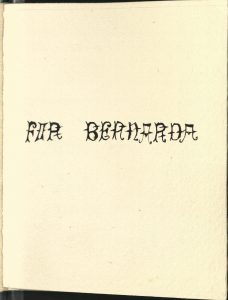
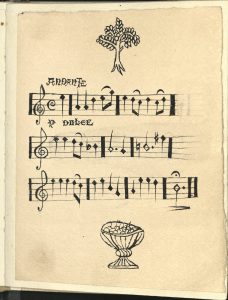
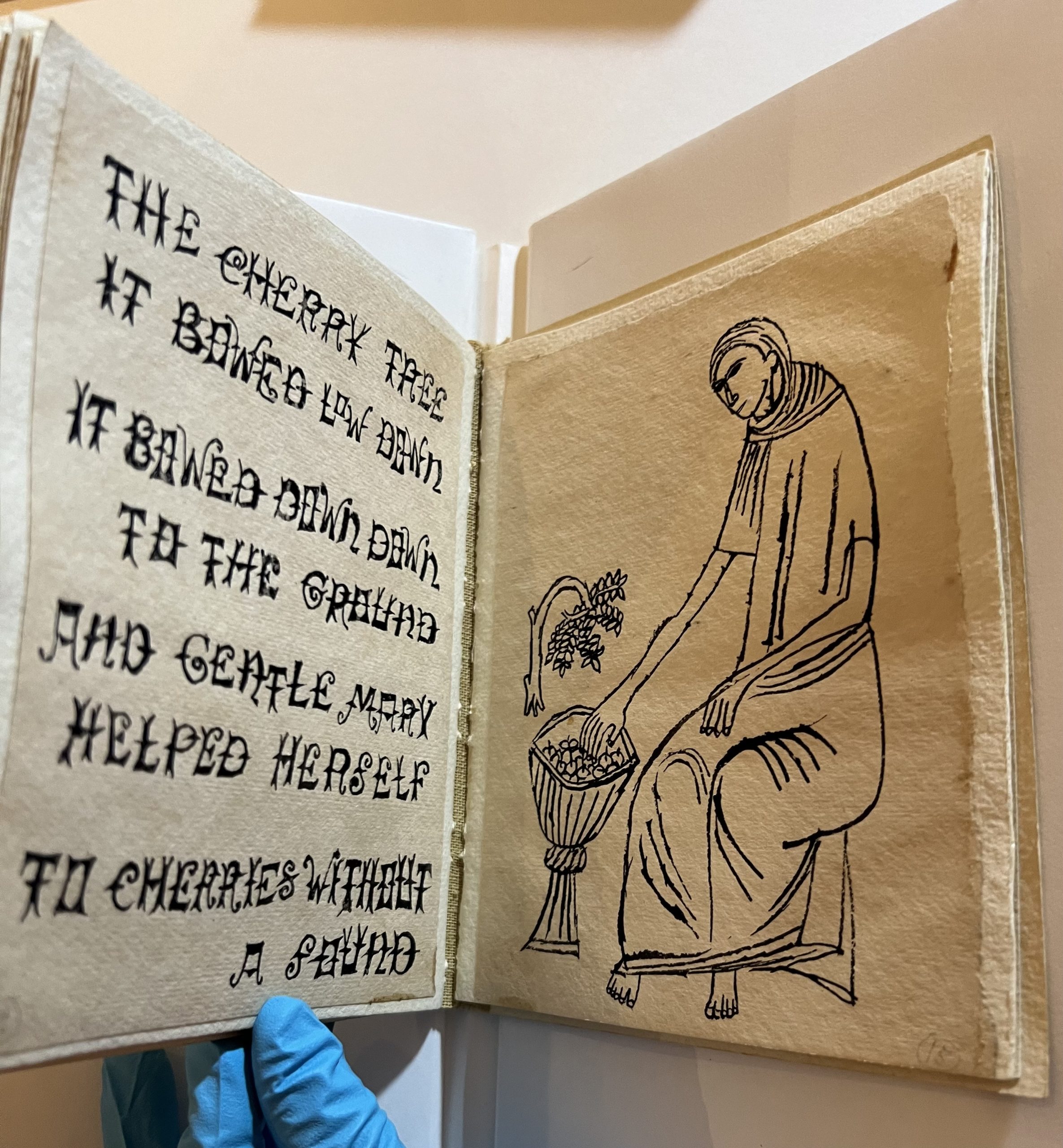
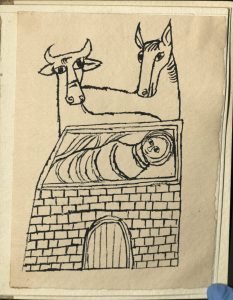
The book starts with a dedication to Bernarda Bryson Shahn, a page with a musical score, followed by nine openings with text on the verso and an image on the recto. The book concludes with a representation of the Nativity.
All the pages are mounted on a larger piece of paper and the text on page two consists of four strips with two lines each that were collaged. It is highly likely Shahn was using sheets of scrap paper sourced from the existing collection in his studio. The book’s twenty pages are separated into three separate quires.
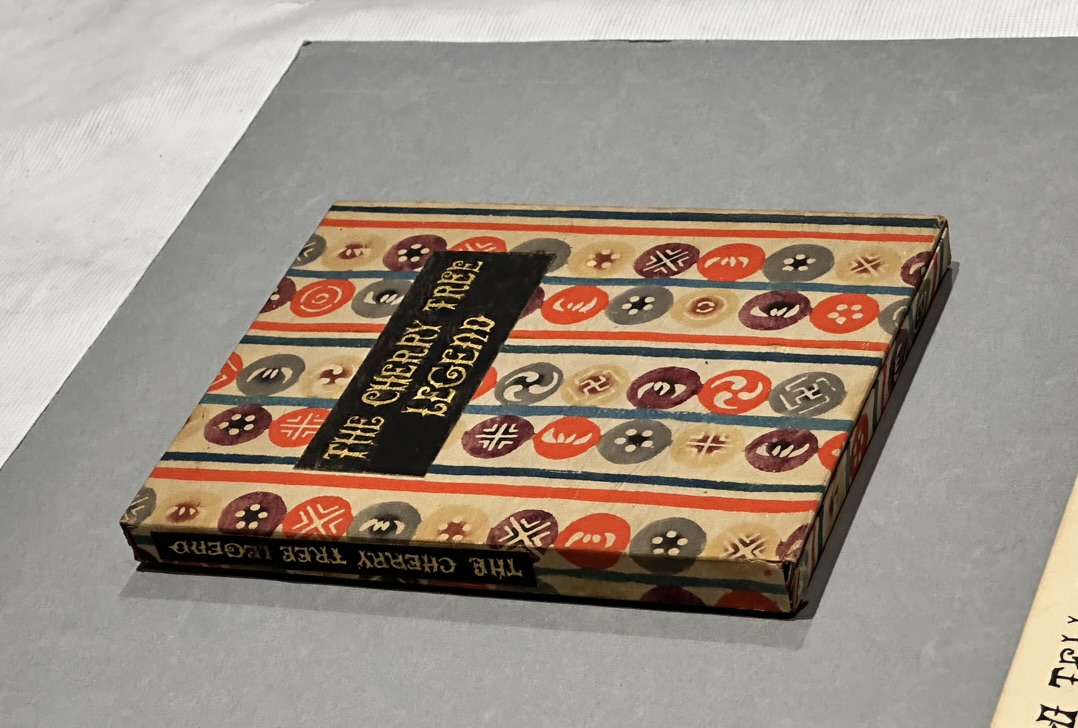
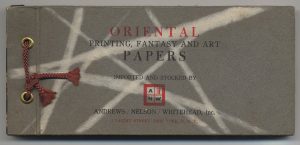
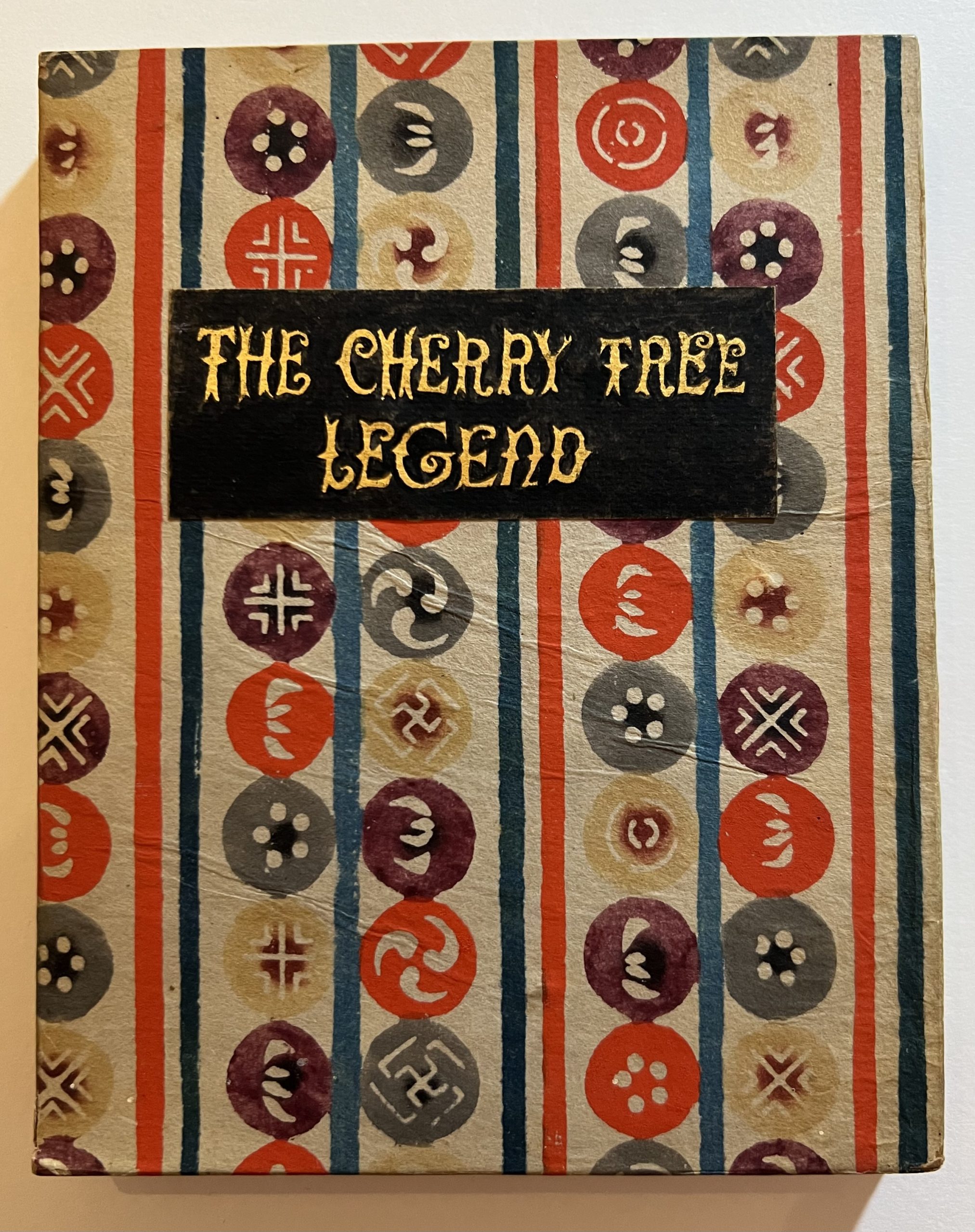
The maquette is encased in a cardboard slipcase covered in Japanese paper, which measures 6 ¾ by 5 ½ by ½ inches. Abby Shahn believes that Shahn likely bought this paper at the Andrews Nelson Whitehead paper store in Lower Manhattan, which imported European and Asian fine papers. Black labels bearing the title in golden paint were glued on the slipcase front and spine.
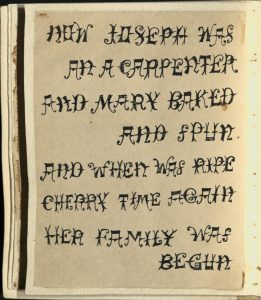
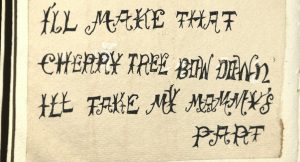
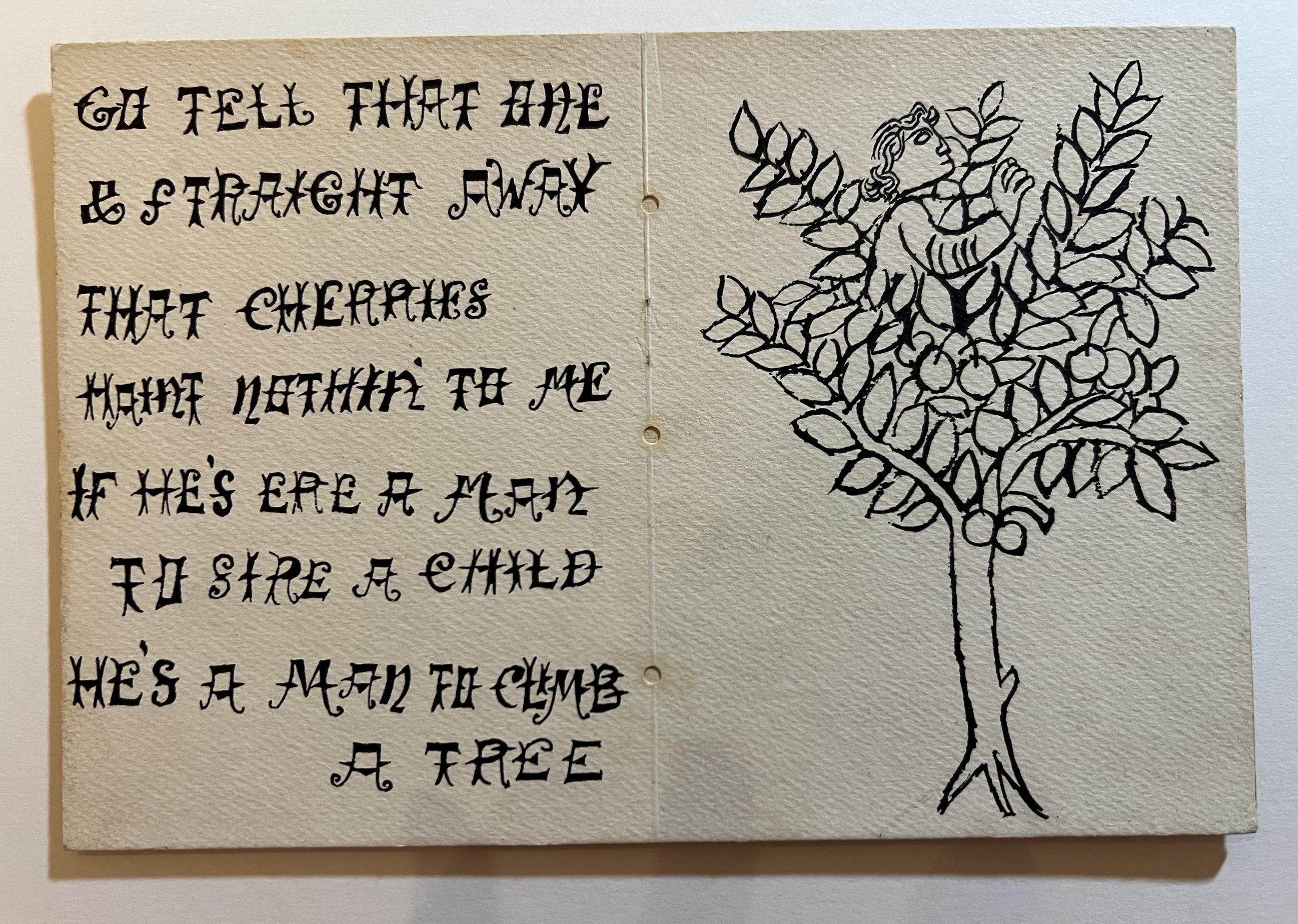
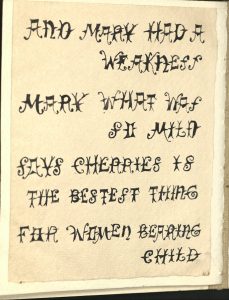
Shahn is renowned for his unique letterforms. The ones in this book are both dynamic while also referencing Gothic script and natural forms. Much as the cherry tree dominates the book’s narrative, so does the branchlike quality found in his lettering, echoing the coexistence of nature and religion.
Art Historical Echoes
The Cherry Tree Legend builds upon Shahn’s extensive knowledge of art history and, in particular, of religious art. Professor Véronique Plesch noted that many of his images draw from Medieval art, both stylistically and iconographically.
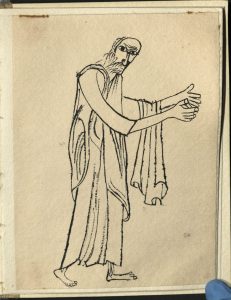
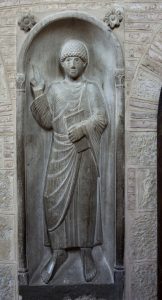
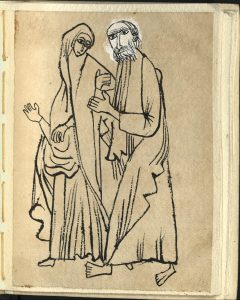
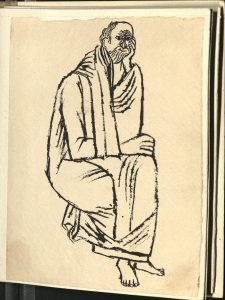
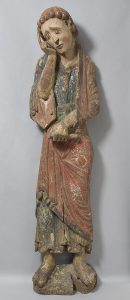
As Frederick Hartt put it, the goal of medieval artists was “to present in vivid form essential elements of Christian doctrine in order to excite not only in piety but also the imagination of the worshiper” (408–9) and through the creation of a vernacular reinterpretation of the Cherry Tree Carol, Shahn similarly pursues this goal, conveying sacred events to the layman. In his illustrations, Shahn endows his figures with features reminiscent of Romanesque art: for instance large feet, while maintaining linear and elongated forms (Hartt 418). Shahn also uses drapery to animate his figures. As in Romanesque art, his characters’ gestures convey emotion (Hartt 417).
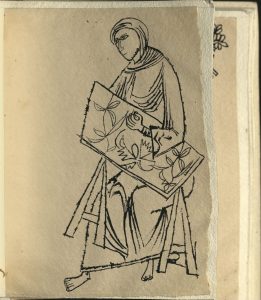

We also find several instances in which Shahn displays his knowledge of Christian iconography. The image of Mary weaving recalls depictions in which we see the Virgin at a loom or embroidering. As written in the apocryphal Gospel of Pseudo Matthew, “She occupied herself constantly with her wool-work . . . From the morning to the third hour she remained in prayer; from the third to the ninth she was occupied with her weaving” (6:1–2; see Ehrman and Plese 87).
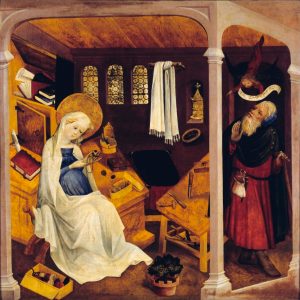
The melancholic-looking figure of Joseph is also based on the iconographic tradition, showing him dejected as he ponders the circumstances of Jesus’ conception. As in earlier works, Joseph, whose role as Jesus’ father was questioned and who was a “victim of slander” (van Aarde 173–75) appears forlorn.

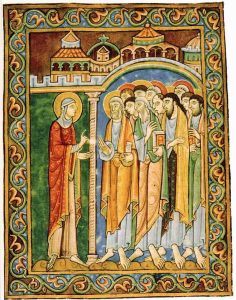
Shahn also draws from medieval art in his use of gestures. On page seven, for instance, Mary points towards the cherry tree. The gesture of “[p]ointing with the forefinger is one of the most common gestures in works of art, for it, among other things, can inform, accentuate and mock” (Räsänen 84). Through Mary’s gesture, Shahn stresses the tree’s importance in his visual narrative.
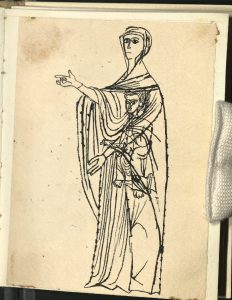

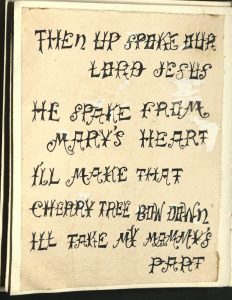
Professor Véronique Plesch noticed that the illustration of Mary with Jesus superimposed upon her figure alludes to the Visitation, a biblical event found in the Gospel of Luke, wherein the pregnant Virgin Mary encounters her cousin Elizabeth, carrying John the Baptist, and the two babies recognize one another in the womb (Luke, 1:39-56). Shahn’s image recalls depictions of the Visitation which include the infants in the womb. In Shahn’s accompanying text we read that Jesus “spake from Mary’s heart”.

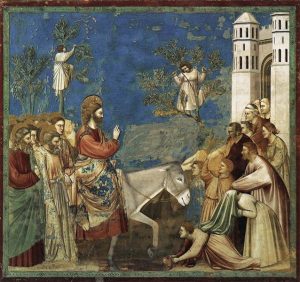
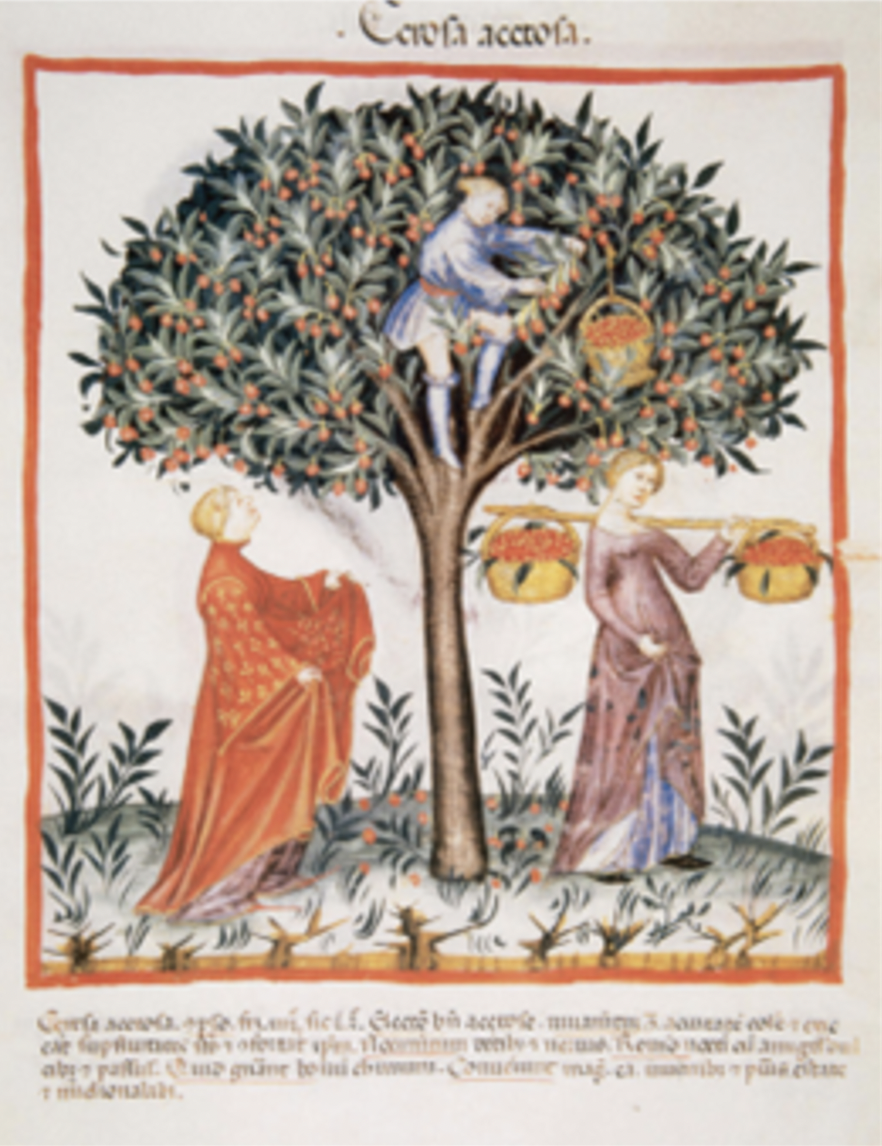
Page 11 of Shahn’s Cherry Tree Legend, depicts a child sitting in a tree, plucking cherries from the bountiful branches, recalling a page from the Tacuinum Sanitatis. This “lavishly illustrated late 14th century manuscript,” based on an 11th-century Arabic manuscript, presents the medicinal aspects of a variety of herbs, fruits, vegetables, and flowers, including the cherry tree. The tart cherry, or cerosa dulcia can “cure bilious attack and dry out and settle upset stomachs . . . soften[ing] the stomach” (Janick et al. 1592). In Shahn’s text, we read that “Mary had a weakness” and that she “says cherries is the bestest thing for woman bearing child”, thus echoing the fruit’s medicinal properties.

The illustration of the musical score, also hints at medieval art with its distinctive medieval style notation and shows his attention to detail. Diamond-shaped musical notes were invented by Franco de Cologne in the 13th century (Schelehoff 49). Shahn accompanies the score with small vignettes of a basket of cherries and a cherry tree, which appear above and below the musical score respectively.
Conclusion
In The Cherry Tree Legend Ben Shahn effectively weaves together textual and visual elements, creating a comprehensive and understandable reinterpretation of the old carol. Shahn’s modern rendition of The Cherry Tree Legend pays homage to Medieval artists and their efforts to create a visual Biblical vernacular, one which establishes a greater sense of connection between text, artistry, worship, and the human mind. The many references to medieval art and iconography endow his work with a timeless dimension, universally appealing to all who wish to venture into The Cherry Tree Legend.
Sources Cited
Carr, Sherwyn T. “The Middle English Nativity Cherry Tree: The Dissemination of a Popular Motif.”Speculum 42. 4 (1967): 739–49. [accessed Nov 13 2024]
Ehrman, Bart, and Zlatko Plese. The Apocryphal Gospels: Texts and Translations. Oxford: Oxford University Press, 2011. [accessed Nov 11 2024]
Hartt, Frederick, ed. Art: A History of Painting, Sculpture, Architecture, Volume 1. 2nd ed. Englewood Cliffs, NJ: Prentice-Hall, 1985.
Janick, Jules, Marie Christine Daunay, and Harry Paris. “Horticulture and Health in the Middle Ages: Images from the Tacuinum Sanitatis.” HortScience 47.12 (2012): 1592–94 [accessed Nov 15 2024]
Räsänen, Elina. “Gestures, Positions and Pictorial Communication in the Late-Medieval Visual Life of Saint Barbara.” In Meister Francke Revisited: Auf den Spuren eines Hamburger Malers, Ed. Ute Nürnberger, Elina Räsänen, and Uwe Albrecht. Petersberg: Michael Imhof Verlag, 2017. 79–93. [accessed Nov 10 2024]
Schelehoff, Nina. Optical Music Recognition: Overview, Challenges, and Possibilities. Bachelor’s thesis, Metropolia University of Applied Sciences, 2020. https://www.theseus.fi/bitstream/handle/10024/344984/Schelehoff_Nina.pdf?sequence=2. [accessed Nov 10 2024]
Sweeney, Dennis. “The Origins of the Cherry Tree Carol.” Biblical Archaeology Society, 2016. Accessed November 18, 2024. https://www.biblicalarchaeology.org/daily/biblical-topics/post-biblical-period/the-origins-of-the-cherry-tree-carol/#note01r. [accessed Nov 9 2024]
Van Aarde, Andries van. “The Carpenter’s Son (Mt 13:55): Joseph and Jesus in the Gospel of Matthew and Other Texts.” Neotestamentica 34.1 (2000): 173–90. [accessed Nov 12 2024]