The Biography of a Painting: From the Hickman Fire to Allegory
Howie Gao, Shayna Purow, Julia Reilly, Noam Reinhorn, Hannah Rosenberg, Victor Sabbatini, and Jenifer Zanabriga
Description
The maquette of Ben Shahn’s Biography of a Painting has ninety-two pages. The plates are unbound and contained within a portfolio. The dimensions of the pages are 11 by 8 1/2 inches; the book is 11 1/2 by-8 7/8 by 1 1/2 inches, and the wrapper is 11 7/8 by 9 1/4 by 1 5/8 inches. The handwritten text was copied from a one of the Charles Eliot Norton Lectures that Shahn delivered in 1956–57 at Harvard University and that was subsequently printed in The Shape of Content.
The trade book was first published in 1966 in the United States by ParaGraphic Books and in Canada by Fitzhenry and Whiteside, Ltd. The trade book is a paperback with ninety-two non-numbered pages, with the text kept in the original cursive writing as seen in the maquette. The dimensions of the trade book are 8 1/2 by 11 inches. In 2011, a hard cover edition was republished by Literary Licensing LLC.
Introduction
Biography of a Painting offers readers an intimate look into Ben Shahn’s creative mind, blending personal reflection with insights on art and its societal role. The book originated from one of six lectures Shahn delivered as the Charles Eliot Norton Professor of Poetry at Harvard University in 1956–57. These lectures provided a platform for Shahn to articulate his artistic philosophy, an opportunity he described as a chance to “get off my chest everything I have to say about art, and then I can shut up for the rest of my life” (quoted in Bryson Shahn 22). The resulting publication defends modern art during a time of intense cultural scrutiny and reflects on the connection between art, individuality, and social justice.
The book’s starting point is Shahn’s 1948 painting Allegory, denounced by art critic Henry McBride for allegedly sympathizing with Red Moscow. While McBride did not explicitly call for Shahn’s deportation, the artist believed it was implied. McBride’s critique echoed broader Red Scare attacks on modern art as subversive (Greenfield 236). Shahn used the Harvard lectures to challenge these misconceptions, reflecting on his inspiration for Allegory, particularly the Hickman tragedy—a 1947 fire that killed four children, leading their father to kill the landlord and igniting national attention.
Shahn’s text extends beyond Allegory, showcasing the artist’s philosophy. Bernarda Bryson Shahn observed that he “pleaded for the rejection of any kind of aesthetic principle as finality . . . The door must always be open; he held that art was liberating of the individual imagination” (Bryson Shahn 23). This ethos defines The Biography of a Painting, where Shahn intertwines personal narratives, visual analyses, and philosophical musings in a journal-like format, offering readers an intimate view of his artistic journey.
Visual Analysis: Allegory
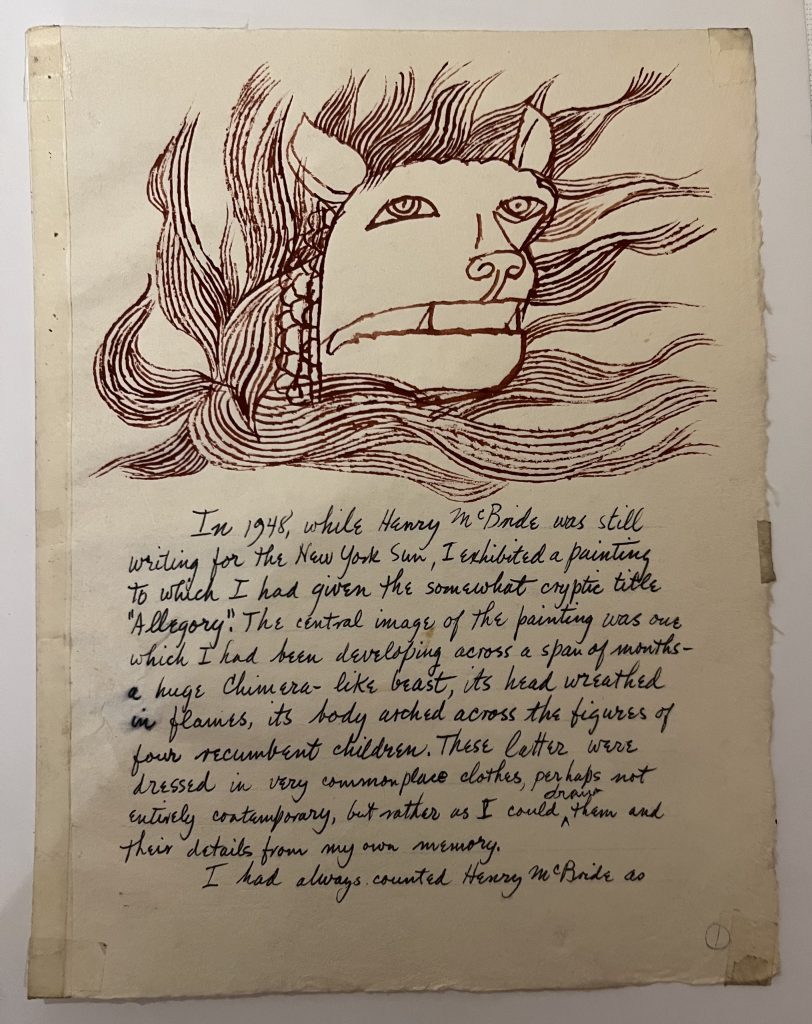
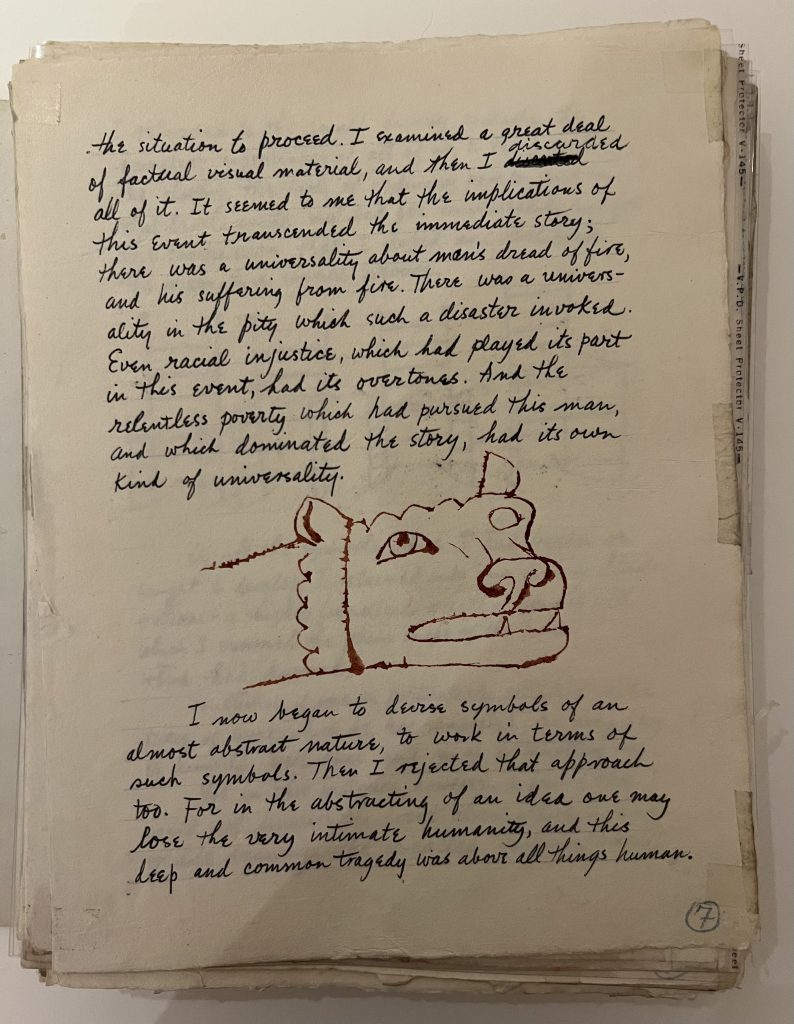
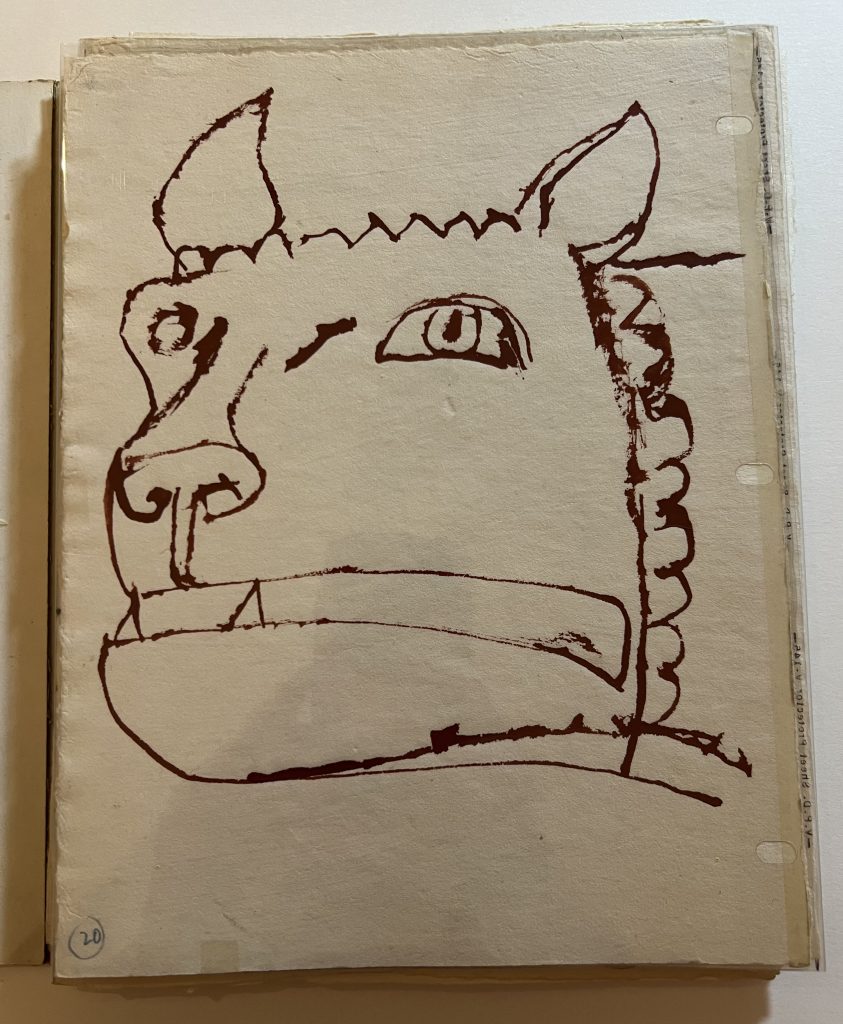
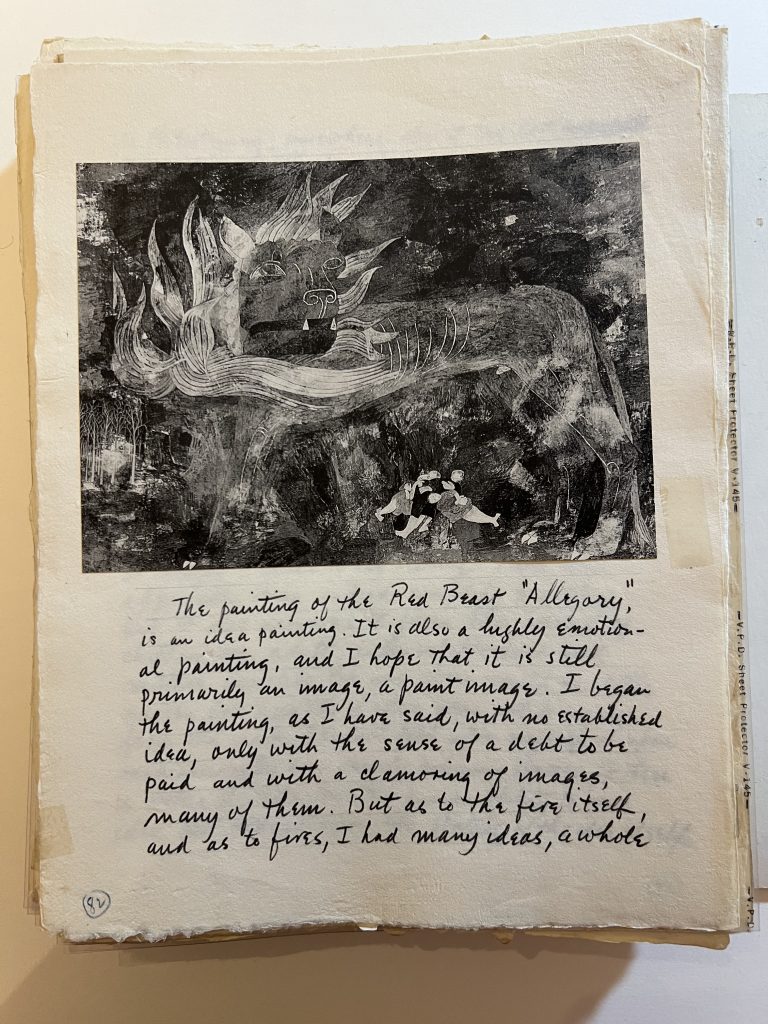
As the book begins as a visual and textual response to Mcbride’s critic of Allegory (1948), Shahn reconstructs what his creative process and intentions were at the time of the painting’s creation. Thus, many of the images reproduced, both of existing works and some specifically made for the book, retrace the various visual iterations of what will become the painting in its finished form. These images include several as pen-and-ink versions of the fire-beast as well as in the trade edition a frontispiece color reproduction of the painting.
On page 92, Shahn’s commentary on Allegory describes it as an “idea painting,” noting that the work owes its emotional impact to the spontaneity and lack of planning that characterized its creation. Shahn describes that when he began, he had only “the sense of a debt to be paid” and a “clamoring of images” (Bryson Shahn 92).
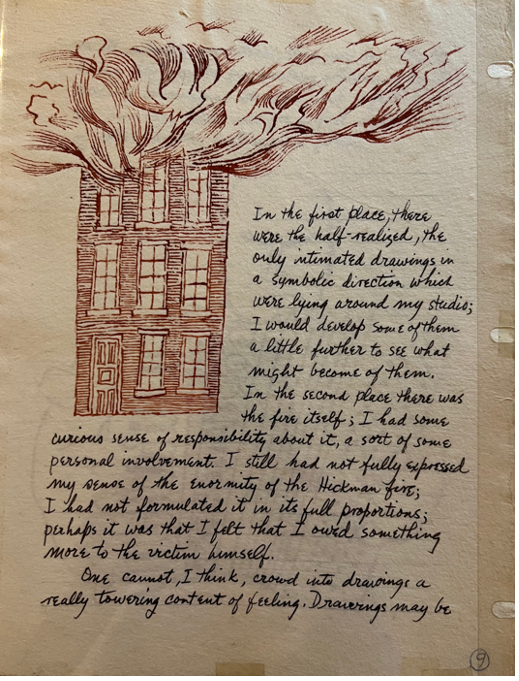
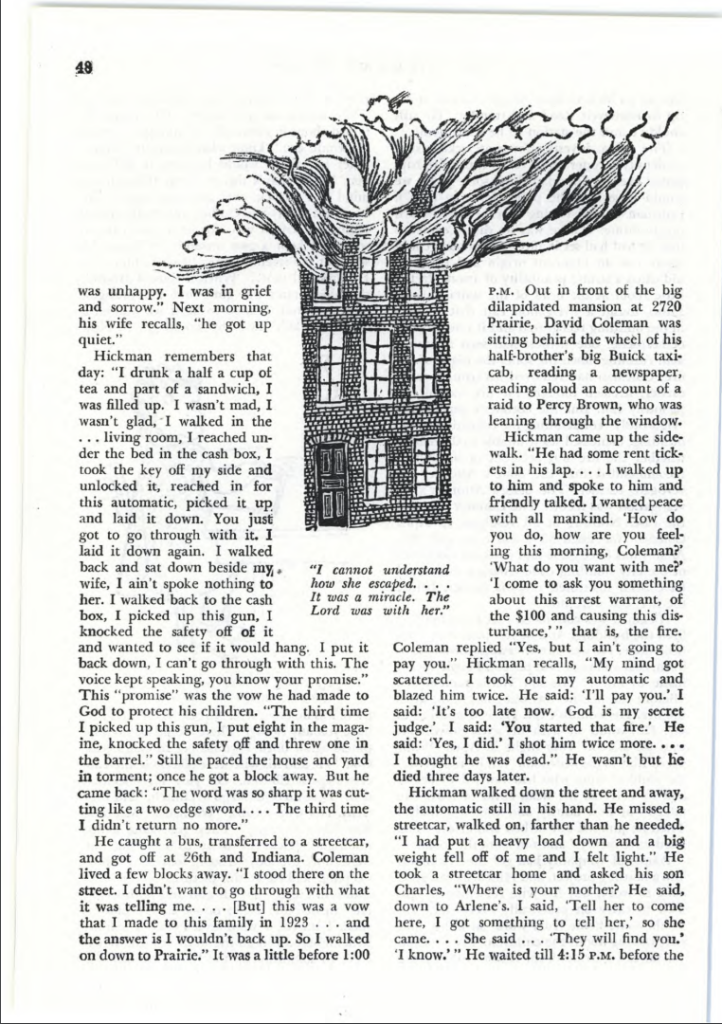
Shahn’s Hickman fire drawings were commissioned by Harper’s Magazine to accompany John Bartlow Martin’s August 1948 account of the trial. The previous year, a fire destroyed a one-room attic of a tenement building in Chicago, killing four of the Hickman family children. James Hickman, the children’s father, shot and killed the landlord, David Coleman, who had threatened to burn the building down (Smart Museum of Art). From the sixteen images Harper’s commissioned Shahn, two of them were reproduced in the maquette and subsequently in the book. One is the image of the burning building, which was reproduced exactly as it appeared in the article on page nine of the book. The second, on page twenty-three, is not an exact reproduction, as identifying features were purposefully blurred in the one reproduced.
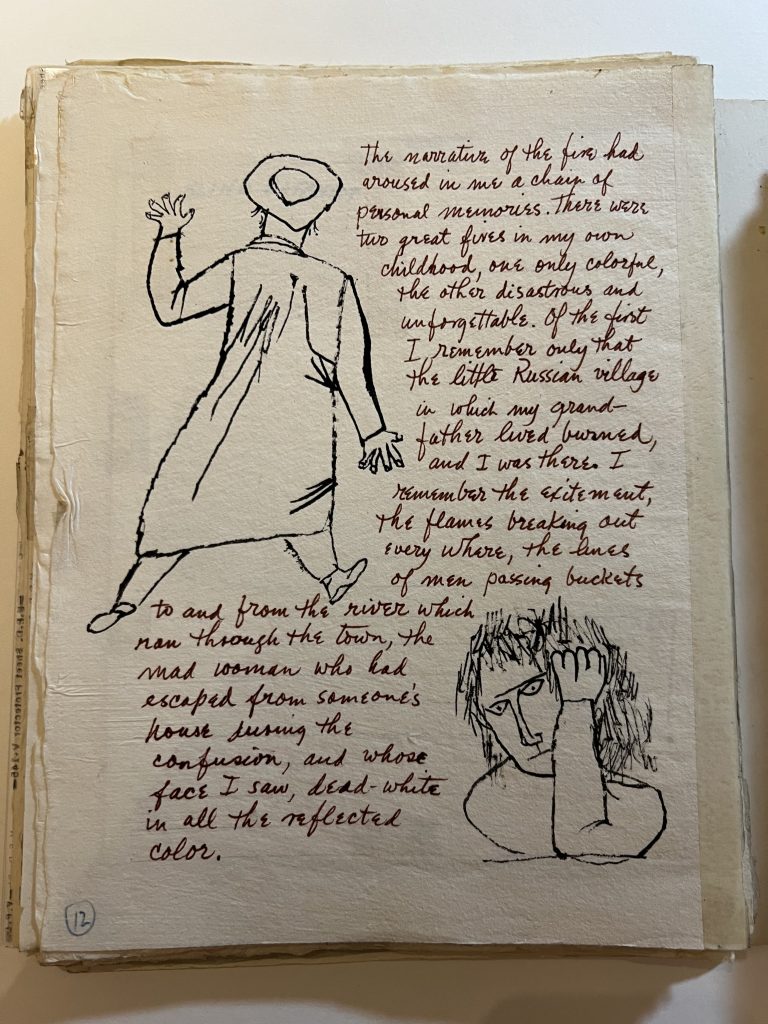
The second category of drawings consists of images created in accordance with the text. Several pages of the maquette feature text that wraps around the images. Page twelve of the maquette exemplifies this. This page includes two small drawings: one of a backward-facing figure and another of a man with his hand on his head. The text begins to the right of the first image and flows between the two, ending to the left of the second image. This irregular layout suggests that the images were created first, and the text was added afterward.
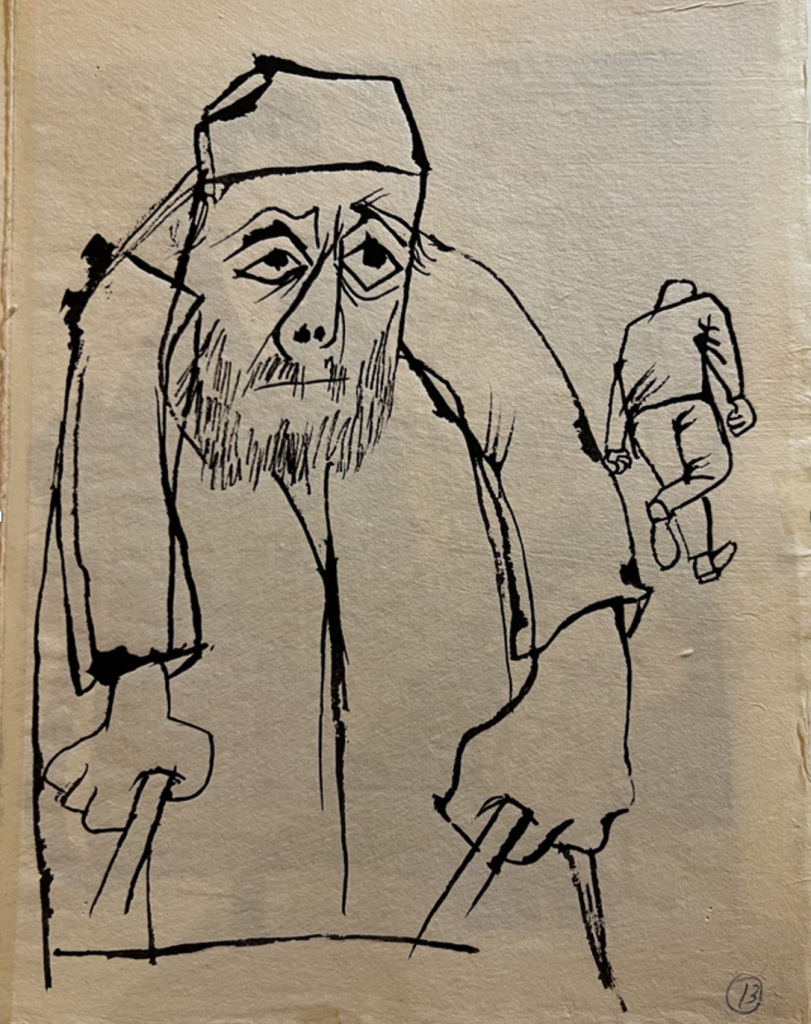
In contrast to reproductions of existing works of art, there are many images that were specifically created for this book. Page thirteen is an example of this. The image depicts two men: one in the foreground, facing forward with something in his hands, and another in the background, walking away, also with clenched fists as though holding something. In the text before and after this page, Shahn reflects on his childhood and his reaction to the fire. This context suggests that the men in the image are likely Eastern European peasants, drawn to illustrate this specific moment in the narrative. Shahn recounts a fire in his grandfather’s Russian village, which he witnessed, and “the lines of men passing buckets to and from the river which ran through the town.” He also mentions “the mad woman who had escaped from someone’s house during the confusion, and whose face I saw, dead-white in all the reflected color.” The woman is illustrated at the bottom of page twelve.
Stylistic Analysis
The maquette reads like a diary, establishing a sense of closeness between Shahn and the reader as he explores his conscious and unconscious process surrounding the creation of art. One gets a glimpse into the inner workings of Ben Shahn’s mind as he reflects upon Allegory, establishing a personal connection with the reader through his combination of text and image.
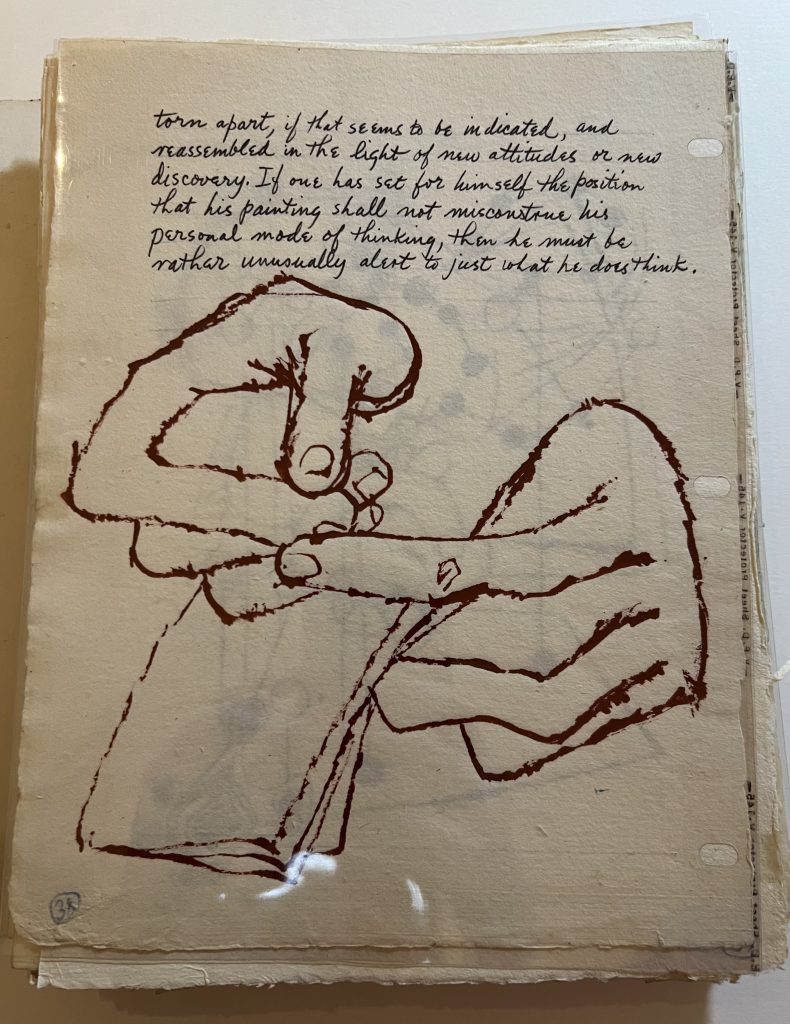
Shahn’s cursive handwriting conveys a sense of candor, of honesty as he dissects his mind and creative process. The text alternates reddish-brown and black ink, sometimes within the same page, yet black script dominates the book, visible in forty-nine pages, while the brown lettering can be seen in thirty-five pages.
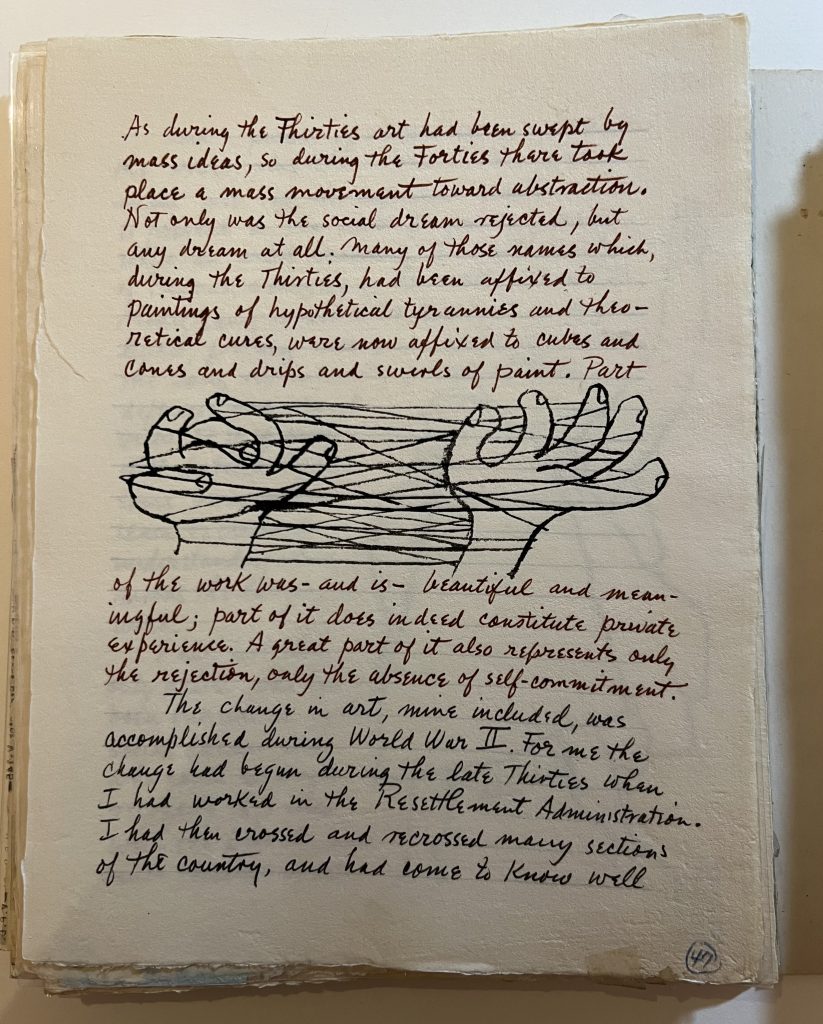
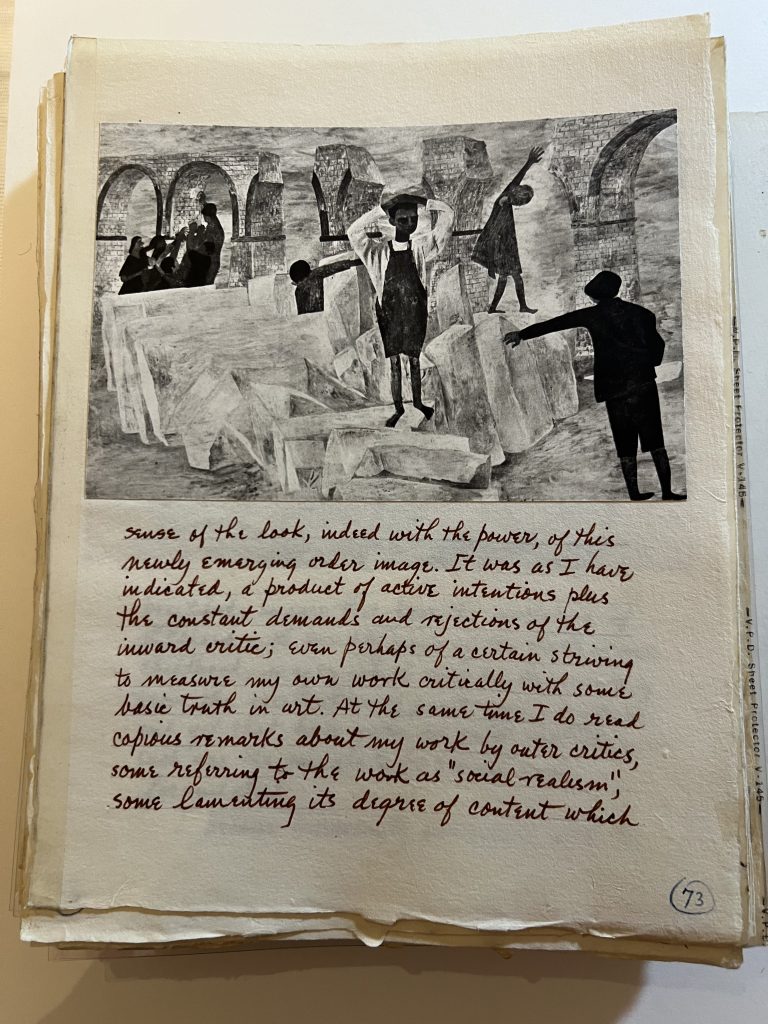
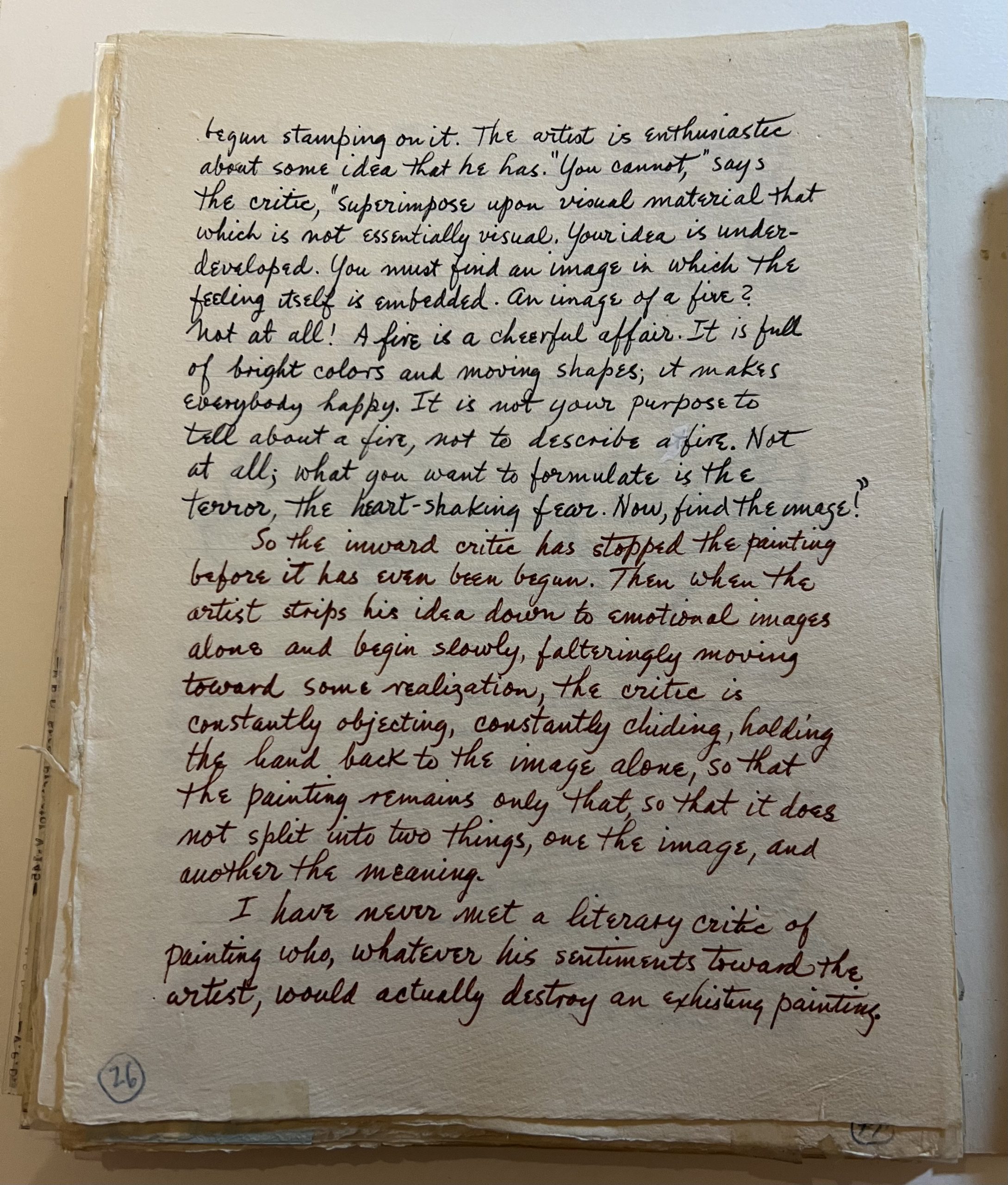
Shahn appears to use this difference in color of the script to shift between personal and emotional accounts, context and observation. As he discusses his conscious and unconscious thought process, he provides contextual facts in black ink and responds to them with the brown. In so doing, he explores the emotional value sparked by the relationship between illustrations and text. The maquette’s layout itself displays these dynamic qualities, as the text sweeps and bends around the illustrations.
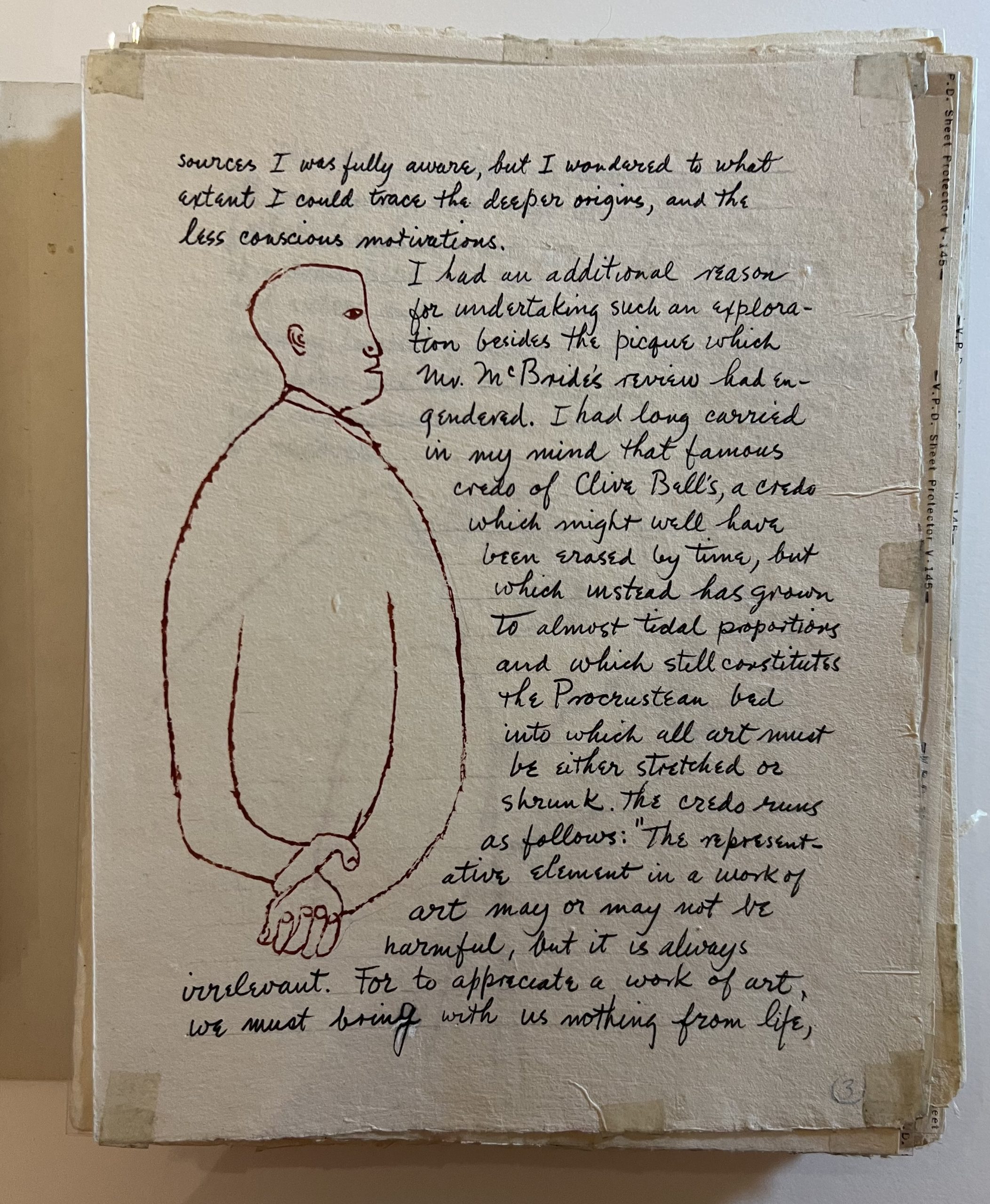
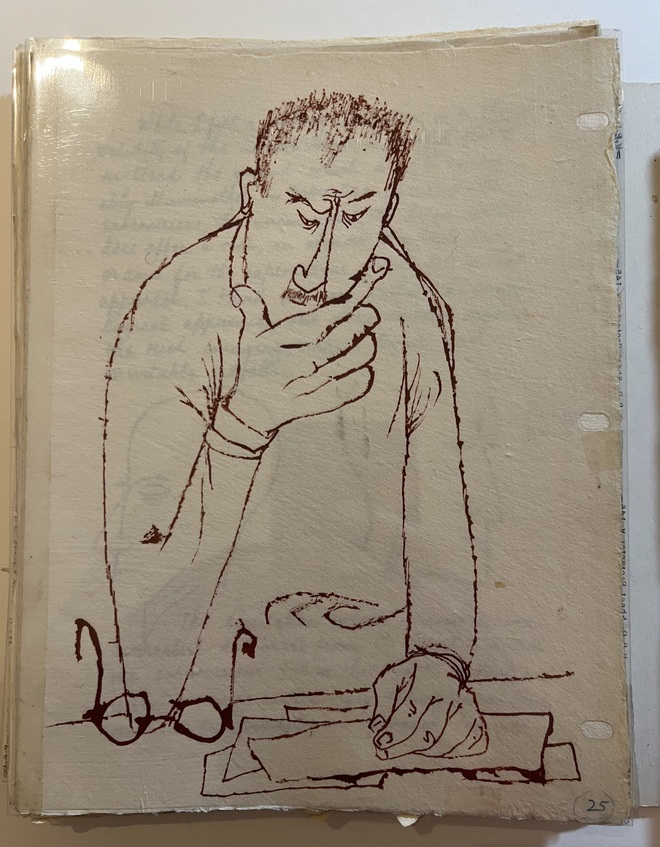
Page three of the maquette demonstrates how Shahn exploits the potential offered by the relationship between text and image: a figure faces the text, both introducing it and appearing as if he is reading the text along with the reader. This makes for a dynamic page that brings the reader to consider the relationship, closeness, and physicality between the cursive lettering and illustrations. In its pairing of visual art with the written work, Biography of a Painting assumes a personal and diaristic nature, reminding the reader of the drawings that appear on the margins of a notebook.
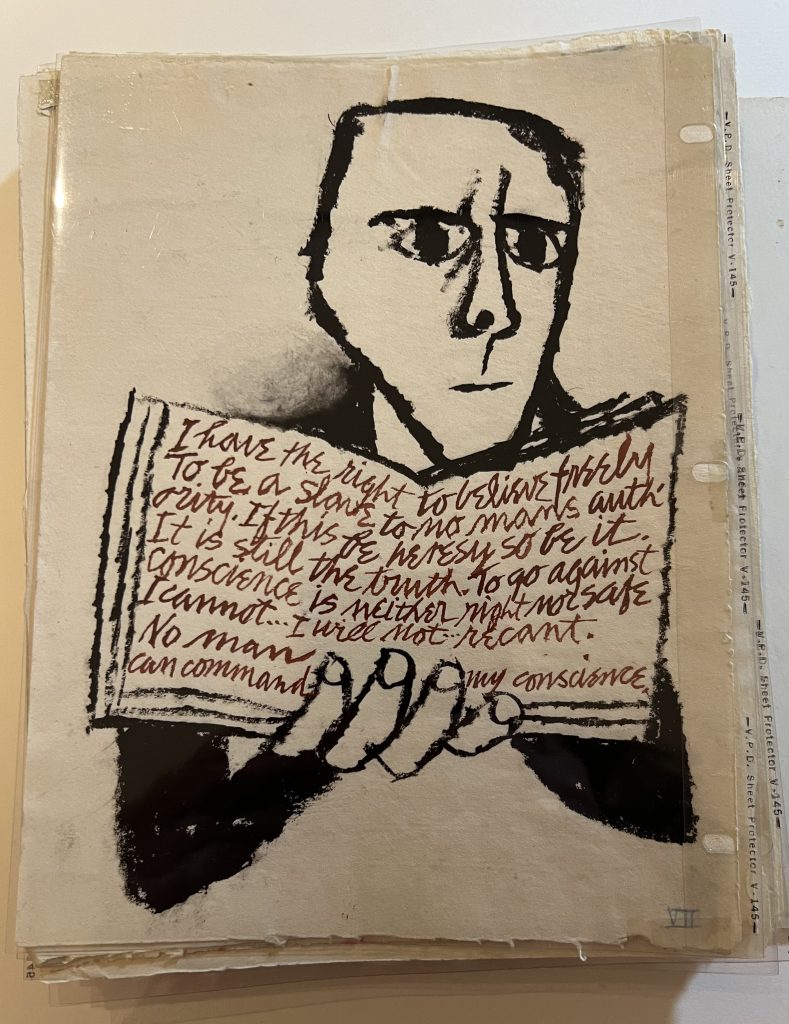
Biography of a Painting is more than simply a response to McBride’s criticism of Allegory. Here, Shahn is providing a detailed documentation of his thoughts and ideas that takes the viewer through the development of the painting. Biography of a Painting stands out among Shahn’s publications, as the detailed documentation Shahn uses from the Hickman fire drawings to the final version of Allegory allows the reader to track the creative evolution of concept and execution in a remarkably vivid manner.
Shahn’s engagement with politically-charged movements of the decade such as the Red Scare is a reflection of his lifelong dedication to justice, as seen in his work on topics such as the Sacco and Vanzetti case and the Dreyfus affair. By framing the maquette in the context of its creation, Shahn demonstrates how artists are able to navigate and respond to criticism and scrutiny through their own creative practice. Biography of a Painting documents a crucial moment in the relationship between Shahn’s art and American society, one that was so important it necessitated its own book.
Sources Cited
Bryson Shahn, Bernarda. Ben Shahn. New York: H. N. Abrams, 1972.
Greenfield, Howard. Ben Shahn: An Artist’s Life. New York: Random House, 1999.
Martin, John Bartlow. “The Hickman Story.” Harper’s Magazine (August 1948): 39–52.
Shahn, Ben. The Shape of Content. Cambridge, MA: Harvard University Press, 1958.
Smart Museum of Art, University of Chicago. “People Wasn’t Made to Burn”: Ben Shahn and the Hickman Story. May 11 – August 29, 2010. https://smartmuseum.uchicago.edu/exhibitions/people-wasnt-made-to-burn-ben-shahn-and-the-hickman-story/ [accessed 26 November 2024].