AR473 | Fall 2023

Category: AR474 (Page 5 of 10)

10/4

Inscribing the body was interesting to read after going through Caplan’s Written on the body, as it seemed a good synthesis of all of the different angles explored in the book. I also got the sense that in this synthesis, were also all of the points we have discussed in class thus far regarding the nature of tattooing, the history of tattooing, the psychology of tattooing and even the anthropology of tattooing.

The notion of a tattoo renaissance specially when it comes to The US specifically was something which I truly enjoyed reading about. The detailing of different artists and how their works have played a role in influencing the scene made the study humanized. While reading this article, it really struck me that these are real people’s bodies, in which they live their lives. I fell in love with Cliff Raven’s work. I adore the notion than in these generations of a tattoo renaissance there is such clear and visible continuity, making this rebirth of American tattooing a development of subculture which has prevailed to the styles we know today.
9/27

Caplan Ch. 10 – 14

Doing further reading on Lombroso’s approach to criminology was very interesting for me after having spent so much time studying Godna for my presentation last class. The idea of criminality being nature instead of nurture is appalling but it also follows as part of a pattern I have been identifying in all of these chapters on how the western views of tattooing have affected all the other tattooing traditions. This belief definitely brings about a bias that we are still attempting to dismantle today, and as mentioned in the chapter, Lombroso’s claim turns a blind eye to the fact that not only criminals were tattooed, since this practice was also simply a practice of the working class.

Still thinking about Godna however, reading about Russian prisoner tattooing cultures makes me wonder what are the factors that make people who are being tattooed in a punitive way reclaim the practice and turn it into a form of subculture? In South Asia it was certainly not the case that Godna was reclaimed and later embraced. An yet on chapter 11, Schrader describes how tattooed which began as a way of preventing the success of fugitives (much like in colonial South Asia) the subculture of Russian prison tattooing quickly turned hierarchical—at least in that they developed a symbology of tattooing which would serve as markers for status among the criminals.

Overall I liked the analysis made in chapter 14 the best out of this week’s assigned readings. I think it very much reflects the current view towards body modifications in general, although I disagree on a couple of points, I think the emphasis on how body modifications (mainly piercings and tattoos) are a form of self expression and moreover a way to externalization the internal self was very spot on. If anything, I don’t believe that in cultures which embraced tattoos there was ever a different idea as to their function. Indigenous cultures of tattooing probably saw them as a form of self-reflection, and the same can even be said of for example, the Russian prison tattooing culture. Which admittedly started from a negative dehumanizing point but went on to become a form of identity within the system.

research for 11/8

This past week, I’ve been exploring a wide array of sources to build a solid foundation for my research. Some of the academic books and articles I’ve encountered have been incredibly enlightening. For instance, Chris William Martin’s “The Social Semiotics of Tattoos” and Michael Atkinson’s “Tattooed: The Sociogenesis of Body Art” have provided crucial insights into the cultural and historical dimensions of tattooing. These sources have deepened my understanding of how societal perceptions of body art have evolved over time.

I’ve also delved into the psychological aspect of this aversion, drawing from studies like “Criminal Stereotypes in the Courtroom” and “Negative Implicit Attitudes toward Individuals with a Tattoo near the Face.” These sources offer empirical evidence and psychological insights, which have been essential in bolstering my argument.

I’ve also explored real-world examples, like the case of the Māori journalist who made history by presenting the news with traditional facial markings. This demonstrates the evolving narratives surrounding face tattoos and the complex interplay between cultural identity, personal choices, and societal responses.

As I continue with my research, I’m eager to delve deeper, connecting the various pieces of information I’ve gathered and weaving them into a cohesive narrative. I want to consider counterarguments and ensure that I provide a well-rounded perspective on this intriguing topic. Overall, my research journey has been enlightening and thought-provoking, and I’m looking forward to further exploring the societal aversion to face tattoos and its implications for individuals and society.

Research 11/8

This week was FULL of research, and I feel like I got some ideas going for my project, which was really exciting. I’m intimidated by but pumped about the fact that I have selected a gap in the research by looking into song lyric tattoos. I found sources on the connections between tattooing and trauma and also music and trauma, which is a way I’m connecting the ideas of music and tattooing. I also found some sources about affirmations and how that promotes well-being but also how music promotes well-being, so words and powerful phrases can be a tool for well-being, hence why many people choose to tattoo song lyrics on themselves. I also was thinking a lot about why people choose to get tattoos and how it can create community between people who are tattooed or connect with the tattoos one has. For example, with song lyrics, fans of that music might be more drawn to one’s tattoos and establish connections with them based on that music.

11/8

In preparation for this class session, I spent a lot of time with my research topic (tattooing and the music industry). I wasn’t sure where my research was going to take me, as I didn’t have a concrete or more specific topic within my broader topic. I probably looked at around 30 sources before I found 10 that I could see working with my topic; I didn’t find any sources directly linking tattooing with the music industry, which is a good thing. By allowing the sources to take me down a variety of paths, I landed on a topic that I don’t think I would have been able to think of on my own: the paradoxical pain-creating and healing capabilities of both tattooing and music-making. The common themes that came up over and over again when I put in my key terms (music, tattoo) were mental health, emotion, subculture, and expression. I’m really excited to look deeper into the connections between the structure of the music industry and the tattooing industry at the level of embodied art, as well as to make more comparisons between the ways youth, mental health, creativity, and the formation of subculture function in both areas. 

11/8 – Readings for Class

Although there were many interesting things throughout the readings, I found myself particularly drawn to Braunberger’s writing. This was because it was tiring to read. Not tiring in the sense that it was long and I was tired, but I found myself emotionally out of it by the end of the reading because there doesn’t seem to be any winning for women, as per usual. Body politics is so prominent and women’s bodies in particular are always being controlled and this reading just seemed to further that idea. Tattooed women are described as bringing up thoughts of groups of people like bikers and prostitutes and that is a perception that, for a while, held weight to the larger society. For instance, Braungberger notes of a rape case in which they decided that two men that raped this one girl were innocent because she had a tattoo on her leg. These are images and perceptions that we cannot change on our own no matter how much we want to. When I think about what I have heard about tattooed women, I often hear that they are “trying too hard to look tough,” hence the biker image. I also often hear of tattooed women being sexualized, hence the image of a sex worker. In addition to this, I also hear about women who get looked down upon within tattooing communities if they have “too feminine” of a tattoo. This can be interpreted as a lack of a safe space for tattooed women to escape the perceptions of the general public. So much of this reading goes into bodily ownership and we have discussed before the idea that getting a tattoo doesn’t give you ownership of your body, but I feel like this is doubly true for women.

It was also just interesting to read these articles while doing more research for my annotated bibliography because from what I understand, tattoos in Korea are perceived to be more feminine than masculine. This is because historically, it was primarily men that had tattoos that had negative meanings such tattoos as signs of gangs. Meanwhile, women historically had tattoos of their lover’s name. But this difference in history still influences their perceptions today as they also see tattoos as a form of body decoration. Interpreting tattoos this way makes many Koreans see tattoos as feminine because decorating the body is something that women place more importance in than men.

Research Diary Entry #9: Body and Gender

The readings for this week’s discussion were informative in the evolving role and acceptance of tattoos with respect to both body and gender. I chose to read some of Margot Mifflin’s Bodies of Subversion: A Secret History of Women and Tattoo first which gave me clear insight into the connection between feminism, tattoos, and body. Personally, when recalling my own understanding of tattooing and women, I immediately go to the idea of self-recovery or the reclaiming of self-identity due to past abuse or experiences that have taken something from me that I want to be able to dictate in my own way. Mifflin’s choice of words in the following quote really resonate with me,  “Tattoos appeal to contemporary women both as emblems of empowerment in an era of feminist gains and as badges of self-determination at a time when controversies about abortion rights, date rape, and sexual harassment have made them think hard about who controls their bodies—and why”  (Mifflin 1). Although I think this kind of statement is continuously relayed in different words as a reason for being tattooed, I think that the idea of the tattoo as a form of non-verbal communication was relayed in many of these readings. 

To feed off of that idea, Atkinson’s article, “Pretty in Ink: Conformity, Resistance, and Negotiation in Women’s Tattooing” opened up with an idea described by Shilling (1993, 1997) as “body projects,” when referring to the physical modifications of one’s body to reinvent or re-construct self-identity. What falls under the title of “body modification” is broad as even getting a haircut is considered body modification because one is changing a physical aspect of themselves. The more drastic examples of body modification are clearly plastic/cosmetic surgery, dieting, surgeries to repair body parts (knee or hip replacements). And then we come across tattoos as a form of body modification. I find that although we consider tattoos to be far more “permanent” than other forms of artistic body modification, we seem to forget that when deciding to get surgery because we need it for our well-being and ability to function. The primary concern of Atkinson’s article highlights how tattoos are studied and interpreted as “embodied signifiers of gender” (220). By exploring research focused centrally on feminist and profeminist body modification, Atkinson reminds us of the multilayering purpose of tattoos, both psychologically and physically. Kosut (2000) cultivates more conversation about ideas conveyed in the other articles and although this does not necessarily directly relate to Elias and Scotson’s theory of established.outsider social relationships expressed in Atkinson’s article, this quote expresses the psychological “layering” of tattoos in a way that I would have described: “No tattoo narrative fits neatly into one category; themes overlap, meld and merge within each story.” (Kosut 82).

Research Diary Entry #8: Subcultures & Identity/Sociological Approach

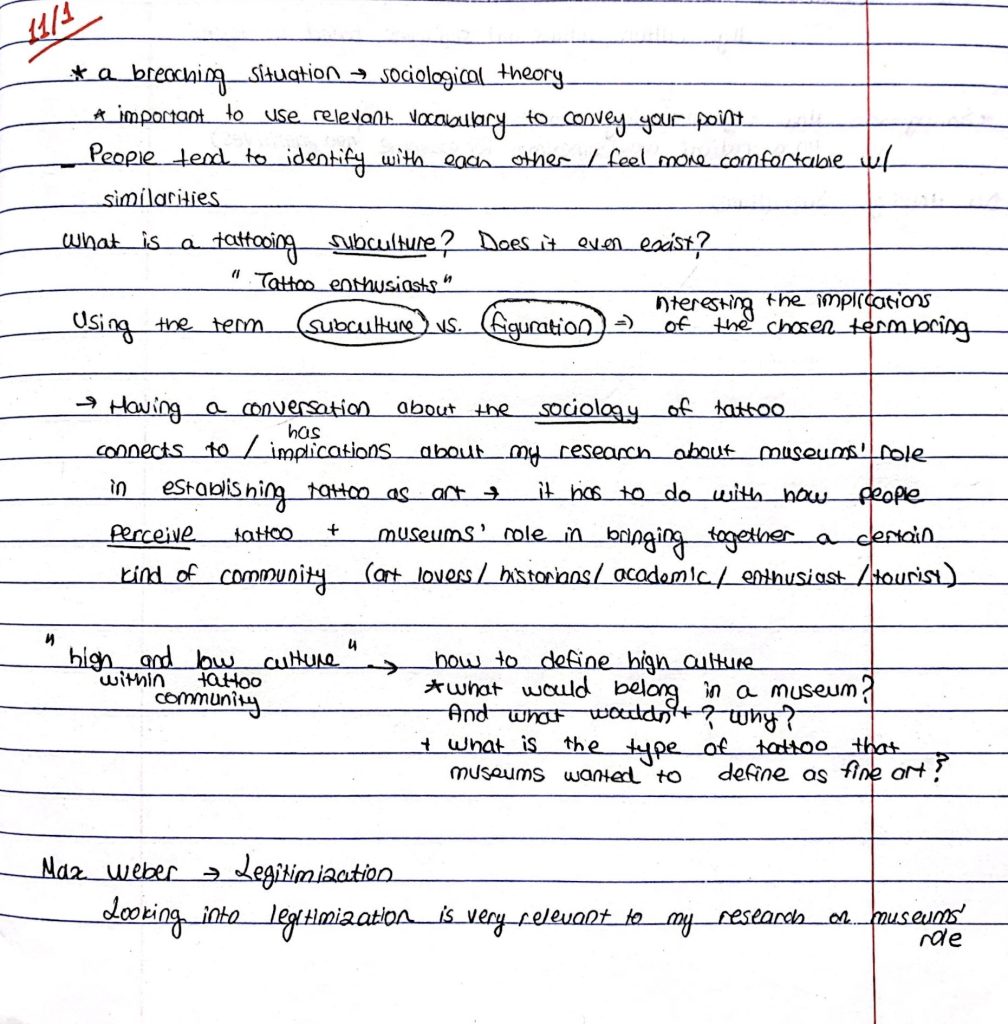
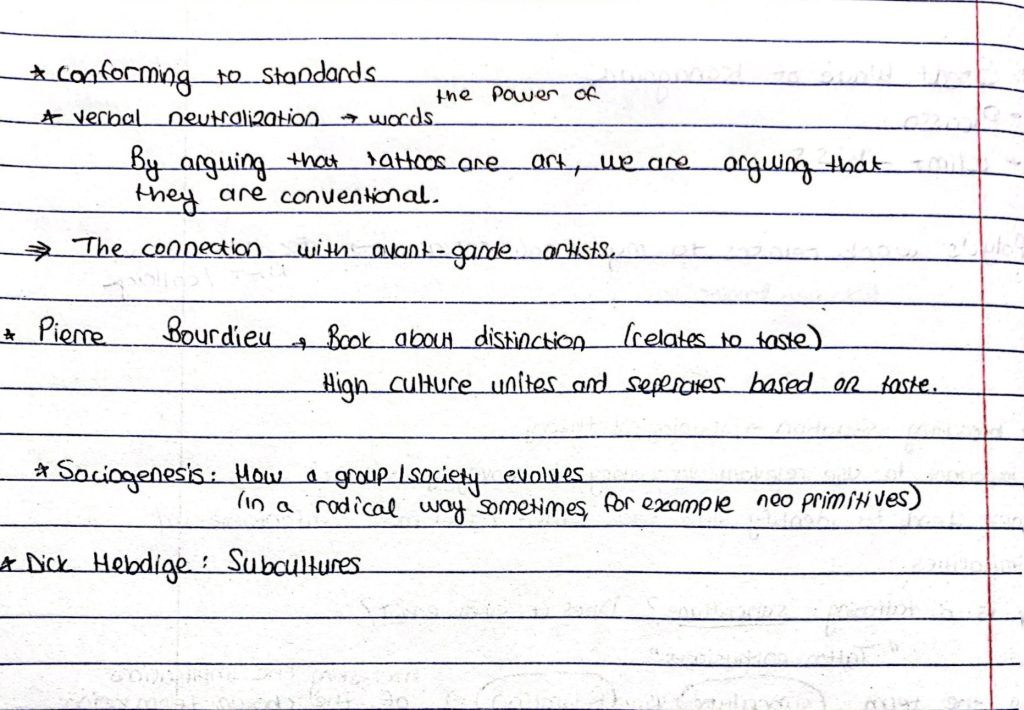
The readings for this week targeted the somewhat subtle yet significant links between tattoos, subcultures, and sociology. Atkinson’s chapter, “Tattoo Enthusiasts: Subculture or Figuration?,” in The Subcultures Reader brought attention to the question of whether or not a ‘tattooing subculture’ existed. This was an intriguing question because as I have gained more understanding of the sociological role of tattoos in relation to cultures or communities, people see it evolve into part of a previously existing culture due to its increased presence in that period of time. Alix Lambert’s “The Mark of Cain” and Jacob Resneck’s “Russian Criminal Tattoos” both study the role of the tattoo, both the process and the product, in criminal subculture.

Research and Readings for 11/1

I spent some time this week trying to research my topic and realizing that it’s actually kind of difficult. I did some online research and came across some examples of song lyric tattoos with little explanations of their importance, but I’m not finding a lot of scholarly articles. I did sit down with some of the books on Reserve but wasn’t finding much. I did think it was cool, though, in the Atkinson reading on straightedge tattooing that the lyrics of a song called “Out of Step (With the World)” by Minor Threat sparked this whole culture of straightedge and certainly inspired tattoos to represent their values of “don’t drink, don’t smoke, don’t fuck. At least I can fucking think,” which were both the song lyrics and the motto of this straightedge philosophy. I’m looking forward to doing more research on this specific topic and my project in general.

« Older posts Newer posts »