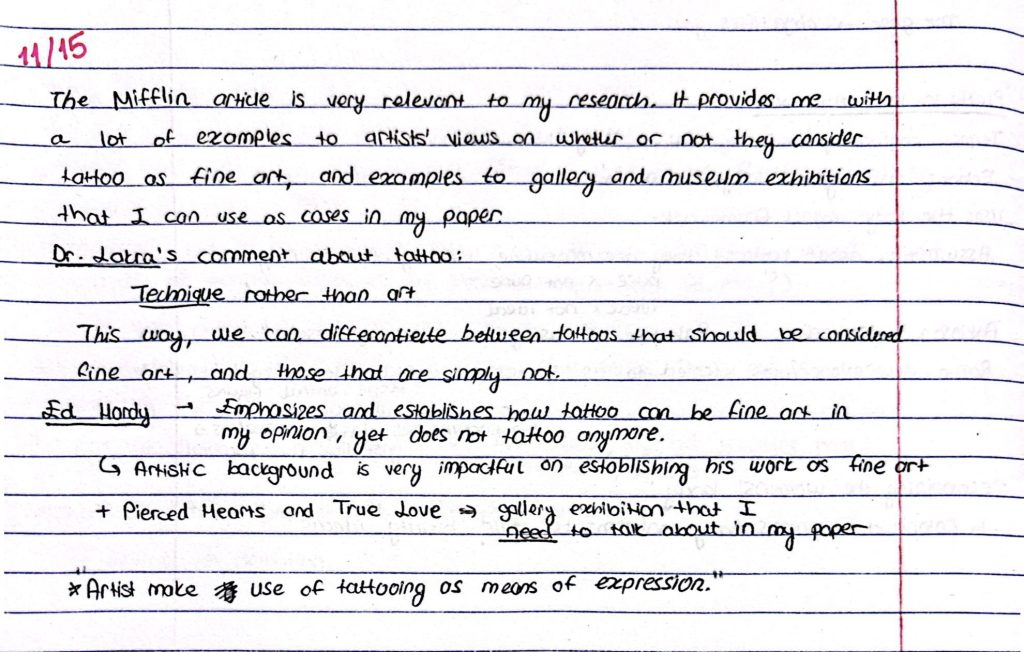
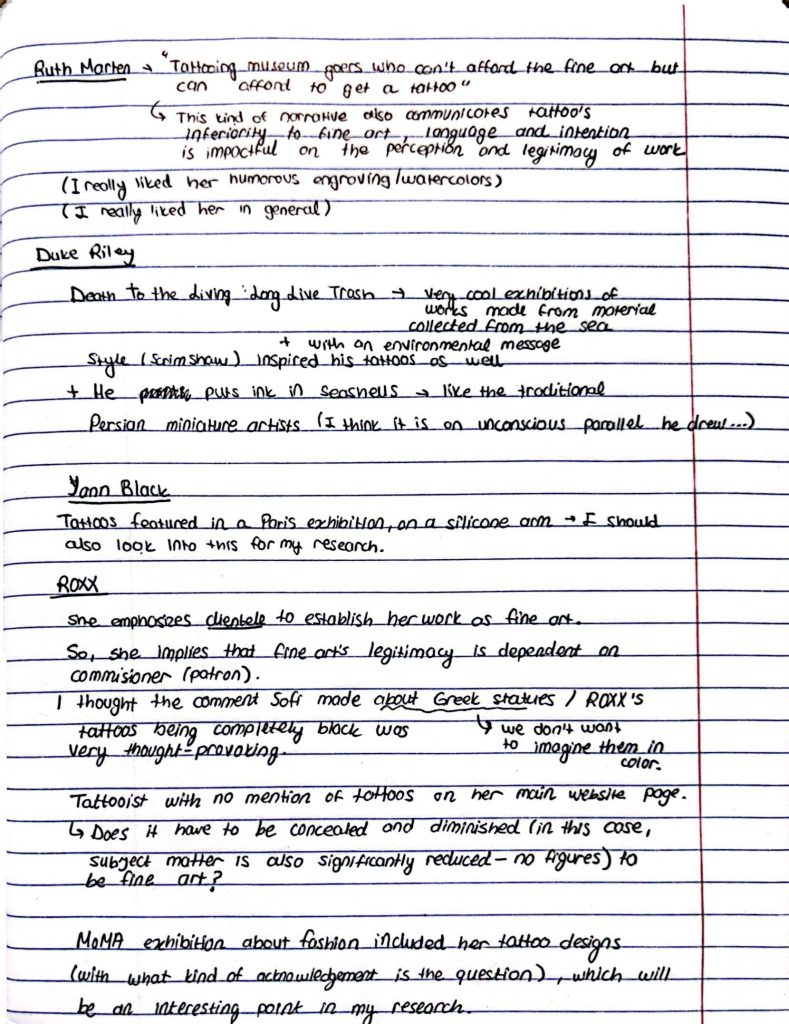
AR473 | Fall 2023
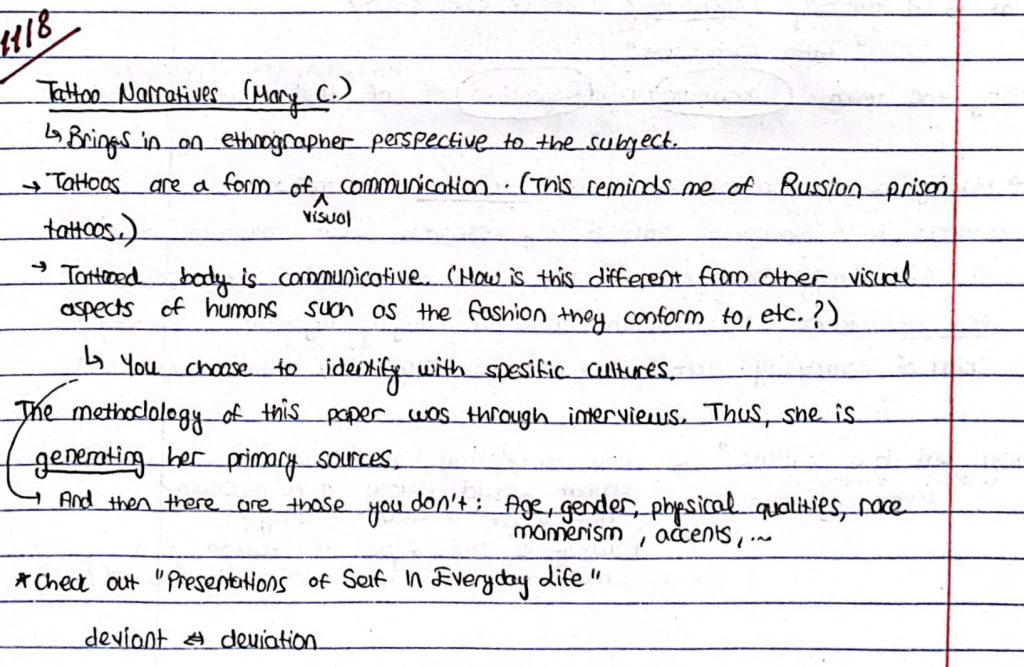
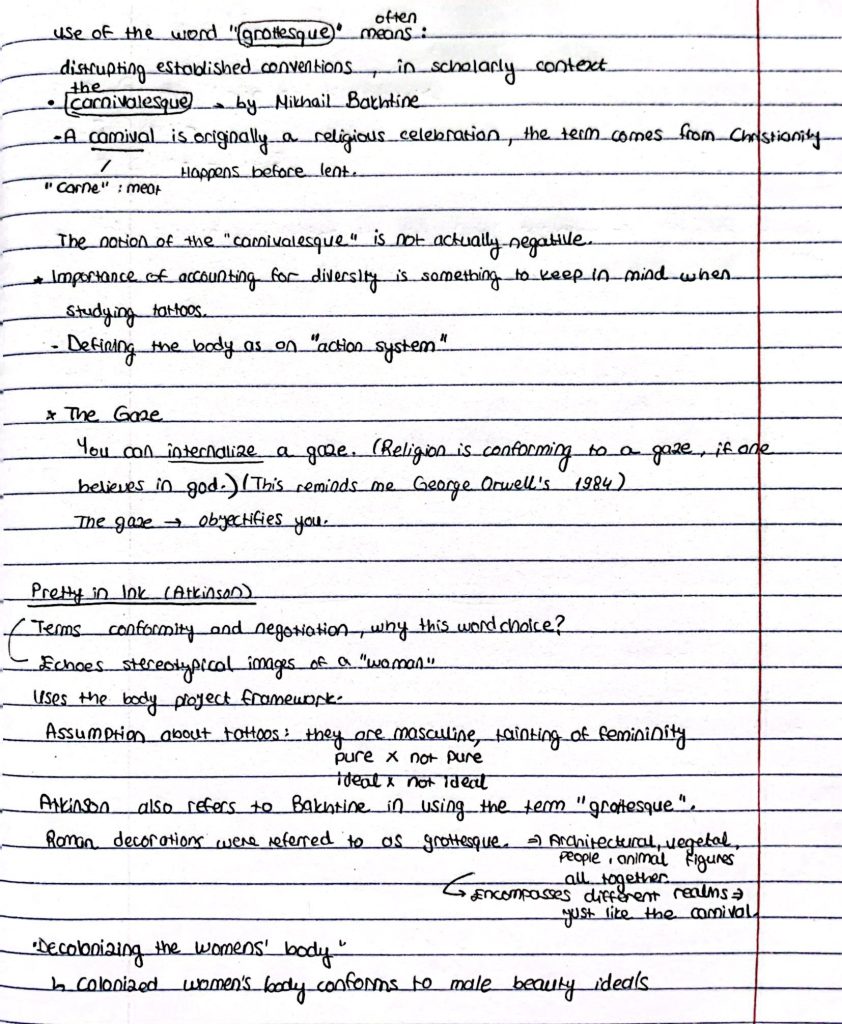
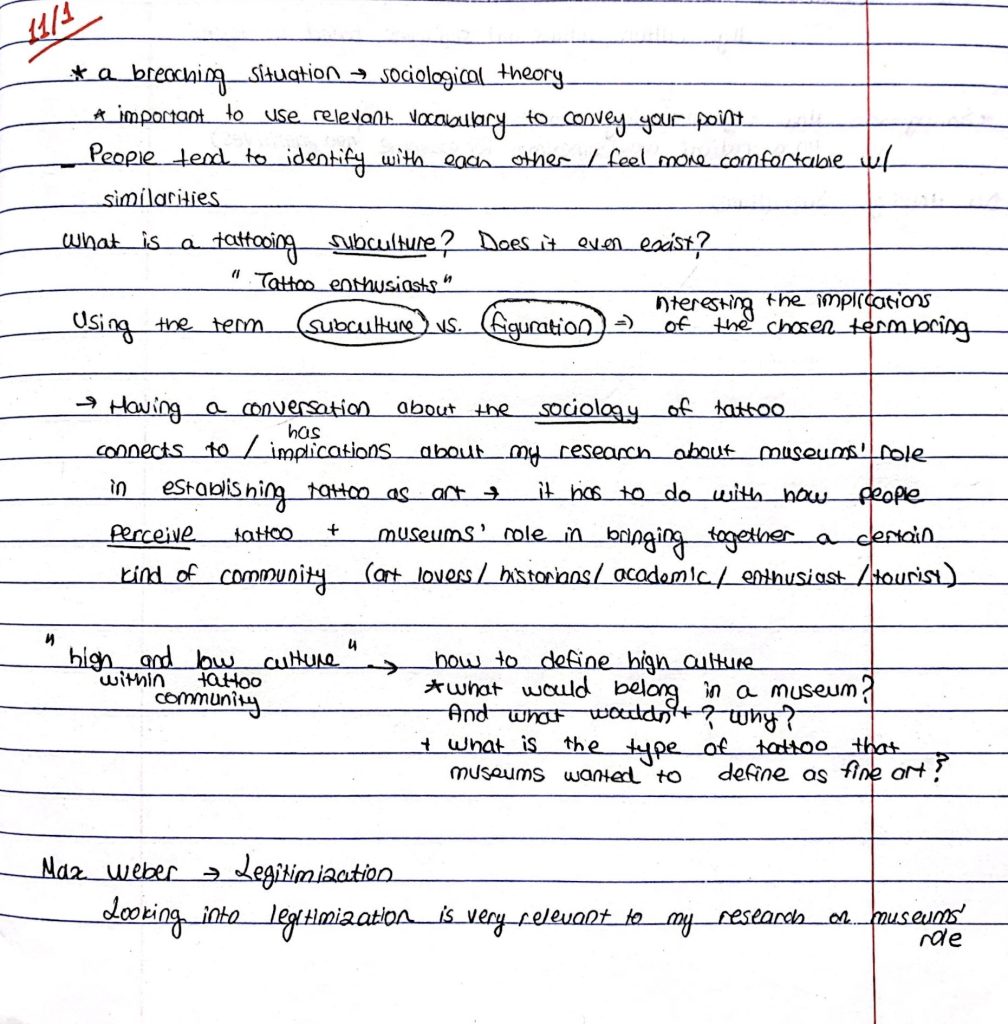
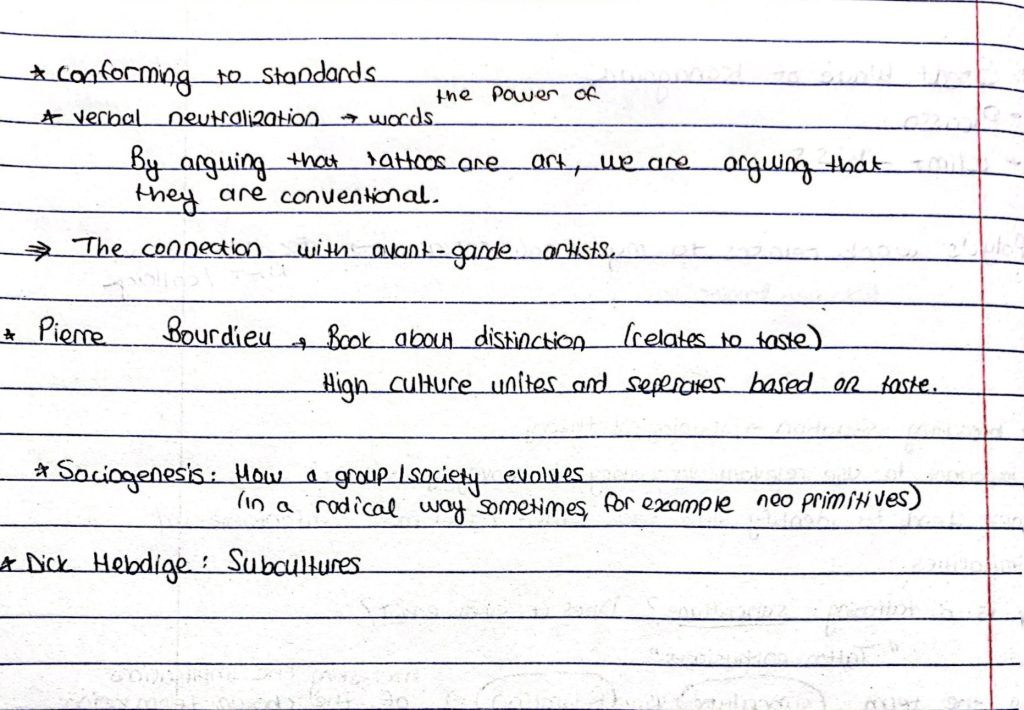
In this class, we explored tattoos by a lot of national traditions including Polynesian, Balkan, Egyptian, and Maori… My presentation was on Balkan tattoos and the more I researched it more I thought that it was a very intriguing topic. I thought the ritualistic aspects of the traditional Balkan tattoos, such as how tattooing is traditionally performed on certain days of the year like the spring solstice, and the unique ingredients of the tattoo ink such as the mother’s milk of a woman with a male baby with blue eyes, was very interesting. I paid attention to the fact that in many national traditions, there are ritualistic aspects to the act of tattooing, like chanting during the application of the Aboriginal Australian tattoos.
One of the new tattoo traditions that I learned about that stood out to me was the Inuit tattoos. I was very intrigued by how the Inuits interpreted some traditional tattoos as protection from the spirits. They believed it was possible to be possessed by the spirits of the animals they hunted, so they got tattoos that would protect them from those spirits.
The contrast between the prevalent contemporary perception against tattoos, and how the people whose tradition is to wear tattoos perceive tattoos was also brought to my attention. Contrary to today’s belief that getting tattoos is a reckless decision made by the young and immature, tattoos were seen as a sign of maturity and power in many of the national traditions we talked about.
This week, we had the screening of the movie The Tattooist and read Schildkrout’s “Inscribing the Body” along with Rubin’s “Tattoo Renaissance” in preparation for the class. “Inscribing the Body” was a great review broken down into sections concerning the different subjects within the existing research on tattoos. Thus, when I was brainstorming ideas on what my final research topic could be, I was able to easily find some initial sources about my options through Schildkrout’s literature review. I will definitely refer back to this review and the sources listed there as my research makes progress.
The movie Tattoist also prompted thought-provoking discussions at the seminar. I was able to learn more about the Samoan tattooing traditions and the function of tattoos in the Samoan community through the movie. Although the production elements such as the animations were understandably not the most advanced given that the movie was made in 2007, it was noticeable that the producers and the screenwriters were very knowledgeable about the Samoan tattoo tradition. Seeing the Samoan characters’ perception of tattoos in the movie provided a unique perspective into the functions of tattoos as markers that unite communities and descendants of the same family, and how tattoos signify honor in certain cultures. Seeing the contrast between the opening and end scenes of the movie and discussing it was also very thought-provoking. I was once again convinced that we should definitely analyze and discuss the reaction to tattoos within the context of the culture and community. In a very traditional Christian culture, tattoos can be seen as defiling the body and something that needs to be “erased”, but in the Samoan culture, only the most honorable are deemed worthy of having tattoos.
In this class, we talked about Chapters 10-14 of the Written on The Body. In Caplan’s article, ‘National Tattooing’: Traditions of Tattooing in Nineteenth-century Europe’ we contrasted Cesare Lombroso and Lacassagnes’ perception of tattoos, and this led to a thought-provoking discussion on nature vs. nurture. We also discussed cultural appropriation and how the phrase is commonly used today. I believe that this discussion was very helpful for me to put some issues into perspective. I have been thinking about tribal and traditional tattoos, which people are entitled to or “allowed” to get them, and how should we think about cultural appropriation when it comes to tattooing.
We also talked about contemporary Russian prison tattoos, which I found very fascinating. When it comes to prisoners, there is a striking contrast between the punitive function of tattoos and tattoos that prisoners get willingly in order to establish themselves, and to some extent, to take pride in their past. Also, in contemporary Russian prison tattoos, we could observe an established visual language, with specific imagery meaning specific crimes or themes such as “freedom”, that the prisoners developed within their community.
I also thought about how tattoos fit in with the concept of femininity at different ages during this class, especially when we were discussing tattooed entertainers in America and Germany, and 1846-1966 changing perceptions of tattoos in America. The conversation around the idea of “tainted women”, why this perception especially arises when it comes to tattooed women in certain communities, is still very relevant today.
In preparation for this class, we read the first four chapters of “Written on the Body”. Presenting “Stigma and Tattoo” by C.P. Jones, I got to learn about the etymology and the use of the word “Stigma” by the ancient Greeks and Romans. I did not know much about the tattoo in the ancient world, even though I am very interested in Classics. Their familiarity and the uses of tattoo was interesting to learn about. While reading and thinking about the chapter, I remember questioning how different neighboring cultures perceived each other many times. The decorative function of tattooing and tattoos as a sign of membership was perceived as “barbaric” in the ancient Greek culture. What were the reactions of the neighbors to Greece’s use of stigma? I would like to learn more about how cultures having a widespread practice of decorative tattooing, such as Thracians, perceived punitive tattoos.
Through reading these articles, I also thought about the self-consciousness of one’s body and especially face, and how the exterior manifests itself to the state of the interior many times. Mark Gustafson talks about the discipline of physiognomics, and how people attempt to detect a lot about one’s character through their face. It was stimulating to think about this in the context of face tattoos.
We also talked about skin and how it relates to the psychoanalysis concepts of self and ego. By communicating with the interior and the exterior, it reveals repressed desires and reactions. These functions of the skin have thought-provoking implications on the meanings of tattoos permanent on one’s skin.
© 2026 Visual Culture of Tattoo
Theme by Anders Noren — Up ↑