As I was researching some of the more popular and historically relevant tattooing styles but I realized that it would be a good idea to present on a less popular style. Maybe a style I would be interested in getting tattooed. So I turned to Instagram and started scrolling through. As I started taking this course, I have been getting a lot more targeted ads about tattoo artists who are now booking. I came across this one Korean artist, who only recently started tattooing, that was followed by two of my classmates from middle school (what a coincidence!). I thought about the topic of trends when it comes to tattooing styles. How does tattooing trends start and die out? When I look at hwin.tattoos style, I can’t help but think that it is a very contemporary tattoo that would not last long in terms off a tattoo and a style. But what actually determines how long a trend/style lasts?
Category: AR474 (Page 4 of 10)
My presentation was on the History and Culture of Tattooing in Japan.
I thought it was interesting to see the tattooing culture of indigenous groups with tattooing that ended up dying out because of the tattoo bans and general animosity between people of the islands and mainlanders.
The Ainu People and the Ryukyuan People both had really interesting customs and a history of tattooing. Compared to more recent Japanese Tattooing, it was way more gendered, focusing on women. A part of me wishes that I had focused more on these two groups instead of irezumi.
But the long history of irezumi made it hard to ignore. It also showed that because of the long history of tattoos in certain groups, the stigma against tattoos is so hard to erase for civilians. I wonder how long it would take for the majority of the people to break free of that hold. We are slowly seeing change as places that accept tattooed people increase.
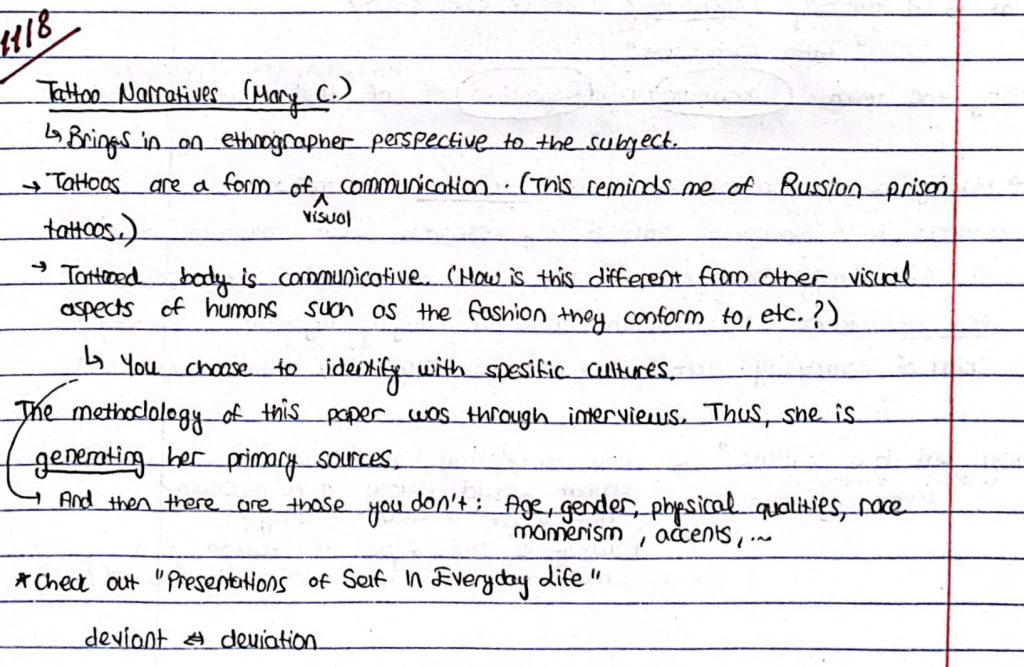
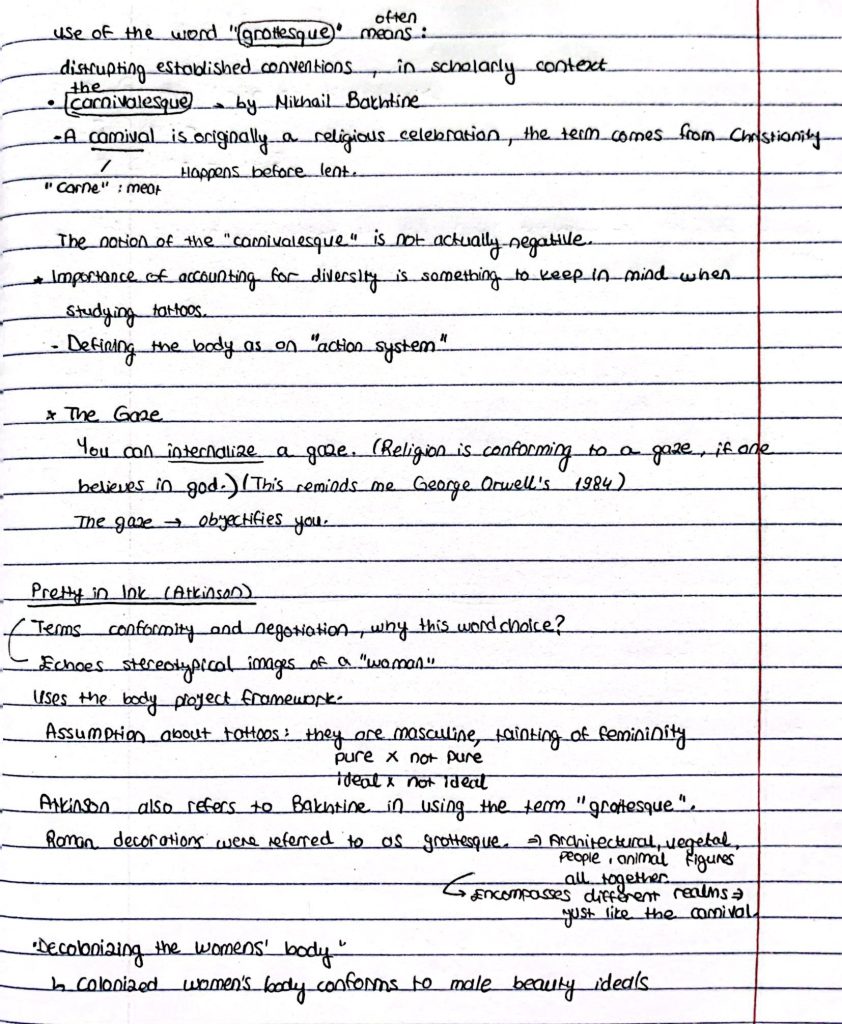
Inscribing the Body stated that the body was a canvas where culture and the individual is defined. So tattoos are a way of expressing yourself and telling your life story. I really liked the idea of “writing one’s autobiography on the surface of the body” through tattoos, piercings, and others modifications when they are voluntary. But at the same time these practices of body modifications through one’s culture or tradition still tells a story about a part of your life. Skin is cool and a little freaky if I think too hard about it.
Ideas regarding my topic:
- Medical tattoos are also very interesting as they are a growing industry that has evolved with the not only the tattoo industry but also the medical field.
- How does tattoo change how a person is perceived depending on age and gender?
- Maybe something about tattoo artists themselves or the evolution of tattoo styles
- Tattoo style that I am most interested in: Suminagashi tattoos
I am curious enough about ink wash technique and that style of tattoo already. I am interested to know how the art form of ink and water gets translated into a tattoo style. There isn’t much information on suminagashi as a tattooing style but I am interested in pursuing it as a topic of research.
Chapter 10 felt like was about the whole idea of tattoos and criminals and the argument of nature vs nurture. Chapter 11 was about penal tattoos mostly, but also the way tattoos represented that you were part of the “other” This and the codification of tattoos have been continuous themes. In Chapter 12, Omai was mentioned once again in regards to displaying exotic people with tattoos, as were the savage people. Those who practiced cannibalism were the most savage. Tattoos are used as something that separates the savage and the civilized. But when it came to being exotic, people saw profit in it and would tattooing themselves to sell their stories. Chaper 13 was more about american tattoo history and once again how non-western culture are perceived cultures that practiced tattooing. The growth of the tattooing industry during this time was because more people like soldiers were getting. But despite being civilized bc they were soldiers with tattoos this meant they were still regarded as savage. I thought the idea of the circus and carnival industry was the most interesting where we see another continuing theme – tattooed bodies are exotic and put on display.
All the chapters had similar themes and we can see that the West had a very similar idea of how they perceived those who were tattooed. If they were of another culture, Non-Westen, they were seen as savages, uncivilized, and something of interest, to be shown off, and exoticized.
Some notes on my research topic:
I found a loads of helpful material for my background as well as arguments with which I can engage in through my research paper. However I struggled to find exhibits of my topic, as I have now realized, tattooing is an extremely niche practice in performance art. I was only able to identify two legitimizable performances which involve the practice of tattooing. And although both of these were extremely daring and interesting, and I am looking forward to exploring them through my research, I am afraid that my roster of sources is limited by the lack of variety.
However I think there are possibly ways in which I can turn this around in my favor. I did find some great stuff about the psychology of performance art, and the drives of the practice both in its origin and its actuality. There must be a reason why tattoos are not commonplace in performance art—I can state the obvious, their permanence is daunting for something as ephemeral as a performance, but then again: is performance art meant to be ephemeral?
My most interesting connection thus far is definitely this article I found on the documentation of performance art and how larger of a role it plays in the identity of the performance. Drawing back to my question about performance being ephemeral, I realized through this preliminary research that tattoos are a form of documenting a performance, I want to continue looking for exhibits with this angle in mind, as I feel there is a lot to explore here.
The reading that most interested me for this class was the Irwin “Legitimizing the First Tattoo”. She talks about the experience of middle class young people getting their first tattoo, and the contrast between The attractive deviance of getting a tattoo and what she calls the “legitimization techniques” employed to even still not be associated with a lower class.
I thought it was spot on when she described how this desire to be slightly outside of the norm, ended up driving tattoos into the mainstream, and subsequently taking away the power of the statement. It made me think of my own experience and what are considered “good” reasons to get a tattoo in my middle class, non-daring environment. Meaningful tattoos are generally accepted as appropriate, as they have been legitimized, while purely aesthetically tattoos, especially if the subject matter refers to anything un-profound are in more of a grey area, where opinions on them will really depend on the person.
It also made me reflect on how my research topic—tattoos in performance art— is one of the few ways in which the practice of tattooing remains a statement of agency. Along with extreme body modifications and such, to tattoo someone for the sake of a single occurring art performance maintains that same pungent effect of discomfort, which tattoos used to provoke when they were not in fashion.
Interested by the americana iconographies associated with the American traditional tattoo style, and how deeply they contrast their own Japanese influences, I decided to research an artist who is a renowned name today on the world of tattooing and specifically the American traditional style. Dan Santoro.
American traditional has deep associations with military symbolisms, bald, eagles or American flags, but Santoro’s work goes even further back in the tradition and emphasizes Japanese motifs, very much how the sailors would do so when they were learning from the Japanese masters on their travels. He also loves fishing, and often so depicts this in a lot of his tattoo work. I found this interesting because in my eyes fishing is equally as American as a gun and a uniform. Yet a lot less violent. There are no sex icons in his work either.
Stylistically the work is beautiful. Tricolor pallet es, usually the primaries, and think black outlines, flat coloring for the most part except for some gradient occurring with the black. There is consistency in his work yet great variety and versatility. It is clear to me that this is a person who is deep enough in. His career to hav e a distinctive voice through his work. I love it.
On studying this I think of symbology and iconography, and how the traditional American style resembles for example, Mexican Huichol yarn paintings, or gothic stained glass windows. I think also, of the masks from the Dancing devils of the Chorpus Christi, and how the style would be perfect for depicting them on skin. I realized while preparing this presentation that there is a reason why the conventions of American traditional work and perdure the test of time—and that this is the same reason why all of these classic styles of art remain similar to each other in all but their subject matter. It seems to name that when any group of people are attempting to portray a symbol, they all resort to the same devices, which I have found are all the most effective in communicating an idea visually.
The subject matter of the readings for this lecture were admittedly hard to swallow. The psychology of trauma in of itself is something that I had never really taken the time to question or explore, and that alone came with some baggage. However I was rather struck by the idea of tattoos as a way to process trauma because they allow for the sort of permanence the brain is looking for when attempting to understand and process traumatic events.
It made me think of how when processing trauma, one is often trying to regain power over the event and how the most immediate sway to obtain this might seem to forget whatever happened and block it out. This however proves unproductive, and so counterintuitively: taking the agency to inscribe your own body with a memento of a traumatic event, allows for the brain to regain the control it is so desperately looking for.
On a lighter note, I decided to look for script tattoo examples for this lecture, drawing inspiration for my own friend who has dealt with some pretty traumatizing loss in her life and who decided to confront this loss by immortalizing a suicide letter into a tattoo. it is interesting to me that people insist on keeping the handwriting of their loved ones reflected in their tattoos. If I take a second to think about it, it makes sense with what Sarnecki was describing in her article about memory, and how painful stories require memory more than happy ones. It makes sense that people not only want the message their lost loved one gave them, but their inscription, the stylistic device of the lettering which says “this is you speaking, and I remember you”.
I researched the Mojave people for my presentation on national tattooing traditions. I regretted not broadening the scope of my tradition to something a bit more general as I learnt through my research that there is very little information detailing the Mojave tattooing tradition which could be helpful for my presentation. I also found out that this is the case for most of the First Nation tattooing traditions at least in the west coast of the US. If I had made my scope larger, I could’ve drawn examples from several different traditions and piece together a more wholistic understanding of their practices—as I also found that there is a lot of similarities between these western indigenous tattooing practices. However these are my presentation notes:
The Mojave people, a Native American tribe indigenous to the Colorado River region, have a rich cultural heritage that includes traditional tattooing practices. In the Mojave tattoo tradition, both men and women adorned their bodies with intricate tattoos as a form of personal and cultural expression.
Historically, Mojave tattoos were created using the “poking” method, where a needle dipped in natural ink made from materials like crushed charcoal and plant sap was repeatedly tapped into the skin. The tattoos held deep cultural significance and were often symbolic representations of a person’s achievements, tribal affiliations, or spiritual beliefs. These tattoos were not only decorative but also served as a rite of passage, indicating important milestones in a person’s life.
Mojave women, in particular, had specific tattoos on their faces and bodies, signifying their transition into adulthood and often reflecting their marital status and roles within the community. These tattoos were seen as marks of beauty and strength, showcasing the individual’s connection to their cultural roots.
However, it’s important to note that with the influence of European settlers and changes in cultural practices over time, the Mojave tattoo tradition, like many other Native American customs, faced decline. Today, efforts are being made by the Mojave people and other indigenous communities to preserve and revitalize their traditional tattooing practices as a way to reconnect with their heritage and preserve their cultural identity.