After giving my presentation and watching everyone else give theirs, I feel like I have a much clearer idea of where my research paper is going to end up. It was super helpful to see how everyone else approached their research – before Julia mentioned it to me, I had not even considered using psychology studies to compare the personality traits of musicians to those of tattooed people. I think this will be a really interesting angle to investigate in my paper, and will help me support my claims related to mental health and the therapeutic roles of both tattooing and music-making. Giving the presentation also made me realize that my history section is neither sufficient nor convincing. I need to find new sources about the intersecting histories of tattooing, youth culture, and music – my history section may end up beginning in the sixties rather than the 19th century. Finally, I will need to find more examples to add to my corpus, this time focusing on either more variety in genre or the complete opposite. I tend to listen to a lot of sad music, and so when I was finding artists to fill out my corpus beyond the GQ video series, I of course chose my favorites. It makes sense that artists who make sad music may also represent their negative emotions through their tattoos. So, I will have to either specify in my paper that I am focusing on a certain genre, which may skew my results, or I will need to find way more examples.
Category: AR474 (Page 2 of 10)
Today’s class was the second, and last day, of our research presentations. I really liked these past two classes with these research presentations. I thought it was really interesting to see the different approaches that people took and how varied our topics were. I was curious about Julia’s because it took a psychological and neurological approach that I didn’t expect, but it was precisely because I didn’t expect it that I found myself absorbed in it. I had never thought to consider the possible reasons as to how our brains work to maybe influence our perceptions of face tattoos. I was also interested by Layla’s. We talked in length about people’s perceptions of tattoos and their relations to gangs, but I never really stopped to consider how tattoos really worked within these gangs. Also, speaking of presentations that made me reconsider things, Rohit’s presentation made me think again about the tattooed characters I have seen in media. It made me reconsider tattoos as a storytelling device and how these tattoos are used in different ways to tell and contribute to these stories.
In my research paper titled ‘The Face of Rebellion: A Critical Examination of Western Disdain for Face Ink,’ I aim to unravel the intricate psychological factors contributing to the widespread aversion to face tattoos in Western society. Despite the acceptance of various forms of body art, there is a distinct boundary when it comes to adorning the face and neck, prompting my curiosity about the underlying reasons for this resistance. My interdisciplinary approach, drawing from my background in psychology and neuroscience, focuses on identifying the specific neural processes responsible for the Western dislike of face tattoos.
The core of my argument centers on the Western society’s distaste for face tattoos stemming from factors such as distinctive visual processing, cognitive associations, and principles of attraction influenced by evolutionary psychology. I contend that the surge in popularity of face tattoos, often seen in celebrities, is linked to a media-driven trend that diverges from the aversion associated with other forms of facial tattoos. By delving into the historical aspects and leveraging scientific evidence, I seek to offer insights into the deep-seated, evolutionarily influenced perceptions that unconsciously guide aesthetic preferences and social judgments.
As I explore the complexities of this phenomenon, I acknowledge the significance of the dual modes of perception—humanizing and dehumanizing—triggered by different contextual cues. I propose that the Western aversion to face tattoos may be rooted in the dehumanizing mode, particularly when faced with threatening contexts. To support this, I delve into the concepts of top-down and bottom-up processing in perception psychology, suggesting that pre-existing knowledge and expectations contribute to the negative perception of face tattoos, especially when associated with historical stereotypes. My research represents a nuanced understanding that integrates scientific evidence with sociological perspectives to comprehensively address the multifaceted reasons behind the Western societal aversion to face tattoos.
Today, I’ve been thinking about the feedback I received for my presentation, and I’m incorporating it into my final paper. I’m doing some research on THE articles for nostalgia and self-continuity and finding some good sources to reference! I also started organizing my figures and the structure of my paper. Other than that, I just need to continue researching and writing.
In preparation for my presentation, I compiled all of my sources and organized them based on BEAM in a google doc that I wish I could attach to this entry. I added notes and correlations between sources, and spend some time making sure I understood the role of all of my information in regards to my paper. I was very unsure on how to script out my presentation because I felt inclined to organize it in a very scholarly manner. I am unsure if I managed to script it properly but regardless, I definitely have a basis for writing my research paper.
I decided to present to the class a lot of my methodological research for the connections I want to make in my research. Namely all of the relevant sources I found on: anthropology, sociology, philosophy. I drew heavy emphasis on the performance side of these areas because the tattoo side of these areas I have mostly drawn from what we have learnt in class, and the sources we have already extensively discussed in class.
I finished devising my thesis statement, but I am not committing to it as I would like to go over it with Professor before I set on writing it. However right now I feel that my topic is slightly convoluted and needs some thinning out in order to obtain some clarity.
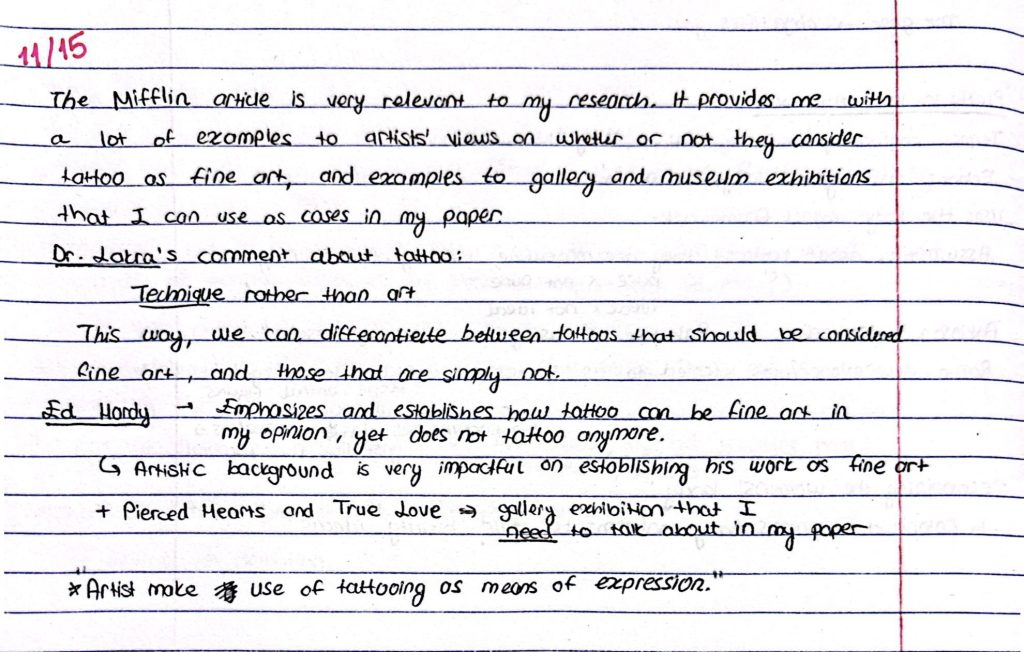
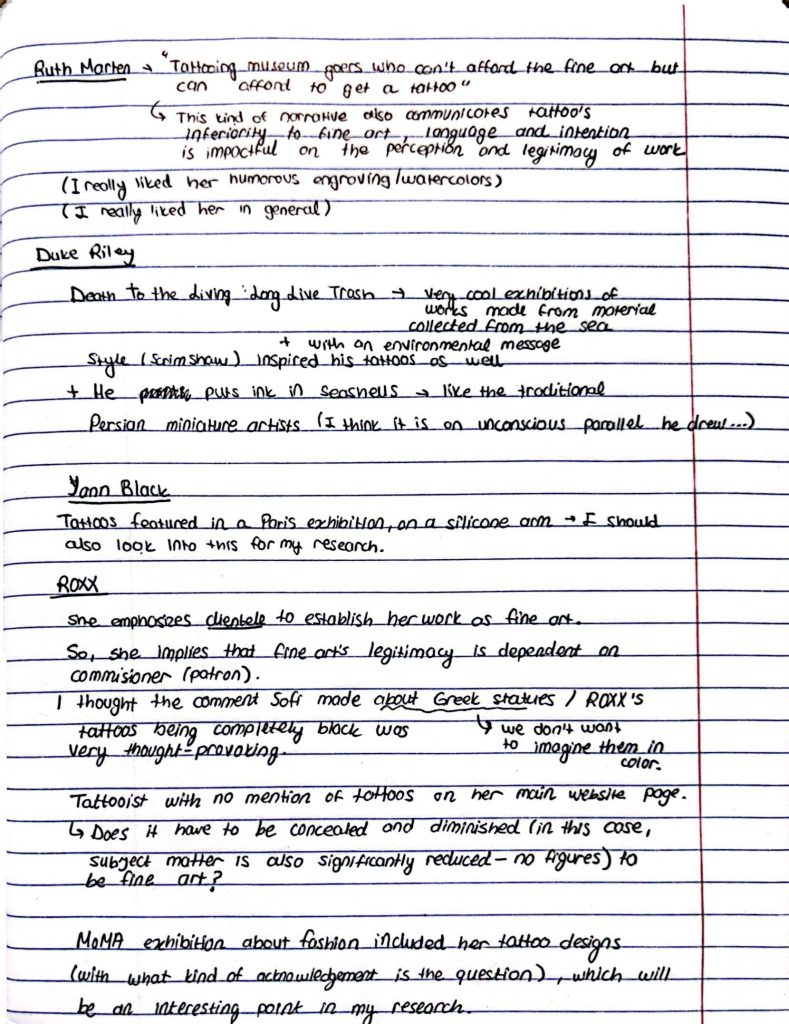
For this class, I researched tattooist and visual designer: Roxx.
I had quite the trip preparing this presentation. Roxx has a very niche style of tattooing. She creates abstract patterns enveloping different body parts, which faction more as decorative patterns that visual language of any kind. In that way, her style resembles tribalism which is something she often mentions when asked about her style. However it rubs me the wrong way that she is able to point this out whiteout giving any further details on which indigenous cultures or tribes she is borrowing inspiration from. It felt to me as if “tribalism” is being used as a buzzword.
She emphasizes that there separation between her being a tattooist and a visual artist, making it seem that whatever she does, it is above tattooing. She claims tattoos are just the medium for her visual artistry. She defends her work with elitism, claiming that her clients are often people who do not have any tattoos prior, and who belong to the highest classes of white collar workers. I think its interesting that she emphasizes the no tattoos prior thing, I think the point she is trying to make is that her clientele are separate from anyone else inclined to get tattoos. Her clients do not belong to the socially rejected demographics of tattoos, they would never get a tattoo! Unless of course, it were her sophisticated tribal patterns. . .
Most of my time in preparation for the next class was spent preparing for my presentation. In the beginning, I was scrambling a bit because, after the annotated bibliographies, I changed my claim, slightly changing the type of articles that I was searching for. I ended up changing my claim to explore the relationship between the South Korean tattoo industry and K-pop idols instead of with self expression and identity. This topic came a lot easier to me considering my interest in both Korean tattoos and entertainment culture. I am a bit worried because as I was doing my research, I found myself encroached in trying to prove my points through other areas of study, but in the end I think I am pretty happy with what I was able to achieve. More into the topic of my presentation, I think it was definitely interesting to try and find the connections between K-pop idols and tattoos in South Korea. One of the things that ended up being mentioned the most was parasocial relationships. I was always aware of, what I call, the twisted relationship between a K-pop idol and fan, but doing research for my paper really made me realize how those relationships can push someone into doing a lot of things, even getting a tattoo. For instance, if a K-pop idol can convince their fans to get plastic surgery, who’s to say that they can’t convince their fans to get tattoos which can be seen as just another form of body modification.
This past week, I spent a lot of time researching, watching videos (GQ Sports specifically), and writing down information with respect to my topic. What I’ve found is that every athlete I have looked at has gotten tattoos for a specific, meaningful reason. As I’ve continued my research, I have narrowed my thesis to focus on how athletes use tattoos as an outlet for many forms of self-expression. I focus on cultural identity, family identity, personal identity, and societal identity to break it down further. Tattoos are an emblem for the intersectionality between all of these forms of identity because they live on/with you forever. While athletes tend to lean towards getting a tattoo for a family member who significantly influenced their career, much of the decision to get tattoos has to do with personal desire for honoring something or someone important to them. Hearing about some of these NBA players like Jayson Tatum or Damian Lillard who pay tribute to their homes by having the names of the streets where they grew up or the towns. I have also spent time reading back through past readings which focus on the branches of identity and its relationship to identity, such as Kosut (2000) “Tattoo Narratives” piece.
In preparation for this class session (and my presentation), I watched so many videos of musicians being interviewed about their tattoos. I actually had a lot of fun doing this, and I found several of the musicians’ statements helpful for my presentation/paper. Something that I’m not sure if I expected, but that definitely makes sense, is that many of the musicians had tattoos (either portraits, logos, or lyrics) referencing the musicians who had inspired their own work. At least two musicians (maybe more) had Nirvana-related tattoos, which is a testament to the cultural impact the band had. When I told my dad about the Nirvana tattoos, he wasn’t surprised; he said that, as someone who was alive during Nirvana’s skyrocket to fame, it was “crazy” how much of a pop-culture mainstay they were. I also was not surprised that several musicians had objectively terrible tattoos. I think, especially before celebrity tattoo artists became more common, it was seen as cool for musicians to go to a completely random tattoo shop and get a crudely-done tattoo for the “rock ‘n roll culture.” I honestly love seeing peoples’ “bad” tattoos – there’s almost always a great story behind them, and the tattoos are worth something for that alone.