AR473 | Fall 2023

Category: AR474 (Page 1 of 10)

Classes 12 and 13: Research Presentations

Listening to the presentations was so interesting, and I enjoyed hearing about everyone’s research process. I was especially excited about Sofia’s presentation because it’s so relevant to my thesis work with Fluxus, and she made me consider the role of artist identity in shaping the art they produce. I think it’s surprising that body modification isn’t really present in performance art because so much of it revolves around body presence and presentation, and tattooing (even if temporary) is an interesting medium for expression. I liked Zehra’s presentation a lot too and thought she presented the tension between tattooing and fine arts very clearly. I think the way we display, discuss, and view tattoos is a crucial part of understanding why tattoos are different from traditional art and what role they play in the art world.

I still have a lot of work to do in forming my final paper, and I have so many ideas that need to be clarified and narrowed down. Listening to the rest of the class presentations helped me understand the direction that I think my work needs to go in and demonstrated some clearly structured research that will be a great model for me. I also need to narrow down my sources, because I have collected too many and some are no longer relevant to my thesis,

12/6

Since I presented my research last class, I find that this class I was less scattered and I was more attentive to what my classmates had to say.

I will spare the compliments for the presentations I saw yesterday, they were all wonderful, I expected no less! However I find that watching my classmates present their research was truly helpful in organizing my own. I realized that the way I have organized my own research was a little obsucre, and that I need to simplify my terminologies and flesh out my ideas better in order for my paper to be more cohesive. I am a bit worried though, about the organizational aspect of my research, because it seems to me that most people in class have a specific idea in mind tha thtey are running with, even if their papers are not argumentative.

However I find that the nature of my paper is more comaprative? And as such, there are a lot of loose points that I will have to figure out how to turn into a cohesive body of work. After having had my meeting with professor Plesch though, I feel like I at least have the resources available to make this a good piece of work, I just need to spend more time organizing my research and working on my thesis.

Class 10: Body and Gender

  1. Mary Kosut, “Tattoo Narratives”
    1. Tattoos as a form of visual communication within a multiplicity of contexts; the tattooed body is communicative and active
    2. Sign vehicles: conveys and transports meaning, presentation of the everyday self; allows for a mobile and transient signifer of the self
      1. Meaningful for dentity and culture 
    3. “Grotesque and carnivalesque” – disrupting conventional standards of beauty, fighting against gender norms, something labeled as unappealing
      1. Mikhail Bakhtine: “the carnivalesque” → determined period where people can let loose, leave constraints of mundane social life
      2. “Carnival” comes before liturgical season of lent (40 days); eating meat, fried food, drinking, and costumes (transformation into something else) 
    4. Kosat wants to account for diversity when studying tattoos; body is both biological and cultural, produced and constructed by its environment, and the different experiences and identities need to be accounted for
      1. Body is an agent, action system, a mode of praxis; indispensable to keep one’s own narrative ongoing
    5. Social components of embodiment; disjunction between self and physical body? 
    6. Idea of the Gaze: power dynamic, shapes subject with gaze into an object that loses agency (put into position of inferiority without control), but also grants it visibility and a sense of social context –> what informs this gaze? How is the recipient determined?
    7. Authentic construction of an identity, distinct from social conventions; also serves a talismanic function; personal landmark; rewriting identity; rebellion; conversation with yourself
      1. Shifting meaning  
  2. Atkinson, “Pretty in Ink”
    1. Framework of body projects, constant modification, communication (of femininity): assumption of tattooing as masculine, impure, ugly, not ideal, outside (all part of binary systems)
      1. “Grotesque”- 16th century, found golden house of Nero in Rome underground, term developed to describe decorations as grotesque: something that was eclectic and encompassed different kinds of components (architectural, natural, animal elements- encompasses different realms, dynamic, cannot be contained → same thing happens during carnival, very expansive and uncontrolled)
        1. Gender and the grotesque; unconventional, unbounded forms of gender expression (something that doesn’t fit into categories) 
    2. Foucault: ways in which society controls people, all about power
      1. Docile bodies, passive and submissive, demure, small (don’t take up space) 
      2. Models: unsexualized bodies that behave without personality (blank and empty expressions) 
    3. Negotiation for women, through tattoos: dainty tattoos (size, symbol, placement) as a form of acceptable deviance, allows women to negotiate their position in society and express themselves while still being socially accepted  
  3. Braunberger: bodies in revolt
    1. Monster beauty of tattooed women; body in excess, becomes spectacle or show; invitation for visibility?
      1. Grotesque applied here too; “freak show”   
    2. Monsters as hybrids, not one thing nor the other; combines aesthetics with anger, still form of beauty but born out of power and reclamation and authority
      1. Process of decolonization 
    3. Sexualization of the body that accompanies tattoos, even though it is seen as less desirable
      1. Beauty to beast 
    4. Introjection: absorption of cultural symbolism, 2 way flow between body and the world (interior and cultural exterior) → tattoo
      1. Alfred Gell comes up again  
  4. Caplan, “Educating the Eye”
    1. Overlap of sexual theory (sexology) and criminology; very visible, socially controlled
      1. Lombroso, Havelock Ellis- criminological studies that rely on biological justification (rationalizing discrimination…)
    2. Social hygiene, concept of deviance emerges → psychologization of crime
      1. Degeneration: hereditary qualities, inevitable cycle  
    3. Double abjection (repels, revolting, shunned out of disgust) of tattoos: emblem of deviance, subjection to men, and also shows her own inferior will
      1. “By being revolting it’s a revolt”
  5. Helen Cixous: laugh of the medusa 

Class 6: National Traditions

There was a lot of overlap in national tattoo traditions, both functionally and symbolically. I found the presentation on Innuit tattooing specifically interesting, as it was a marker of gender and served as a way for women to distinguish themselves. It was also usually done by women for other women, and served as a sign of beauty, maturity, and protection against spirits, drowning, animal attacks, etc. They also helped reflect religious beliefs, and they were used for both medicinal purposes and funeral celebrations as functional symbols of health and rebirth. Chin tattoos were especially important, and were seen as a sign of strength and identity during periods of violent conflict. Tattoos served a huge range of purposes in Innuit culture, and clearly exemplify how they could be useful, beautiful, and affirmations of identity. Tattoos in the Balkans were similar in their range of purpose, and were medicinal, magical, religious, and ritualistic, especially for women. The relationship between women and tattoos was also a large part of Godna culture, and tattoos provided women with agency and power. They also allowed women to reclaim their subordination and abuse from men, in the context of the Hindu aristocracy (marriage and status).

I did my presentation on Ancient Egypt, which paralleled a lot of these places in their customs and traditions surrounding tattoos. Some of the earliest instances of tattooing are actually provided by the Nubian Mummies found in King Mentohotep II’s funerary complex, who reigned during the 11th dynasty of Egypt’s Middle Kingdom around 2000 BC. This was really interesting to discover. The mummies are speculated to have been Nubian dancing girls that provided entertainment for the king, and display tattoos that are similar to styles of Egyptian body decoration from the same period. The Nubian mummies were found alongside the body of Amunet who is believed to be a priestess of Hathor, the goddess of fertility, beauty, sexuality, and music, as well as the protector of women. Her tattoos are a complex array of dots and dashes across her upper body with an especially dense pattern around her lower abdomen. While the purpose of the tattoos was initially associated with provoking sexual arousal, they are now understood as a ritualistic practice in the service of Hathor that promised fertility and rejuvenation. One of the most prominent images in the tattoo culture of Ancient Egypt was the God Bes of revelry and patron saint of dancing and music. His image is found on the thighs of dancers and musicians throughout many paintings, vases, and amulets, as well as on the Nubian mummies from 400 BC. He most likely served as an omen of fertility and protector of women, similar to Hathor. This is a major theme in Ancient Egyptian tattooing, and many of the styles seemed to have protective functions that signified the importance of motherhood as a source of power. Others are interpreted as a rite of passage that marks sexual maturity and fertility as well. This is also similar to the Innuit tattooing culture. Overall, it was useful and exciting to learn the similarities in tattoo purpose and how they have served a pretty consistent purpose throughout decades of history.

Class 5: Inscribing the Body

Notes:

  1. Cultural (and identity based) construction of the inscribed body and the visual surface of the body as “the interface between the individual and society”
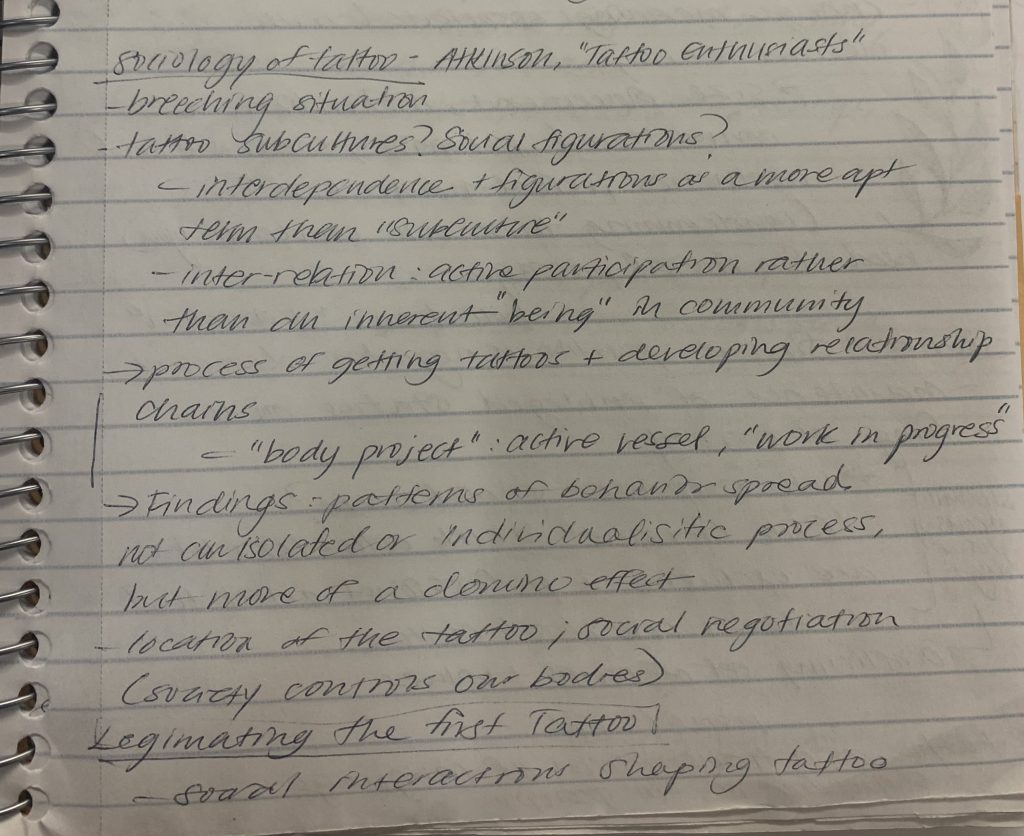
    1. “Body as a text upon which social reality is inscribed” (Foucault); body as subject and material object with personal agency and powerful materiality (rather than the “disembodied” post structuralist body), vessel for outward communication and identity 
    2. Liminal quality of the skin (interior vs exterior binary), boundary phenomena –> “skin ego” as an interface between psyche and body, self and the other; Freud’s “mystic writing pad,” the way memories and perceptions are entangled through the body’s surface (“waiting for imprinting”)
      1. Social skin: culture constructed and expressed through individual bodies, the “socially informed or socialized body,” relationship between the individual and the world in which they live in (Kayapo culture, specifically)
    3. Effacing boundaries between time, mortality and the divine, social norms, etc.
  2. Ambivalence of inscribed skin as a boundary due to the possibility of individual agency subverting externally imposed inscriptions; political control or domination (“canvas for inscription of political power,” symbolic denial of personhood) as opposed to the “agency of the individual in constructing a relationship between body and society”
    1. Sex workers, gang members, sailors, soldiers: voluntarily assumed markings that allow them to reclaim and gain power from the fusion of subjection and resistance; confronting the projected fantasies or prejudices of others
  3. Early Comparative Studies:
    1. Body markings as a sign of savagery, juxtaposed against the pure, untouched “God-given” body (linked to Protestant Reformation): 
  4. Representation of the Exotic Other:
    1. “Body art thus worked its way into Western thought as a major trope in identifying both non Western peoples and the subaltern exotic within the West” –> tattooed bodies of lower class Westerners became conflated with the exotic bodies of Africans, Asians, and Native Americans. 
    2. Empowerment and social control: women in the 20th century using it for subversive resistance to colonial power in Mozambique; engagement with colonial economy, images of modernity (sheds erotic meaning)
      1. “Rewriting the the boundaries of difference,” provided avenue for women to create networks of connection and associations among themselves 
  5. New Identities, Modernity, and Authenticity
    1. “Movements of cultural identity within pluralistic states, the commodification of body art, and the symbolic use of body art as political symbols by environmental and indigenous rights advocates are salient issues.”
  6. Tattoo Renaissance: shift in practices of Western tattooing (change in clientele, style, iconography, and artists) –> Is this really the right word for it?
    1. Tattooing generally remains within European aesthetic tradition until the 1960s, when Polynesian and Japanese imagery became more popular: more travel, commercial success, influx of artistic stylistic trends (especially among the middle class)
      1. Body art becomes more mainstream, though continues to redefine social boundaries; rise of “extreme” body modifications, pushing limits of acceptability (less art, more social protest)
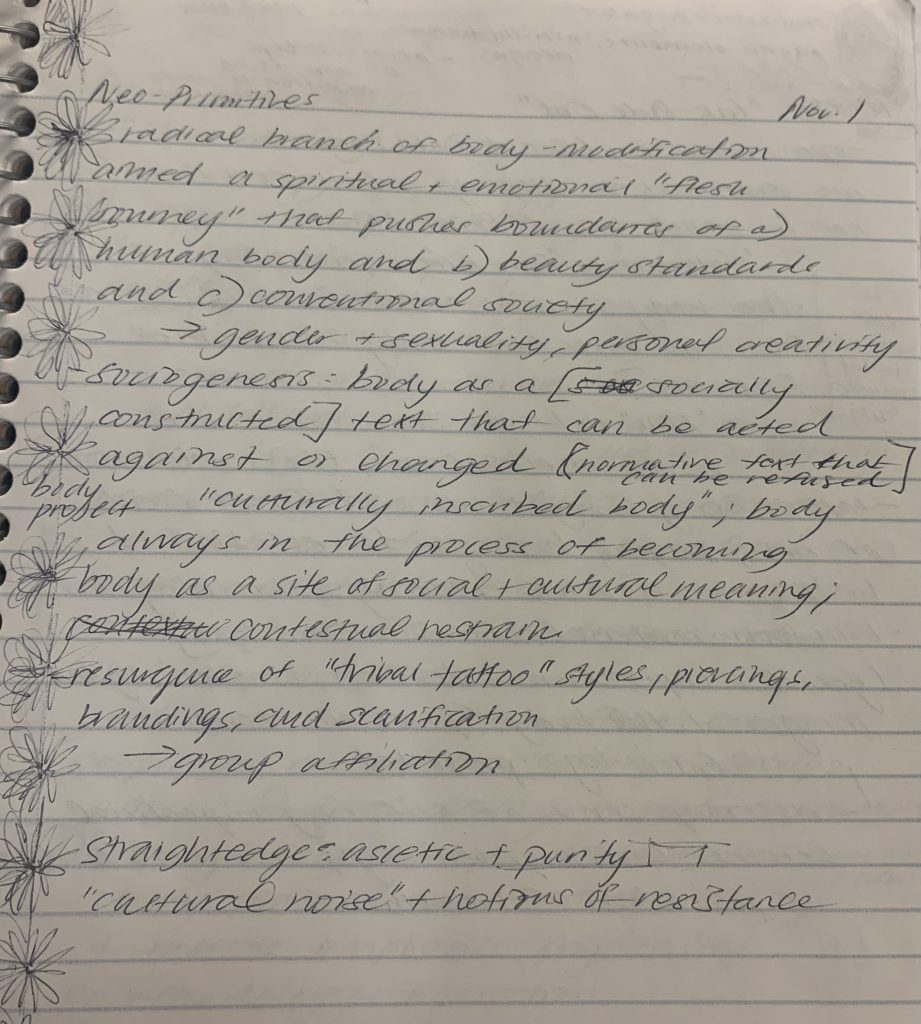
      2. Ongoing and shifting relationship; body art and deviance, “neo-primitive culture” of tattooing that embraces this- idealized non-Western culture and alternative lifestyle (issues of cultural appropriation, authenticity, media culture, and consumerism) 
      3. Consumer culture and body commodification 

Class 2: Caplan Presentations

  1. Looking at tattooing as a non-linear, multicultural (global), intersectional practice with a discontinuous history 
    1. Intersection of religion (*identity)/ spirituality/ culture/ ritual (a practice repeated throughout time) and art
      1. Human agency and activity involved in the practice of tattooing 
    2. “Tattoo Renaissance:” rebirth or betterment of tattoos
    3. Binaries between inclusion and exclusion, internal/ external, invisible/ visible 
    4. Alfred Gell: “Wrapping in Images”
      1. “… Exteriorization of the interior which is simultaneously the interiorization of the exterior” 
    5. Anzieu: “The Skin Ego,” similar idea of tattoos as a communication between interior and exterior
      1. Skin allows for exchanges, but also protects the body; reveals the interior (ex. blushing) 
  2. Chapter 1: “Stigma and Tattoo”
    1. Greek and Roman stigma around “barbarians,” but that “stigmata” meant tattooing and now branding/ burning
      1. Exposure to tattoo: Egyptians, early Israelites, and Northern Neighbors (Southern Bulgaria and Turkey) 
      2. Clear etymological evidence about stigma meaning tattoo
    2. Cultural Significance of Stigma: decoration vs degradation
      1. Also sometimes a status marker 
      2. Persians often used it as a punitive function
        1. Greeks adopted this 
        2. Samians also would tattoo Athenian prisoners on their foreheads 
    3. Membership and Religious Function: sacred tattoos in Syria, the mouth of the Nile with the initials of God on their wrist 
    4. Long standing tradition of decoration and punishment as a binary of tattooing, bridged by human participation/ agency 
  3. Chapter 2: Function of tattooing in punitive situations specifically from late antiquity into the Byzantine period?
    1. Christianity as a force in administering this 
    2. Ambivalence of the signs: difference between intent and how it became understood 
    3. Edict of emperor Constantine that says punishment cannot mark the faces because “divine beauty cannot be disgraced”
    4. Function and form of penal tattoo (often on foreheads):
      1. Name of crime, name of the empire/ symbol of it (owl for Athens), name of punishment 
    5. Shifting meaning of symbols, transition from “defacing” into venerable living icons (inscription with the lord’s name)
      1. Christianity reconsiders suffering, turning it into sacrifice, martyrdom, bravery, etc. A lot of Christians used the “punishment” tattoos as a voluntary faithful practice 
  4. Chapter 3: Tattooing practices of the Celtics of the British Isles
    1. St Brigid 
    2. “Indelible mark made on the skin” 
    3. Saints: behavior dictated by the Bible or a written tradition (scripture), body becomes a place where scripture is inscribed
      1. Powerful idea of claiming identity through written language imprinted on the body 
    4. Absence of language to describe tattoos, make it incredibly hard to trace/ document

Class 4: Caplan Presentations

Appropriation, Exoticism, and “Othering” seems to thread through these Caplan presentations, and connected the historical practices of tattooing with different time periods and geographical locations. The European fascination with “savage,” foreign cultures manifests in both the appropriation and condemnation of tattoos. Chapter 12, for example, discusses the role of tattooed people in the entertainment industry, and how foreigners were captured and displayed to both the elite and general public as a spectacle. PT Barnum and the traveling circus commodified people who did not fit into mainstream society, especially those with extremely tattooed bodies, and put them on display as erotic attractions. This especially affected women, and normalized revealing female bodies for money and entertainment. Interestingly, femininity was juxtaposed with tattooing; the art of performance, display, and the centrality of the body is something inherent in female existence, but tattoos and the “defacing” of the body was seen as something purely masculine. Several women, like Betty Broadbent, were able to negotiate the contradiction that their tattoos posed to their femininity through body language. By behaving “modestly” and “properly,” tattooed women were able to maintain at least part of their image as a socially acceptable woman.

Tattoos being a signifier of social ostracization, but being co-opted by mainstream society for either entertainment or status, is a large part of the history of tattoos. This is clearly seen in sailors, who were visually exposed to Japanese art and carried the imagery home on their skin where it was re-defined and re-purposed by the elite. Symbolic and linguistic aspects of “other” culture was adopted for a wealthy, white audience, and the people that it was appropriated from continued to be marginalized without credit. The field of criminology was heavily developed during the 19th century in Europe, with figures like Lombroso, Baer, and Leppman, and they criminals were determined as biologically different (and inferior). Because tattoos were strongly associated with the lower class, socially and economically, they were also associated with criminals. In 18th century Russia, peasants, vagrants, and criminals were exiled in Siberia and were branded as a form of punishment. Tattoos were used to solidify status and class among convicts as a form of control, while also creating a structured hierarchy. However, they became a source of pride rather than shame, and tattoos developed as a form of ritual that allowed “vagrants” to reclaim their identity (tattoos referred to as regalia).

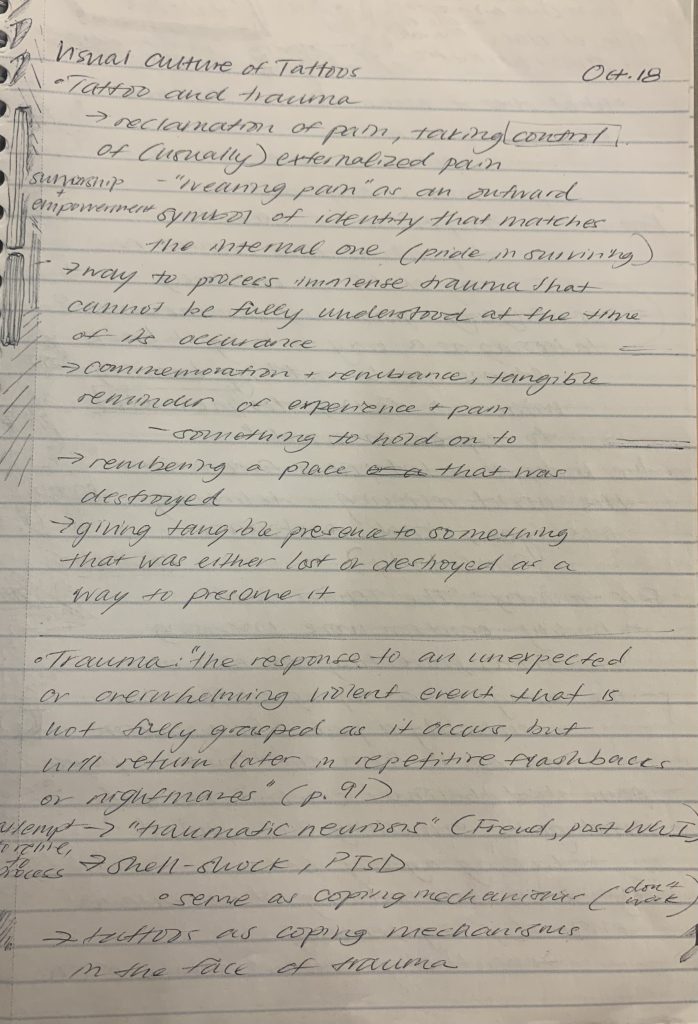
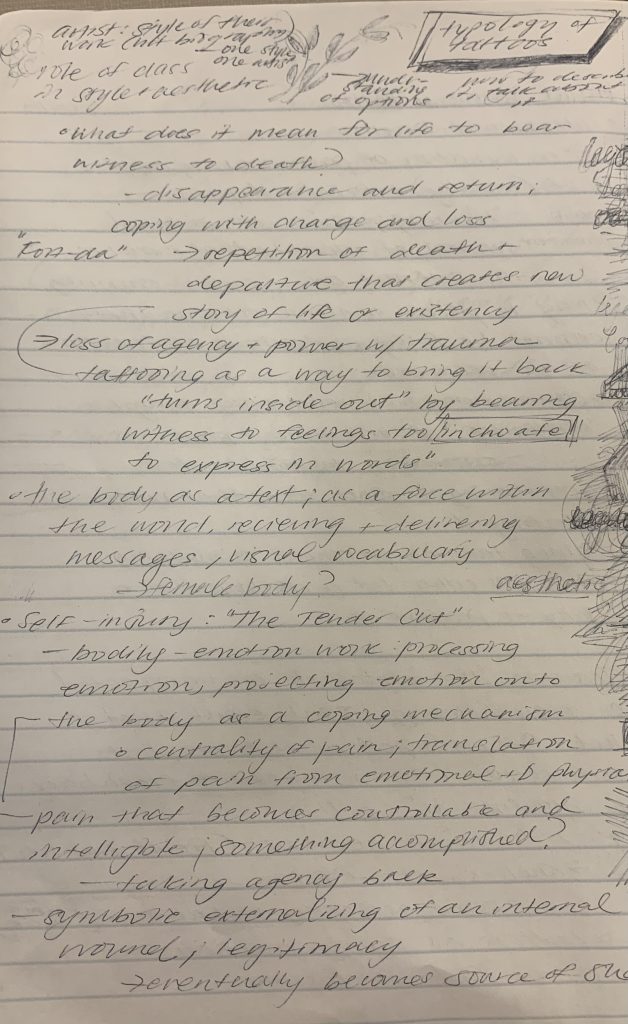
The class presentations were really interesting and allowed for an engaging discussion about the larger themes in the Caplan readings. They built very clearly on what we’ve been talking about tattoos as a signifer of social standing and a tool used by the powerful to other certain members of society. I’m especially interesting in how they can function as a source of empowerment and creativity and also as a form of punishment.
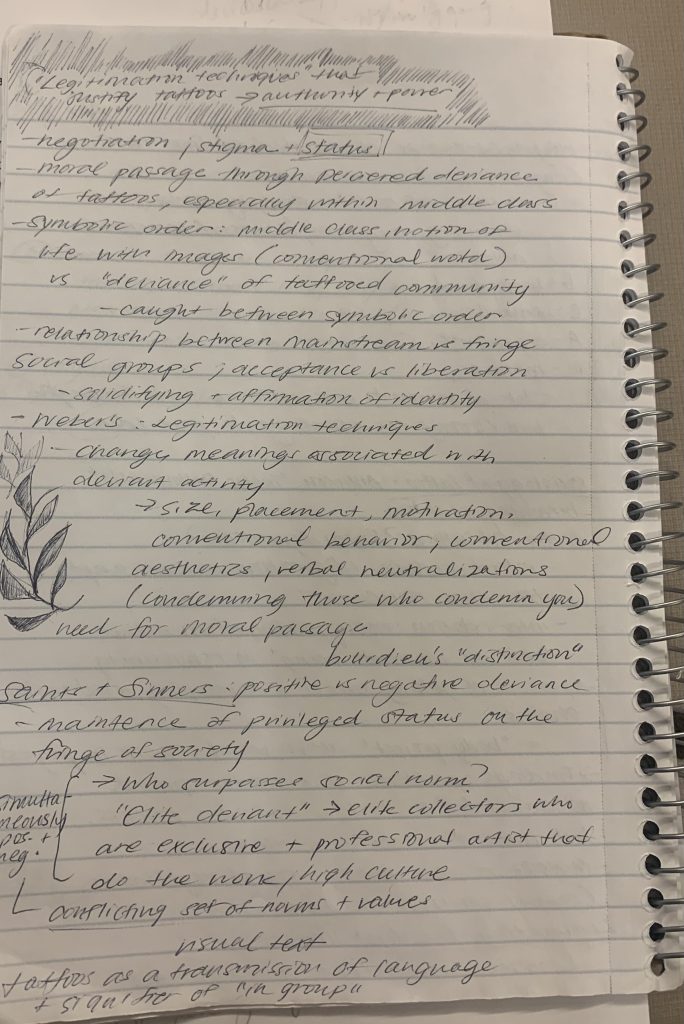
Class 11: Tattooing and the Contemporary Art World

Mifflin’s “Ink Side Out” is an interesting profile about tattoo art in mainstream culture. She identifies an overlap between tattoo imagery and fine art, and describes the techniques that are used by several artists to break away from the narrow visual language of traditional tattooing. Her article is really an exploration of creativity and eccentricity that helps bridge the gap between fine art and tattooing, which is an important effort that elevates how tattoos are viewed and received.

I did my presentation on Ruth Marten, whose work I really enjoyed. She builds her tattoos around a playful and Surrealist sense of humor that she says will keep the field from stagnating. She clearly favors reforming and revitalizing tradition as an artistic practice, and has altered an abundant amount of prints and lithographs from the 19th century. Inserting animals, colors, or abstract shapes, she takes old portraits and turns them into a scene of carefully constructed absurdity. I think she definitely took a similar approach to tattooing, and tried to disrupt the traditional practices of tattoo. At the time while she was working as a tattooist, there were a lot of subversive movements (both artistically and culturally) which made room for her as an artist, and its clear to see where she got some of her inspiration.

« Older posts