 by
by C.P Snows’ influential “Two Cultures” essay outlines the great cultural divide that separates the disciplines of the “sciences” and the “arts and humanities.” Snow, who was both a physical chemist and novelist, saw himself as a bridge between the two cultures, yet declared that the sharp line that divides the two areas of intellectual activity was dangerous. While the sciences provide the “how” of the natural world, it is the humanities which depict the history, the emotion, and ultimately the “why” behind our humanity. As the divide between the arts and sciences has only become more sharply defined in our tech-centric 21st century world, the importance of the intersection of the arts and sciences in combating the pressing issues of our time has become ever more important.
Climate change is arguably the most pressing issue of our time. Yet while scientists have published numerous cautionary reports, detailing terrifying statistics about the dangers of global warming (such as the IPCC warning that we only have ten years to prevent the worst impacts of climate change or the U.N report that 20 of the warmest years on record have occurred in the last 22 years) our governmental leaders, policymakers and the general public have been slow (and in some cases completely unwilling) to accept, and even slower to act upon the facts that have been laid out by the scientific community. I believe that an interdisciplinary approach to the climate crisis is the only way in which human understanding, action, and ultimately change will occur.
Maya Lin, an architect, visual artist and environmentalist is an exceptional example of the interdisciplinary approach to scientific fact which I believe is crucial to combat climate change. Lin, who described herself to my Environmental Humanities course as “a data lover” works across the artistic and scientific cultures in order to convey scientific knowledge and history to the general public. Maya Lin is also a memorialist, and believes deeply that memorials both teach the history of the past, and serve as a warning for the future.
Lin’s sculpture Disappearing Bodies of Water, Arctic Ice (2013), situated in the Colby museum, is a marble memorial to the “death” of the Arctic ice shelf. The sculpture, made with slabs of layered white marble, depicts the shape of the Arctic ice shelf as it shrinks year after year, and draws attention to what is missing in our environment today. The sculpture, which balances on a cement pedestal, is a reminder of the precarious situation of the Arctic shelf. And its shadow which only depicts the bottom slab of marble (the iceberg before it had melted) acts as a haunting memory of what used to be.
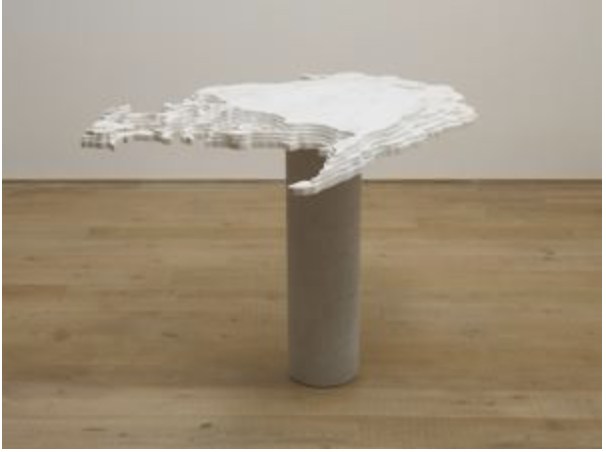
Before viewing this artwork I knew about our earth’s rising temperatures. I knew about rising sea levels, and I knew about the icebergs which shrink every year. Yet the art piece struck me to think more deeply about the situation.
Lin’s work is an example of how science and the arts can work together to create a deeper understanding of the impacts of climate change, convey messages to new audiences, and hopefully create the momentum that is needed to foster real change. The facts about climate change are out there. Yet without the emotion, the stories, and the empathy and humanities provide, we will remain unable to push knowledge into action. Visual art and storytelling can connect the data behind the scientific how of climate change to the understanding of why this issue matters.
Sources:
https://www.earthday.org/5-terrifying-climate-change-facts-scare-halloween/
Maya Lin, Disappearing Bodies of Water: Arctic Ice, 2013. Vermont Danby marble on a granite base, 48 x 46 x 52 in. (121.92 x 116.84 x 132.08 cm). Colby College Museum of Art. The Lunder Collection, 2013.537.