
by Sarah Kaplan ’20
One of the best ways to get to know a person is to drive around in a car with them for a while. Sandy Hammond and I have been doing Monday morning food pickups mornings for the Waterville Food Bank for a few months, so I have certainly gotten to know her well. Sandy’s typical WFB uniform is shorts and a Disney baseball cap; pants are only acceptable on the coldest of Maine winter days. She taught me that you do not wear things you care about too much when you volunteer, and she taught me the proper way to hold a banana box. I have also learned Sandy’s opinions about institutionally cooked food, raking leaves, and why it is an outrage that the Wendy’s on Main Street will be closing in the spring for a redesign. Most importantly, I have learned that Waterville is lucky to have a person like Sandy Hammond.
Sandy says she works at the Waterville Food Bank because it keeps her out of trouble. While she jokes that she became increasingly involved because “she’s a sucker,” it’s really because she is committed to giving back. Sandy began her work with the food bank 12 years ago when she was in a car accident that put her out of work for good. These days, you can often find her at the WFB or out on a food pickup run.
Over time, Sandy went from handing out food once a week to restocking to buying food for the food bank. Now she serves as one of the coordinators. The WFB is not a religious organization, but it is housed in the Pleasant Street Methodist Church, which Sandy attends. Her faith is connected to her work at the food bank because “it is part of the church’s mission to help the community. Volunteering at the WFB is a very direct and active way to help the community. … I come from a place where I believe no one in this country should be hungry. You start there and work [outward].”
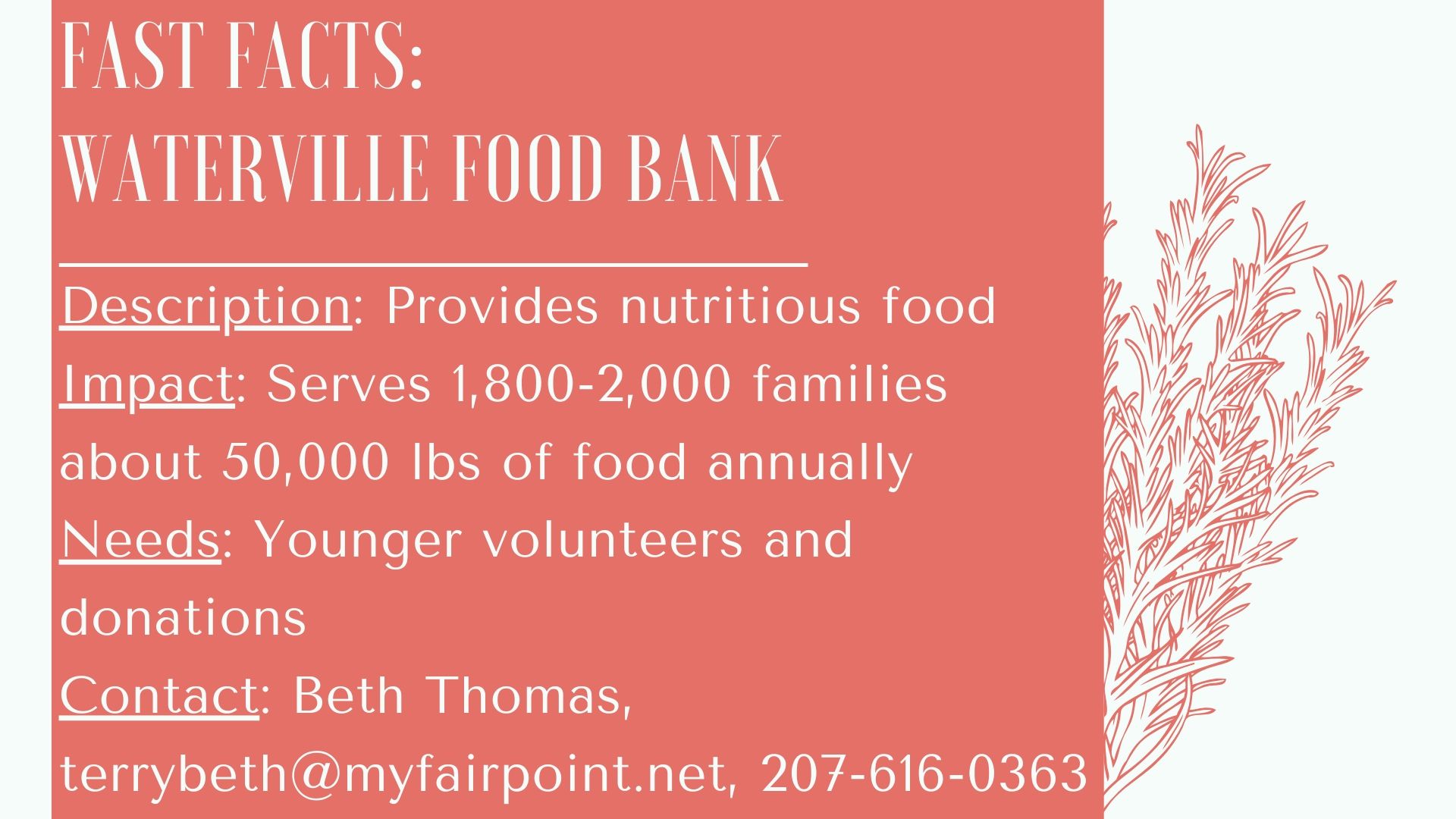
Sandy’s work at the food bank goes beyond simply handing out food: she also educates clients about the importance of nutrition. “The challenge is getting people to understand how much they can do with their food. How they can use their ingredients better, how to make the ingredients go further, how to eat healthier.” In particular, Sandy is excited about the WFB’s new initiative to hand out recipes that show clients what they can do with their food.
The ingredients available in the food bank have changed over the years, thanks to Sandy. “Some of the success of the food bank is from the refrigerators we got so that we can offer fresh produce and a number of other items that require refrigeration. We’ve also switched to all low-salt canned vegetables, light-syrup fruits, water in our tuna and chicken cans, and we try to encourage much more healthy eating for the community.” Sandy’s efforts provide not only immediate help but also ways of living a generally healthier life.
Sandy has also increased the communication between the WFB and other food organizations. “A lot of the [food groups in Waterville] when I started said, ‘No we don’t do this, no we don’t talk to them.’ … I think we are now pretty much tapped into every organization we need. The only constraint we have is the amount of volunteers and the amount of time.” How did this happen, I asked? “That’s easy. By talking to each other. That’s all it took. Taking the time to make that connection… That’s just how it works.”
The connections Sandy built benefit not only the WFB, but the entire Waterville community. “We got Wal-mart. We got Shaw’s. We got Hannaford. Also, we started working with all the other food organizations within the city area so we are sharing produce. We have the farmers bring us fresh produce every week and what we can’t use, we share with other food banks and other groups. We work with approximately 14 other organizations within the city to ensure that there is food available at all times.”
Sandy jokes that she has stayed at the WFB for so long because her “truck’s on auto-pilot.” But really, she says, “It keeps me busy and it’s a way of giving back. It can be very rewarding when you’re helping people.” Sandy sees how giving back can be deeply ingrained within us. “It’s a gene that we have in our bodies to give back. I want kids [volunteering] in the food bank. I want them now. Because, if you activate that non-profit gene, at some point those kids are going to make a difference.” While Sandy has been working to activate that gene in many of the young volunteers that come to the WFB, it is greatly because of her non-profit gene that the WFB has grown to do as much as it does for the people of Waterville.