
 by Sarah Kaplan ’20
When I first walked into the Pleasant Street United Methodist Church office, I found Reverend Thom Blackstone there alone, steadily working at the copy machine duplicating pages from a book. He invited me to sit down to talk about his work at the church. I quickly learned that talking to Rev. Blackstone was going to be harder than I thought: he loves to talk about work others do in the community rather than about his own efforts.
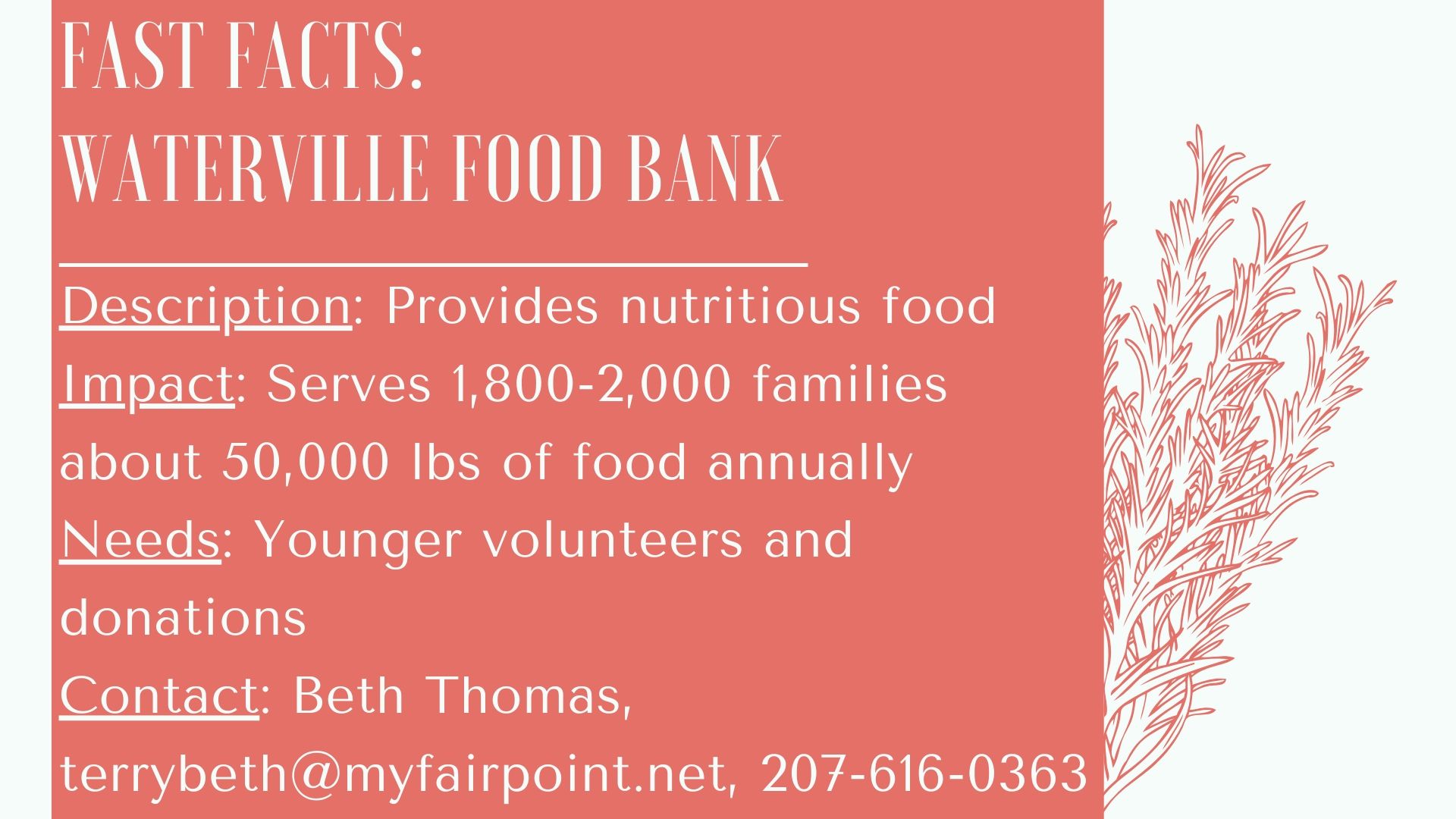
Rev. Blackstone has been the Pastor of Pleasant Street UMC for about five years. In the United Methodist Church, pastors are moved around based on the needs of the churches. Before being in Waterville, Rev. Blackstone had been in Augusta and always worked with churches that are very involved in the community. His current church’s primary ministry partnership is with the Waterville Food Bank, which the church houses.
The food bank is what Rev. Blackstone calls a ministry partner. He explains that ministry partners are “organizations that we are involved in through volunteers, that we support financially, or that we share space with. There are probably thirty [ministry partners] that would meet here once a year or are here constantly, like the WFB. … We use the term partner because we don’t necessarily require that [partners] convey our faith convictions as part of a condition of giving assistance to somebody.”
Ministry partners try to be very clear that one does not have to be a member of the church to receive assistance. “Sometimes the fact that we’re a church can be intimidating to some people or cause them to keep their distance, so it helps that it’s called the Waterville Food Bank and they have a good reputation for not proselytizing.” While many of the volunteers are connected to the church or to another congregation, the food bank itself is not considered a faith-based organization.
 There are often times when a congregant resides at the homeless shelter or receives aid from the food bank. Rev. Blackstone explains that other congregants “try to be supportive if there is a role for that, but also not to single them out as a charity-case. We want them to be comfortable.” For all of the services that the Pleasant Street United Methodist Church can provide, there is always respect in the way folks reach out. Rev. Blackstone explains that these actions are intentional. “We do have members of the church who are clients at the food bank. We’re very deliberate about that—we want to be the welcoming community that can allow people to do that. I understand that it can be very difficult for folks to do that. If you come to the WFB and the person across the table from you is your fellow parishioner, that can be awkward for people who are on the receiving end.” The respect that is ingrained within the congregation ensures that recipients of aid should not feel self-conscious, but there is still recognition that this may occur.
Communication and networking is critical for the church to help as many people as it does. Pleasant St. UMC is part of the Interfaith Council, which meets monthly to discuss what is going on and what organizations need support. Rev. Blackstone sees, though, that not all denominations are represented there: “It’s the nature of religious institutions that some feel more oriented toward ecumenical and interfaith activity than others. There are some churches and probably other faith groups that are defined more by their independence and are not as oriented towards working cooperatively with others—and I don’t really judge that, it’s just the nature of who they are. So when the Interfaith [Council] meets here, it tends to be mainline Protestant folks.”
The nature of certain religious institutions affects their approach toward community work. “Methodism is a very practically oriented faith,” Rev. Blackstone notes. “I’m sure from our DNA we’ve passed on ‘doing all the good you can’ [to the food bank]. It’s a quote from our founder. I think that the idea of passing on to partner ministries our passion for being of us in the community—I’m sure some of that has rubbed off.”
As much time as Rev. Blackstone puts in, he still focuses on what others do for the community. “[The volunteers] are amazing… They’re dedicating their time to folks they want to assist. They continually astound me. And I try to work at the level of organizing the programs and funding the ministry partners. But as often as I can, I try to jump in and be a part of whatever project. And it just astounds me that I’m doing something once a month and they’re doing it thirty times a month and never complaining. It just astounds me.”