
 by Oscar Garcia ’22
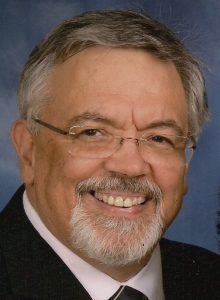
The first time I met Subdeacon Stephen Crate of St. Joseph Maronite Church, we began talking as if we were longtime friends. I asked him if there was a significant event that shaped his way of approaching life.
“I had a traumatic experience when I was 17,” Stephen said. “I was working at a building in the campgrounds in Etna… and someone was putting a nail into the top of a stud and it bounced off the ceiling and hit me in the eye.” This incident left Stephen blind in one eye and out of work with excruciating months of eye surgeries and recovery.
Afterward, Stephen attempted to go back to college, but he underestimated how much of a struggle his newfound blindness was going to be. He was in and out of jobs, trying to make enough money to stay afloat. It wasn’t until Stephen met a vocational rehabilitation counselor that he was able to get back on track. She reassured him that despite his injury, he possesses the skills and knowledge to get through college. With this encouragement, Stephen was able to regain hope and give it another shot. When he got back into college, he began studying psychology and rehabilitation. It was at this point when Stephen had a realization: with his experience of learning to work again, he could help others who had been injured on the job.
Stephen graduated in 1980, and by 1986, he was ready to start his own company to help injured workers overcome their disabilities and get back into the workforce. Stephen gave me this familiar analogy: “You give a man a fish today and he eats for today; you teach him to fish, he eats for a lifetime. So I was always wanting to teach people how to fish, how to gain a skill so that they can always take care of themselves.”
At the same time, Stephen was becoming more involved in his church and had an epiphany. The ministry and the work he was doing were similar: “helping people, reducing their suffering, [and] helping them learn functional capacity.” Recognizing the connection between the work he was doing and his faith, Stephen found new meaning in his work.
“Our goal [in the Maronite Church] is to teach people what we believe to be the truth, the objective reality, of how you develop a relationship with your creator and why you’re here on this Earth.” This teaching affects how parishioners choose to spend their time outside of the church. Many are teachers or volunteer with non-profit charities such as the Sacred Heart Soup Kitchen, the Alfond Youth Center, and local schools. Stephen made it clear to me that, although St. Joseph’s Church has no specific programs dedicated to poverty relief, its teaching of the core fundamental value of compassion enables parishioners to better serve their neighbors.
Stephen no longer works in the field of vocational rehabilitation. Instead, he currently works part-time at Northern Light Inland Hospital as a spiritual care coordinator and is taking a clinical pastoral education course to improve his chaplaincy skills. He finds that becoming a chaplain is an extension of his vocational rehabilitation work and his church ministry: “All I do is give people hope.”
Stephen endured a disabling experience, sought help from others, and then returned the favor by helping others recover from their traumatic experiences. After retiring, he continues to find ways to help people regain hope. When you pair hope with the necessary skills, you can help people overcome obstacles in their lives, and then they can do the same for others.