Art or Science?

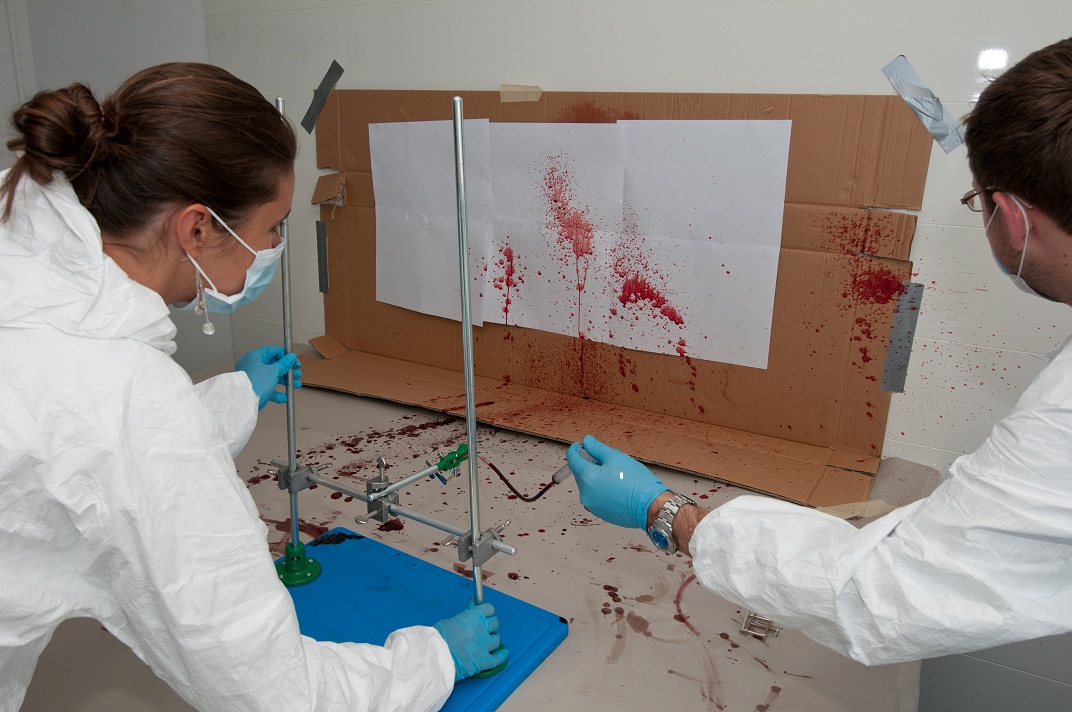
Bloodstain pattern analysis is a very useful tool and can provide important information in a case, by providing insight into what type of weapon was used, how many blows, the size of the assailant, and more. There are many scientific aspects of it, and experts in this field are very skilled and go through much training. They use principles of science by looking at the cohesion of drops, angles, distance, and geometric shapes of the blood. 

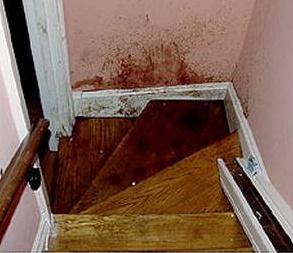
However, bloodstain analysis can be subjective as different people can interpret the scene in different ways. In the documentary, The Staircase, two qualified bloodstain analysis doctors interpreted the scene differently. The first blood stain analyzer believed that the bloodstain patterns were consistent with that of a beating, however, when Henry Lee reexamined the scene he believed that the bloodstain patterns matched those of an accidental fall. As this type of forensic analysis is purely visual, and interpreted strictly by humans, it leaves room for error. 

It is also difficult to recreate the scene entirely, as there are other factors that cannot be accounted for. For example in the first analysis in the Micheal Peterson case, they tried to recreate the bloodstain pattern using a beating, however, this is difficult to do as there are some variables that cannot be accounted for. The methods are based on the opinion of the expert which can be subjective. 

While blood stain analyzers can provide insight into what may have happened they can also rule out many things they know did not happen which provides investigators with crucial information to narrow down the case. Overall it is inherently scientific, however, there is an area for subjectivity due to bias. Bloodstain pattern analysis is an important tool that should be used however, it should be used alongside other forensic evidence in order to uncover the full truth.

(Word Count: 308)
Posted in Science of Crime | 1 Comment

Bloodstain Pattern Analysis: Science or Subjectivity?

Bloodstain pattern analysis is vital to modern forensic science. This involves examining the characteristics, locations, and dispersions of bloodstains at a crime scene to recreate events and gather as much information from a scene as possible. Its use in criminal investigations often provides insights into crucial details such as the weapon type, the number of blows, and an assailant’s characteristics and position. However, bloodstain pattern analysis’s scientific validity remains a subject of debate due to a few complexities.
In cases like Michael Peterson’s, documented in The Staircase, a Netflix documentary, two bloodstain pattern analyst experts produced opposing conclusions from the same blood evidence. The prosecution’s expert claimed the bloodstains indicated a brutal beating, while the defense’s expert argued the bloodstains were consistent with an accidental, intoxicated fall. This disparity raises many inquiries into the scientific nature of bloodstain pattern analysis, with the primary concern being the subjectivity involved in the analysis.
Despite reliance on fundamental scientific principles, such as blood behavior/physics, analysts must employ their judgment and expertise for interpretation. This can introduce bias which may affect the objectivity of an expert’s analysis. This bias may stem from training, preconceived notions, legal pressures, or missing an aspect of the blood evidence. Coupling this with the inconsistent terminologies and procedures used within bloodstain pattern analysis further complicates bloodstain analysis. Different experts might use a variety of names for the same bloodstain, highlighting the severe lack of standardization and the potential for inconsistencies and inaccurate conclusions.
However, it’s important to acknowledge that bloodstain pattern analysis is fundamentally scientific. It draws on the principles of many fields of science, some being physics and mathematics, and is observed with many scientific concepts in mind in regards to blood dispersion, and results of impact. In cases where bloodstain pattern analysis is conducted without bias, like the Marilyn Sheppard case when analyzed by Paul L. Kirk, it becomes a powerful tool used to uncover the truth. When executed effectively without biases, bloodstain pattern analysis can accurately uncover a crime’s sequence of events, and in the instance of the Marilyn Sheppard case, exonerated Sam Sheppard.
In conclusion, bloodstain pattern analysis exists at the intersection of science and subjectivity. Subjectivity and bias can be challenges, however, the underlying scientific principles render bloodstain pattern analysis an invaluable forensic tool. Bloodstain pattern analysis should be used in corroboration with other evidence to uncover the full truth about a crime.
(400)

Posted in Science of Crime | Leave a comment

Blood Spatter Analysis: Reliable or Questionable? 

Bloodstain spatter analysis is a forensic method that looks at the shape, size, distribution, and placement of bloodstains in order to reconstruct the scene of a crime. However, numerous research and publications have suggested significant mistake rates and poor consistency. Also, subjective interpretations among bloodstain spatter analysts have called into question the scientific validity of this procedure.

Bloodstain spatter analysis has a number of issues, including a lack of consistent processes, techniques, and validation. The same form of bloodstain may be referred to by several analysts using different names, such as “impact spatter,” “cast-off,” or “arterial spurting.” Additionally, there is no universal agreement on how to categorize, quantify, and interpret bloodstains, which produces inconsistent and incorrect results. Additionally, there is no set standard or benchmark to compare the analyst’s findings with the real occurrences, so there is no easy way to evaluate the precision and dependability of bloodstain spatter analysis.

Bloodstain spatter analysis also has the drawback of primarily relying on the analyst’s individual judgment, experience, knowledge, and presumptions. Based on the information at hand, such as the origin, direction, velocity, and angle of impact of the bloodstains, the analyst must draw a conclusion. However, a number of variables, including the analyst’s training and biases may affect their judgments and conclusions. The analyst might also disregard or miss additional scenarios that could explain the bloodstains.

For example, in The Staircase it is shown how different specialists can draw varied conclusions from the same blood evidence. In this case, the defense expert contended that the bloodstains on the wall and the defendant’s clothing were the result of a fall down the stairs, contrary to the prosecution expert’s assertion that they were consistent with a brutal beating. Both experts supported their opinions with their own expertise and presumptions, but neither offered any unbiased tests to back up their assertions. Therefore, bloodstain spatter analysis is not scientific because it lacks standardized language and methodology and is dependent on the analyst’s subjective assessment. More research is required to develop an objective and quantitative method for bloodstain spatter analysis. (344)

Posted in Science of Crime | Leave a comment

The Mess with Bloodstains

At crime scenes, bloodstain pattern analysis is used as a forensic measure to determine factors like weapons, number of blows, positions, etc. Bloodstain pattern analysis is the observation of bloodstain and their patterns. Bloodstain pattern analysis has proven to be a scientific method that can acquit or convict people of crimes.

However, bloodstain pattern analysis limits how scientific it can be when analyst enters their perception of crime scenes. In the case of Kathleen Peterson, when attempting to prosecute Michael Peterson, Kathleen’s husband, the test replicated the blood spatter with the idea that Michael would be performing the actions. However, the defense’s bloodstain pattern expert revealed that Micheal couldn’t have killed Kathleen because none of the stains matched that of a cast-off. Nor was Michael covered in blood. In this case, bloodstain pattern analysis resulted in two different verdicts, even though both experts analyzed the same scene. Since bloodstain pattern analysis is an observation science, it can be subjective. Having bias prevents the analyst from having clear eyes and interpreting things in ways to secure their conclusion.

Yet, this is not always the case for bloodstain pattern analysis. In the famous case of Marilyn Sheppard, bloodstain pattern analysis was performed by two different experts with no bias in the case. When the murder originally occurred in 1954, the family brought in expert Paul L. Kirk, who claimed that he would report whatever he discovered at the scene whether it convicted Sam Sheppard, Marilyn’s Husband, or not. Kirk’s finding found that Sheppard was innocent because the assailant should’ve been injured due to the blood stains on the stairs. However, Sheppard was still convicted, through a false confession. Then in 1999, Bart Epstein recreated the entire layout of the house to see if Kirk’s conclusions were accurate or rather interpreted to show Sheppard’s innocence. Epstein would find the same result, which would prove Sheppard’s innocence and exonerate him.

Bloodstain pattern analysis is scientific because it has the ability to observe something and prove facts through simulations or experiments. We saw this through both the Marilyn Sheppard case and the Kathleen Peterson case. However the legitimacy of bloodstain pattern analysis can be tested when there seems to be bias behind the scenes. (369)

Posted in Blog #3: Blood Spatter Analysis | 1 Comment

Seeing What We Want To See

Forensic scientists use several approaches to analyze crime scenes and evidence. Some techniques produce highly reproducible laboratory test results, while others are subject to varying human interpretation. Blood pattern analysis is one of those that is less likely to have the same results when analyzed by multiple experts.

Observation is one of the most essential steps in the scientific method and the basis of blood spatter analysis. Blood spatter experts observe blood’s shape, size, location, and distribution and use concepts from biology, physics, and mathematics, like blood behavior, capillarity, cohesion, distance, and angles, to provide information about what could or could not have happened. These inferences help the investigator understand the crime’s sequence of events, corroborate witness statements, and include or exclude suspects.

Basic Bloodstain Analysis Course

Considering the extent of scientific methods involved in the analysis of blood patterns, the inferences generated by different experts should be more consistent. However, this is not always the case. For example, in the 2003 murder case against Michael Peterson, as documented by the Netflix series “The Staircase,” blood spatter experts Duane Deaver and Henry Lee had opposing views on the same pattern, resulting in different opinions on what happened at the location of the “crime.”

My hypothesis for the disparity in their conclusions is the plague of confirmation bias. The scientific interpretation of the pattern depends on what the experts observe, but I believe they saw what they wanted to see. Both experts possessed too much information about the case before scrutinizing the scene, which influenced what they chose to see and ignored. Deaver was technically working for the prosecuting party and inherently looking for evidence to prove that Peterson killed his wife. Furthermore, he tried reconstructing an improbable scenario based on his pattern interpretation to confirm the prosecutor’s theory.

On the other hand, Lee sought exclusive or exculpatory evidence to prove that Peterson’s wife died from an accident on the staircase. DNA expert Timothy Palmbach said, “He (Deaver) worked from the end result backwards. That’s dead, polar opposite to good science.” The blood pattern analyst should be shielded from bias-informing details about the case, whether from the prosecutors, defendants, or the press.

In conclusion, confirmation bias undermines and corrupts the science of blood pattern analysis. However, I wonder if an attacker with expert knowledge about blood patterns could alter the patterns to throw the investigators off their scent. That would make for an excellent documentary!

(Word count: 399)

Posted in Blog #3: Blood Spatter Analysis | 1 Comment

Is It Really Science?

How scientific is bloodstain pattern analysis? Certainly if it’s used in criminal trials it has to have a degree of credibility. Bloodstain pattern analysis or BPA is a subjective forensic science. In episode 5 of The Staircase we can see that the prosecution’s expert claims that the bloodstains in the staircase could have only been caused by a beating. However, in episode 7 the defense’s expert Henry Lee claims that it is impossible for these stains to be caused by a beating and that the only cause for these stains must be from an accidental fall. So if both experts seem to entirely disagree on their conclusions is BPA really scientific? 

Like most observational sciences, BPA is highly subjective. But whether a science is subjective or not, the fact that it still goes through the scientific method is not taken away. BPA uses the chemistry of blood and the physics behind falling liquids to analyze why a scene might look a certain way. Just like in any other science, experiments are done to test the hypothesis of the conclusion that might have been reached. For example in episode 5, the prosecution’s expert tested his hypothesis of how the crime might have happened. He wore a white suit and recreated the crime to analyze whether the bloodstain pattern appeared the same as in the crime. He placed several objects with blood in them and beat them several different ways to see if any of them produced the splatter seen in the scene. In episode 7, Henry Lee also analyzed the blood and tested his hypothesis in front of the jury. He used pieces of cardboard and threw blood at them by coughing on them or just swiping the blood at the cardboard. They both had a scientific analysis of the evidence but I think that the prosecutor’s expert has a bias towards the crime being a beating.

I think the tricky part about BPA is that the analyst might have biases when inspecting the scene and therefore might gear the conclusion to suit this bias. This issue can be overcome by gathering several opinions. But at the end of the day BPA is still science. (364)

Posted in Science of Crime | 1 Comment

A Bloody Mess

Keeping the data accurate and not fabricating results is one of the most crucial aspects of an experiment. The analyst changed the data in the first video to create a replica of the scene by working backward after the initial test did not match the intended outcome, which prompted him to hit the skull multiple more times. In a real experiment, the outcome is the outcome, and it doesn’t matter if it is similar to what was predicted by the hypothesis, rather try to explain why the result is different.

While in court, they played a video of the analyst hitting the blood very unscientifically. They used a random location with an unspecified amount of blood and force to make the pattern making it unable to be exactly reproduced. The blood spatter analyst was able to create the pattern they found in a scenario that wasn’t possible given the situation of the crime which goes back to going to fabricating the desired outcome, further proving how unscientific this experiment was. As seen in the second clip, blood spatter analysis needs to be very scientific and take the outcomes of how they are not trying to fabricate the scene. Dr. Henry Lee showed by paying close attention to how the blood looked on the wall you can tell that the way the analyst said the crime happened was impossible. The many inconsistencies with the experiment made the case easy to pick apart in court. There was no credibility in the experiment due to a lack of care when it came to conducting it when it should have been an extremely powerful tool.

In the different cases we looked at in class, blood spatter analysis proved Sam Sheppard’s innocence by looking at the physics of how the blood came off the body. According to the analysis, Sam would have had to be sprayed with blood. A corner of the room was spotless meaning that some of the blood must have been blocked by the body of the perpetrator, but Sam did not have any traces of blood on him on the morning after the crime. Overall, if done correctly bloodstain pattern analysis should be extremely scientific and helpful for gathering evidence; however, it is easy for bias to be formed when an unwanted outcome occurs.

Word Count: 383

Posted in Blog #3: Blood Spatter Analysis | 1 Comment

The Illusion of Optics, a Crime of Inaccuracy

What provokes human error? Is there something innate within us? Is it hereditary, or a learned attribute? Or is it the culmination of an entire sheriff’s department misguiding you to a single, innocent, man? 

In “Eighteen Years Lost”, the premier of the Making a Murderer documentary, this –near purposeful– human error is brought to light. It depicts the story of Steven Avery and his infamous wrongful conviction. Avery is described in this documentary as many things: a delinquent, an outsider, even reckless. Yet to contrast this, honest, and incapable of a violent crime such as a gruesome case of sexual assault. So what exactly led to him being misidentified in this case? 

Firstly it’s important to establish the common causes of false identification in criminal proceedings. To name a few: the stress and weight of the sentencing, the pressure enforced by police, influencing lineups, and flawed memory. To a large extent, all of these factors were present in the identification of Avery as the perpetrator, which led to an 18-year sentence and a string of strenuous judicial fights. However, veiled at the time, what seems to be the largest contributor to this false testament was a social agenda. 

You might be wondering how something as trivial as rumors and hierarchy plays into this case. It all comes down to the players involved in this case, and in particular, the police department that was itching to convict an outcast. Before there was even a crime (of this stature) linked to Steven Avery; the groundwork for his arrest was being set. The Averys were not the typical inhabitants of Manitowoc County, and from youth rumors about Steven the misfit were being spread. This established his place in the hierarchy, desolate in the depth chart. When the violent crime was committed, the police department ignored a known serial sexual assaulter and was immediately honed in on Avery. 

This was the first step in their corruption. The second and most pivotal choice they made was affecting the memory of the witness testifying. Before they did the lineup for this witness, she was given a lineup of photos. The only common denominator was Steven Avery. So when the lineup was made, and she looked at who was standing there, the only familiar face was a man sentenced to 18 years in jail for who he was, not a crime he committed. (396)

Posted in Blog #2: Eighteen Years Lost | 1 Comment

A Hateful Conviction

It’s no secret that today’s world has advanced in criminal forensics to create a “fair” criminal justice system. However, individuals still act on their emotions and prejudice when convicting someone wrongfully. That is the case for Steven Avery.

On July 29, 1985, Penny Ann Beersten was sexually assaulted on the Lake Michigan shoreline. Despite not having her full vision, Beersten signed the incident report that described her assailant as Steven Avery.

The errors in the case began before the crime, with the police department feuding with the Averys. Steven Avery had a criminal past and not even the year prior had been arrested for a car incident involving his cousin Sandra Morris, who had been married to the sheriff’s deputy. The event caused the department to strengthen its hatred towards Steven, with the already festering dislike of the Averys. So, when Beersten described someone similar to Steven, the detectives said, “Sounds like Steven Avery,” and had a sketch composed of Avery’s 1984 mugshot to show the victim before a lineup. Thus, when the lineup happened, Beersten picked Steven because he had been the only man the police had shown. All these factors caused the warped testimony that Beersten gave, which wrongfully convicted Steven.

However, there were still factors in the case, such as rights violated. The police department had ignored claims on Gary Allen, a repeated sexual offender, who fit the crime better and frequented the beach where Penny Beersten was assaulted. Determined to punish Avery, the department prevented him from receiving his one phone call and an attorney, which violated the law. The judge also discredited the accounts of multiple eyewitnesses, who had been with Avery and a receipt from a Burger King where he had taken his family that day. Nothing in the case was in the favor of Steven Avery.

It would be 18 years later that Steven Avery was exonerated, with the discovery of DNA testing, Avery was able to prove his innocence. The DNA testing also found a cold hit on Garry Allen, who would claim another victim in the same location two years after. I believe that faulty identification should’ve been avoided, had the police done their job correctly and without bias. They should’ve first allowed Beersten to give a sketch of her assailant without them just presenting one to her. Also, they should had multiple suspects instead being focusing on purely one.

(399)

Posted in Blog #2: Eighteen Years Lost, Science of Crime | 1 Comment

18 Years, No Confession

If you were in jail for 18 years, you would probably do whatever you could to get released early. In Steven Avery’s case, that required a confession in order to be eligible for parole, but he never gave in. He maintained his innocence, and with his parents by his side, was eventually exonerated using DNA technology.

What was most appalling in this case, but also understandable in some sense, was the way in which the personal relationships played a role in this story. In a town like Manitowoc, where a lot of people know each other, what you do to one person can have lots of other consequences. This was definitely the case for Avery, when he pulled a gun on his cousin after he rode her off the road. Her grudge against him spread to her friends, who were involved in the criminal justice system. His actions before the initial conviction did not help his case, as many people wanted him to be locked up and taken into custody.

This was a giant issue in this case, as the complete lack of evidence was ignored, and he was portrayed as a rough person who had to deal with the consequences of his actions. Law enforcement also (appeared) to intentionally ignore any signs that it could have been someone other than Steven Avery. Simply wanting to get the case over with and provide closure, as the District Attorney wanted, is a complete lack of due diligence and fails the defendant. Penny Beernsten’s initial description of her assailant did not match Steven Avery in many areas, but that did not seem to matter to anybody when he was taken into custody. 

This case is also another example of a lineup failing. Beernsten had also already been exposed to a picture of Avery, leading her to be 100% sure that he was the correct person. However, as we know, if you are exposed to someone before the lineup is presented you are much more likely to choose that person. That sense of familiarity is extremely dangerous because it can construe what you believe you remember from the time of the crime. The lack of physical evidence was large, but the conviction was based on recollections and verbal testimonies. 

This has to be a happy ending, right? He was freed, after all. Well, maybe not. (392)

Posted in Blog #2: Eighteen Years Lost | 2 Comments

Sketch-y Business

When a person hears that someone witnessed a crime, their first instinct is to believe everything they said. They were the ones that witnessed the crime and therefore can be trusted completely. However, as we talked about in class this week and witnessed in “Making a Murderer” episode, this isn’t always completely true.

Generally, witnesses can usually be very trusted and important when building cases and catching guilty parties in crimes. However, as we talked about in class, there is a large problem with mistaken identification. People’s memories are generally very malleable and susceptible to suggestion and as a result, many times witnesses remember the perpetrators incorrectly. There are problems with many people’s cross-racial identification (especially due to many continued racially segregated communities across America due to past housing policies), along with problems with some people being very poor identifiers as we talked about in class, along with new information manipulating people’s memories.

Specifically in the case of the Avery case, the misidentification came as a result of the police. The victim/witness gave the description of the perpetrator and the police stated that that sounded like Steven Avery, then drew a sketch of Avery and gave that to the victim and then had her identify Steven from a lineup. Instead of taking her information to guide them, they took her initial description and used that to point her towards Avery, instead of her really pointing them towards Gegory Allen, the true perpetrator. There was also a lot of corruption from the police who chose to not investigate Gregory Allen despite multiple parties telling the sheriff that he could be a suspect. The police had also been watching Allen during this time knowing that he could be a danger to the community and lost track of him during the time of the crime. Also, many people said that the sheriff said that he was going to get Avery for the crime whether he did it or not. This mistaken identification could have been avoided in a million different ways. If the police didn’t immediately single out Avery and do everything in their power to point Penny Beernsten towards Steven Avery and had actually followed up on multiple suspects and possible leads, they would have avoided the misidentification and caught the real perpetrator quicker.

Word count: 383

Posted in Blog #2: Eighteen Years Lost | 1 Comment

The Point of a Finger

Steven Avery was a father of five children and the husband to the love of his life in 1985 when he was convicted of sexual assault and sentenced to 32 years in prison. But did he do it? To be charged in the United States of America, you need to be guilty beyond reasonable doubt. What forces were working for him? What forces were working against him?

The primary force against him was his own last name. The Avery’s had a reputation for trouble in Manitowoc County, which made the sheriff biased against him from the start.

After the attack, police asked for a physical description of Penny’s attacker. The picture that the artist came up with is almost identical to a previous mugshot of Steven Avery – he technically had the image available to him while he was creating the image. So, when presented with a lineup, Penny Beernstein selected Steven Avery as her attacker – because he was the only one that she had seen before.

However, Penny’s original description of her attacker does not match Avery’s physical characteristics whatsoever. For example, she said that her attacker had brown eyes, when Avery’s are a very distinct and bright blue. Her description of her attacker’s size and build were not consistent with those of Avery. But, because she had seen Avery before, she selected him out of the lineup. 

The Sheriff of Manitowoc County was actually warned of another potential suspect, a man named Gregory Allen who had attacked a woman on the same beach three years prior. He dismissed the tip because he already had a vendetta against Avery.

Avery had several alibi witnesses confirming that he was nowhere near the beach at the time of the attack. He had multiple receipts and credit card bills. If this was the case, how was he convicted without any physical evidence and with several alibis?

The answer: The point of a finger. 

When asked in court to identify her attacker, Penny Beernstein pointed to Steven Avery. The weight of her testimony was greater to the jury than the several that cleared Avery’s name.The only reason, the only reason, that she pointed to him, is because of her picking him out of a lineup, because the sketch artist copied a picture of him from a previous mugshot, because they wanted it to be him.

Posted in Blog #2: Eighteen Years Lost | Leave a comment

I got you now

From the start of Steven Avery’s case he was being targeted to be the person convicted no matter if he did the crime or not. This was a hit the Sheriff’s department wanted to have on the Avery family.  They weren’t like everyone else in Manitowoc County, never fitting in and outcast to their scrapyard on the street with their name. The people of Manitowoc cared about their appearance and education, and the Avery family were the opposite. They were seen as dirty and uncaring. They were loathed by the community and Steven was just the outlet to take it out on them.

With the Beerntsen case, The police took over practically forcing Beernsten to pick Steven out of the lineup. The sketch created of what the perpetrator might look like was almost identical to Steven’s mugshot from an earlier misdemeanor rather than the description Beerntsen gave, and even forcing Beerntsen to sign documents when she wasn’t able to even read what she was signing. The police fabricated this whole case against Steven by dismissing his alibi and sweeping the chance that it could possibly be anyone else under the rug. Had the police not done this I think Steven could have walked away innocent. Beerntsen picked Steven out of the lineup not because he was the one who looked like her assailant but because of the information the Police had been feeding her. Steven was the only person who looked familiar to Beerntsen so she is going to select him out of the lineup.

This all reminds me of the video we watched in class of how the people created false memories based on what the person was telling them. This is the same as Beerntsen as she truly believed that Steven was her rapist from what the police were telling her despite the description she gave being very dissimilar to Steven. In the end, I think faulty identification could have been avoided without foul play from the police trying to book Steven in the first place without any evidence.

Word count: 341

Posted in Blog #2: Eighteen Years Lost | Leave a comment

Eyewitnesses And Their Inconsistencies: The Avery Case 

                Eyewitness testimonials may be powerful tools in criminal investigations, but they are not the most reliable. Take 9/11 for example, although everyone says that they know where they were when the planes crashed, 40% are wrong. This is thanks to the ‘illusion of truth’ phenomenon, which essentially means our memories tend to believe false truths after repeated exposure. The ‘illusion of truth’ phenomenon is just one way in which our memory can be faulty. When looking at crime cases, there is a high likelihood that the eyewitness makes a false testimony due to aspects that contribute to a warped perception. For example, bias, emotional state, memory decay, suggestibility, and misattribution. This now brings us to the Avery case, a great example of the effects of erroneous eyewitness testimony.

                In 1985 Steven Avery was wrongfully convicted of the rape and attempted murder of Penny Beerntsen. He had spent 18 years incarcerated before his conviction was overturned because of DNA evidence. A key component that led to his conviction was Penny Beerntsen’s faulty testimony. She had recognized Avery as her attacker from a photo lineup and a composite sketch. Her identification, however, happened in a pressure-filled situation after repeatedly having been exposed to Avery’s picture. These all had a great impact on her memory and influenced her false identification.

                Overall, the eyewitness should not have been exposed to Avery’s photo, this greatly tainted her testimony. Furthermore, if the police had followed the correct eyewitness identification procedures, a mistake in identification would have been prevented. For example, the police suggest setting up a lineup with multiple suspects rather than just one suspect. It’s also best to avoid repeating a lineup with the same suspect and the same eyewitness.  Additionally, this procedure should have been recorded and documented on camera. All these methods would have helped to lessen the possibility of a false identification.

Posted in Science of Crime | 1 Comment

An Innocent 18 Years

My whole life I have enjoyed watching murder shows or movies, where a case is presented and the murder or felon is caught, and it is usually always the right suspect. It was always extremely entertaining to attempt to determine who was guilty and when the case was resolved, a wave of relief would wash over me. I was never previously aware that an individual could be wrongfully accused for such a serious crime. After watching the documentary on Steven Avery, I am completely baffled and concerned for our past and even present justice system. 

Incorrect eyewitness testimonies occur more than one would think. Before knowing this statement, I believed that an eyewitness was the most reliable source in a case because why wouldn’t someone’s real life account be completely accurate, unless they were trying to lie. Turns out I could not have been more wrong. Memory is an odd concept, we as humans tend to be persuaded by outside input as well as connect people or information that is not even related at all. Being in high stress situations when anxiety is surrounding you can often lead to incorrect claims, or one can even jump to conclusions in order to revolve the trauma of, for example, an attack. On top of false accounts by witnesses, bias also plays an important part in an incorrect eyewitness testimony, and that was definitely the case in Steven Avery’s situation.  

It is apparent that this case was unfair from the start as Avery was seen as an outsider to his community. Being somewhat of a troublemaker in his town, stealing a few times, almost running his cousin off the road, and burning a cat, one can make assumptions about Avery’s character. On the other hand, a certain individual was most certainly a contributing factor to Avery’s false arrest. Reserve Deputy Judy Dvorak, who happened to be Avery’s neighbor at the time, strongly disliked Avery. As the victim Penny Beernsten was describing her assailant, Deputy Dvorak mentions that who she is describing sounds like Stephen Avery. Dvorak putting that idea in Beernsten’s head was the start of Beernsten’s false claims and eventually choosing Avery in a lineup.  

Today there are definitely less false arrests and false eyewitness statements due to DNA evidence as well as an adapted lineup system although there are still times when an innocent person is tragically put in jail. 

Word Count: 399

Posted in Science of Crime | 2 Comments