The copy of Mabel Osgood Wright’s The Friendship of Nature that I am looking at does not show obvious signs of wear and extreme use, but there are little tells that reveal the history of the book as being more complicated than it seems. Any little mark made in a text has a story behind it, and holds more importance in telling the history of the text and its use than it may appear. Based on the minor stains throughout the book, little black dots, pencil written letters and library cards, we can deduct that The Friendship of Nature has a more complicated history than it’s near-pristine outward appearance reveals.
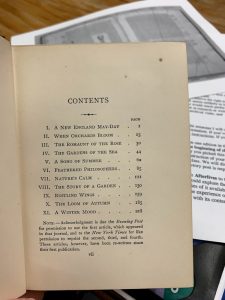
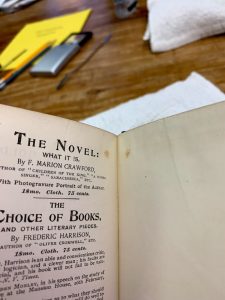
In older books, marks such as these are common, brownish spots that can take up most of a page or, as we see here, only a small part of one. These spots are called foxing, and they are primarily found in 19th-century books with machine-made papers. The cause of foxing is still a mystery, although there are assumptions that they appear due to impurities in the pulp or size leading to fungal growth, the presence of iron leading to rusting, or problems with the bleaching process (WordPress.com). Humidity has shown to accelerate the appearance of foxing, so while The Friendship of Nature does show possible signs of the splotches, there are not many, leading me to think the book was not kept in overtly humid conditions that would have spread the spots far more than they have. Whatever the cause of foxing is, modern practices in bookmaking do not cause it, so something has changed to avoid it.
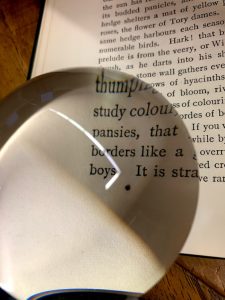
Throughout the book are small black dots that pose as more of a mystery than the foxing. When I first saw the dots I assumed they were made from ink mistakenly put on the pages. They aren’t raised, and they don’t show signs of being created by mold on the pages. Therefore the cause of the black dots seen on multiple pages of The Friendship of Nature is unclear. If it was caused by someone dropping ink, it can be deduced that the book was open and used while someone was writing or drawing something, perhaps in an educational way or for creativity from the text describing the beauty of nature. If they were made from some chemical deformity in the paper, we can see evidence of the time it was made, and if we could look further into it we could see if more books printed at the time had these same marks, and what they could mean regarding the printer or techniques used.
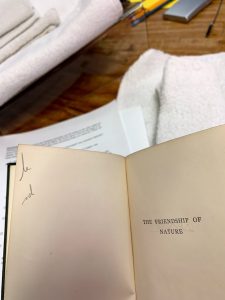
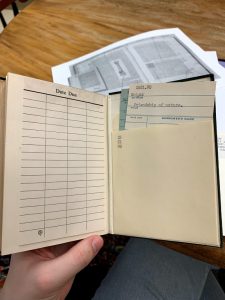
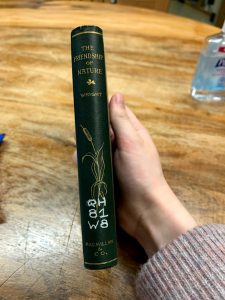
The only marginalia in the entire book is two pencil-written words on the first section before the title page. There are two words, one being “le” and the other harder to read, but presumably “nd.” These could be meant to combine into “lend,” or they could be notes written by someone for an entirely different purpose, but as they are the only handwritten notes in the book it’s unclear what they are meant to represent. They might be connected with the book’s history belonging to a library. On the end cover, there is a slot with two library cards in it, as well as a “Due Date” page adjacent to it. This tells us that at some point the book belonged to a library. The card also says “QH 81 W8,” as a way to identify where the book is shelved in the library stacks, and the spine of the book has the same identification on it. Through these markings, we know that this copy of The Friendship of Nature was kept in a library before coming to Colby’s Special Collections, and also that it was not checked out once, as there are no dates listed in the “Due Date” section.
Bibliography
“Foxing.” Making Book, 17 July 2017, rhollick.wordpress.com/2017/07/17/foxing/.