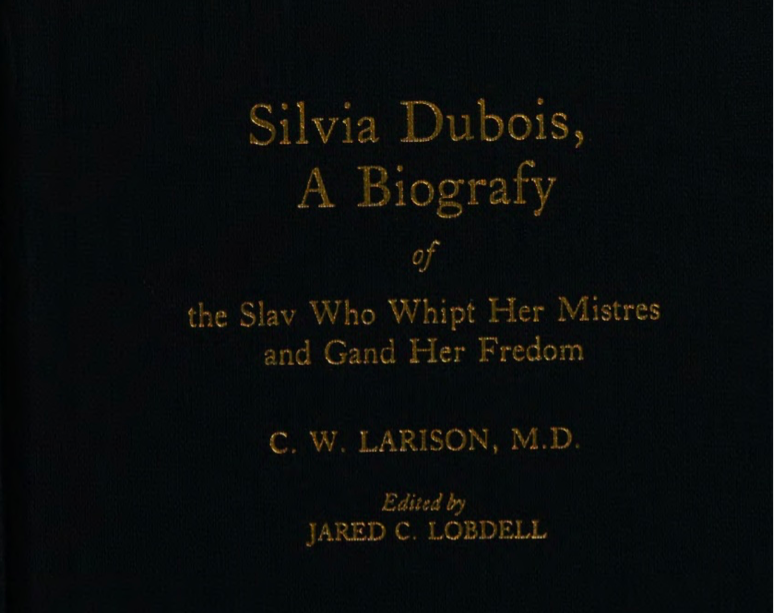
Comparing the edition of Sylvia Dubois (Now 116 Years Old): A Biografy of The Slav who Whipt her Mistres and Gand her Fredom I worked with in Colby’s Special Collections to a digital facsimile on Hathi Trush proves to be a process made particularly complicated by the COVID-19 pandemic. Instead of comparing a physical book with its virtual counterpart, I find myself scrolling through images of my own dilettantish facsimile snapped quickly on my cell phone before the beginning of self-quarantine and the closings of archives and libraries. I remember certain qualities of the book itself, but after eight weeks without physically working with the material text in-person, the images I collected provide a more reliable recollection than my memory. 
Cover design from digital facsimile
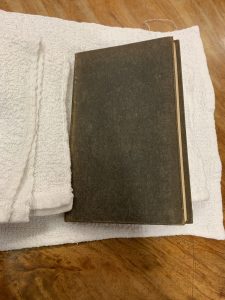
Cover design from original edition
Despite comparing what are, in reality, two digital renderings of the Biografy, significant differences in the physical version of the text and digitizations of the material text are present. What stood out initially to me is that the digital surrogate is a scan of an entirely different version of the Biografy than the original edition I worked with. The online facsimile, a publication from the Oxford University Press, is an edited volume with a formally printed black and gold cover. Additional forwards and appendices are also included, presumeably intended to provide academic context to the text. The facsimile and the original edition I worked with both include the foreward by Cornelius Larison that frames the narrative and his involvement with its creation before the biographical section that Dubois supposedly dictated herself. In this section, Larison explains how he became interested in Dubois from a medical standpoint and how he then became fascinated by her story. Another introduction from Jared Lobdell that suggests Dubois’ narrative is folklore and three additional appendices also appear before the section of the text meant to be dedicated to Dubois’ telling of her story. Lobdell’s introduction in some ways felt like it was challenging Dubois’ narrative by suggesting that her recall of dates was faulty and through the use of language like “folklore” that did not seem to take the available narrative quite seriously enough given the challenges to black women’s voices in the nineteenth century. However, Lobdell does raise important ideas about alternative forms of significance in the text such as exemplifying oral history and providing context for social history purposes. Michael Bethold argues that these claims are “not misguided in emphasizing ‘the material for social history,'” but warns against taking these as much more than a social history of literary social history more closely related to Larison because of the power imbalance in the author-biography subject relationship (Berthold, 4).
This layout of the text in digital form makes it difficult to navigate referencing previous sections of the book–something that is important when reading Larison’s phonetics. In the physical book, it was easy to oscillate between the instructions for reading Larison’s alphabet and the narrative text, but this felt clunky in the online edition, especially given all of the additional scholarly context added by contributors. However, this facsimile is a digital copy of a book that translated the original edition I worked with out of phonetics and back into standard English, which made the text much easier to read from my perspective as someone not well-versed in orthoepy.
This facsimile book is part of a collection published by the Schomburg Library of Nineteenth-Century Black Women Writers, which is where the purpose behind the added material comes from. The collection is a twenty-three part series of works by black women in the eighteen hundreds. The library has a stated goal of preserving underrepresented black female voices and exploring the experiences of those involved in black diasporas. Of the twenty-three volumes, which include authors such as Phillis Wheatley and Anna Julia Cooper, Sylvia Dubois (Now 116 Years Old): A Biografy of The Slav who Whipt her Mistres and Gand her Fredom is the only volume written by a white male rather than a black woman directly. Although one could argue that Dubois’ voice is in the text, my previous research showed that Dubois was not entirely aware or consenting to the writing of the narrative, and because she could not read or write, there is no way of knowing if what Larison wrote was in fact representative of Dubois’ voice. Larison’s preoccupation with Dubois as a curiosity first and a human being second comes through in his marveling over her age and in the detailed descriptions of Dubois’ “primitive” living situations and her ability to complete heavy farm work despite her circumstances.
Larison’s authorship and the power differential between him and Dubois brings me to question the extent to which the digital facsimile and the Schomburg Library of Nineteenth-Century Black Women Writers achieve the stated objective of preserving Dubois’ voice along with her black female contemporaries. In both the original first-edition book and in the text in the academic compilation of the facsimile, there is a suggestion that Dubois’ story is central, yet the book and the book facsimile both position the narrative that may or may not be an accurate depiction of Dubois’ story as secondary to the words of the man who benefitted from the telling of the story most immediately. Much as the original edition shapes one’s reading of the text by flooding the introduction with the mechanics of orthoepy, the facsimile shapes one’s reading by suggesting that the story may be a tall tale and by placing Larison’s voice before the supposed voice of Dubois. At the same time, the Schomburg Library identifies its goal of preserving black women’s voices, and although the exact voice of Dubois is made murky by Larison’s authorship and the exact dates of events in the book cannot be corroborated logically; Lobdell points of the value of the social history the book provides. Works published directly by black women are incredibly important accounts of voice and experience. Because she is not her own author and did not particularly want her narrative published, the inclusion of Dubois’ story in a collection meant to preserve voices is complicated. The experiences and dynamics Dubois tells of, even if filtered through Larison’s writing, can offer insight to the vastly underreprented histories of nineteenth century black women’s experiences. However, Dubois’ attitude toward publishing and the benefits it fails to offer her are also a component of her voice, and by publishing a narrative meant to reflect voice, the Biografy neglects this aspect of Dubois’ stated wishes.
Berthold, Michael C. “‘The Peals of Her Terrific Language’: The Control of Representation in Silvia Dubois, a Biografy of the Slav Who Whipt Her Mistres and Gand Her Fredom.” MELUS, vol. 20, no. 2, 1995, pp. 3–14.