By Serena Desai
This is an ongoing blog series. To view my other posts about this text’s Introduction, Origin, and Additions, click the links below:
Introduction to the Text: http://web.colby.edu/bookhistory2020/2020/02/20/decoding-the-codex-the-calendarium-historicum-conscriptum/
Origins of the Text: http://web.colby.edu/bookhistory2020/2020/03/04/paul-eber-challenging-roman-catholicism-using-his-calendarium-historicum/
Additions to the Text: http://web.colby.edu/bookhistory2020/2020/03/29/a-diary-or-an-encyclopedia-how-paratext-defines-ebers-calendarium-historicum-conscriptum/
An Overview of the Text
In 1559, George Rhau’s printing press in Wittenberg, Germany printed Calendarium Historicum Conscriptum– the first calendar of its kind to undermine the papacy by replacing the traditional “Saint of the Day” format with a historical account of the Reformation. Written by Paul Eber– a devout Lutheran and follower of Martin Luther himself– this text highlights important Protestant holidays, leaving ample space for readers to continue the historical progression by making notations about their own lives in the margins and blank leaves. The Calendarium is also filled with information about the constellations, planets, and the zodiac, containing numerous astrological symbols and a five-page ephemeris at the back of the text for readers to reference. Colby College’s 1559 copy of Calendarium Historicum Conscriptum is the focus of this ongoing blog series; the text was donated by Mrs. Florence Hahn and currently housed in the Special Collections Library.
On Used Books and My Discovery of the Calendarium
When I was presented with the task of finding a “Pet Book” for this project, I eagerly browsed Colby College’s Special Collections bookcases, hoping to find a text that included numerous annotations made by previous owners. I wanted something worn– a book that had been held by the hands of students and scholars for hundreds of years. My fascination in “used books” was not unfounded; according to William H. Sherman, author of Used Books: Marking Readers in Renaissance England, “for an increasing number of cultural historians and historians of the book, a marked-up copy was more interesting than one in pristine condition.”* In fact, as evidenced by sale and exhibition catalogues from 1952-1953, a bookseller who once critiqued a sixteenth-century volume for being “rather soiled by use” later described as “well and piously used [with] marginal notations… [that] bring to life an early and earnest owner.”* While I was scouring the shelves of Special Collections for my own text to analyze, I too found myself feeling especially drawn to the “well and piously used” books. Each fingerprint, annotation, stain, bookworm hole, and pasted bookplate unearthed a “vast archive” of information about the book’s long and complicated history that I wished to uncover.
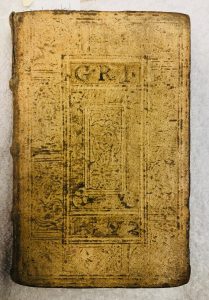
I found what I was looking for in Paul Eber’s Protestant work, Calendarium Historicum Conscriptum— a text that traveled from Wittenberg, Germany to Waterville, Maine sometime between 1559 and 1958 (a span of three hundred ninety-nine years). As I picked up this antiquarian text for the first time, careful not to tear the delicate quarto, I could not help but marvel at the Calendarium’s resilience; not only did the work escape censorship during the politically-turbulent Protestant Reformation, but it endured a boat ride across the Atlantic Ocean (along with numerous trade deals into the hands of various collectors) to reach its current home Colby College’s temperature-controlled bookcases. Despite its relatively sturdy binding, this calendar has certainly been used; the blind tooling featured on its front and back covers has eroded, its index has been eaten away by insects or rodents, remnants of woven bookmarks have been trapped in the gutter of the Dedicatory Epistle, and its pages are covered in writing– some notes dating back to the mid-sixteenth century.
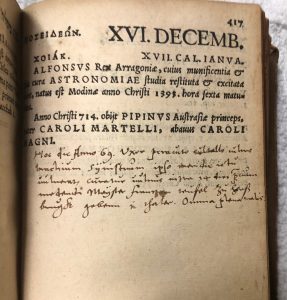
Seeing as this is a quasi-diaristic text, and that the author, Paul Eber, utilized his preface as an opportunity to encourage marginal notes, it made sense that readers chose to fill several blank leaves with dense Biblical and historical annotations. After spending my first few weeks with the Calendarium trying (and failing) to translate its marginalia– all written in nearly indecipherable Latin shorthand– I quickly realized that crafting a comprehensive analysis of this book’s provenance was going to be difficult; however, with the aid of Colby College’s alumni contribution records, catalogues from the British Library, and Professor Cook’s Twitter page, I have managed to discover some crucial information about Eber’s Calendarium that has changed my original perception of its literary purpose. While I originally believed that this book would have been owned and read by Protestants alone (based on its Lutheran contents), my research has led me to conclude that this text may have been owned the longest by a non-Protestant audience who read it as a more practical astrological reference tool or basis for theological debate instead of a guide to their own system of beliefs. But more on this below.
*Quotes excerpted from Sherman’s synopsis of his text written for the University of Pennsylvania Press, found here: https://www.upenn.edu/pennpress/book/14394.html.
On the Text’s Previous Owners
Based upon the dense annotations written throughout the Calendarium, two bookplates that are pasted to the inner front cover, two written inscriptions that lie on the text’s first few leaves, and blind-tooling on the book’s binding, I have deduced that this “reformed calendar” was owned by at least six different individuals or libraries over the past four hundred and sixty one years (perhaps even seven owners, if I am correct in assuming that the marginalia in the book was written by two separate people with slightly different hands). I will go through each “chapter” of the book’s history in the chronology that is most supported by the material qualities of the text, along with substantial outside research. Whenever there is not enough information on a person or collection to definitively place him or her within the provenantial chronology, I will place an asterisk (*) next to his/her name.
1. Printers of George Rhau’s Press in Wittenberg, Germany (1559)
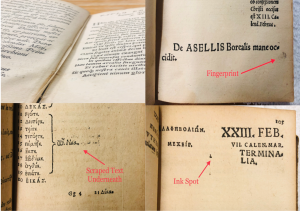
While the individuals who produced this copy of Calendarium Historicum Conscriptum cannot be categorized as its previous “owners,” they represent an essential position along Darnton’s Communications Circuit that cannot go unrecognized. Despite the fact that books, pamphlets, and broadsides were being “mass-produced” by Gutenberg’s printing press throughout the sixteenth century, the process of crafting each copy was still physically laborious– often resulting in errata and other remnants of “human handling.” For example, this copy of Eber’s Calendarium contains the following: a) a page bound incorrectly between the “Dedicatory Epistle” and the “Johannes Stigelius’ Elegy,” folded upon itself in the gutter of the text; b) ink fingerprints and unintended black dots appearing on pages 69 and 105*; and c) smudges on pages that were likely improperly inked. Though these errata are not necessarily signs of “use,” they are undoubtedly evidence of human craftsmanship and care, thus holding a necessary and crucial position within this book’s storied history.
*Note: I have reasoned that the fingerprints and smudges came from the printers as opposed to the text’s readers due to the lack of handwritten annotations on or near the aforementioned pages. The smudges additionally appear in the same pitch black color as the text, not in the oxidized brown color of the marginalia.
2. The Carmelites of Bamberg (ca. 1560-1580)
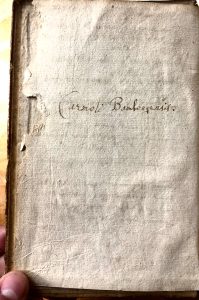
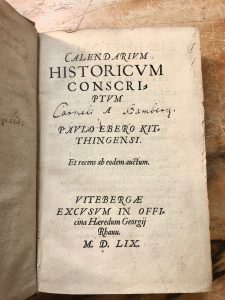
A rather salient discovery I made while researching the previous owners of the Calendarium was my newfound understanding of two of the flowing inscriptions that lie within the first few leaves of the text. The former of the two, “Carmely Bamberg,” appears on the fly leaf of the book, while the latter, “Carmeli Bambergensis,” is written on the general title page (in a size almost as large and sprawling as the name of the work itself). Upon first glance, both of these inscriptions looked like the neatly-drawn signatures of a collector or scholar; based on my previous knowledge of this text’s Protestant affiliation, I guessed that this was the name of a student or professor at the University of Wittenberg, or perhaps a wealthy Lutheran looking to expand his personal library. As approximately two thirds of the annotations throughout the text are written in the same short and wide script (bearing a striking resemblance to blackletter), and contain dates ranging from 1562 to 1568 (including a note on the back paste-down mentioning “Anno 1563”), I was led to believe that this scholar purchased the individual sheets from George Rhau’s press in 1559, had them bound, and then annotated them over the course of the next ten years. However, after searching for the name “Carmeli Bambergensis” in online library catalogues and finding that the Codex Justinianus (1488), Repertorium Juris (1478), Recueil Ascétique (1471), Vitras Patrum (1488), Libros Sententiarum (1491) and a trove of other fifteenth and sixteenth-century texts contained the same inscription on their own fly leaves, I realized that the signature I found was not a signature at all; rather, it was the name of a much larger monastic order dating back to the twelfth century.

“Carmeli Bambergensis,” or “the Carmelites of Bamberg,” was (and still is) a monastery located on the hill of Kaulberg near the Chapel of the Virgin Mary in Bamberg, Germany. Established as a “hospital for the poor” in 1030 by Archbishop of Trier Eberhard I, and then converted into a women’s monastery in 1157 by Archbishop Eberhard II, the convent housed a vast collection of manuscripts and prints until its first dissolution in 1554. Despite the shutdown of the institution during the Protestant Reformation, the Carmelite Library within the monastery remained intact, and was used by members of the order who occupied the convent’s “abandoned rooms” until it was re-instituted in the seventeenth century. In 1803, the monastery was once again dissolved by the government as Bavaria began a period of secularization, meaning that the majority of the texts housed inside the convent were eventually donated to Bamberg State Library (Staatsbibliothek Bamberg). Another portion of the prints and rare incunabula were sold at auction to American collectors– which explains their 3,500-mile journey over the Atlantic during the mid eighteenth century.
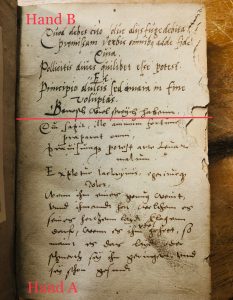
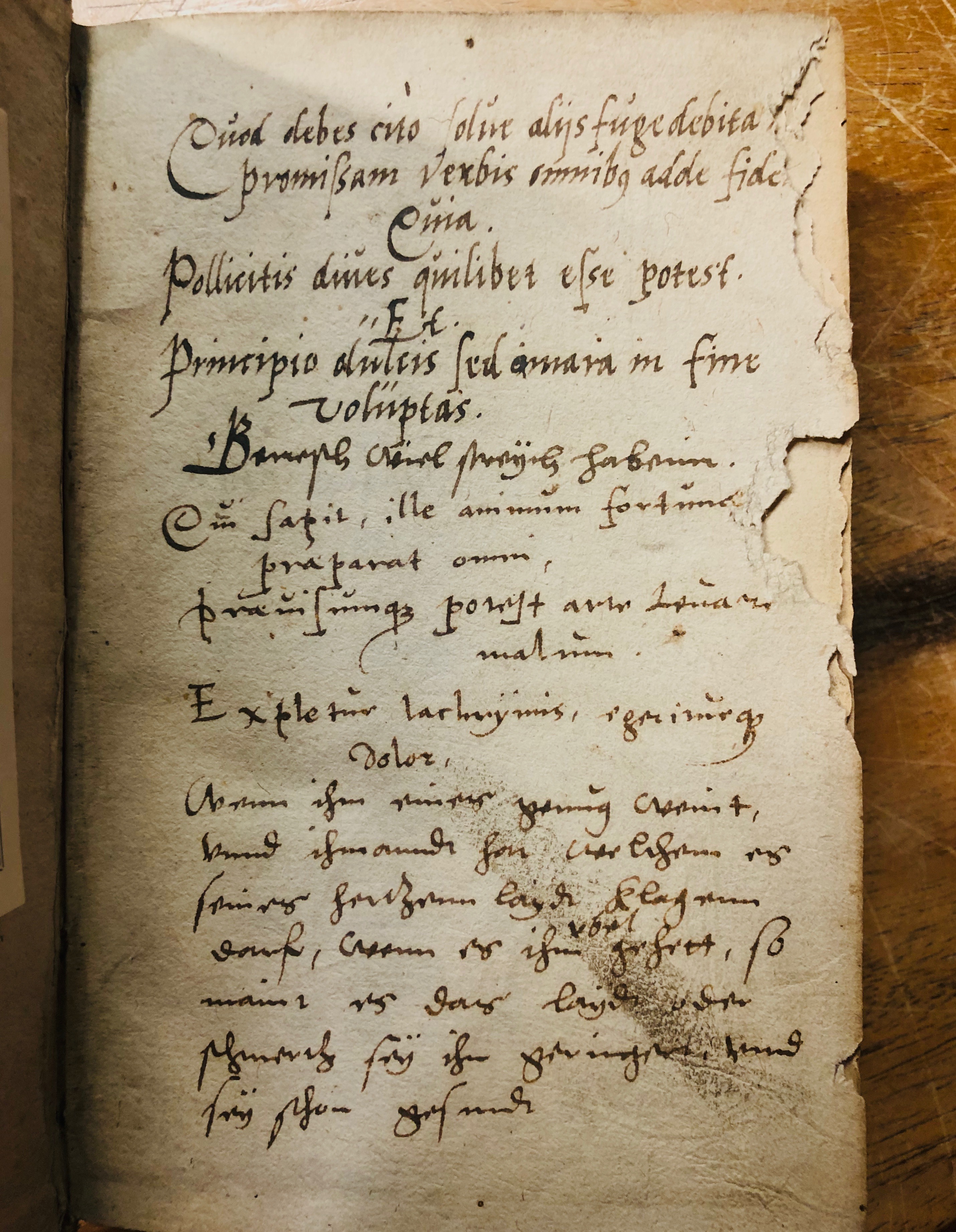
While it appears that the 1559 copy of Calendarium Historicum Conscription was annotated intermittently between 1560 and 1580 (as evidenced by the conveniently-dated marginalia), my analysis of the script in the text has revealed that at least two separate individuals made notes in the blank spaces. While one of the hands (Hand A) resembles blackletter with its wide spacing, short mid-height, and thick stroke width, the other (Hand B) has a slight slant, longer mid-height, smaller spacing, and a thinner stroke width, boasting slight flourishes on its capital letters. The difference between the two scripts can be seen clearly on the second blank leaf of the text; notice how the top half of the page depicts the qualities Hand B, while the bottom half (marked with the digitally-drawn line in Figure 7) has the characteristics of Hand A. The same visual difference is evident in a side-by-side comparison of pages 119 and 122, the former containing Hand B and the latter containing Hand A.
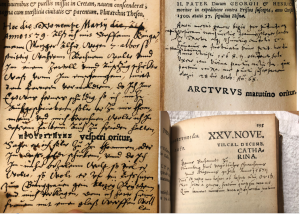
It is also possible that a third script, Hand C, appears throughout the text; it bears a striking resemblance to Hand A, but has a “cruder” appearance (characterized by a lack of separation between each individual letter). While it could be true that Hands A and C are written by the same scholar on two different occasions, the scripts look different enough to attribute them to two completely separate individuals.
As there are two or three different writers who have annotated the Calendarium, I have reasoned that they were likely sitting down with the text at different points during the mid-sixteenth century, each utilizing the blank space in the book to write notes about their own lives or theological beliefs. Fortunately, most annotations are conveniently dated, indicating that they were written during or after the years mentioned in the marginalia. While the following conclusion is undoubtedly an oversimplification (as there are multiple exceptions to this general rule), it seems as if Hand A was written between 1562 and 1568, while Hands B and C were written between 1568 and 1579.
While it makes complete sense that these notes were made by a group of nuns or friars in the Carmelite Monastery who revisited the text at various points during the Reformation to record current events as Eber recommends in the Preface, it is perplexing that they chose to do so in a text so strongly tied to the Protestant cause. A devout Lutheran and close companion of Martin Luther, Paul Eber strongly (and openly) opposed the beliefs of the papacy, choosing to supplement the traditional Roman calendar with the corresponding months of four other populations (two of which– the Jewish and the Egyptians), would have been considered “barbarous” and “heretical” by Roman Catholic leadership of the time period). So what was this text doing in the hands of some of the most conservative Roman Catholics in Germany? Why would one of the sources of the Counter-Reformation be preserving and annotating such a “scandalous” work?
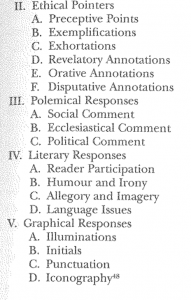
While I cannot be completely sure that I am correct due to my inability to decipher Latin shorthand, I can guess that many of the longer annotations written in this text are “social,” “ecclesiastical,” or “political” comments, which William Sherman categorizes as “Polemic Responses” in Used Books: Marking Readers in Renaissance England. Debate was common in the annotations of antiquarian texts, and this argumentation was even prevalent between the annotators themselves when they disagreed with previous owners’ notes. For example: One of the digital facsimiles of Calendarium Historicum Conscriptum, whose marginalia have been translated by paleographers, contains a written debate between two sixteenth-century scholars, each disagreeing as to whether or not Gutenberg’s press could be considered a “major technological advancement” in the printing industry. As it was a common occurrence, it is quite possible that the long paragraphs of writing on pages 118 and 119 of this text are theological arguments against Paul Eber’s statements in the Calendarium. I will be diving deeper into the potential contents of these notes in the section “On the Marginalia of the Calendarium,” but for now, it is sufficient enough to conclude that the book was likely purchased, bound, and annotated by a group of Roman Catholics between 1560 and 1580.
3. William E. Saunders (1871)*
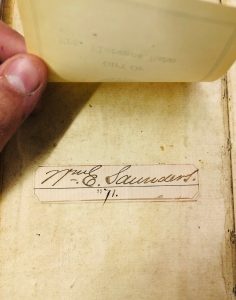
The third person whose name appears in the text is “Wm. E Saunders, ‘71,” which seems to correlate to a book collector named William E. Saunders who lived in Cambridge, Massachusetts in the nineteenth century. As this name is signed on an uneven, hand-cut label that seems to contain the bottoms of three numbers offcut from a lithograph plate in its top right corner (which would have been too small for letterpress of the day), it is likely that Saunders owned the Calendarium in 1871 as opposed to 1771 (this also matches up with the rough date that the Carmelite Monastery’s books were shipped out of Germany). While it is impossible to know for sure, it is possible that William Saunders purchased the text at auction directly from the Carmelites of Bamberg (similar to the way a man named “Mr. Marks” bought the texts for a collection at Amherst College in the 1830’s).

After a bit of research (which would not have been possible without the help of Professor Cook’s Twitter page), I discovered that William E. Saunders was the name of a wealthy Cambridge collector whose father (also named William) erected the William Saunders House for him in 1843 (another date that lines up with the “71” on the book label). According to a “Report of the Free Public Library Commission of Massachusetts (Vol. 10-18),” “the income of the William E. Saunders Fund [was] devoted to the purchase of books on local history as well as to books on genealogy, as heretofore limited.” Despite the fact that the description does not include antiquarian prints, it is quite possible that the library began collecting these as soon as they became available at auction.
*Note1 : The reason why I have asterisked this owner’s name is because I am currently unsure if the book label in the Calendarium truly says “Wm. E Saunders.” This seemed like the guess with the most historical support (especially when taking the date into account), but I cannot say with one hundred percent certainty that this particular Saunders owned the text.
*Note 2: I have reasoned that William E. Saunders was a resident of the United States as opposed to Germany due to the etymology of the last name. I have also used the style of his signature as evidence for the “1871” ownership date, as Saunders’ hand is more reminiscent of a nineteenth-century handwriting than one from the sixteenth century.
4. Holmes (Date Unknown, Perhaps Late 19th Century)*

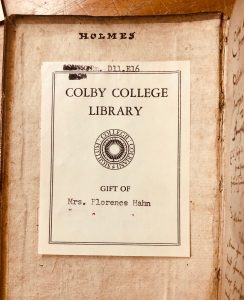
The name “Holmes” has been stamped in black ink above the Colby College bookplate on the front paste down of the Calendarium. There is no first name or date provided with this inscription, making it extremely difficult to track the person or library who placed their name within the text. There is a library in Oxford, Maine called the Freeland Holmes Library, which was established in 1873 after its founder (Freeland Holmes) bequeathed a fund of $500.00 to be matched by the town to purchase books, however I cannot be sure if this is the library being referenced in Eber’s work. Though this answer makes the most contextual sense based on the research I have completed, the Freeland Holmes Library’s small size and initial lack of funding implies that it may not have been able to purchase a book like the Calendarium upon its establishment in the late nineteenth century.
5. Florence Perry Hahn and William Harding Hahn (~1903-1957)
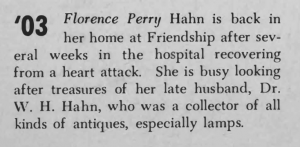
The owner with the most number of existing records was Florence Perry Hahn (1881-1957), a resident of Friendship, Maine who graduated from Coburn Classical Institute and then studied two years at Colby College from 1899 to 1900. According to (an extremely detailed) family history book called “Our Perry Family in Maine,” Florence was a “fine teacher” at Camden, Maine, and a faithful member of the Baptist Church. On April 8, 1907, she married Dr. William Harding Hahn, who graduated from Vermont Academy in 1899 and then earned a degree from Baltimore Medical College in 1904. According to the book, he was a “good physician” and a Knight of the Pythias.
One of Dr. William Hahn’s largest hobbies was collecting antiquarian treasures, as was evident by passages in Maine, A Guide Down East, which mention that “in a small building on the grounds of Dr. William H. Hahn is an extensive Collection of Glassware, consisting of about 1,000 pieces, most of which are early American lamps. Dr. Hahn also has a collection of ruby glassware and some old Roman and Turkish lamps.” While Hahn mainly collected light fixtures, he also maintained a library of old literature, the majority of which was a collection of historical documents from Friendship, Maine. According to a legal case detailing transactions between Florence Perry Hahn and the town of Friendship, the Hahn’s possessions included four folders containing typescript copies of deeds for land in Meduncook, Lincoln County, Maine from 1762 to 1807, when Maine was still a part of Massachusetts. Meduncook was later renamed “Friendship”– the eventual birthplace of William Hahn. Though Paul Eber’s Calenarium Historicum Conscriptum does not fit the typical description of items owned by the Hahn’s, it was certainly in Florence’s possession by the time she donated the text to Colby College in the mid twentieth century.
After William Hahn’s passing, Florence was responsible for tending to his collections. Likely in an effort to donate them before her own passing, she gifted a large collection to Colby College– a donation recorded on the bookplate lightly pasted to the inner front cover of the Calendarium. The label depicts the Colby College official seal, along with information on the room and shelf number for the book when it first arrived. Notably, according to the plate, the text was placed in the Robinson Room on shelf D11.E16– the very spot where I found it at the beginning of this Pet Book Project.

6. Colby College (~1957-Present)
While there are no records indicating the exact donation date of Calendarium Historicum Conscriptum from Florence Perry Hahn’s collection, we can assume that it was donated close to the year of her death in 1957. Still kept in the Special Collections Library today, this text is available for all Colby students to view during the school year.
On the Marginalia of the Calendarium
While I have spent a considerable amount of time hypothesizing how many members of the Carmelite Monastery annotated Eber’s Calendarium Historicum Conscriptum, I noted that I was not able to read the marginalia written in the text’s blank leaves. Despite my lack of expertise with paleography, I have noted some key elements of the annotations that should not go unmentioned:
1. Almost every single annotation includes a date, whether that be a day, month and year or just a simple “Anno ____.” As this book is a calendar, and contains information about contemporary historical events, it makes contextual sense that its readers continued this historical progression with notes about their own lives.
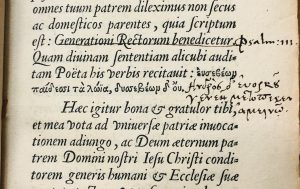
2. I have detected numerous Biblical references throughout the marginalia, such as the word “Mary” appearing on page 119, the word “Christi appearing on page 518, and the note “Psalm 111” written next to an underlined sentence stating “Generationi Rectorum benedicetur” in the Dedicatory Epistle. I was able to translate the Latin on this page, and I have confirmed that the reader was correct in recognizing the language from Psalm 111 (perhaps further justifying the idea that the person annotating this book had a firm grasp of the Bible and was likely a scholar or member of church).
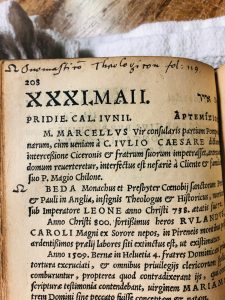
3. There are notes in Greek that appear throughout this text, indicating that whomever annotated the work could read and write in multiple Classical languages (typically an ability of educated scholars or ecclesiastical leadership). Most of these annotations are phrases written next to sentences that are already in Greek (such as a sentence in Attic Greek midway down page in the Dedicatory Epistle), while other notes are small Greek symbols that probably have other literary or astrological meanings (such as the Omega [Ω] appearing twice on page 208 (once in the top left hand corner of the page, and the the other time appearing next to the word “BEDA” in the body of printed text). One page (264) additionally includes two identical symbols that look like three tally marks crossed out by a diagonal line, although I am unable to comprehend what the reader was intending to draw (perhaps it is another Greek symbol or part of the reader’s Latin shorthand).
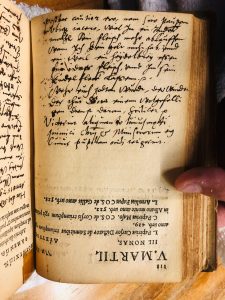
4. Multiple annotations are written upside down, such as those on pages 118 and 356. While it seems like both annotations were written this way for either spatial reasons or personal preference (ie: if the reader found it easier for his or her hand to write at the tops of pages than the bottoms), it is interesting that the practicality of writing was consistently prioritized over future legibility. In one of my earlier posts I mentioned that Paul Eber’s layout of the calendar forced readers to rotate the book in various directions in order to properly read multiple month charts; based on the annotations in the Calendarium, it seems that his readers were listening.
5. At least three or four of the annotations mention the word “folio” or “fol.” followed by a number, indicating that they are likely referencing sections of another text within the Calendarium (perhaps the Bible or some other religious work). According to Sherman, “cross-references and passages copied verbatim from other books are frequent enough to attest to the wide-spread practice of what has been called ‘extensive’ rather than ‘intensive’ reading,” meaning that quoting and then citing folios from other works would not have been unusual for the time period.
On the Binding of the Text

One of the most fascinating signs of “use” in this text is the book’s binding, which I have identified as tawed pigskin by magnifying its pores and comparing their triangular pattern to those on Colby College’s copy of The Nuremberg Chronicle. Though several grooves filled with fading black ink indicate that the blind tooling on the front and back covers of the text used to be colored for emphasis, most of the ink has been worn away. Furthermore, while it is evident that the binding is covered in divine figures (and a small phrase written in almost illegible Latin due to its miniscule font size), it is very difficult to determine who the saints are and what the text says because of the erosion of the stamp imprints over time.
The lack of ink in the grooves of the blind tooling on the front cover was a serious issue that changed my understanding of the year that this book was bound in my first blog post: “Decoding the Codex.” When I first picked up Calendarium Historicum Conscriptum, I was under the impression that the stamped date was either “1602” or “1502” based on the numbers that I could decipher under a magnifying glass. This was perplexing to me; how could the book have been bound in 1502 when it was printed in 1559? Moreover, how could it have been bound in 1602 when a paste-down on the back front cover bears an annotation mentioning “Anno 1563”?

For a long while, the date of this book’s binding was a mystery to me. However, in last-resort attempt to determine the date stamped into the front cover of the text, I placed a sheet of white copy paper on top of the Calendarium, took a light pencil rubbing, and discovered that the date stamped into the book was neither 1502 nor 1602; it was 1562, seen clear as day on my sheet of paper but nearly invisible when observing the text itself. This date corresponded with the year of this book’s printing in 1559.
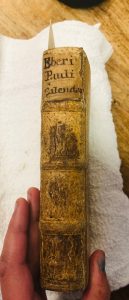
*Note 1: While this book was bound within a few years of its printing, it is possible that the text was rebound between 1559 and 1562. On the spine of the book there lies a square of paper bearing the abbreviated title “Bheri Pauli Calendar” written with quill and ink. A common practice of the time period, according to Colby College Librarian Pat Burdick, was to remove the titles of original bindings and glue them to the new spines of the books in order to maintain a sense of authenticity.
*Note 2: The initials “G.R.I.” are stamped into the front cover of the Calendarium, which are potential indications that someone (perhaps from the Carmelite Monastery) with these initials owned the text in 1562 and decided to have it bound. When I wrote “Decoding the Codex” I mentioned that the initials could have belonged to the printer of the book, George Rhau; however, my study of Darnton’s Communications Circuit has led me to believe that Rhau’s press would likely not be responsible for the book’s binding. A more real possibility is that one of the text’s first owners bound the book with his or her own name in mind.
On the Wear of Calendarium Historicum Conscriptum
While Eber’s Calendarium remains intact despite its taxing five-hundred year journey across the Atlantic Ocean, the book is not exempt from the damage that typically befalls texts of its age. I have listed the largest elements of wear below:
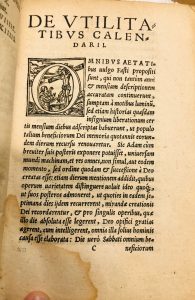
1. Water Stains
The Calendarium exhibits large water stains the lie across the gutter of multiple pages, each light brown in the center and dark brown on the edges (this detail is how I was able to identify the damage as a water stain as opposed to foxxing). The staining is most prevalent in the Preface of the text, indicating that the book was likely open to its beginning pages when the water came in contact with the paper.
2. Insect or Rodent Damage
One of the rather enigmatic mysteries that I discovered in Calendarium Historicum Conscriptum is that this copy of the text bears significant damage in its index; the back pages of the book are extremely delicate, each one resembling lace more than paper leaves. Based on the bite pattern evident at the edges of each affected page, the creature that ate the index was likely not the typical culprit of damage: the bookworm.
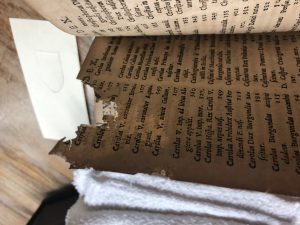
While the bite marks of bookworms typically look like small holes that have been drilled through sections of pages, tunneling through the heart of a text, this damage is erratic and widespread. Instead of resembling drilled holes, the holes in the affected pages resemble large patches of paper that have been removed by larger bites. This has led me to believe that the damage could have been caused by silverfish or even rodents. During my research, I emailed Erik Kwakkel at the University of British Columbia about the bite patterns in te text, and he responded saying that he too believed it was caused by mice (although mice typically eat larger sections of pages at a time). While the damage to the index is still a bit mysterious, I believe that the answer most supported by my research would be mice or rats.
3. Fraying Binding
While the binding is actually in exceptional condition for the book’s age, if one were to open to the text’s fly-leaf, one would be able to see the areas where thread had been woven through the pages onto the supports that hold the book together. Currently, the damage is not extremely obvious unless one is looking for it, but it exists nonetheless.
On Some Interesting Finds Throughout the Text
Throughout my analysis of the Calendarium, I found some other interesting signs of use that did not neatly fit within my previous sections but deserve some recognition:
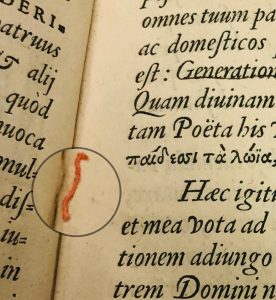
Firstly, within the text’s Dedicatory Epistle, there lies a centimeter-long fragment of a red thread tucked into the gutter. This could have been a piece of a thread bookmark that books from the time period typically contained, or it could have been a thread from the clothing of a previous reader (potentially even a Colby reader, although it is always more fun to imagine the thread getting into the text through a chain of events similar to those described in People of the Book).
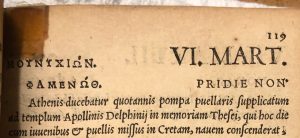
Secondly, someone placed a piece of brown tape in the top inner corner of page 119 (the page where a reader made copious annotations in Hand B, which seem to have been written during the 1570’s). Since adhesive tape had not been invented until the mid twentieth century, I can assume that William E. Saunders, the Hahn family, or someone from Colby College used tape to bookmark the page (or perhaps mend a tear).
Takeaways from the Research
When I first picked up Colby College’s 1559 copy of Calendarium Historicum Conscriptum, I made initial assumptions about everything, ranging from the date on which the book was bound, to the identities of the text’s former owners, to the source of the tears and holes at the index of the text. One of the largest theories I presented was the concept that because this book was written by a Protestant scholar, it must have only been appealing to Protestant readers. However, my findings from this leg of the Pet Book project have exhibited quite the opposite: according to the material evidence inside the text, for the majority of its existence (ie: from the mid-sixteenth to mid-nineteenth centuries), the Calendarium has been owned by non-Lutherans. The fact that this calendar could be viewed as a reference book meant that it possibly had a vaster appeal than other religious texts meant to be read from cover to cover (ex: one of Philip Melancthon’s sermons or a volume of Luther’s lectures at the University of Wittenberg). Despite threats to Lutheran work made by the papacy (and a mass shutdown of Protestant presses across major printing centers in Germany), this book escaped censorship and destruction by its Roman Catholic owners. I wonder if it would have had the same outcome, had the monastery not decided to preserve it between 1559 and the mid nineteenth century.
*Note: The annotations written throughout this book are still enigmatic to me, as I have not been able to read them correctly; if I were Hannah Heath from People of the Book and could hire some paleographers to decipher the words, I certainly would ask for a translation (especially since the notes reference events that occurred on specific dates and could act as a snapshot of the Counter-Reformation movement in Bamberg).
Sources:
https://en.wikipedia.org/wiki/William_Saunders_House
https://twitter.com/meganlcook/status/1254538403405860864
http://www.carmelites.net/tag/catholicism-in-bamberg/
https://en.bamberg.info/poi/carmelite_monastery-4639/
https://www.spottinghistory.com/view/5703/carmelite-monastery/
https://libraryguides.library.clark.edu/c.php?g=513132&p=3552302
https://digitalcommons.colby.edu/cgi/viewcontent.cgi?article=1192&context=alumnus
https://www.upenn.edu/pennpress/book/14394.html