Overview
I want to start off with a list of casualties caused by my undertaking of this unessay project: 2 broken tapestry needles, 1 broken paper clip, my dignity, 15 episodes of Community (watched in one day), a misplaced embroidery needle, and about 10 cups of coffee were all killed or consumed in service of my completion of this project. May they rest in peace, and hopefully I don’t find the embroidery needle in the bottom of my foot a week from now.
Now that I’ve paid my respects:
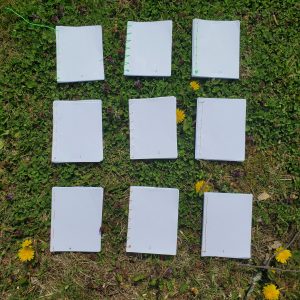
For my unessay project, I decided to sew nine booklets using denim thread(cotton ), hemp thread (an organic thread similar to what would have been used in medieval times), and embroidery floss (a more modern thread made of loosely spun strands of cotton or rayon). The books were stitched in three patterns: a straight stitch, a double-back straight stitch, and a modified whipstitch. In doing so, I’m investigating each material and sewing pattern in regards to how easy/hard it was to sew and how the qualities of the material interacted with the stitching process.
The time it takes to sew, the amount and kind of material that would be available, and the durability of the finished product are all material aspects of a widely available format that would affect how people would produce them. I hope to contribute to Aaron Pratt’s research on how material limitations would have affected the form of the book.
I’ve made some slight changes to my project since I proposed it in the Moodle forum last week. For one, I swapped the acrylic yarn for embroidery floss. I made this choice because frankly, the acrylic yarn was too thick to fit in any of my needles and I had to improvise with materials I had on hand. Second, I ended up scrapping the second part of the project where I subject the book to wear and tear. This was primarily due to time constraints. I had other projects to work on in the last two weeks, and I overestimated how much time I would have had to use the books. Additionally, I decided that any amount of wear and tear would probably be unrealistic. These booklets would be, realistically, kept in the home for long periods of time, months at least. Unfortunately, I am unable to accurately simulate the passage of time and if I tried I think I would just get inaccurate results.
Materials
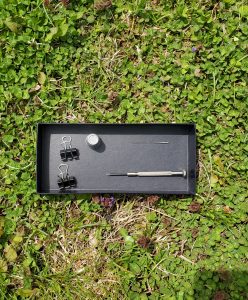
For this project, I used:
- 90 pieces of 8.5 by 11 copy paper, 10 per booklet
- this resulted in 40 pages per booklet
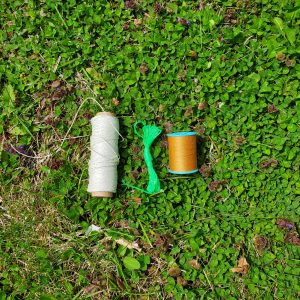
- Hemp thread
- Embroidery floss
- Denim thread
- Tapestry needle to poke holes and sew booklets
- Small Philips head screwdriver to widen holes
- Paper clips to hold books in place while stabbing and sewing
- A ruler to mark hole placement
- Thimble
The Sewing Process
In order to sew the books, I decided it would be best to recreate the activity that we would have done in class. In order to do this, I followed these steps
- I took the paper I was using and added the letters/numbers to the pages so I would know how to fold them so the ‘book’ would be read in the correct order. While the pages were blank and I didn’t have to do this, I felt it would be in the spirit of the project to add these so I could better recreate the stab-stitching process. I lettered/numbered pages A – J, which would result in me stitching through 40 layers of paper once everything was folded into quartos.
- I folded the papers ‘hamburger style’ so that the A2 was behind the A1, and then folded the paper so that the A3 ended up behind the A2. I did it for all the pages, then used scissors to cut the pages along the initial “hamburger” fold. Ideally, I would have cut the tops after binding but I did not have an X-acto knife on hand and Walmart is hellish.
- After folding and cutting, I stacked the booklets in groups 3 to 5 and used the tapestry needle to poke holes in the paper. After the first three books, I decided to use a small screwdriver after the tapestry needle to create larger holes. (I found that it was impossible to pierce the paper with just the screwdriver). When I finished the first batch of quartos, I used the top booklet as a template for the next booklets instead of re-marking the holes for each set of 3-5 books.
- After putting holes in all 10 quartos, I sewed the books in one of the three patterns I chose to perform.
Differences in Sewing Patterns
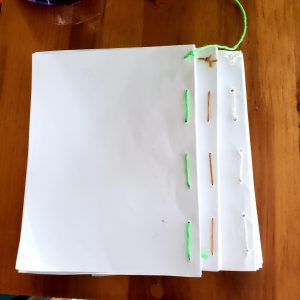
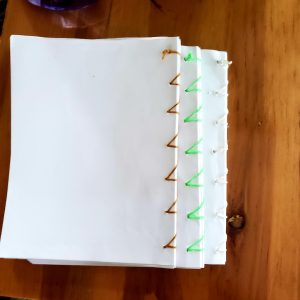
The first pattern I used to sew the booklets was a basic one-way running stitch. I picked this stitch for a few reasons. One, it requires the minimum amount of thread out of any of the sewing patterns I used. Two, it doesn’t require any familiarity with sewing to execute, making it easy for the uninitiated. Because it was so easy I really have nothing to say about it. However, I will say that the books sewn in this way felt flimsier and less secure than books sewn in other patterns. It also looked less attractive than the other sewing patterns I used.
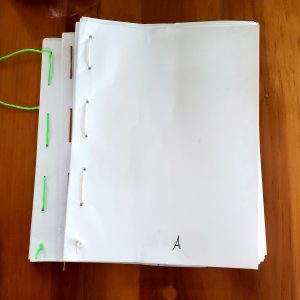
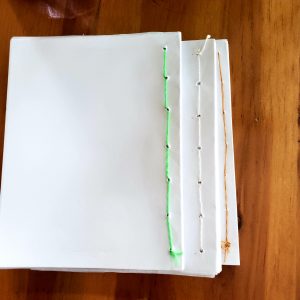
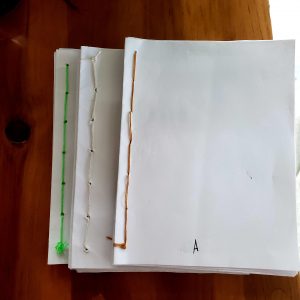
The second stitch pattern was a double back running stitch. This stitch used the most thread by far since the booklet was stitched both up and down the spine. Additionally, the sewing pattern was easy in concept because it was just an extension of the running stitch. However, it was made more complicated by the fact that if, on the way back down the spine, the needle accidentally went through and caught a strand from the already-made stitches, the book would be ruined because the spine could not be tightened. This meant that in a few cases, the booklet had to be taken apart and restitched, which as frustrating. This sewing pattern was benefitted by the fact that these booklets were very secure – if a bit tight – and the binding looked less cheap and unattractive.
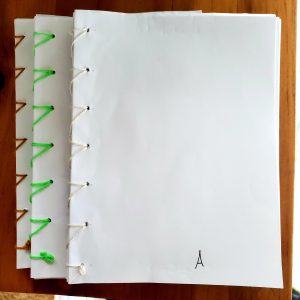
The third stitch pattern was a modified version of a popular hand-stitching pattern known as a whipstitch. I picked this stitch because Professor cook mentioned that students in the past have done the quarto activity had wrapped the thread around the spine, so I wanted to see how that would work. This version required a little more thread than in the basic running stitch but much less than in the double-back running stitch. It also looked pretty attractive. However, I worry that the thread was crushing the spine a bit, and the wrapping of the thread around the spine in that manner may put a twisting stress on the booklet that the running stitch did not. Additionally, this sewing pattern also required extra care so that the thread wouldn’t get tangled on itself, which would ruin the booklet. Plus, this may require more sewing knowledge than either of the basic stitches which could be confusing for a hypothetical stab -stitcher.
Differences in Thread Quality
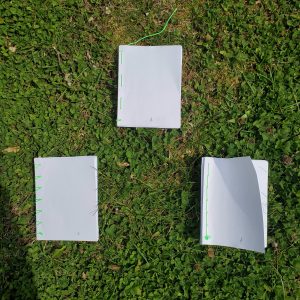
I started off my stab-stitching project using denim thread. This was the easiest to handle by far due to two key qualities: it’s thin, and the strands are tightly wound. What this meant for stab stitching the book was that the thread was less likely to get tangled on the running back stab-stitch and on the whipstitch. The thinness of the thread also meant that it was much easier to thread the needle. Lastly, the thin thread meant that I only had to puncture the paper with the tapestry needle and didn’t need to follow up with the Philips-head screwdriver. However, it seemed to me that it was less secure than the other two threads.
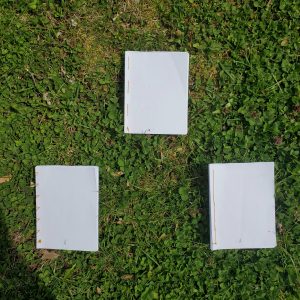
The second thread was the hemp thread. This thread I had to buy specifically for this project, which automatically made it less convenient. It was also the thickest thread in my arsenal which made it difficult to handle, especially in regards to threading the needle. However, the strands stayed pretty woven during threading and sewing, and it was much less likely to get caught on itself than the denim or embroidery thread. Additionally, it had a good structure and resulted in a much more stable and less flimsy binding. As a plus, it also closely resembled what would have been used at the time that stab-stitched quarto was a popular format.
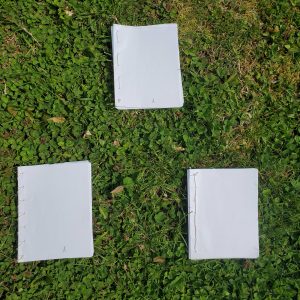
The last kind of thread I used was embroidery floss. This was my least favorite thread by far. Since this was a last-minute substitution based on the limitations of the material available to me, I felt like it was a fitting lesson about how what’s available affects how these things are made. That being said, since embroidery floss is loosey woven by design, it caused a lot of problems with the thread getting caught on itself, which resulted in me re-binding one book twice. Additionally, it was difficult to thread the needle, which was especially frustrating since the needle often slipped off the thread. The book was also more flimsy than the hemp-bound book. Overall an unpleasant and frustrating experience.
Final Thoughts
This project gave me greater hands-on experience with how material limitations affect the construction of these stab-stitched quartos. I myself often ran into the wall of limitations in my project. For example, adding the screwdriver to the book-stabbing process came about because the tapestry needle wasn’t making thick enough holes to thread with hemp thread or embroidery floss. Since I wasn’t in possession of an awl I had to improvise with available materials. Additionally, as I stated before, I had to change one of my binding threads from acrylic yarn to embroidery floss due to the fact I didn’t have the tools that would be able to handle the yarn. On top of that, the steps taken to produce the book were often modified to maximize efficiency and make the process more streamlined. time is something in an ever-shortening supply (and marginalized people have less of it than others) saving time would be just as important to the production of these books as the cost and availability of binding materials. I had to save time so I could get this project in by the deadline. Because I had to work against these limitations, I gained a greater understanding of how material limitations that people may have faced during the time in which these stab-stitched quartos were popular. The hands-on nature of the project was therefore extremely informative (and fun). This semester was stressful, unforeseen, and in many ways I feel sad for what could have been for this class. However, I want to thank Professor Cook and my classmates for making a bad situation much more bearable. I hope to see everyone when we are all on campus again, and I hope everyone has a safe and lovely summer.