Music: A Visual Art
The progression of music packaging as a form of art and advertisement has been instrumental in the music industry’s evolution. Music packaging began as a purely functional aspect of vending recorded music, and little attention was given to the appearance over the actual sound. Looking beyond what was originally just about practicalities, publishers ask “how will consumers notice this album in a store full of others, and how well does this cover represent the images of the artist?” (Cusic 52). Cover art, function, physical formatting, and audio content all go into the cohesive product. Packaging in itself is embodied in the conglomeration of technological and sonic capacity, eye catching advertisement, and the formatting of these components. Albums can be appreciated for their sonic features, visual features, or both; the two aspects go hand in hand. The format and visual aspects impact the experience of the consumer, their usage or purpose for the musical content and its physical representation, and the music’s significance throughout time.
It began in 1892 when Thomas Edison invented the National Phonograph to publish songs on wax cylinders (Jones and Sorger 73). These were encased in mundane boxes and sleeves, sometimes listing the company name and a slogan about the sound quality (Jones and Sorger 73). They were typically designed by retailers without having artists and publishers weigh in (Alleyne). The appearance was scarcely valued because the cylinders themselves were not. However, in 1910, varying sleeves were made available in different colors, even in metallic pigments (Jones and Sorger 73). At this time, artists actualized their influence on their albums’ characteristics. This stimulated a widespread transition into artist promotion on the product’s facade. Displays shifted from mere images of the band to imagery representing the content’s sonic elements or dreams of the artists, as the desires of the artists (Alleyne).
During the post-depression economic growth of the 1930’s, packaging was utilized to present album titles, artist information, as well as unique photos of the artist or other elements (Jones and Sorger 74). Producers began to harness the physical materialization of their music to accurately and profitably advertise it. “In addition to the photos, there is also the question of graphics and colors, involving background as well as clothing” (Cusic 52). Columbia Records pioneered deliberate viewable advertisement for their music during the 1940’s when they designed casing to speak vociferously to customers with bright hues and eye catching lettering (Jones and Sorger 74). Columbia strived to cultivate imagery that allowed the consumer to “see the music” (Alleyne). They continued to drive the industry’s growth through their introduction of the LP, the most iconic physical representation of music. The LP, an abbreviation for “long playing” is a 12 inch square album most historically and culturally appreciated. One year after its initial influx during 1949, nearly every album on the market had adopted that formatting (Jones and Sorger 74). Each artist strived to apply the most striking and stimulating concepts to their allotted 12 inch spaces.
The 1950’s marked the beginning of what was arguably the most critical overarching era of the music industry’s timeline: the reign of the LP. From its dawn as the prevailing format in music publishing, various genres diverged into subcategories of frequent design patterns. Jazz covers modeled faded text, subtle imagery, and generally straightforward parallels between the audio and the art. “The progressive nature of jazz as it developed in the 1950s was reflected in an avant-garde approach to photography, illustration, and typography. Conscious attempts were made to link visuals and music” (Jones and Sorger 74). Conversely, the 1960’s yielded an influx of abstraction on albums. Ambiguous messages were conveyed through obscure visions on rock album covers. British bands like Pink Floyd, the Beatles, and the Rolling Stones both introduced and reinforced imagery until it became associated with rock and roll (Jones and Sorger 74). More bands looked to the development of unmistakable logos that personified rock and roll visually. This included groups such as Grateful Dead, Yes, the Rolling Stones and Kiss. They applied the same imagery to an array of albums, further cementing the iconic counterparts of rock’s tangibility. This motion towards distinct obscurity sparked the Psychedelic Revolution. Artists were no longer concerned with legibility; they employed swirling, visual effects and standard rock and roll configurations. These included gaudy, flashy pigments and outrageous images accompanied by often illegible text, or none at all. They were inspired by images akin to mysticism, sci-fi, and fantasy. Rock and roll was as much an artistic craft as it was a music genre.
The “Summer of Love” of 1967 shot this established mainstream music design to further abstraction. Psychedelic covers were directly influenced by and expressing the drug culture of the era. San Francisco’s concert scene urged the movement forward through the production of posters for shows at the Fillmore, as they intended to create visual imagery to represent the music being played. This cultivated an entire subcategory of music advertisement: concert posters. Vintage posters are boasted and displayed pridefully today similarly to LP’s, but formatted for the home without the actual audio components. At this time, cassette tape began its introduction into music consumption, but were never displayed like other mediums of visual depictions. Concert and band posters fluctuated along with the tendencies of contemporary artists, but the LP always remained classic.
Unparalleled rising oil costs during later years abated the growth, although it intersected with the rise of the Punk Era of the mid-late 1970’s. Albums promoted outrageous imagery: ripped clothing and designs and even brighter colors than before packed together with cheap mediums (Alleyne). The products were excessive, but the packaging quality was cheaply made and modest due to limited resources. The albums were purely exorbitant to match groups’ novel sounds. Then, the New Wave rolled in. Artists reverted to cutthroat classic techniques, applying a “clean use of space and geometry; elegant, restrained typefaces; and dramatic, black-and-white photos” (Jones and Sorger 81). Woodcuts and paintings were flaunted on trim, uncluttered vinyl sleeves. Although vinyl had seen substantial change in style of print and design, the original formatting had remained relatively untouched until this point. The preexisting 45 single became popular during this period due to its superior sound quality from wider grooves (Jones and Sorger 81). 45 singles yielded little appeal from artists and producers due to their one-song capacity, and the cost of production for just one track. When they surfaced at the forefront of manufacturing, artistic qualities were sacrificed for improved sound on the individual track. The 7-inch cover, differing from the 12-inch LP cover, allowed for reduced design space in order to allow for elevated auditory experiences. This provoked the cycle of decreased capacity for artistic configurations at the hands of preferred sonic characteristics in technological advancements.
Although the cassette had been designed decades prior, it never outweighed LP popularity until the introduction of the Sony Walkman in 1979. The following developments of CD’s and downloaded audio thrusted vinyls into technological obsoletion. As the physical nature of the products changed, along with the dimensions on the face for design, vinyl’s cultural significance has remained unrivaled. The LP, encompassing both the sleeves and the records themselves, has prevailed as an untouched icon of the music industry. Vinyl records have even come back into style as they gain retro stature. Emblematic albums are pridefully flashed in a bohemian-bourgeois way. Recognizable artists from the era have gained a swanky status, especially the artists associated with psychedelia, Woodstock, and the vanguard rock and roll designs. Vinyls from artists like Pink Floyd, the Grateful Dead, Jimi Hendrix and the Rolling Stones are honored reminiscently as flavorful visual paramounts of the industry. Pink Floyd’s blend of essences derived from surrealism, psychedelia, and rock and roll has earned their LP’s a keepsake, tony character.
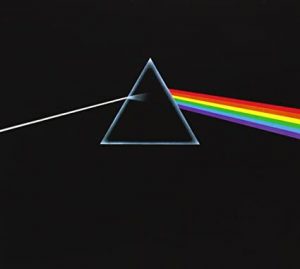
Pink Floyd’s album The Dark Side of the Moon may be the most supreme, recognizable album in history. Few quite understand what it means, or the tracks on the record, but they were adroitly developed in alignment. The sleeve was conceived by English graphic designer George Hardie, along with Storm Thorgerson and Aubrey Powell of Hipgnosis (Epstein). The company notably designed covers for Led Zeppelin, AC/DC, Black Sabbath, Electric Light Orchestra, and other visually and acoustically unorthodox groups from the time (Epstein). Thorgerson is recognized for designing surrealistic interpretations of photography. “What’s remarkable about Storm Thorgerson’s legendary album covers is that while they were designed as supposed adjuncts to the music inside them and have become identified with those bands, the pictures have achieved, consistently and repeatedly over forty years, a separate life of their own” (Source 5). Inspired by the band’s collective appreciation for comics, Hipgnosis suggested an image of the Silver Surfer for The Dark Side’s cover. However, they determined that rights to the figure were likely unattainable, so they turned their attention to new designs. The pyramid at the center is an abstract depiction of Thorgerson’s photograph of the Pyramids of Giza. Storm Thorgerson stated in an interview with Gary Graff of Guitar World, “I hired a taxi at 2 o’clock a.m. to take me out to the pyramids. So there I am, thinking I’ll be fine, and I put the camera on the tripod to do a long-time exposure. It’s a wonderful, clear night, and the moon is fantastic. So I’m doing it… and then, at like 4 o’clock a.m., these figures come walking across – soldiers, with guns. I thought, ‘This is it. The game is up – young photographer dies a strange death in a foreign land.’ I was actually really scared. Of course, all my fears were unfounded. They were really very friendly. They wanted a bit of bakshish, a little bit of money to go away. They kindly pointed out that where I stood was actually a firing range, and they’d come to tell me it wasn’t very cool for me to be there. If I was there first thing in the morning, I might get a bullet up my butt.” (Source 5, 360)
Thorgerson actually journeyed to Egypt to photograph the Pyramids, when all that came out was the moon (Mason 189). His cover design was a representation of the chaotic emotions Thorgerson felt while shooting the Pyramids, along with the ambiguity in the frames, as only the moon came out. He infused these sentiments into his interpretation of the transcendental, abstruse tracks on the album. Thus, he forged the “cosmic version of the prism” (Mason 189). The design both matches and accentuates the distinct obscurity cultivated by the tracks. “‘It’s very stark and simple; it’ll look great in shop windows.’ It wasn’t a vague picture of four lads bouncing in the countryside. That fact wasn’t lost on us,” asserted Pink Floyd guitarist, David Gilmour to Rolling Stone in 2003 (Epstein). Its significance has reached far beyond Hipgnosis’ and Pink Floyd’s initial intentions; it is an artistic masterpiece, both audibly and visually. It rapidly became “an essential fashion accessory” for the home (6, 189), and a manifestation of what an optical representation of sonic qualities can be. Rarely do the tracks and the cover art dovetail so harmoniously.
Although the classic nature of The Dark Side has lingered unmatched by Pink Floyd or other artists, the band’s enigmatic originality has prevailed throughout their career. Following a 19 year hiatus, the group decided to drop a new album, Endless River. At this point, in 2014, Storm Thorgerson was retired. The group hunted for preexisting art that they believed to represent their music, rather than hiring an artist to interpret it. Their pursuit of fresh surrealistic conceptions drew them far from where they had previously been, yet surprisingly close to The Dark Side.

Back to Egypt. Ahmed Emad Eldin, a seventeen year old Egyptian, was an aspiring painter with an amateur website for the display of his work (Source 5, 360). He was emailed about a piece on his website by the band’s representative on July 31, 2014 (Source 5, 361). An avid Pink Floyd fan, Eldin claims to have been listening to Hey You, a track on their album entitled The Wall when he received the email. For this reason, the band’s prior work is speculated to have subconsciously directed his art. The group expressed interest in Eldin’s painting he had named Beyond the Sky (Source 5, 361). It depicted a whimsical Thames skiff gliding through the clouds, and he was asked to paint an oar in the hand of the figure (Source 5, 361). Endless River’s album art was so intriguing to the public that it was the fastest selling album of the year, and it set Amazon’s record for most album pre-orders (Source 5, 361). This was before anyone had even heard the tracks. At that point, the industry’s advertising capacities had shifted so significantly that the band was forced to adopt commercial communications. Since their most recent album had been released in 1995, Pink Floyd was obliged to acclimate to the transformed climate of the industry. Endless River’s intangible nature as downloaded audio contrasted the vinyls, cassettes, and CD’s that the band was accustomed to releasing. The band released it in a variety of formats, including vinyl, just to preserve their material artistic quality.
Music packaging has undoubtedly been an instrumental aspect of the industry’s evolution. Music has become an art form beyond the audio itself. For this reason, advertisements and physical forms are appreciated for aesthetics, timelessness, and originality. The vinyl record is an unrivaled manifestation of perpetuity of great musicians’ work. Not only does the formatting impact the virtues and experiences kindled by the audio content, but it matured into its own art with or without the music.
Sources
- Alleyne, Mike. “After the Storm: Hipgnosis, Storm Thorgerson, and the Rock Album Cover.” Rock Music Studies, vol. 1, no. 3, 2014, pp. 251–267., doi:10.1080/19401159.2014.949553.
- Jones, Steve, and Martin Sorger. “Steve Jones And Martin Sorger: Covering Music: A Brief History And Analysis Of Album Cover Design.” Journal of Popular Music Studies, vol. 11-12, no. 1, 26 Aug. 2006, pp. 68–102., doi:10.1111/j.1533-1598.1999.tb00004.x.
- Cusic, Don. “Music in the Market.” Google Books, Popular Press, 1996,
books.google.com/books?id=CEt9fa9ZKSYC&printsec=frontcover#v=onepage&q&f=false.
- Epstein, Dan. “Pink Floyd’s ‘Dark Side of the Moon’: 10 Things You Didn’t Know.” Rolling Stone, Rolling Stone, 22 Sept. 2019,
www.rollingstone.com/music/music-features/pink-floyds-dark-side-of-the-moon-10-things-you-didnt-know-201743/.
- “Mind over matter: the images of Pink Floyd.” London: Sanctuary, 1997.
http://londongrip.co.uk/wp-content/uploads/2011/06/Art_Storm_Thorgerson_Pink_Floyd_2008.pdf:
- Mason, Nick. “Inside Out: A Personal History of Pink Floyd (Reading Edition).” Google Books, Chronicle Books, 2017, books.google.com/books?hl=en&lr=&id=N9Q3DwAAQBAJ&oi=fnd&pg=PP1&dq=Pink+Floyd,+cover+art&ots=0nbr4XQMpg&sig=4BnqC6ZTVET7H8u_R5gnmqczipo#v=onepage&q=hipgnosis&f=false.