Up until this point, most of the information I’ve presented about Moses and Aaron is about the people who created it or the intended purpose and audience. These are all related to the content of the book and what it says about who made it, where it was made, why it was made, etc. and can therefore be gleaned from just about any complete copy of Moses and Aaron. There is, however, a great deal to be learned from studying features unique to this copy of the book. These can give further hints as to how the book, at least this one copy, was used, as well as hints about who might have owned it at various points in its life.
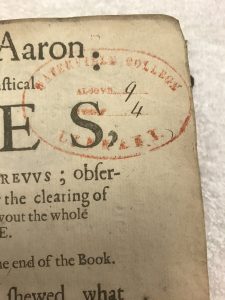
The copy in Colby’s collection is unique in a few regards. While it is one of two copies of Moses and Aaron in Colby’s Special Collections archive, it is the only copy of the tenth edition. Some obvious features that come from that are the various stamps, inscriptions, and other accessories that mark it as property of the Waterville College Library (Colby’s name before it was changed in 1867).
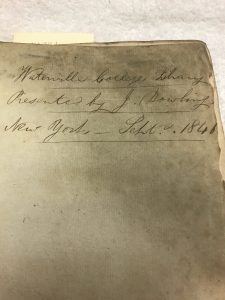
Among these marks is an inscription that says that the book was donated to Waterville College in 1846 by one J. Dowling of New York. This is important as it is a very clear indication of the previous owner, and is also the most extensive note written in the book.
The final and most puzzling copy-specific feature is the partial (I think) chapter from another book bound in at the end. This seems like an intentional inclusion given that the title page from the book is bound in with pages 95-120, making it seem fairly unlikely that it was accidentally bound into Moses and Aaron.
I don’t really feel the need to talk about library stamps and things of that nature. It’s clear that this was a library book and it’s moderately interesting to look at the fact that it was a circulating book, there’s other stuff going on that’s far more interesting.
In that vein, the pages from Episcopus Puerorum bound into the back of the book have been a mystery to me since I first opened it up and paged through it. Given the knowledge that their inclusion was intentional, the question then becomes who added them, when, and for what purpose? Looking first at when this was done, there’s a big clue on the title pages of the books. Both Moses and Aaron’s 10th Edition and Episcopus Puerorum were printed in 1671. This makes me think that the pages were bound closer to the time when the books were printed. I don’t, however think that it was bound at the point of sale or by the printer. Looking at the printer and publisher information on the English Short Title Catalog, I couldn’t find any links between the printers or publishers of the two books.
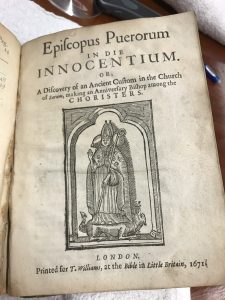
The other clue is in the content of the chapter. The book itself is about the Christian tradition of making a boy bishop out of one of the choristers at certain feasts and holidays, as is made clear from the subtitle. This chapter in particular, while I haven’t read it in full, contains multiple references to Hebrews and/or Jews. Given Moses and Aaron’s focus on Jewish customs and their relation to the customs of other religions, it seems likely that this chapter was bound into the book to serve as an additional resource about a tradition that may not have been covered in Moses and Aaron.
The other question raised in thinking about how this book was used is that of ownership. While there are no marginal notes other than the aforementioned library markings, the one that reveals the identity of the previous owner opens up a potential avenue for study.
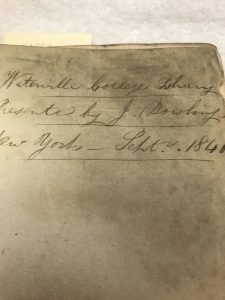
A quick Google search for “J Dowling NYC 1846” yielded this catalog of a library in Lowell, Massachusetts containing a book written by one Rev. J. Dowling of New York and published in 1846. With the knowledge that he was a reverend, I added that to my searching and by searching “Reverend J Dowling NYC 1846” I found a biographical essay on Reverend John Dowling of New York City, pastor of Berean Baptist Church. There’s a lot of information about his life, the various churches he preached at, and his various publications, but one thing is of particular interest to me in my study of his copy of Moses and Aaron is that he gave a speech about the Jews in 1846, the same year he donated the book to Waterville College. While there’s no way to know for sure, I would guess that he used the book for his research for that speech. Given Dowling’s affiliation with the Baptist Church and Colby’s founding as a Baptist institution, I thought there might be a connection between Dowling and the college. While I still think that the Baptist connection is meaningful, I couldn’t identify a specific Colby/Dowling connection in any of my sources. (Straub, Jeff. “John Dowling.” A Noble Company: Biographical Essays on Notable Particular-Regular Baptists in America, edited by Terry Wolever, vol. 10, Particular Baptist Press, 2006, pp. 148–181.)
While this answers a lot of my questions, there are still certain things I don’t, or can’t, know. I have some sense of the potential reasons for binding the additional pages from Episcopus Puerorum into Moses and Aaron, I still wish there was a more satisfactory and conclusive answer as to the who, when, and why of their inclusion. The other thing I’d like to be able to do is look at the other copies of Moses and Aaron in Colby’s collection and see if there are any signs that they might have also been owned and/or used by John Dowling. Marks left in those may be the key to understanding the story of this copy.