In the last entry to my pet book project, I came to the conclusion that my book may have served as a book to teach priest-in-training about theology and Bible exegesis. I came to this conclusion based on a couple of features in the paratext. First, I noted that the commentary presented alongside the New Testament was conflicting. Not only that, but the material was actually a sort of Biblical conversation. Nicholas de Lyra wrote, book by book, how the Bible should be interpreted more literally, and scholars should eschew more fanciful and allegorical readings. Paul of Burgos, about a hundred years later, wrote criticizing de Lyra’s approach. Soon after, Matthias Doering published his response. I believe these debating commentaries were published in order to show men of the cloth the different ways of interpreting the Vulgate.
Another feature in the paratext that indicates the use of the book was the presence of footnotes that connect key points in the text to the relevant commentary. These footnotes, the small letters to the left of the New Testament itself, indicate to me that the book was made primarily to be referenced, not read straight through from beginning to end. From my experience in a (modern, protestant) church, the Bible is not usually read through. Rather, the leader of the sermon selects relevant passages to discuss that Sunday. I suspect that this Bible was designed so that when a priest was preparing his sermon, he would turn to the relevant passage and use the footnotes to survey the relevant commentary.
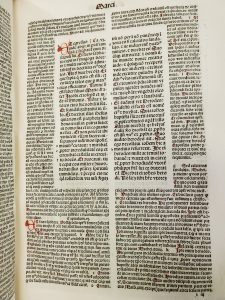
Looking beyond the text and paratext, I was able to find many other clues to the audience of the book, and to the ways in which my book was meant to be used. Looking at the book itself, I was first struck by its large size. Without having it in front of me I would estimate it to be a foot tall, almost as wide, and a few inches thick. This is not the sort of book one would carry from place to place; it’s just too burdensome. Therefore, I made the assumption that it was designed to be kept in one room, a personal library most likely.
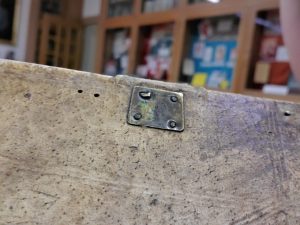
There are other clues to its audience that one can see by observing its decoration. Take the binding. When I looked at the covers of the book I can see the imprint of circles present on the cover. These circular implants are an indication that the book was at one point fitted embossed metal so that when it was opened it could be lifted above the table is laid on. This is not the kind of book you lay in your lap or read while standing. Other details of the binding support the hypothesis that this book was part of a personal library. Looking at the binding now, 500 years after the book was bound, I could see that it was made to be fairly attractive. The front has the remains of a title on it, and both the front and back covers are carved with a diamond pattern. There is evidence of clasps on the front and back covers that have since been removed.
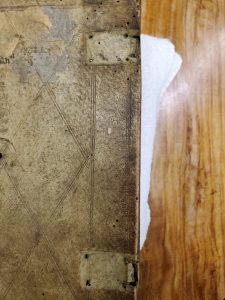
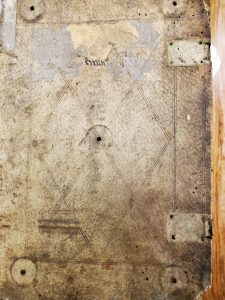
UPDATE: Some additional information has come to my attention that the book may not have originally belonged to a priest’s personal library. Instead, it was more likely to have belonged to a chained library, which were popular in the middle ages because most people could not afford books. the clasps on the book are a clue to this, as is the mark along the back that was likely made from a chain, support this theory. Alternatively, the book has had such a long life that it could have been in a chained library and then been owned by a priest or vice versa. Thanks to Professor Cook for not letting me overlook this important piece of the book’s history.
Some evidence for use is the extensive water damage in pages of the book. It appears as if a long time ago a glass of water or some other beverage was spilled onto the book, causing the paper to crinkle and discolor. A less-used book would most likely be better preserved since a book kept on one shelf its whole life is less susceptible to human clumsiness and folly.
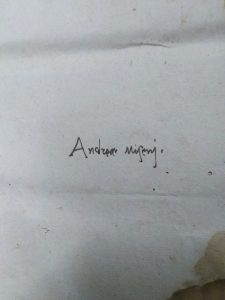
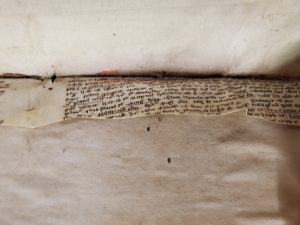
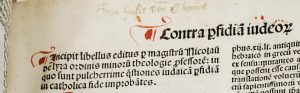
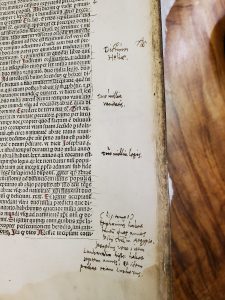
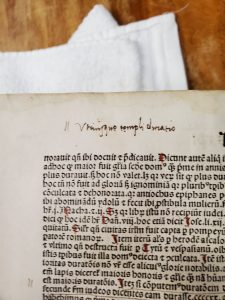
Other evidence for use can be found in the margins. When one looks at the margins, we see the notes of a scholar diligently taking notes on the book. His name, from what I can read, is Andreas, though I can’t make out the last name. He, like many readers, wrote his name in the front of his book. Because of this I’m confident he was an owner. Only his handwriting is found inside of the book, and he has only written in a few places- towards the beginning and in the last sections. Since I don’t read Greek or Latin (and am not great at deciphering handwriting) I have absolutely no idea what these say, but based on my analysis of use above I would assume these are scholarly in nature. One thing I find interesting is the fact that we can see different colors of ink being used even though the handwriting is the same. This provides insight into the life of a medieval scholar because it shows how he would make his own ink as needed, which led to changes in color and quality as each back was slightly different.
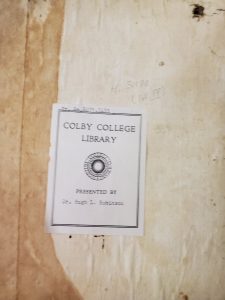
Lastly, an interesting clue to use is the name printed on the bookplate, a Dr. Hugh L. Robinson. I assumed that the book was donated by him so I looked him up. It was hard to find information on him. However, I was able to uncover that he was an alumn who graduated from Colby College in 1918. I also found out that he performed missionary work in China according to an article in the book Christianity in China. (page 144) As I dug, I found a Colby alumnus magazine from 1948 where he was mentioned a few times. I discovered that he was the head of the Boston Colby College Club and that he helped organize a secret fundraiser to present a Professor Chester with a $640 check to help with retirement ($7,000 in today’s money)! It makes sense to me that a person with strong convictions to Christianity and to his alma mater would donate such a large and interesting Bible to the Special Collections Library.