
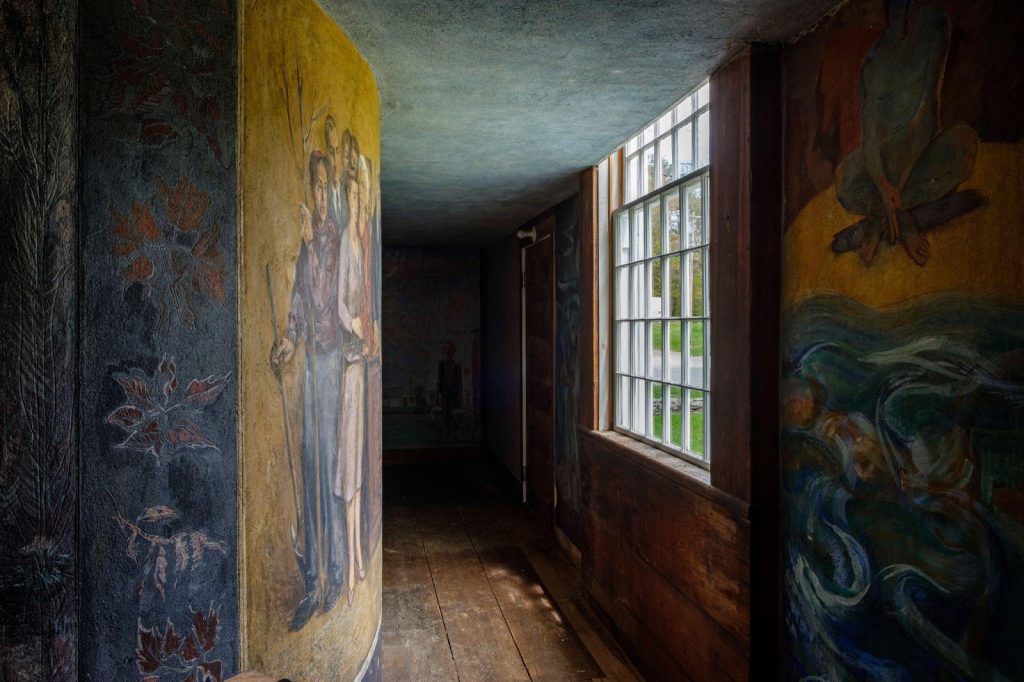
In 1956, Sidney Simon painted two vertical panels for the vestibule of the South Solon Meeting House. Placed on either side of a window centered between the two entrance doors, the large panels run from the floor to the ceiling and depict the four elements of fire, air, earth, and water. Given their location, the paintings are most visible upon exiting the Meeting House, which helps reframe the visitor’s experience.
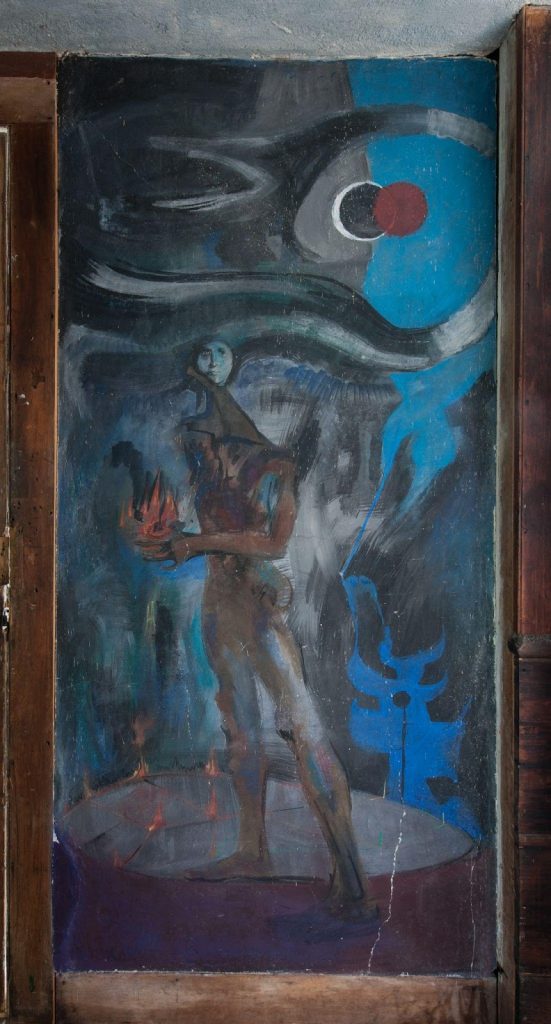
In his panels, Simon achieves a striking sense of motion through his brushwork and paint application, translating the concept into a dynamic image that encapsulates the whim and impermanence of the elements. The left panel depicts the elements of fire and air in a deep color palette. Abstract plumes of gray and blue frame a central figure, who holds an orange flame while standing atop an elevated, cylindrical platform that seems to be partially ablaze. The ambiguous form and facial features are congruent with the fluidity of the background, which help capture the fleeting motion of the elements.
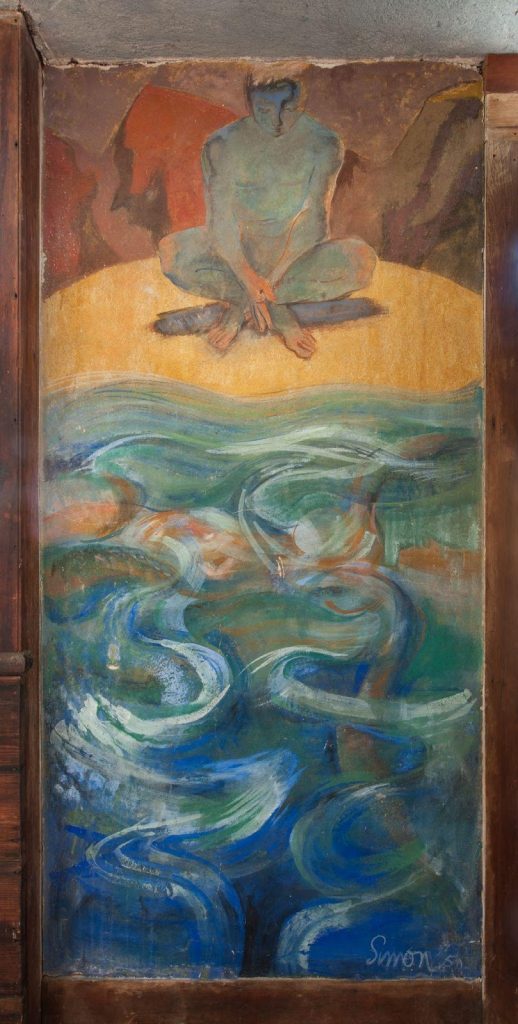
The panel to the right of the window depicts earth and water. A seated figure, perched on a warm yellow dome of sand, occupies the top of the panel and stares down into a pool of blue and green waves that echo the left panel’s brushwork. The figure is similarly vague in detail, and is painted in a mixture of teal and orange that is carried throughout the rest of the painting. Though the panels are clearly differentiated, Simon achieves a sense of continuity through the compositions (with in one the figure at the bottom and in the other at the top), parallel color schemes, and convincing sense of movement.
Traditionally, the elements are often closely associated with the four seasons, the four ages of man, and the four times of day, all of which are a fundamental part of the natural world and its life cycles (Cirlot 95–96). The four elements can thus be seen as an all-encompassing force that contextualizes and precedes the human experience, making it an integral part of existence. Because they are so fundamental to the natural world, many of the religious frescoes within the Meeting House include these very elements in their biblical scenes. In this way, Simon connects the religious world to the secular and natural ones, providing a bridge between the two that is strategically placed just next to the building’s exit.
Additionally, Simon’s pairing of the elements—fire and air, earth and water—fits with the iconographic tradition. Because of their grammatical gender in Romance languages, fire and air are usually associated with active, masculine energy while water and earth are passive and feminine (Cirlot 95–96). The figure in the fire and air panel stands in a powerful, almost confrontational stance, and embodies a sense of action and initiative. This contrasts with the figure in the right panel, which sits passively and looks away from the viewer, gazing into the water.
In art, the elements are usually personified and gendered, as seen in a 16th-century engraving by Jacob Matham after Hendrick Goltzius. At the bottom of the print, the two verses on the left declare: “Sub caelo Pater omnipotens Elementa locauit/Quatuor, his constat quicquid hic orbis habet” (Worcester Art Museum). Roughly translated as: “Beneath the sky the Almighty Father has placed the four elements, with which all this world is made up,” these verses affirm the elements’ all-encompassing function while setting them within a Christian framework.
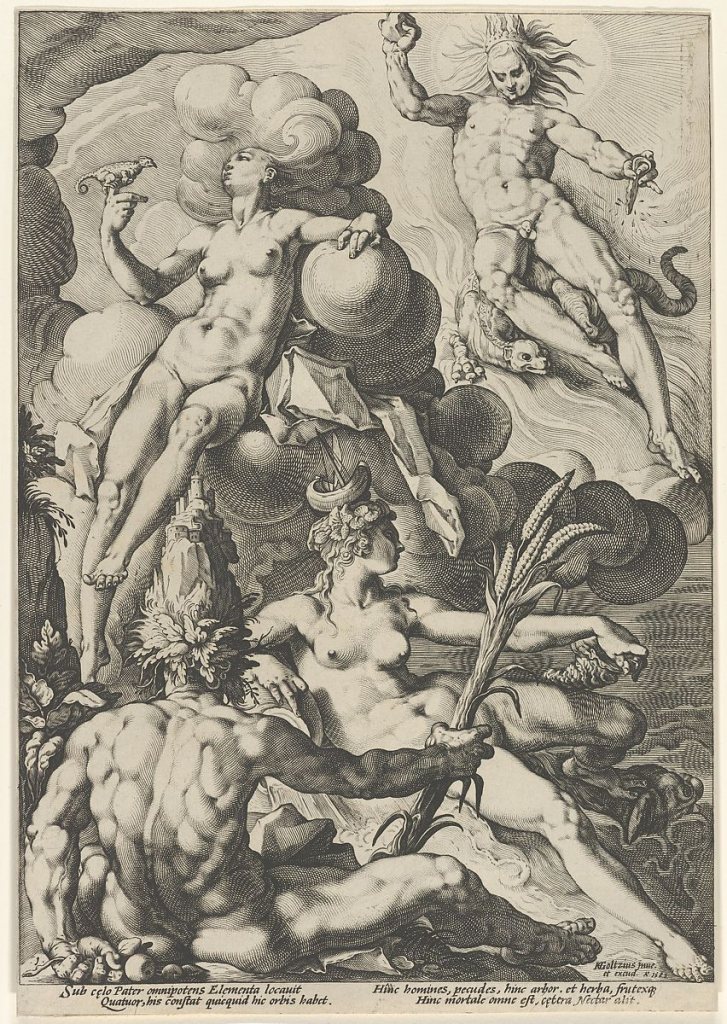
Simon chose to forgo this tradition: his ghostly characters do not personify the elements but instead interact with them. As the figures mirror the environment that they are placed in, they display a connectedness with the natural world. This decision represents a departure from a history of anthropocentric artwork, shifting the emphasis upon the elements’ agency, thus suggesting the omnipotence of nature.
In the context of the Meeting House, Simon’s choices seem particularly deliberate; the space had a religious history but was repurposed as a communal place for the public to hold gatherings (Kent 48). Simon’s panels reflect a similar recasting of traditionally religious iconography, adapting the concept into a more secular artwork that focuses on nature as an overarching force. The allusion to the Meeting House’s history furthers Simon’s personal interpretation of the four elements as a concept, and shows how thoughtfully he considered the context and the space where his art would be displayed.
—Layla Faragallah
- Cirlot, J.E, A Dictionary of Symbols. Trans. Jack Sage. London: Routledge & Kegan Paul Ltd. 1971.
- Kent, Norman, “Frescoes in Maine.” American Artist 5 (1958): 48.
- Worcester Art Museum. “The Four Elements.”