Connor Metz
5/17/19
Stuart Hall, in his paper Encoding and Decoding, puts into words how everybody consumes, internalizes, and acts on information transmitted broadcasted on television. Written 17 years before the advent of the World Wide Web, Hall’s work explains almost perfectly the way people on the internet are exposed to and internalize new ideas. This process of “decoding” various “codes” that are broadcasted on the television has an almost perfect analogy to the politicization that occurs when one views and internalizes enough political content on the internet. A crucial difference between the internet age and the television age, however, is that traditional media gatekeepers – the large broadcasters that dominated in Hall’s time – are far less powerful today. The internet has allowed for the creation of a new group of “encoders:” anybody with an internet connection. Hall’s “encoding” process is thus upended, at least as far as the internet goes. For the majority of political content creators online, there exists no equivalent institutional backing or pressures that are faced by large broadcasters initially. “The institutional structures of broadcasting, with their practices and networks of production, their organized relations and technical infrastructures, are required to produce a programme.”(92) With some exceptions, few people who have become politically active online, even the most popular ones, did so because they were “required to produce a programme.” Natalie Wynn of ContraPoints, one of Youtube’s most popular creators of political content, started her Youtube channel in 2008 to share her views on Atheism. By 2016, the rise of the alt-right, especially on Youtube, had prompted her to start advocating for leftist political ideals and arguing against right wing and classically liberal ones. There is no evidence an outside interest paid her to start producing a programme. Contrast this with the fact that investors and shareholders of CNN or Fox have a monetary incentive that they not only broadcast political programmes, but ones that will attract maximum viewers. That is not to say that all internet-based content creators are motivated by genuine urges to share their perspective on politics initially; Dave Rubin used to be a left-wing host on the Young Turks before he started the Rubin Report Youtube channel after receiving funding from a Libertarian think tank in 2016. Coincidentally, his views are now libertarian. It must be acknowledged that after a certain internet personality achieves popularity, there begins to exist a financial incentive for churning out content that is “on-brand” with your and your followers’ politics. This quasi-institutional pressure still does not hold as much sway over the individualized (and generally genuine) political content creator as it does on an explicitly shareholder-profit driven entity like MSNBC, and the vast majority of internet “encoders” have no monetary incentive to broadcast their views at all and are thus completely immune from this.
The rise of internet content creators has also changed the relationship between encoder and decoder, blurring the distinction between the two, and in Hall’s theory, reducing the prevalence of ‘misunderstandings’ occurring during the decoding process. Hall posits that an “asymmetry” between encoder and decoder is responsible for misunderstandings, the decoder decoding the wrong message. Hall attributes these misunderstandings to “structural differences of relation and position between broadcasters and audiences… misunderstandings arise precisely from the lack of equivalence between the two sides in the communicative exchange”(93). Hall argues that “since there is no necessary correspondence between encoding and decoding, the former can attempt to pre-fer but cannot prescribe or guarantee the latter, which has its own conditions of existence”(100). On the internet, encoders and decoders are barely separated at all; a simple comment from a decoder expressing a certain misunderstanding need not even be answered by the encoder herself. The simple ability for decoders to broadcast their views physically next to the encoder’s content means that a decoder misunderstanding the content need only peruse the comment section to seek clarification. Comment sections online serve to “construct some of the limits and parameters within which decodings will operate” to a completely uninitiated or bewildered consumer, who may then re-analyze the content with these general parameters in mind (100). Take for example this post on the Marxist subreddit r/ChapoTrapHouse.

This post was very popular within the subreddit, and it appeared prominently for a day in r/all, reaching redditors who are not members of the subreddit. The name of the subreddit and of the encoder herself reveals nothing to the uninitiated, and the post itself is just a picture of Bernie Sanders buying groceries with a self-explanatory (and not obviously sarcastic) title. A follower of this subreddit however can immediately decode exactly the message the encoder desired; that which conservatives call hypocrisy in politicians who advocate for economic or environmental revolutions while simultaneously using money or driving a car is in fact an unavoidable consequence of being forced to live in a capitalist system, which needs to be overthrown. To the uninitiated, however, this meaning might not be clear, until one reads the top-rated two comments on the post:

Note: for some reason it would not let me post a normal-sized version of this screenshot despite half-an-hour of trying, so here it is transcribed.
Commenter 1: Bernie Sanders wearing clothing and buying groceries that were made by Capitalism. Where is your God now commies?!?
Commenter 2: why is bernie not living in a cave and howling at the moon like a true anticapitalist? checkmate socialists
There is no equivalent mechanism for immediate clarification in Hall’s time. The average person does not know about much, and there existed no resource like the internet one could immediately access to clarify misunderstandings about or lend additional context to a topic one saw on the nightly news, as Hall observes: the (encoder) cannot determine or guarantee, in a simple sense, which decoding codes will be employed. Otherwise communication would be a perfectly equivalent circuit, and every message would be an instance of “perfectly transparent communication”(100). Although it is an exaggeration to say that the existence of a comment section on almost every bit of internet content “guarantees” a symmetry between encoding codes and the desired decoding codes, it certainly increases the degree of symmetry.
Hall’s discussion of different types of “signs” exposes another difference between his age and the current one in how one reads certain codes into content, a difference borne of internet communities.
“The functioning of the codes on the decoding side will frequently assume the status of naturalized perceptions. This leads us to think that the visual sign for ‘cow’ actually is (rather than represents) the animal, cow. But if we think of the visual representation of cow in a manual on animal husbandry – and, even more, of the linguistic sign ‘cow’ – we can see that both, in different degrees, are arbitrary with respect to the concept of the animal they represent. The articulation of an arbitrary sign – whether visual or verbal – with the concept of a referent is the product not of nature but of convention, and the conventionalism of discourses requires the intervention, the support of, codes. Thus Eco has argued that iconic signs ‘look like objects in the real world because they reproduce the conditions (that is, the codes) of perception in the viewer” (96).
The phenomena of internet memes, and their viral popularity, proves Hall’s “arbitrary sign” notions totally correct. Internet memes rely on convention to function. When one sees an internet meme that one knows is a meme, one understands that the actual image of the meme itself is not what is being encoded. The image itself represents an abstract concept, a concept that mixes with the text of the language. Neither the image nor the text are complete by themselves, and the “arbitrary sign” of the image imbues the text with an additional meaning. Take for example the following post on r/socialism:
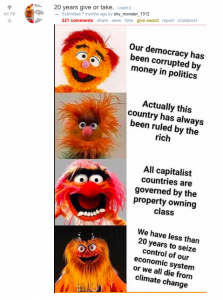
The visual sign here is the depiction of Gritty, a character from The Muppets, in progressing stages of dishevelment and seeming alarm. This meme format is popular all over the internet, not just on leftist forums, and is used to demonstrate how one’s views on something can, and should, become more radical over time. The four images of Gritty, iconic signs, “look like objects in the real world” in the sense that one who becomes increasingly fixated on any viewpoint will devote less time to their appearance – think of the disheveled mad scientist. This broad cultural ‘meme’ of the mad scientist helps Gritty the iconic sign to “reproduce (the codes) of perception in the viewer” when viewed in relation to the image’s text. In this instance, the ideal decoding is that there must be an urgent shift in how people think about capitalism’s harm, and that more people should focus on it and devote themselves to direct action and not just verbal or written criticism. Hall’s discussion of what the use of a sweater in an advertisement encodes is evidence that he is reckoning with and recognizing those attributes that make memes so powerful. “And in the specialized sub-codes of fashion, sweater may also connote a fashionable style of haute couture or, alternatively, an informal style of dress. But set against the right visual background and positioned by the romantic sub-code, it may connote ‘long autumn walk in the woods.’ Codes of this order clearly contract relations for the sign with the wider universe of ideologies in a society” (99). Whereas Gritty as a meme entails a desired progressive radicalization, the Expanding Brain meme entails quite the opposite:
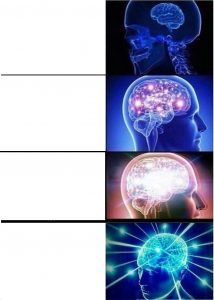
As long as one is familiar with the “wide universe” of memes, one will understand that the text accompanying this format is supposed to be interpreted sarcastically – the “most enlightened” opinion panel, the lowest one with the large brain, usually contains the silliest premise, the object of mockery. Thus, an identical text, let’s say the text from Gritty above, supplanted onto this new format holds a completely different meaning. Just as the same sweater can elicit different decodings when placed in front of differing visual backgrounds, the same text can elicit different decodings depending on its visual background. This example shows the value of Hall’s dominant meanings narrative – “We say dominant, not ‘determine’, because it is always possible to order, classify, assign and decode an event within more than one mapping. But we say ‘dominant’ because there exists a pattern of preferred readings… we are not talking about a one-sided process which governs how all events will be signified” (99). The dominant interpretation of a certain meme is almost always baked into what the encoder is trying to encode, different mappings mean that one who is more detached from the pattern of “preferred readings” (knowing which meme images signify what code) might decode incorrectly. Think of a Marxist who is not familiar with “meme culture” viewing a post with the Gritty text in the Expanding Brain format, she might not understand that the format is supposed to be ironic and derisive towards the text and share the image online. Those who can decode correctly, due to their exposure to the “wide universe” of memes, will thus view this Marxist as a reactionary or right-winger, simply because of a misuse of the visual background behind the text.
Stuart Hall’s theory of how messages are encoded through their television broadcast and decoded by each individual is prescient in many ways, and demonstrates how a changing media landscape can make different parts of the encoding – decoding process more or less recognizable. Hall’s theories concerning large corporate encoders, broadcasting companies, were correct then as they are now, but now the internet competes with, and draws large swathes away from, cable television. These internet encoders do not confront the same institutional pressures that big broadcasters do. The decrease in the “distance” between encoder and decoder online has implications for Hall’s theory – the newfound equivalence between a Youtuber and a Youtube commentator stems from the commentator’s ability to voice their perspective in a place that is physically close to the media itself. Thus, people who initially misunderstand the content may reference the comments, if not for reliable facts, for at least ballpark “limits and parameters within which decodings will operate.” In Hall’s time, an equivalent process was not possible, making miscoding more prevalent. Internet memes overlap with Hall’s theory of “signs” as being arbitrary with respect to that which is actually being encoded – when people share pictures of Gritty, they are not sharing pictures of Gritty, they are in fact encoding with deeper meaning the ‘code’ of the text itself. Absent the image, the text is a non sequitur, and absent the text, the image means nothing – when the two are combined is when meaning arrives. One can still make errors decoding and encoding, and these stem from a lack of understanding of proper conventions: an understanding of which memes hold what context. The internet’s decentralized and subdivided nature means that there exists lots of content that is being decoded by those for whom the content was not encoded. Contrast this with the TV age, where every demographic was watching the same large news broadcasters; nowadays the threat of making an error decoding content initially is higher online than on TV, but the consequences of a TV-based misunderstanding, the remedy for which is time-intensive knowledge-gathering (sans internet) are much higher than an internet one, where context can come from the parameters and limits found in the quickly-accessible comments. The crux of the difference between the internet age and the past is the merging of media encoders and decoders, and the ability for a confused consumer to view, live, what fellow decoders are encoding in their own comments.
To Prof. Gordon and fellow classmates,
Thank you all so much for a crazy-fun semester. I learned a ton from all of you guys, and I am honored to have been in a class with as much collective brain power as ours’. You guys are all super smart cookies, and although I am not a major, I felt welcomed and valued in our class. I hope that anything I had to say at the table was half as good as the ideas I was picking up from y’all, I will look back on this class fondly as the last seminar-style class I end up taking at Colby. Congratulations to everyone for finishing the semester strong, and thank you Jill for all the wisdom you have bestowed upon us.
Thanks!!!
Connor