“The banjo in American culture has always been a loaded symbol, perhaps more ideologically loaded than any other musical instrument in the United States; it has never been neutral” (Linn 442)
Since its introduction to the commercial music culture of the twentieth century, the banjo is known as “America’s Instrument”. This is true, but not because its signature ‘twang’ is intrinsically symbolic to mainstream American culture, the flag, country music, or the white south. The history of America’s instrument, and its consequential role in ideological constructions, is emblematic of what Stuart Hall calls “the dialectic of cultural struggle”. From its origins in the slave trade, to its weaponized role in minstrelsy, and its eventual return amongst the commercialized symbolism of the “hillbilly” south, the banjo is steeped in changing cultural and economic circumstances and purposes, incorporated into different “social fields” that have progressively constructed and reconstructed the instrument’s role and place this “cultural struggle”.
Taken on a whole, the banjo’s place in popular culture is rife with contradictions; however, when seen through this procedural understanding of this dialectic, these contradictions demonstrate the shifting ideological identity of the banjo. Its history reveals “the complex lines of resistance and acceptance, refusal and capitulation, which make the field of culture a sort of constant battlefield” (Hall). The purpose of this article is then to trace the movements of the “battlefield” of the banjo, to instruct on the history of the banjo through a Marxist frame. Working from Hall’s model of “cultural struggle”, the history of the banjo reveals itself to be a dynamic construction and reconstruction of the instrument’s status in popular culture as it passes through changing circumstances of class and race struggle and appropriation of the instrument by media. I borrow heavily from Hall, using his model of the dynamic tension of popular culture, as a battle between dominant and subordinate forces of class struggle. Additionally, I rely on Adorno and Horkheimer’s mechanisms of media as an appropriating, formulization, totalizing entity to characterize the induction of the banjo to commercial culture. This article will split the history of America’s instrument into four period in order to reveal each subsequent ideological formation: First, the banjo as an instrument of minstrel shows. Second, the banjo as a prospective instrument of the bourgeoisie. Finally, the banjos appropriation by commercial culture as a symbol of the hillybilly is analyzed.
While this article is more concerned with the broader cultural constructions of the instrument in and through class and race struggles, rather than the physically “fixed historical object,” these ideological changes have caused physical changes in the construction of the instrument. Understanding the physical instrument helps to identify the importance of these changes. This description is meant to convey the broad, contemporary construction and classification of the instrument, the result of this history of change.
The banjo is a five stringed instrument that belongs to the “plucked-lute” family of instruments. The instrument features a wooden, hooped frame-drum body, with a metal tone ring to help with resonance. Banjos use strings to create tones, four of which stretch from the bottom of the instrument to the end of the neck. A characteristic fifth string stretches half-way up the neck, creating a higher pitched “drone” sound that is utilized in different ways depending of the particular style of the musician. Modern banjos typically have frets along the neck to assist in achieving contemporary standards of pitch and conform to western scales. While other models of banjo’s have been invented and spread in popularity, including four-string ‘tenor’ and ‘plectrum’ banjos, the five-string banjo remains the most culturally iconic model, and this history will focus dominantly on it. Similarly, the banjo has developed several techniques of play that differ substantially from one another over the course of its history, each of which comes to be identified with a particular era of music making on the instrument as well as the ideological significance behind the instrument at the time.
Five Strings of Domination
The origins of the banjo in the Americas reveals its the scene for its first ideological identity. Most are surprised to find that the banjo is the descendant of musical instruments brought to the Americas through the slave trade, particularly through the diaspora of Western Africans as they were forcibly brought to the continent. Historic musicology has pointed towards a direct link in both construction and play style between “spiked lute” instruments prevalent in West Africa, in particular the Ekonting, and the spiked lute instruments that were recorded as used by slaves in the Caribbean. The earliest recordings of these date to the seventeenth century, but the presence of these proto-banjos becomes ubiquitous in the American south and Appalachian mountains by the end of the eighteenth century.
Early banjos during the eighteenth and early nineteenth century preserved most of the characteristics of their antecedents. These instruments still featured gourd and calabash-based bodies and were played with a distinct “stroke” style that matches the technique of the ekonting (Adams). Unlike most western styles, which involve “picking” individual strings with a finger or pick, the “stroke” style relies on striking strings in a downward motion with the back of the fingernail, and catching the fifth “drone” string of the banjo with the thumb as the hand recovers from striking a string. The result is a locked in driving rhythm of strokes broken up by drones on off-beats. The sound is markedly different from most western styles of music, produced by a technique that does not have a recognizable equivalent. The style has persisted until contemporary times; nowadays its known as “clawhammer” or “frailing”.
Above, Contemporary player Mike Seeger plays Josh Thomas’ “Roustabout” on a gourd banjo, using techniques from the nineteenth century. Source: Smithsonian Folkways “Classic Banjo”.
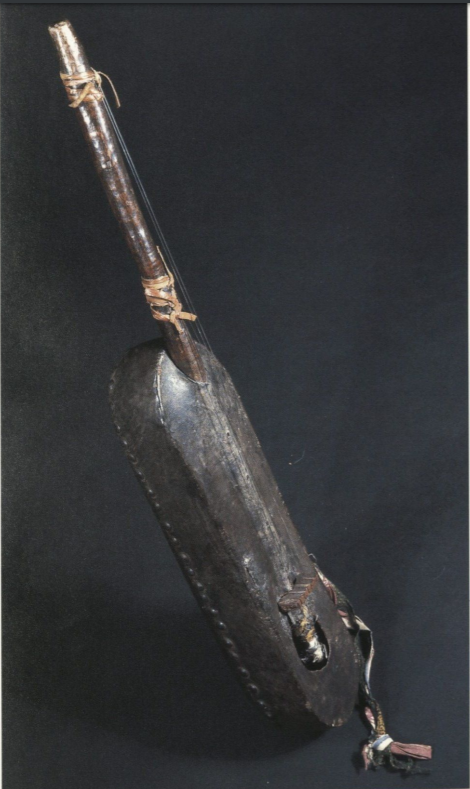
While its slave origin eventually became ammunition with which to naturalize the instrument with the racist ideologies of the nineteenth century, the original spread of the banjo in the United States through economic class rather than racial caste. Significant research demonstrates that the instrument was a part of the “folkways” of both black and white lower classes, who shared significant cultural contact throughout the mountains of Kentucky and Tennessee. Migrations west, from states like Virginia and Maryland, brought with them slaves who played the banjo. Often, lower class individuals shared recreational and musical spaces.
This historical position has two important results: First, “banjo music” of this inception period is the product of an amalgamation of musical styles brought by both the Anglo-Celtic settlers and their West African slaves. Second, the banjo became recognized as a proletariat instrument, rejected by colonial elites. Sentiments such as “Dr Marion Mayo said “classy people” did not dance jigs to the banjo” fill early records of the instrument, taken down by educated individuals foraying into this “lower” musical strata. One writer categorized the instrument as “The Bandore, n. A musical instrument… in use chiefly, if not entirely, among people of the lower classes” (Gibson 243). As Hall puts it, this process parallels “the relations which constantly structure this field into dominant and subordinate formations.” The banjo, on its outset, was cast into the subordinate formation of popular culture. Its induction ran along economic lines.
This lower-class history of “creolization” was quickly distorted by racist ideology after the instrument became a trope among minstrel shows (Gibson 244). The first full length minstrel show, staged by 1843, featured two banjo players who used their banjos as extensions of their character. Rightfully, these events have been wholesale denounced for their racism and the role they played in the Antebellum and Jim Crow era. However, it should be said again. Minstrel shows became wildly popular tools of dehumanization and violence against both slaves and freedmen throughout the United States (Linn 3). What is not widely known was the banjos place in this process, where the instrument served as a crucial part of the minstrel act, resembling the rough but innocent “happy” music of degraded slaves.
Even though it was now being used as an icon of slave music, the banjo’s construction underwent a period of formalization, becoming more indicative of present-day models. The gourd and calabash bodies were left behind for the hooped frame-drum construction that would be recognizable today. These models toted wide, unfretted necks which ended in scroll peg heads (Gura). Furthermore, the five-strings of the banjo became the typical standard for the instrument during this period.

These instruments became icons of minstrelsy, used the enforce and educate racist ideology: “By the early 1800’s, Americans had become familiar with the idea – though not necessarily with the reality – of the banjo as an instrument of black culture” (Linn, 2). They were evidence of the “obvious” barbaric and unrefined nature of African American slaves and freedmen in the United States. In order to do this, however, the historic relationship of the banjo as a lower-class instrument, rather than an African-American instrument, needed to be dealt with. A “distortion” of this sort is exactly the kind of process which Stuart Hall outlines as part of the perpetual process of popular culture: “cultural struggle, of course, takes many forms: incorporation, distortion, resistance, negotiation, recuperation.” Here, the banjo’s importance passes through its first social field. Its role in culture becomes subject to the relations and demands of a new set of material and social conditions, as the antebellum south seeks to redefine and strengthen racial classes and division. Consequently, its history and position within class relations shifts, from a construction of economic class into a weapon of racist ideology.
In effect, this movement of the banjo from common class square dances to the minstrel show stage serves to “naturalize” the racist symbolism used to assert the barbarism of African American slaves and freedmen. According to Hall, naturalization allows ideological premises to begin to pass as self-evident assumptions (Hall, 18). Through such a process, a racist conception can become part of the shared social “chains of meaning”, where it is given constructed importance within an ideology. Through the ridicule of the minstrel show the banjo becomes a weapon of this kind of movement. In this case, it comes to stand for, as Hall describes them, the ideological base-image of the slave-figure and, to a degree, the clown. The blackfaced character, armed with the banjo, becomes “the familiar slave-figure: dependable, loving in a simple, childlike way” while also exemplifying the “clown”, as Hall goes on to explain, that “captures the ‘innate’ humour of the licensed entertainer… It is never quite clear whether we are laughing with or at this figure”. In its burgeoning introduction to popular culture, the banjo starts its life as an explicit and gawdy symbol of racist ideology.
There is a contradiction already present, indicative of the “the double stake in popular culture, the double movement of containment and resistance, which is always inevitably inside it” (Hall). The more the instrument came to represent the musical lives of African-Americans, the more the black string bands of the eighteenth and early nineteenth century started to disappear. By the end of the century, resisting and repulsed by the instrument’s symbolism, less and less black people actually played the banjo, save in some rural spaces (Gura). That reality, of course, does not need to bear on the construction of the banjo in ideology, which is ever in the process of distortion and reinventions through the dialectic cultural struggle. Given this dynamism, it should not be a surprise that even this racist role for the banjo falls out of fashion.
Five Strings of the Bourgeoisie
Crucial to Hall’s understanding of the process of popular culture is a sense of periodic but constant change:
“For, from period to period, the contents of each category change. Popular forms become enhanced in cultural value, go up the cultural escalator – and find themselves on the opposite side. Other things cease to have high cultural value, and are appropriated into the popular, becoming transformed in the process.”
The relations of “popular” and “dominant” cultural formations are not by any means fixed. Even the banjo’s status as the instrument of the uncivilized would be overturned. By the end of the nineteenth century, the banjo faced another shift in ideology, as the instrument passed from weapon of racism to icon of the genteel.
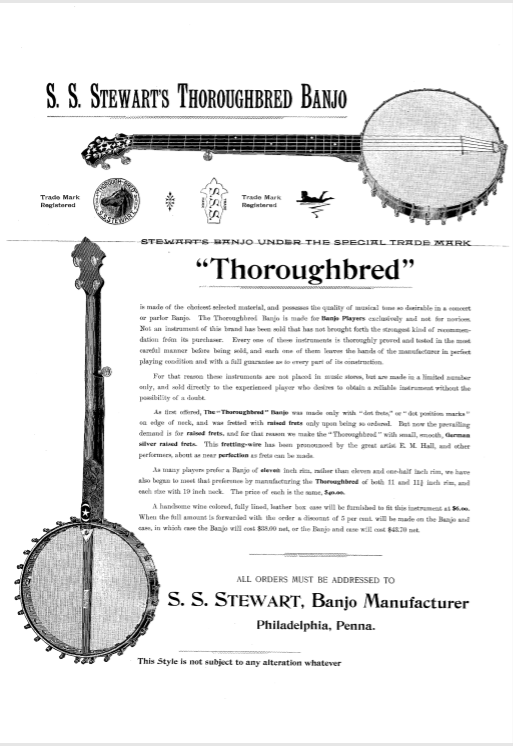
During the 1870’s, either through the popularity of minstrel shows or the influence of the amalgamated origins of the instrument, the banjo found its way into the hands of the middle and upper-class whites. Although the banjo became directly associated with the minstrel context, it had become popular and recognizable in broader American culture (Gura). The banjo was beginning the extend its sphere into barrooms and parlors. Whatever the reason for this sudden spread, elite white musicians faced a problem: The instrument and the music it played had been naturalized as primitive. The banjo’s identity lied in minstrelsy: a “mandatory blacking of the white performer’s face accompanied the white use of black music” (Linn, Elevation, 443).
In order to overcome this predicament, a change in cultural values was necessary. White banjo sympathizers, hoping to achieve acceptance for their instrument and its music, campaigned for an “elevation” of the banjo from its “degraded origins” (Linn, 9). As such, the banjo faced its second social field, its conversion to the sphere of the dominant class and culture. We see again the distortion and reinvention of the symbol of the banjo through the “culture struggle” as its older formation in minstrelsy was erased to make way for bourgeois acceptance. These campaigns were largely successful – by the turn of the century “white culture incorporated a recognized symbol of African-American music without the theatrical metamorphosis of burnt cork; the white musician no longer had to feign ‘blackness’ to play the banjo” (Linn, 443).

This process was spearheaded by producers and manufacturers of the banjo, especially Philadelphia’s S.S. Stewart. As an owner of a banjo producing capital, his “Great Instrument Factory”, Stewart engaged in a considerable advertising and production campaign with the aim of reconstructing the banjo’s position in American culture. In particular, he wanted to let the banjo rise “above the ham”, a reference to the pig’s fat used in blackface that stood as an idiom of low culture. He and his allies’ efforts changed the construction of the instruments, their playstyles, and ultimately imbued the instrument with the values of refinement and luxury. These producer-driven changes to the banjo sought to relieve it of its subordinate status and let it rise into the dominant class of culture.
First, the appearance of Stewart’s banjos overhauled the instrument to emulate wealth and sophistication. The gourd bodies of early slave banjos were done away with entirely in favor of hoop construction styles meant to mimic western craftsmanship. These Stewart banjos were meant to “convey an elitist image”, often featuring intricate “mother-of-pearl inlays along their necks as well as “ornately carved heels at the base of the necks” (Gura 173). Furthermore, the advertisement of such instruments conducted the same “refinement”. These banjo models were called the “Imperial” and the “Thoroughbred”, advertised as available only to serious banjo players (Stewart, 8).
These banjos were equipped with new hardware, such that the instruments could be inducted into the expectations of high art music at the time. This eventually resulted in a fundamental redesign of the banjo in line with Western formula:
“Older banjos had been larger in size, lower in pitch, darker timbred, with short sustained tones on stopped strings that gave the instrument a percussive, more African, quality. Late nineteenth-century banjo manufacturers followed the general trend of Western art music, gravitating toward higher pitch, brighter timbre, and longer sustained tones. Frets were slowly accepted in the 1870s and 1880s; strings continued to be made of gut (occasionally silk for the humid summer months). By the end of the century, the pitch of the instrument had risen a minor third, from A to C. The actual sound of a high-quality banjo of the 1890s was remarkably different from that of an 1840s banjo. These modifications of tone quality, though always presented as improvements in advertisements, were not essentially improvements, but changes” (Linn).
The aural quality of the banjo had to be reinvented, too, not just its physical appearance. The “stroke” style of the banjo associated with black banjo players and minstrel shows created distinctly syncopated and rhythmic music unlike most compositions of western and European music. In fact, the stroke style of play was prohibitive to executing western styles of music, since it was unable to play slow melodies with variating rhythm (Linn 2). Elevating the banjo meant developing playing techniques that could replicate and mimic elite music. Along side the “stroke” style, the banjo’s “guitar” style began to become favored. The “guitar” style relied on picking string with the use of the thumb, index and middle finger, mimicking the style of play used on most guitars during the period. Stewart’s banjo manuals emphasized this style of play as the proper manner to play instrument, as it allowed the instrument to conform to western musical genres. In addition, Stewart’s ideal banjo player learned by notation, written music, rather than the oral tradition that defined early banjo playing (Gura).
Through changes like this, the banjo’s place in popular culture shifts upward. As the minstrel shows fell out of fashion, the banjo wisped into the dominant culture, assisted by physical changes in the instrument and alterations to its sound. These let the banjo slip into containment among the dominant class by conforming to its ideological “chain of meaning”: the banjo, just like the bourgeois, is refined, modern, and luxurious. The instrument no longer referenced the jolly, caricatured slave. Now, it found its place as a sign of the genteel.
Five Strings of the South
It is a testament to the dynamism of the “cultural struggle” that the banjo’s position in the dominant formation did not last long. The five-string banjo “fad” of the end of the nineteenth century ended abruptly, in the face of recording media that favored music aimed at the common class. Since the banjo had been “elevated” from this, it fell out of the foreground. While the banjo as a symbol of the bourgeoisie may not have lasted, its rise sidelined the history of the black banjo. By the turn of the century: “the plantation setting for the banjo had nearly disappeared in the popular media… and the association of blacks with the banjo continually lessened in the minds of Americans” (Linn 118). This erasure was completed with the induction of the banjo’s modern image: the instrument of rural, white America.
After “discovering” the children’s ballads of traditional, mountain singers, folklorists at the beginning of the twentieth century became obsessed with the Appalachians. For these researchers, the music of the mountains represented a “authentic” culture. This term was strictly ideological: “For the folksong and folklore collectors working in Appalachia in the early twentieth century, authenticity was located in the past… They valued cultural stability over the technological change of modern America, handicraft to the machine-made, and they valued purity over the dynamics of ethnic and racial pluralism (Linn 137). These collectors were mostly put off by the traditional banjo playing that had remained robust here, which was living on as an echo of the “creolization” that defined the banjos material existence within the lower classes. The older ideologies of the banjo stained the instrument’s image: the banjo’s time as a minstrel instrument, and then as a rich “fad”, precluded it from becoming part of the “authentic” values with which these folklorists were painting the Appalachians. Not until the mid-century, when these notions had all but eroded from popular culture, did the banjo become “authentic” in the hands the revivalists like Pete Seeger.
Instead, the banjo’s reemergence among popular culture was driven explicitly by commercial media, namely the sudden popularity of “hillbilly” music and depiction of mountain culture. This genre, hillbilly, is a “cultural and ideological” construct, centering around the demoralization of poor, white Americans from the mountains through the assertion of their identity as “stereotypical portrayals of shiftless, drunken, promiscuous, and bare-footed people, living in blissful squalor beyond the reaches of civilization” (Sopriaz 2).
A consequence of this formalization of mountain music is that black string bands and banjo players were wiped from the public eye: the hillbilly construct under which this mountain-like music was explicitly white, in order to keep this music separate from their “racial” offerings in the blues (Linn 139).
The hillbilly banjo was and is still played with a distinct technique, generated by Earl Scruggs of the “Blue Grass Boys”. The stroke style firmly left behind, Earl Scruggs’ style revolved around rippling roles of three-finger picking that produces the rapid twang that most are familiar with (Sopriaz 3). The addition of a resonator behind the body of the instrument sharpened the tamper and amplified the volume, giving the banjo a new slate to be inducted into “hillbillyhood”.
Above, Earl Scruggs plays his “Bluegrass Breakdown”, demonstrating the speed and twang of his three-fingered style, which came to identify this brand of “hillybilly” banjo. Source: Smithsonian Folkways “Classic Banjo”
The subsumption of the banjo into commercial media represent its third social field, subjecting it to the formalization, tropes, clichés and sameness of Adorno and Horkheimer’s “culture industry”. They write: “There is nothing left for the consumer to classify. Producers have done it for him”. Given that, under this mass media, the reality of the world becomes indistinguishable from the filmed one, the banjo’s ideological place in popular culture during this period becomes more potent in “containment”. The banjo was used as an unmistakable symbol of this “mythically rural, white, poorly educated and thickly accented region”, contributing to this ideological process of ridiculing poor white Americans. As a result, the banjo became a symbol for a familiar trope, used here in the “demoralization” of impoverished whites: The Clown. A trope like this, here, acts as predetermined classification, such that audiences are left with “no scope for their imagination” when they are presented with the meaning of the banjo (Adorno and Horkheimer).
Above, “Stringbean” leads a quartet of banjos during an episode of Hee-Haw.
The five-string banjo found its home among television programs that exploited this stereotype, parading rural, southern culture around as a spectacle. Earl Scruggs himself was convinced the compose the theme music for CBS’s The Beverley Hillbillies to lend some semblance of authenticity to the project (although it should be noted that, true to Horkheimer and Adolpho’s depiction of formulization, the lyrics were written and sung by Hollywood professionals). Programs like this and Hee-Haw created variety shows out of the rhythmic and jovial manner of the hillbilly image, replete with hay, barns, banjos, blond women and plaid-wearing men getting into all manner of hijinks natural to them: “Here the five-string banjo becomes not a musical instrument with a pre-republican heritage, but a symbol of a degraded segment of American culture and society” (Sopriaz 6). Such depictions materialized the framework of the Clown onto these impoverished figures, collaterally using the image and sound of the banjo to do so. The banjo, once used to make the world laugh at the brutishness of slaves, now taught the world of popular culture to laugh at the poor. It’s an ironic pivot that represents capital’s constant proletarization and demoralization of the lower classes. This ideological status of the banjo has been stalwart for sixty years: “The instrument today can be heard… ‘rippling through beer commercials’, though you are more likely to encounter it in children’s programming or as it accompanies “hillbilly” antics in episodes of shows like TLC’s Here Comes Honey Boo Boo, A&E’ Duck Dynasty, or MTV’s Buckwild than anywhere else” (10). Today, America’s instrument is a distinct symbol of the hillbilly ideological construct.
Five Strings of Liberation
So far, we have seen the banjo in popular culture be constructed and reconstructed through periods of ideology through this process of “cultural struggle”. However, for Stuart Hall, the popular culture struggle is not a dialectic if does not offer “resistance”:
“If the forms of provided commercial popular culture are not purely manipulative, then it is because, alongside the false appeals, the foreshortenings, the trivialization and short circuits, there are also elements of recognition and identification, something approaching a re-creation of recognizable experiences and attitudes, to which people are responding. The danger arises because we tend to think of cultural forms as whole and coherent: either wholly corrupt or wholly authentic. Whereas they are deeply contradictory; they play on contradictions, especially when they function in the domain of the ‘popular’.”
The banjo’s history is rife with the contradictions, distortions and erasures that Hall is speaking of. Repeatedly, the instrument has been envisioned by competing struggles of class and race throughout its lifetime, each time receiving a new ideological identity. We would be mistaken to stop here and see the instrument as “wholly corrupt”, however. Today, the banjo still undergoes a tense, constant evolution between competing factors. To conclude, I hope to briefly outline three avenues of “recognition and identification” to the popular conceptions of the banjo that have been constructed through its history. These avenues represent new attempts at imagining less manipulative roles for the banjo outside (and in tension with) popular culture. These are the banjo’s place with counter-culture folk singers such as Pete Seeger, its role in Northeast and Midwest participatory folk dancing, and ongoing artists who seek to reinstate the legacy of the black banjo.
As I mentioned, it was at the hands of artists like Pete Seeger that the banjo was lent a semblance of the “authenticity” that collectors denied to it. After coming across the instrument, the young counter-culture leader fell in love with what the symbol could represent: “For Pete Seeger, the five-string banjo became a metaphor for the rural working class and the nobility of folk culture. There was nothing clownish (minstrel-like) about his idea of the five-string banjo” (Linn). However, his use of the instrument was not limited to getting in contact with a traditional form of music. Pete Seeger was, as understood in literature on revivalist, a “utilizer”. These individuals use the aesthetic of traditional forms for new purposes. Pete, then, put the banjo back into cultural tension as he asserted it as the icon of his revival. Folk music represented a musical culture outside the influence of commercial media and society. The banjo, its symbol, acted as a hammer to break-out of such a closed universe. His own book on the instrument, “How to Play the Five-String Banjo”, celebrated both its history but also advocated changes in favor of accessibility: his banjo’s neck was extended three frets to accommodate more keys. He instructs on an amalgamation of styles, including the old “stroke” style and a two-finger version of the guitar style (Gottshalk). His revival music, which was demonstrably anti-war, anti-fascist, and anti-capitalist, used the banjo as its weapon. Quoting Plato, Pete liked to refrain that “RULERS should be careful about what songs are allowed to be sung.” (The Economist).
Above, Pete Seeger backs his singing with a simplified two-two finger picking style. Notice the elongated neck of his banjo.
The banjo also as become a staple instrument of the music of “participatory” musical cultures in the north of the United States. The music of square dances and contra dances throughout New England borrows an array of traditional cultures to support their amateur, community based musical events. These dances are the banjo has become a versatile instrument for musicians of such a culture, where its presence on stage is regular. There is a unique structure to these events that defies the alienation of capitalist culture. These dances are what Ethnomusicologist Thomas Turino calls a participatory musical culture, defined by the lack of a distinction between performers and audience. At dances like these, there is no functional audience: everyone present, including dancers, callers and musicians are integral parts to the event. The structure of these events is of particular interest to Marx-minded observer: it undermines commodification by resisting its structure. There is no “producer” of a contra dance separate from its “consumer”. The event cannot be exchanged, it cannot be packaged, and it cannot be effectively sold. Instead, it supports broad, inclusive and accessible participation of amateur community members. Here, the instrument is sheltered from the commercializing effect of media industries. Especially in “Old-Time” circles, the banjo is the icon of this amateur, participatory culture.
In 2010, the album Genuine Negro Jig received the Grammy for Best Traditional Folk Recording. Its band, The Carolina Chocolate Drops, a group of four black traditional musicians, were inspired by the surviving black banjo and fiddle culture that still exists in the mountains of North Carolina; the album and its musical style were learned from traditional bearers of the black banjo. Rhiannon Giddens, a banjoist, fiddler and singer from the band, calls herself a musician of “black non-black music” (Sullivan). Her work, solo and with the group, is a reinstatement of the legacy of the black banjo using replica instruments from the minstrel models. Giddens repertoire includes both traditional tunes and songs as well as compositions of her own, many of which feature both the “stroke” and “guitar” styles historically used with the black banjo. Through a genuine emulation of such music, Giddens reformulates this tradition and makes it a symbol of pride.
Above, Rhiannon Giddens plays clawhammer, contemporary “stroke” style, on her minstrel banjo behind her own song, Julie. The lyrics of this tune were inspired by the writings of slave memoirs.
Works Cited:
Adorno, Theodor and Horkheimer, Max. “The Culture Industry: Enlightenment as Mass Deception”. 1944. Web. https://www.marxists.org/reference/archive/adorno/1944/culture-industry.htm
Adams, Greg C. and Levy, Chuck. “The Down-Stroke Connection: Comparing Techniques between the Jola Ekonting and the Five-String Banjo”. In Banjo Roots and Branches. Edited by Robery B. Winans. University of Illinois Press. Urbana. 2018. Print.
Gibson, George R. “Black Banjo, Fiddle, and Dance in Kentucky and the Amalgamation of African American and Angle- American Folk Music”. In Banjo Roots and Branches. Edited by Robery B. Winans. University of Illinois Press. Urbana. 2018. Print.
Gottschalk, Stan. “Pete Seeger, the 5-string Banjo and American Culture.” Australasian Journal of American Studies, vol. 25, no. 2, 2006, pp. 12–22. JSTOR, www.jstor.org/stable/41054021.
Gura, Philip F and Bollman, James F., America’s Instrument: The Banjo in the Nineteenth Century, University of North Carolina Press, Chapel Hill. 1999. Print.
Hall, Stuart. “Deconstructing the Popular”. In Cultural Theory and Popular Culture. Edited by John Storey. Pearson/Prentice Hall. 1998.
Hall, Stuart. “Whites of Their Eyes”. In Gender, Race, and Class in Media: A Text-Reader. Edited by Gail Dines and Jean M. Humez. Sage Publication. London. 1995.
Linn, Karen Elizabeth. “The ‘Elevation’ of the Banjo in Late Nineteenth-Century America.” American Music, vol. 8, no. 4, 1990, pp. 441–464. JSTOR, www.jstor.org/stable/3051763.
Linn, Karen Elizabeth. That Half-Barbaric Twang. University of Illinois Press. Urbana. 1991. Print.
Sopiarz, Josh. “Dueling Perceptions: The Five-String Banjo in Contemporary American Popular Culture”, Popular Music and Society, 41:1, 1-15, DOI: 10.1080/03007766.2016.1169643
Sullivan, John Jeremiah. “Rhiannon Giddens and What Folk Music Means”. The New Yorker.May 13, 2019. Web.https://www.newyorker.com/magazine/2019/05/20/rhiannon-giddens-and-what-folk-music-means/amp?fbclid=IwAR0aIyJVOuChAyIsxAIbbfU-TB04vuXuRjc-IFdWSJ57HY9DbnYLG-e5pz8
“Bolshie with a Banjo; Pete Seeger.” The Economist Feb 01 2014: 24. ProQuest. Web. 17 May 2019.
Turino, Thomas. Music as Social Life: The Politics of Participation. The University of Chicago Press. Chicago. 2008. Print.