Summary
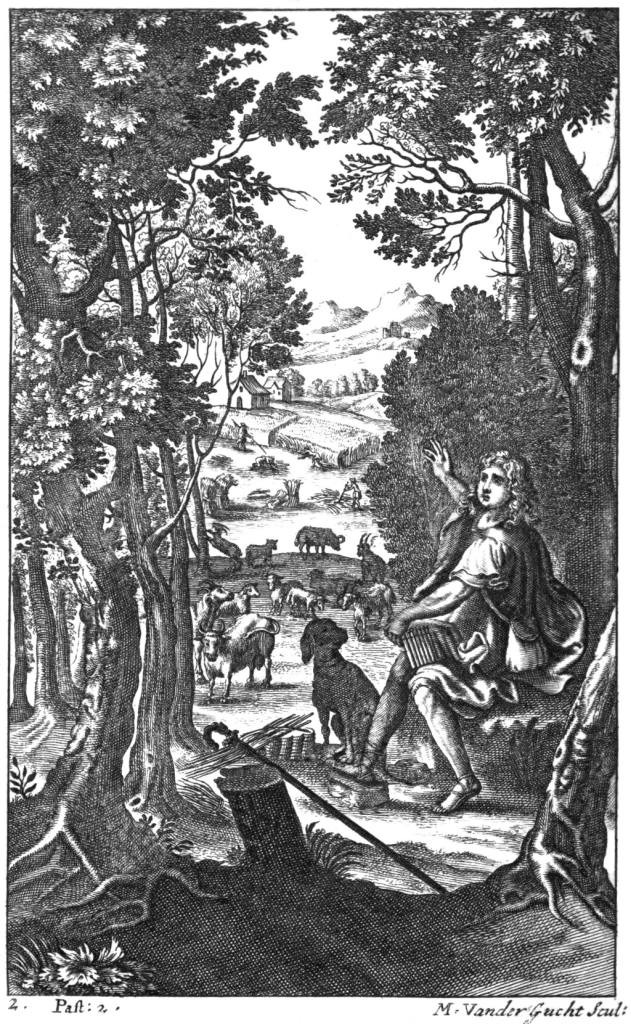
Formonsum pastor Corydon ardebat Alexin, delicias domini, nec quid speraret habebat. Vergil, Eclogues II.1-2
“Corydon, the shepherd, was aflame for the fair Alexis, the sweetheart of the master, nor did he have what to hope for.”
Believed to be one of the earliest composed of the Eclogues, Eclogue 2 focuses on unrequited love. It is inspired by Theocritus’ Idyll 11 and contains some lines lifted straight from the source material. In Theocritus’ poem, the cyclops Polyphemus longs for the sea nymph Galatea while in Vergil’s version a goatherd Corydon longs for the slave boy Alexis.
Setting
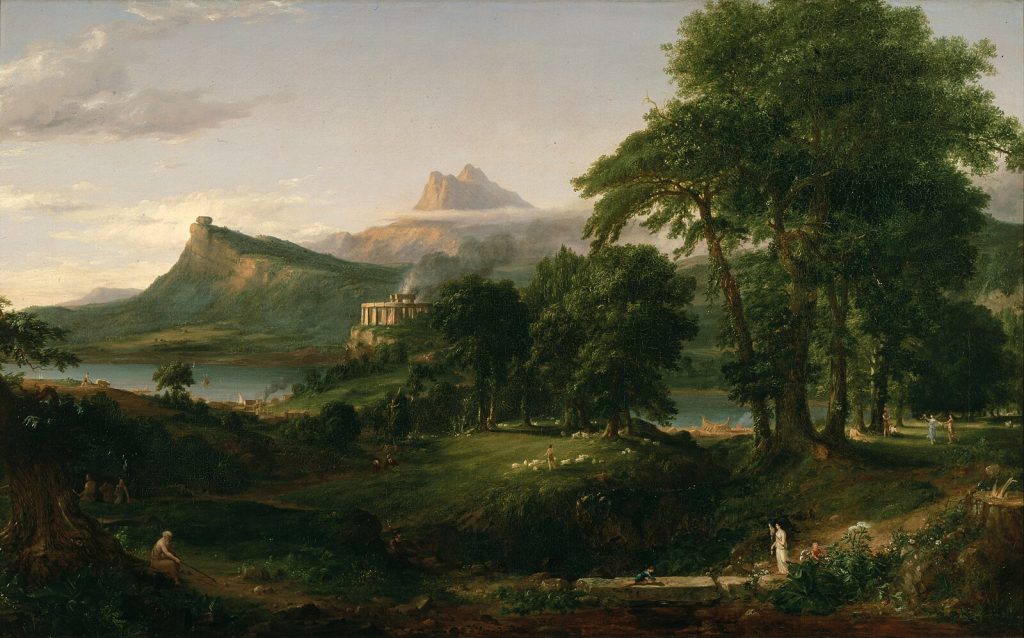

Mille meae Siculis errant in montibus agnae; lac mihi non aestate nouom, non frigore defit. Vergil, Eclogues II.21-22
“A thousand lambs of mine roam over the Sicilian hills; new milk is not lacking for me, through the summer or winter.”
This eclogue is notable as it is the only one explicitly set in a traditional Greek pastoral location. The most notable of these pastoral locations is the utopian vision of Arcadia introduced in Theocritus’ Idylls. A land of mountain ranges and sparse populations, the word itself was used to describe an idyllic vision of unspoiled wilderness. Theocritus crafted this version of Arcadia to appeal to the educated urban class of Alexandria. The real-life region of Arcadia is located in central Peloponnese and was traditionally regarded as the home of Pan.
Geography
Attic Aracynthus
Canto quae solitus, si quando armenta uocabat, Amphion Dircaeus in Actaeo Aracyntho. Vergil, Eclogues II.23-24
“I sing as Amphion of Dirce was accustomed to, if ever he was calling the herds on Attic Aracynthus.”
The mountain mentioned here likely borders upon Boeotia and Attica and is presumably in the same range as Mount Cithaeron (shown in map below.) The Latin in this line is constructed as if it were drawn from Greek poetry. For example, the hiatus in the arsis “Actaeo Aracyntho” is common in Hellenizing contexts. Vergil intentionally has Corydon insert this incongruous piece of learned Alexandrianism into the line in order to give the poetry an overly portentous tone expected from the wooings of a rustic goat herd.